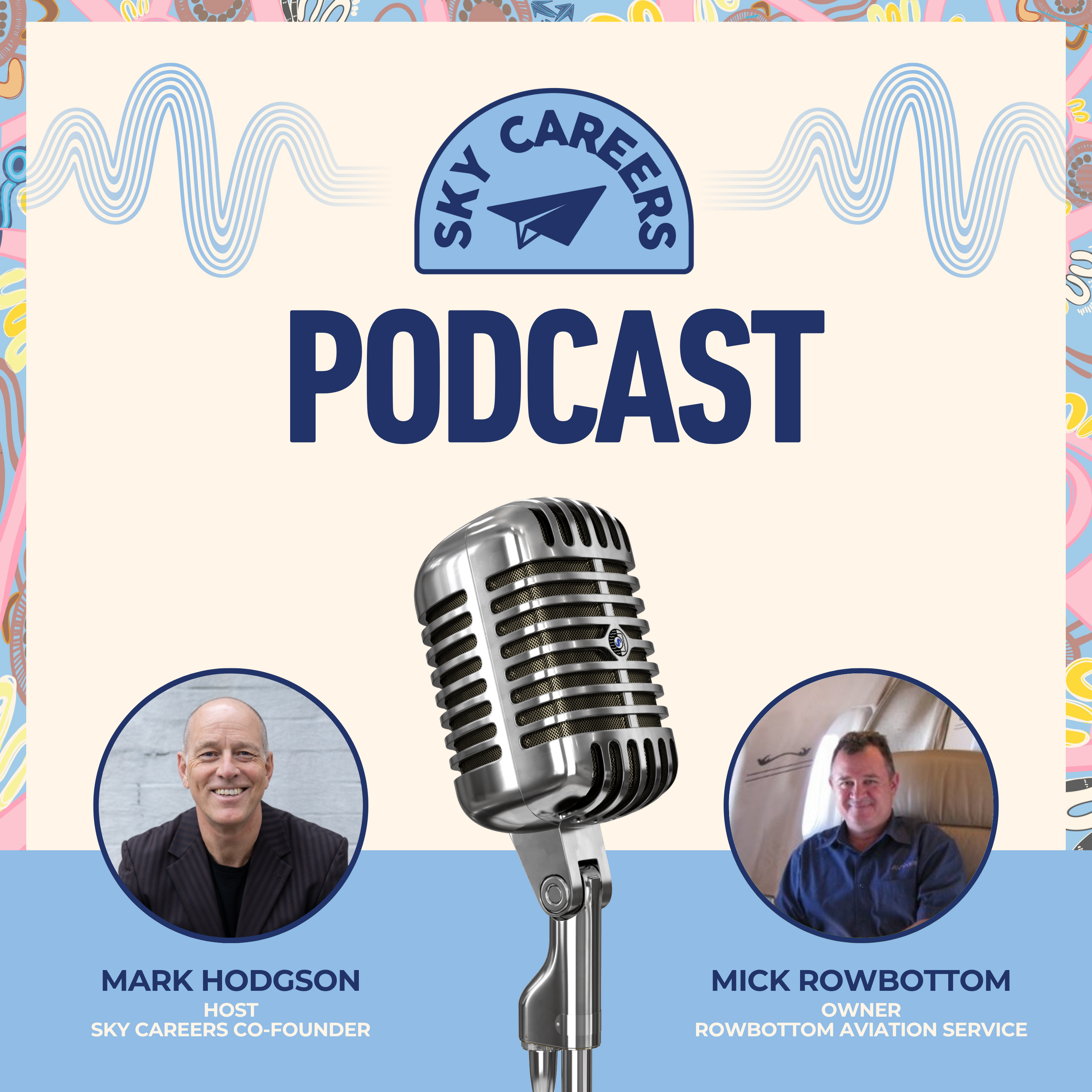
[00:00:07] Speaker A: Hi. Welcome to this edition of the Sky Careers podcast. I'm your host, Mark Hodgson, and today it's my pleasure to introduce you to you, Mick Rowbottom. Now, Mick is one of those guests who's got a great story who started in the industry as an apprentice aircraft maintenance engineer and went on to own and his own airline called Rowbottom Aviation Services. So I'm really looking forward to understanding more about that journey. So, Mick, welcome to the Sky Careers podcast.
[00:00:46] Speaker B: Thank you, Mark. Thanks for having me.
[00:00:48] Speaker A: Okay, so I've got a few questions for you and hopefully in the process, we'll not only uncover your fascinating backstory, but also get some of your expert views on, on some industry trends around leadership and workforce. So starting at the beginning, you started as an apprentice aircraft maintenance engineer and have gone on to work around the world and to build your own aviation business.
That's a hell of a story. Mick. What have been some of the defining moments in that journey?
[00:01:20] Speaker B: Well, look, many, you know, it started off as an apprenticeship here at Hawker de Havilland, at, in Perth, at Perth Airport.
That was an outstanding start. We had, you know, great leadership there.
The apprenticeship structure was taken very, very seriously. And you moved around in, and were trained in a lot of different areas, not just in one part of aviation. So we did all sorts of different parts. We did fuel control systems, we, we did fabric, we did composites, we did engine overhaul, we did airframe overhaul, hydraulics. So there's a great cross section which unfortunately a lot of that isn't available today. So it was a really, was a solid start into, into aviation.
[00:02:17] Speaker A: Yeah, it's, it's, it's, it sounds like
[00:02:20] Speaker C: it's almost like the, the, the aviation equivalent of a classical education, a broad say.
I think we, we lose out on, on rushing past that in so many areas today, don't we?
[00:02:34] Speaker B: Yes, we do. We don't. From what I see today, there doesn't. The facilities that were around in the 80s that did all of that work in house are not around these days. All the, all of these components that we used to work on are now sent to factories and facilities through to Europe or the US for that repair and overhaul. And today's engineers just predominantly change components.
[00:03:04] Speaker A: Yeah, yeah, yeah. It's, it's. And it's interesting without, without getting too geopolitical. It's interesting. I think some of that's maybe not in aviation or certain aspects of, but it's interesting how that's circling back and there's more of a, more of a, I think an emphasis on sovereign capability and sovereign development, isn't there?
Okay. You've gone from working on aircraft to senior management and ultimately running robottom Aviation Services, which is quite the journey.
How did your technical grounding, Mick, shape the way you lead the business and the people you work with today?
[00:03:41] Speaker B: Yeah, Paramount. So to have.
I had a very good technical grounding with Hawker de Havilland that become Hawker Pacific. So I had really good people teaching us there and, and working with us to improve our skill sets. There was also opportunity to sort of diversify a bit. So I, I did quite a bit of quality training so the company afforded me to go back to Curtin University at night school and I did quality management and then in going forward I was then in a good position. I led a number of companies as engineering manager in their engineering departments and then general manager of a corporate outfit which I traveled the world looking after or looking at aircraft to buy and sell and reviewing compliance.
That's when I found myself finding a niche market about 15 years ago on the compliance aspect of aircraft which there was a big hole and we have successfully over the last 15 years concentrated on corporate aviation and filling that void with compliance and best practice to keep aircraft airworthy and up with all the latest and greatest.
[00:05:12] Speaker A: Love it.
[00:05:12] Speaker C: And just going back a bit further. Did, did you always know you were going to be messing around with airplanes from a.
[00:05:19] Speaker B: My father was a glider pilot as a hobby and so from a very young age, sort of 8, 10, I was always with him on a weekend out on the airfield at Pierce Air Force Base doing gliding and messing around on, on gliders. So yeah, it was sort of something that really kicked off very early on. So I had a, had a fascination with, with aviation from there.
[00:05:49] Speaker A: Yeah, love it, love it.
[00:05:52] Speaker C: Now you started talking about the specialist business. So you now support or Raz now supports business business aircraft across Australia and Asia covering everything from maintenance, maintenance control, compliance, deliveries, parts procurements and on and on and on.
That sounds like a lot. What does running that kind of operation actually involve for you on a day to day basis?
[00:06:18] Speaker B: In the beginning it was just purely looking after the maintenance control aspects of the aircraft and doing the maintenance planning and preparation. But I soon realized that as that grew we needed to add other strings to our bow and offer more services so you can move between the peaks and troughs financially with, you know, you can flatten that curve out quite a bit more.
So we, we procure compliant parts for our clients that are on non programmed aircraft. We, I went back and did a whole heap of education and training with Civil Aviation Safety Authority. And I have delegations to do the import certificates of airworthiness for aircraft, the export certificates. I can issue special flight permits, I can write and approve minimum equipment lists, reliability programs, maintenance programs.
So that's another element of the business that brings, you know, keeps that curve or keeps the line nice and flat.
So adding those strings to the bow, the, the business grew and that enabled me to sort of hand pick quality staff.
So my day to day job now is working with the staff and setting, you know, setting the tasks for the day, the week, the month and keeping everyone busy. And I now spend a lot more time concentrating on the specific client needs and being, being more engaged day to day with the clients.
So I'm, it's just, the business is just a single touch point. Everything comes through me and delegated out to my staff.
[00:08:26] Speaker A: Give me a. Sorry, give me, give me a sense sense, Mick, how and how many, how
[00:08:29] Speaker C: many staff sort of permanent otherwise do you have?
[00:08:32] Speaker B: Okay, we've just, we've got five, five permanent staff here in, in the Perth office and we have a number of contracted.
[00:08:44] Speaker C: Yep.
[00:08:44] Speaker B: Depending on the thing that we use for different projects.
[00:08:49] Speaker A: Yeah, love it.
[00:08:50] Speaker C: And where did you.
[00:08:51] Speaker A: So you know what?
[00:08:51] Speaker C: I'm hearing a lot of couple of things here. Firstly, as anyone who's listened to the Sky Cruise podcast or just knows aviation, aviation's got a gazillion moving parts. Everything needs certifying, checking, testing, you know,
[00:09:06] Speaker A: and the detail and the compliance is massive. And you've got, you've got to know what you're doing. Right.
So that's the first aspect. The second aspect of it, which you've just touched on in a little bit of detail is you've also got to be able to run a business and you can be great at the first thing and not very good at the second thing. And I'm sure plenty of brilliant technicians and, you know, aviators and so forth have gone out backwards because they couldn't do the second thing. Where did you learn your business skills?
[00:09:32] Speaker B: That was.
Being higher level management in some of the organizations.
But then I also, I had a little leave of absence out of aviation during my career where I was involved with a vineyard and ended up starting a contracting company which I built and ran for about six years. And I sold that company and at that point I had 140 staff in here in Western Australia and that led to the 40 under 40 awards which I was a recipient of.
And, but that was the, that was the real start of learning how not to go about running a business.
So I look, I learned a massive amount. It was a successful business, but when I look back on that now, it could have been way, way more successful. So what I learned from that I took forward.
[00:10:41] Speaker A: Yeah.
[00:10:41] Speaker B: And then when I started this business, I had a really, I already had a good backgrounding of what needed to be done and a lot of the pitfalls to watch out for and things like that. So that, that successful but not super successful business was a great grounding for what is now robot aviation service, which is a successful business.
[00:11:06] Speaker A: Yeah, I love, I love that. You know the fact that you learn all the way through, don't you? And I do business advisory and executive
[00:11:14] Speaker C: coaching in addition to sky careers.
[00:11:17] Speaker A: And I, people say, what business did you work with?
[00:11:18] Speaker C: I say, I kind of said it doesn't matter. Well, how can it not matter? Because it really doesn't matter. A certain level of context, there are some basic principles that, you know that people, people, if they learn them, they do well. And also there's, as you say, there's plenty, there's plenty of traps for new players, aren't there? Mistakes to make and understate and overextending and cash flow and over relying on one client and peaks and troughs of revenue. There's so many things. And I love the fact you pulled on some working in the wine industry, which has got its own challenges, especially now, I think, and then flowing through to aviation because that leadership and business school is just so important, aren't they?
[00:12:02] Speaker B: Yeah, it was a great cross section. Good, very, very good learning experience.
[00:12:07] Speaker A: Yeah. And have you still got a few cases stashed away somewhere from those days?
[00:12:11] Speaker B: I think they're long gone now.
[00:12:15] Speaker A: Okay, looking more broadly now, Mick, so when you look across the broader Australian aviation industry today, where do you come across or see the biggest workforce and skills challenges? Where are the big shortages?
[00:12:30] Speaker B: Look, really it is in the space where I'm at and that's, you know, maintenance support and aircraft maintenance engineers.
The, you get that you jump on a lot of sites or do any, a lot of career stuff and it still tends to be pilot centric because being a pilot has that very, very shiny look about it. It does y and everything like that. Whereas the, the engineering and maintenance side doesn't have that glossy feel to it. But equally as important, pilots don't get to go anywhere unless the engineering's done.
So.
Yeah, I think.
Well, my personal view is there needs to be a significant emphasis on, on engineering training and building sound skill sets in that area to to support the growth that is already, that we're already seeing. And you've got a lot of experience retiring out and there isn't the numbers coming on board at the, at the starting end to cater for those, you know, those massive years of experience that are retiring out over the next sort of 10 years, 5 to 10 years. It's going to.
[00:13:57] Speaker A: Yeah.
[00:13:57] Speaker C: I mean I'm hear, I'm hearing that across the board and I'm not sure I can't see any other market forces will correct and at some point the salaries and the wages will go up such that people, you know, people see it as a really good opportunity. And it's interesting with AI and other things, people like software developers, they're now being. Their roles are disappearing because AI can do those jobs. But they've probably got similar skill sets in some ways. Not all, but some would have similar skill sets of analysis and logic and working through processes and it's sort of.
There's that whole back to the trades conversation which I think is a very positive one both in Australia and other places because at the end of the day if the things don't get certified or repaired or serviced airplanes don't go anywhere and that becomes, that's a logistical businesses just stop don't they?
[00:14:50] Speaker B: It is. And the, you know, the people you need need to be able. You can get a very, very highly intelligent individual who can fault find and has that great brain for working out the schematics and everything like that. But they've got to be able to translate the skill set from the mind out to the hands to be able to do that physical change of component.
So you got to get that combination person. There's, there's also great people who have great hand skills but not necessarily the, the other to get around the manuals and work out exactly what's got to be done. So you've got to get person that's got, got both, that can impart both skill sets and that. That's training.
[00:15:45] Speaker A: Yeah, no, and I said I think it's a really interesting conversation and I don't see, I don't see how this doesn't get resolved because we'll have to get resolved because otherwise industries will just not. They'll stop moving and then so they will, you know that that will, that will then that will then get resolved in the same way.
I've literally just read the newspaper today in Sydney airport.
They've had four air traffic controller incidents in the last four weeks. Four weeks or four months and shortage of air traffic Controllers.
I know there's a whole lot of reasons around that and there's some politics and so forth and so on that's got to be resolved because that's a billion dollar industry that is being jammed up. And as you say engineers and air traffic controllers, things don't go if these
[00:16:31] Speaker C: people aren't in place and properly trained and remunerated.
[00:16:34] Speaker A: So I think it's interesting to see how these things are emerging, looking, I guess on taking that idea a bit further. I mean there's a lot of knowledge sitting with experienced people across the industry. You said quite a lot of them retiring.
How important is mentoring and transferring that knowledge to the next generation? And do you do it a robot? Have you gotten. Are you able to do that or is that something you'd like to do?
[00:17:05] Speaker C: More of
[00:17:08] Speaker B: the mentoring side is huge.
I currently sit on the Civil Aviation Safety Authority Delegates advisory committee committee that's working with the regulator.
I also have two up and coming CASA delegates under mentorship at any one time. So that's. I take. And that's about a year's process for each individual. So I usually take two on per year and mentor them as we move forward.
And I also work with Edith Cowan University, so I'm on the Edith Cowan University Engineering steering committee for their syllabus which I'm hoping will start to progress to having more maintenance, functionality and the requirements of in that syllabus going forward to their bachelor's degree.
I'm huge about mentoring. We. Yeah, as you can see, I do a lot of it and I think people of my age within the industry owe it to pay back to industry to share their skill sets with the, with the young, younger people coming up through the, you know, through the industry. I think it's, it's part of paying back and it needs to be done.
[00:18:39] Speaker A: So we need to clone you, don't we brother? We need about four of you or five of you.
[00:18:44] Speaker B: No, no, not necessarily. What it needs to be is everybody, you know, everybody with a skill set needs to participate and share that knowledge back down because once sort of my era and that retires out if you haven't shared it back down.
There's a, there's a, there's a big learning curve gap.
[00:19:08] Speaker C: Yeah, yeah, yeah.
[00:19:09] Speaker A: And there's an expertise and qualifications are
[00:19:13] Speaker C: brilliant and they're necessary and they go
[00:19:15] Speaker A: so far with that experience layer on
[00:19:17] Speaker C: top of that is so important, isn't it? Yeah, it's critical.
[00:19:23] Speaker B: Absolutely. So, yep.
Big, big fan of mentoring people.
[00:19:28] Speaker A: Yeah.
Some of that would be paid and some of that would be voluntary.
[00:19:32] Speaker B: I'm thinking all voluntary.
[00:19:37] Speaker C: What do you.
[00:19:37] Speaker A: What I was going to ask what do you do when you're not doing this when you're not running the business or, or main tree. It doesn't sound like you've got much time still.
[00:19:47] Speaker B: Plenty of time. I've got an awesome team here that, that they take their fair share of the load as well.
So. Yeah and one we have a lady on board here is a junior maintenance controller and myself and one of the other.
One of my senior maintenance controllers mentor her as well. So we're bringing her along to get her skill set.
[00:20:10] Speaker A: Yeah.
[00:20:11] Speaker C: Just.
[00:20:11] Speaker A: Do you still get on the tools at all?
Are you dangerous? Because I've got a friend who's now the CEO of an ASX listed software business and he originally started out writing code and he said you don't want me writing code now because I'm so far away from it. I'm dangerous.
Well those of you be dangerous.
[00:20:33] Speaker B: Yeah. Similarly, I mean look I, I'm just. Would be out of touch.
Although I'm from a technical perspective. Sound.
[00:20:42] Speaker A: Yeah.
[00:20:43] Speaker B: I wouldn't.
I still have a current Part 66 license as an engineer so I could. But I don't.
[00:20:51] Speaker A: Yeah, yeah, no I did. I didn't think you did but some.
[00:20:54] Speaker C: Sometimes it's.
[00:20:55] Speaker A: Sometimes it's, you know people who especially come up and there's something, there is something about physically doing something, isn't there?
[00:21:00] Speaker C: And then fixing a problem and changing a component or, or just getting something done. It's just the touching, the. What's the word I'm looking for? It will come to me. I can't remember. It's Friday afternoon. My brain's not working particularly well.
That just touched not kinesthetic. I'll come to me. It doesn't matter.
It's satisfying, it's nice to do.
[00:21:22] Speaker A: Okay, moving on.
So thinking now more about the workforce for the future and obviously you're doing. You're playing a really important part in that through your mentoring role, through your involvement with industry and education. As we've touched on where do you see the biggest opportunity to create better career pathways to bring people through from I guess from the so called from education through to aviation employees. Can you see it or can you just see gaps?
[00:21:57] Speaker B: I'm sort of very engineering centric because that's been my field and I still see gaps. I, I do really think the.
There's a lot of.
There's some great training available around Australia which gives the technical side but I think that needs to be beefed up in a big way with application of hand skills.
[00:22:26] Speaker A: Yeah, yeah.
[00:22:28] Speaker B: The two really need to go together and I think, you know, there's some great lecturers around, there's some great training courses and training institutions, but it's coupling that with, you know, the hand skill set that goes with applying that technical expertise.
[00:22:50] Speaker A: Yeah, I mean, one of the, one. I mean one of the things we're
[00:22:53] Speaker C: trying to do with sky careers is firstly increase the awareness of some of these things and also to increase awareness of people at a younger age. So if you like, broaden the base of the pyramid so people are coming in and becoming aware of some of these, as you say, of all the various disciplines within aviation, which there are, as you know, there are many, many, many. And not just pilot, just, just to, just to really get to spark that interest because there's plenty, there's plenty of, there's plenty of young people, boys and girls, I'm sure, who, you know, they love, they love fixing stuff and taking stuff apart and putting it back together and you know, it's understanding the possibilities and aviation just offers so many. I think there's a big gap, I think there's a big aware, an awareness gap in terms of where the, where the roles actually are and where you can go with them. Like you said, you've traveled all over the world.
[00:23:43] Speaker B: Yes. And I think that in time the, from the compliance side and where, where your engineering privileges will allow you to work, I think there'll become more commonality stream across the world which currently I couldn't take my qualifications out of Australia and certify for something in the UK or America unless I'd been and sat their individual exams and got their licensing.
Probably a bit like a doctor has to do it in different locations.
I think over time that'll streamline a bit better. So the opportunities for young people to travel and, and work abroad, if that's what appeals to them, it would be something that be very good. And I think that'll, that'll be a function that will be easily accomplished in years to come.
[00:24:51] Speaker C: Yeah.
[00:24:51] Speaker A: And I think, you know, with it I'm doing a lot of work in this space and working with organization. I hear a lot about AI and there's this thing about AI is taking over certain jobs, but I think aviation and specific, as you know, AI cannot do your jobs. You can't pull stuff out of complaint and I mean it can be part of the process and diagnosis, diagnostics and so I'm sure it can help be Helpful but it physically can't do because of what the physical jobs that you have to be done. And I think therefore that some of these, some of these roles will start
[00:25:25] Speaker C: to draw more people to them as
[00:25:27] Speaker A: those kind of other, other, other jobs
[00:25:30] Speaker C: disappear or, or can be done by AI, are done by AI and I think it will free up other people look, consider other things. So I'm quite hopeful there. I hope that's just not hypothetical because yeah, the needs very clear, isn't it?
[00:25:46] Speaker B: Yeah, look I'm, I'm confident that there will be a part for AI in the industry most definitely and as you pointed out it'll be along that diagnostics thing and getting that database of hey, we've had this on this airplane before and you'll be able to go in and, and get scenarios and if it's the scenario that you're having at the moment maybe it's going to point you a lot quicker in the direction for rectification than before. But the physical rectification will still have to be carried out by a human and endorsed by human.
Yeah.
[00:26:28] Speaker C: Have you sort of experimented or incorporated any sort of AI practices into your operations at row bottom Aviation Services at this point?
[00:26:37] Speaker B: Not at this point.
It's something that we may explore in the next couple of years.
We've had some very low, low level discussions just around it and what, what we could apply it to.
So just sort of really enough in a feel out stage as to what, what we could apply it to and what benefits we may gain from it.
[00:27:09] Speaker A: I, I think that, I think, I think this is a sound approach. It's a sound approach and it, and I, yeah my sense of it and I'm seeing it obviously I work in debt.
[00:27:16] Speaker C: Various.
[00:27:17] Speaker A: I've got different, different marketplaces, different disciplines and I think there's some where there's a really obvious piece that goes really quickly and there's other bits where as you say, I mean they're around administration and things like that and rostering and things you can do some really quick gains which are nice but that's probably not big core part of the business. And then my business consultancy and leadership, I use it a lot and it actually can really accelerate my productivity.
But yeah, I think the thing is to walk slowly and understand it's often wrong as well.
[00:27:49] Speaker C: That's the, that's the.
[00:27:50] Speaker A: I think, I think a lot of it's having the wisdom to understand, to be able to be able to interrogate the outputs against your own experience.
Yeah, that looks great, that's fantastic. Or that looks a bit, there's something not quite right in there. And that's, I think that's the, it's the discernment that's important as you, as
[00:28:07] Speaker C: you, as you, as you move through the process. I'm sure of it.
[00:28:11] Speaker B: Absolutely.
[00:28:12] Speaker A: Okay. Couple of, couple of you. You thought we wouldn't get past 15 minutes. Here we are, half an hour. I knew we would, but I am going to, as we say, land the plane. A couple of last questions for you, M. I really enjoyed this conversation.
What's the best piece of leadership or career advice you've ever been given?
[00:28:31] Speaker B: Keep investing in yourself from an educational and personal growth perspective.
Yeah, I was always told, like when I got my first qualification as an engineer, a basic engineer, that you need to now keep going with that and keep improving yourself, keep adding to your qualifications, adding to your personal growth.
And that was advice.
Yeah, right. Right from the beginning and, and I followed that through and I still, you know, I still do training.
[00:29:14] Speaker A: I love that. I think that's gold. That's absolutely gold. And it's, it's so, I think this, that idea of lifelong learning is so, it's so important and it's interesting, as you say.
I find it interesting in lots of industries, but especially, Ava, you do get people. I'm a pilot. I'm qualified as a pilot. That's great. Okay. But yeah, you're probably there in your 20s now. What else are you layering on top of that? Leadership experience? Doing different things. Such when you're 10 and 20 and 30 years old, are you still just a pilot with 30 years experience? Nothing wrong with a pilot with 20 or 30 years experience, but that's not the same, is it, as all these other things you can be adding to. So I think that's gorgeous advice and we've had that from a few of our leaders, actually. I think that's to keep investing, investing and reinvesting in your own growth because it helps grow you and I think it helps you understand the learning journeys of the people who work around you as well and encouraging them to grow.
[00:30:07] Speaker B: Agreed, agreed.
[00:30:09] Speaker A: So that's cool. And I think also the, that sense of curiosity, what can I learn? And also what's changing? Because whilst obviously core areas of aviation have not changed in so many other ways, both in terms of specifications and technology, but also the business of the business of aviation. I mean, it's light years away from when you started out 30 something years ago, isn't it?
[00:30:36] Speaker B: Absolutely, yeah. Yeah.
You know, it is, it's. It's a massive industry now and it's got a massive amount of compliance to keep, you know, to keep that safety there.
[00:30:48] Speaker A: Yeah.
[00:30:48] Speaker C: Gorgeous.
[00:30:49] Speaker A: And last question. Mick, when you look from your office in sunny Western Australia, across this great continent and look at the future of Australian aviation, what gives you the greatest confidence?
[00:31:03] Speaker B: Look, although we.
We complain from time to time about the. The regulatory requirements and that they are quite arduous, we are still predominantly one of the safest, if not the safest place in the world to fly in an aeroplane.
So that. That gives a great level of comfort.
[00:31:25] Speaker C: That's gorgeous.
[00:31:27] Speaker A: All right. And hey, at the end of the day, if you get to where you're trying to get to safely and all the load gets there, or the people, especially the people get there, that's the
[00:31:36] Speaker C: most important thing, isn't it?
[00:31:37] Speaker B: 100%.
[00:31:39] Speaker A: I really enjoyed speaking with you. I wish you all the best with robot and Aviation Services and I think you've been winning awards and going from strength to strength and bestriding the globe with some interesting things. And I really enjoyed talking to you and look forward to seeing you again soon.
[00:31:59] Speaker B: Thanks very much, mate. Thanks for your time. Cheers.
[00:32:01] Speaker C: Super welcome.
[00:32:10] Speaker A: Thanks for listening to the Sky Careers podcast. If today's conversation has sparked your interest in aviation, then head over to our
[email protected] au.
Whether you dream of flying aircraft or you're curious about the hundreds of other exciting roles that keep the aviation industry moving, Sky Careers is your gateway to discovering these opportunities.
And if you are already in the industry, check out Sky Careers Connect and Sky Careers Leadership and consider joining our online learning community.
Until next time, keep reaching for the skies.