[00:00:00] Speaker A: Foreign.
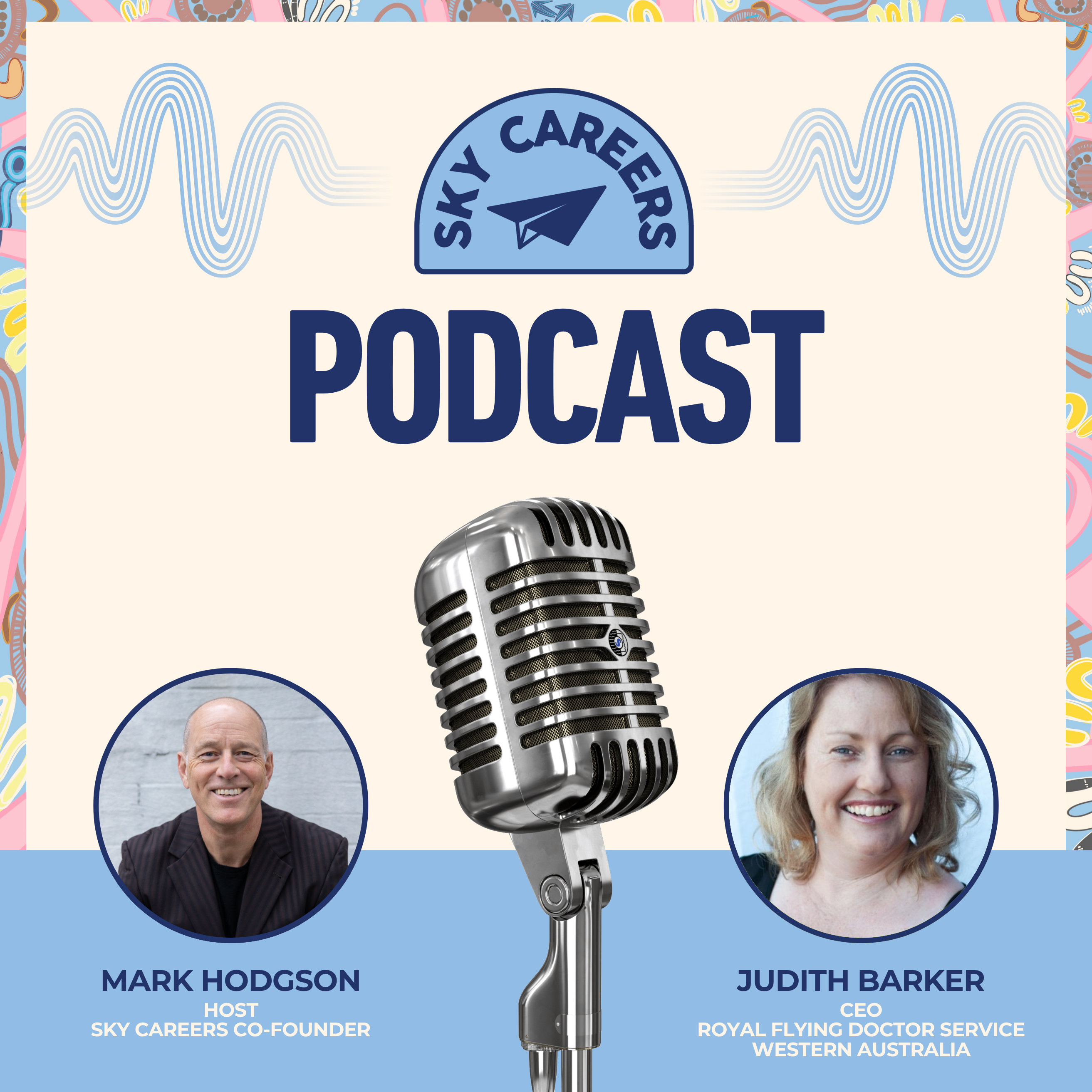
Welcome to this edition of the Sky Careers Podcast. I'm your host, Mark Hodgson, and today it's my privilege to have a special guest joining us from Western Australia.
Judith Barker is the CEO of the Royal Flying Doctor Service in wa. Judith, welcome to the Sky Careers Podcast.
[00:00:30] Speaker B: Thanks for having me.
[00:00:31] Speaker A: Yeah, I'm really looking forward to having a bit of a discussion about your leadership journey because you've done a few things. So you've had a career that's taken you from frontline healthcare and emergency services into leading one of Australia's most respected aviation organisations in the Royal Flying Doctor Service.
Can you give us a quick snapshot of what sounds like quite some journey?
[00:00:57] Speaker B: Well, I guess this is probably going to give away my age as well, but just over 30 years ago, I started my career as a paramedic here in wa, and it's where I thought I'd always be. I mean, being on an ambulance, responding to people on the worst day of their life and making things better is, you know, one of the ultimate careers that you can have.
But I guess as I went along, I realized that I like to change and I liked to do different roles and I like to have an impact.
So I moved my way up and I moved my way across services. So I went from Western Australia to South Australia.
I went from being a frontline paramedic to a frontline manager to finishing up as a director with SA Ambulance Service.
And then that took me into the Northern Territory. Not somewhere I ever thought I would go, but I was the CEO of the ambulance service for the Northern Territory for about four and a half years, which really developed my passion for rural and remote healthcare. And, you know, my family are all rural and remote wa, so it's very important to me.
And this amazing job with raw flying doctor service came up and it brought me home to Western Australia.
So still impacting on frontline healthcare. Not operational. There's better people than me for that. But, yeah, it's an amazing organization.
[00:02:21] Speaker A: Wow. That. That you've covered. You've covered some kilometers there, Judith. I reckon.
[00:02:27] Speaker B: Yeah, they're all pretty big geographical areas.
Northern Territory, big area, very small population, which makes it, you know, that adds a whole different dynamic to providing health care to people in rural and remote areas.
But, yeah, WA is an amazing place to be.
[00:02:48] Speaker A: Yeah. And we'll come on to that more. I'm interested.
Your four years in the Northern Territory as the CEO of the Northern Territory Ambulance Service, that must have been quite an experience.
[00:03:00] Speaker B: It was quite an experience.
There's a lot of Challenges in the Northern Territory, like I said, it's only 1% of the population.
For Australia, 30% of the population is indigenous. And the economy in Northern Territory can also make it challenging to provide services.
And then during that time, a pandemic hit.
And so that just added a whole nother element to my role as a CEO. But the Northern Territory is an amazing place to be.
[00:03:34] Speaker A: Fantastic. So today you're the proud CEO of the Royal Flying Doctor Service in Wall. What does your role look like and give us a sense of what you're responsible for.
[00:03:48] Speaker B: The role never looks the same two days in a row, but that's part of the excitement. So Royal Flying doctor service for WA covers 2.5 million square kilometres and we have five bases throughout the state. So we're as far up as Broome and Port Hedland, down to Meekatharra, across to Kalgoorlie and then at the Jandicot base. And we're currently working through adding a base to Geraldton as well.
We have three different type of aircraft, so we have our PC24s, we've got three jets, we've got 17 PC12 prop planes and we've got two EC145 helicopters, so they deliver our aeromedical care. And we see, we move around the state, about ten and a half thousand people a year. So on average we're moving 29 people to healthcare, either because it's an emergency response and like I said before, it's the worst day of their life, all because they need a higher level of care. Down here in Perth, that's what everyone knows us for.
But we also deliver primary health care. So we will fly out to stations, to small nursing posts at Euclar and indigenous communities, and we see close to 7,000 people a year at our GP clinics.
And then we have a permanent GP clinic in Kalgoorlie and then jump across to our industrial health and paramedics. We're also on mine sites and oil rigs, so it is quite a diverse and exciting operation.
[00:05:20] Speaker A: So there's so much to unpack in that. There's logistics, there's distance, there's complex infrastructure and multiple bases and multiple disciplines and risk and compliance and cost.
What are your main sources of funding, Judith?
[00:05:42] Speaker B: So we've got a variety. We've got our state contract, which is what sees us move patients from hospitals to hospital. We've got our Commonwealth contract, which is where we provide our primary healthcare, but also where we do our emergency response and we respond to stations and mine sites. And road accidents.
Fundraising makes up a large part of what we do as a not for profit. But the reason we're also doing things such as GP clinic and industrial health is we've also got a profit for purpose as well. So those funds then get channeled back into frontline services.
So there is a lot going on. And it sounds really easy when you say it quick, but there's a lot to be across in the organization.
[00:06:27] Speaker A: Yeah.
As someone who's worked in commercial, mainly in commercial organizations, but I've also worked in a not for profit and that sort of. That intersection of profit and purpose, which case that can sound a smooth intersection. But there can also be a lot of tension in there, can't there? It doesn't sound straightforward at all.
And also aviation. Aviation, any sort of logistics business, incredibly expensive, lots of moving parts, things breaking things, you know, things being affected by weather and other and other contingencies.
It's a massively complex role and I can imagine the bill can roll up quite quickly.
And is there any element of user pays or is this effectively, you know, a free at the point of use service?
[00:07:19] Speaker B: It's effectively free at the point of use.
So what we don't want to do is restrict access for people in rural or remote areas to the healthcare that they can't get any other way.
But you're right, you know, when you look at we're operating an airline, essentially aviation, and then we're operating a healthcare service, both of those are standalone. The governance, the accreditation, the regulations and what it costs to operate each one.
Yeah, it can be challenging.
[00:07:51] Speaker A: It sounds. Yes, it sounds like you're the kind of person, if I said, can you juggle chainsaws? You say, yeah. How many?
Three or five.
What do you enjoy most about the role, Judith? What keeps you motivated? Because, you know, you're a CEO, there's a lot of responsibility, there are budgets, I'm sure there is pressure.
So in all of that, what do you enjoy the most about the role?
[00:08:17] Speaker B: So a couple of things. I'm motivated by what we do and no matter where I go, what sort of event, who I'm talking to, someone has a story and either it is, we've saved someone's life. So I remember doing a charity event and a guy came up to me and lifted the legs of his jeans and he had a tattoo of a snake down his leg with a date. And he said, I got bitten by a snake on this day at this mine site. And he said, you guys saved my life. He said, I lost my Sight my kidneys started to fail. You guys flew in and saved my life. So it's stories like that or it's we've moved someone's loved one or we've just moved someone to get better care. And they talk about the care and the compassion of our people.
So, you know, wherever you go, someone's got a positive story and that's always uplifting.
And then for me, on like a role basis, it's just doing something different. Like you said, juggling chainsaws. It is the diversity and the complexity that I really enjoy in this role. And you know, as a leader, I, I just can't imagine doing one task and one task only.
I, I do enjoy the variety.
[00:09:31] Speaker A: Yeah. And there's, there's plenty to dig into.
What's, what would you say is the most challenging part of leading an organization like the Royal Flying Doctor Service?
You know, especially in such a, such a large, Larger, Larger, large and complex operating area.
[00:09:50] Speaker B: I think we've got quite a few challenges. I mean, the first one is always we're dispersed right across the state.
And while I can get around to all of our bases a few times a year and I can make sure that I see everyone and most of our aeromedical crew cycle through Jandicot and I can say hello, there's all of our mining industrial health paramedics that I just don't see because they go straight to mine sites or our primary health clinic people who just fly out to clinics and don't cycle through a base necessarily to stay in touch with all of the staff to make sure that everyone understands what they're doing and what our mission is. The communication and the culture factor. Faction.
Sorry. The communication and the culture factor can be really challenging because you just, you can't reach everybody in the same way.
And then with that, we've got quite an ambitious strategy for where we want to be by 2028 when we turn 100.
So trying to deliver on that in what are probably some difficult economic, you know, economic challenges for Australia or for wa.
You know, it's an ambitious plan with quite a large capital assets program that goes with it.
So that is keeping me very busy at the moment.
[00:11:16] Speaker A: I love that I'm interested in the cultural conversation. So tell me, how many people, how many people do you direct, do you directly employ?
[00:11:24] Speaker B: We've got about 550 people, not all of them full time, so there's about 500 full time equivalent.
And they're right across, right across the spectrum in terms of pilots, nurses, doctors, engineers, Paramedics, corporate. So, yeah, about 550.
[00:11:43] Speaker A: Yeah. So that's a diverse range and the distance. And it's interesting because I do a lot of leadership work and that cultural aspect is so important. And I know one of the things that's presenting in so many organizations at the moment is that lack of trust and lack of cohesion and that lack of connectedness, um, and which is to do with a lot of things. But, you know, you, like, you put your finger on it with, with, with, with, with you being pulled and stripped so many different ways that creating, creating a culture that people want to belong to is, Is an ongoing challenge. And, and also I'm mindful, and I've got no idea how it, whether it exists in your, in your area, but I know in some areas of, certainly the ambulance service, there have been quite some significant cultural issues, haven't there?
[00:12:36] Speaker B: Yeah. In some ambulance services there have been and there's been some significant inquiries into ambulance services and their culture.
I think for us being so dispersed, it's really hard as well because you end up with a lot of subcultures.
So you'll have a base subculture that you need to try and have a line to where you want to be as an organization. You will have a technical subculture. You know, between doctors and pilots. It's going to vary. So it's somehow having all of that, trying to understand them all and trying to get them all in the one direction, you know, it is.
No one's ever going to tell you. It's easy. And I think culture for a lot of leaders is one of the things that requires the most attention and one of the things that is the challenge to manage or turn around or keep on track.
[00:13:31] Speaker A: Yeah, it's a fascinating area and it's interesting because you don't just own culture in your organization, do you?
It's affected, excuse me, by external fears, worry about the economy, general trust or distrust in institutions and so forth. So it's a moving face. And I think there was that lazy old definition of old school leadership story. Old culture is just the way we do things around here, and that's not enough. I mean, that could be amazing. If you've got an amazing culture, that's great. But also you could have a terrible culture and they very much need active attention. I think, as you said, as a leader, it's hard to put your finger on. You've got to get that.
What I heard in your answer, I love. This is a bit of a mosaic. Yes.
You will get an unavoidably and it's probably a good thing to have some individual flavors in different places, but it's got to be part of a united recipe. If I haven't mashed too many metaphors in, what do I say? A mosaic. A mosaic and a recipe. Yeah, that's.
Try and land that later on.
Let's talk about a safety culture which is not a million miles away from this. So the role Flying Doctor Service operates in an environment where safety is absolutely everything of a course.
How do you, as part of that cultural conversation, build a culture where safety and performance and there's a tension potentially there go hand in hand?
Yeah.
[00:15:08] Speaker B: And I think, you know, people look at Royal Flying Doctor Service and think safety and aviation, but also our people are operating in really austere, remote environment.
So once they land, wherever they are, it's, you know, the doctor, the nurse and the pilot and everything's on them. There is no extra help to call in. There's often, you know, no police if they get in trouble. So safety is aviation, but it's everything else that comes with it. And of course, patient safety.
So reporting culture, and thankfully this is quite strong amongst clinicians and aviation. You've got to have the reporting culture to know what's going on, because safety has to trump performance, because performance is going to slide if you don't have safety. So you've got to have that reporting culture. For us, it's. Then what do we do about it? How do we recognise where the trends are, where we can have impact?
So one of our spotlights at the moment is on airstrips. So we operate across 6 to 700 airstrips across Western Australia and you can imagine the variety.
[00:16:16] Speaker A: Sorry, Judith, I'll just stop. Yeah. So for those who listening, because I've got a bit of an understanding of what you're talking about in terms of going out to the outback. But for those who are listening, six or seven hundred airstrips, essentially in the middle of nowhere. Right. Just. Just a little more than a track or a road, where. Something that gives you a sense of, you know, the kind of scale of. Of. Of. Of. Of. Of where. Of where. Of where you guys are operating. Sorry, Judith, just wanted to try and pay for those who've never, never been to the outback of Australia.
Yeah.
[00:16:45] Speaker B: And look, some of them are your. Your bigger airport, say at Broom, is fantastic. Some of them are owned by local councils and really well controlled and lit and have fences, but they're still gravel and some of them are just barely that.
So we have just received a Commonwealth grant for about 280,000, because our focus is airstrips and airstrip safety at the moment, because vermin strikes and lighting have become issues for us and trying to get aros and airstrip inspections. So from all of the reporting with our pilots, we know that's a focus. And so we've got the next 12 months and engagement out to communities, out to councils to try and work with wa, because those airstrips are the first access point to healthcare for people and a huge safety factor for us. So we've seen the trends in reporting, we've seen the incidents and we know now where we have to focus.
[00:17:46] Speaker A: Yeah. And as you say, I mean, whilst you've got helicopters, they don't have the range, do they? So most.
You're going to. You need a landing strip for most to be efficient in most of what you're trying to do.
[00:17:57] Speaker B: Yeah. And the helicopters are great where we can't, you know, so they will get up to Abrolhos Islands, which is just outside of Geraldton, because we can't land there. The airstrip, nothing can change with it. It can't be lengthened. The Abrolhos Islands are protected, so helicopters absolutely serve their purpose for us, where it's too wet, where there is no airstrip. But, you know, the prop planes, the PC12s, they're our largest fleet, they do the most retrievals and they're landing on some really high risk airstrips. And we do risk. Right, the airstrips. So there are some airstrips we just won't land in at night. And there's some airstrips that we have just stopped landing at because safety's gotta be first.
[00:18:42] Speaker A: Yeah, 100%.
Changing gears a little bit, talking about the workforce challenge around aviation.
And, you know, I go to aviation conferences. I'm sure you do occasionally as well. And we hear all about, you know, the lots of people retiring from the industry.
Lots of people were lost during COVID who haven't come back, and especially so engineers and other people.
And aviation is facing significant workforce challenges. From where you sit, what do you see as the biggest issues over the next five to 10 years in terms of workforce challenges?
[00:19:19] Speaker B: I think the pathways in to aviation or certain aspects of aviation.
So to combat some of the engineering shortages, we've got five apprentices on at the moment, so we have started an apprenticeship program.
So we need to be proactive in addressing those workforce shortages for pilots.
And we did see this during COVID and the aviation industry tells me the Numbers are bouncing back.
But the challenges of getting pilots or trainers through their licensing, there's sometimes the challenges for bringing someone in from overseas or bringing someone out of the Air Force and having their skills and qualifications recognized, that for us slows down the throughput.
And you know, we're not training brand new pilots. We're not employing pilots fresh out of school.
Our pilots need 1500 hours as a starting point and then they're brought into our flight school. And so our check in trainers, you know, we expect the best from them. But getting through and developing check in trainers to then allow the pilot workforce to come through, that's a huge challenge for us.
[00:20:45] Speaker A: Yeah, yeah, There's a lot in all of that and there's that gap and also, and I mean, we've talked about it quite a lot on the Sky Careers podcast. You get there's quite a lot of people coming out with CPLs and paper qualifications, but there's a big gap both in terms of getting the 1500-000150-02000 hours or whatever it is, but also the human skills. Yeah. The confidence, the communication skills, the leadership skills and the self leadership skills.
Such, especially with the environment you're talking about, they're often operating very remotely, often having to make command decisions and medical decisions and a whole lot of. Yeah. And as you say, there's the. For those who think, oh, I'm a bit stuck, I'm broken down on the side of the road, I'll jump on my mobile and call some people in half an hour, you know, people are going to be here. There ain't anyone to be there, is there? It's very much self supporting. A lot of the work that your guys are doing.
[00:21:40] Speaker B: Yeah. And look, we expect, you know, a large number of our pilots live remote, so we, look, we need pilots in MacArthurra, we need pilots in Port Hedland. So that can be a challenge where they've got families and our pilots don't turn up and the plane is ready for them and they can jump in and go, our pilots need to turn up and get the aircraft ready. They need to do the flight planning. You know, we're not Qantas and the hours aren't 9 to 5, so then all of that makes things just that bit harder for us. And of course then we've got the larger airlines that can poach from us and that is what we see, that people get a lot of experience for us, they do some amazing time with us, but then they can move across to the larger airlines and it's a Lifestyle and career change for them.
[00:22:31] Speaker A: Yeah, I mean that kind of make. I can imagine you have a lot of people who come in here relatively early in their careers and do a stint when you kind of maybe have fewer responsibilities. But also maybe at the other end you've got people doing what I call career downsizing, where they maybe have done airline work and they actually want to do something a little bit different, maybe a bit more hands on flying. Something that maybe some sense of giving back even. Did you experience that kind of flow in your workforce?
[00:23:01] Speaker B: No, unfortunately, not so much. They're coming back.
[00:23:06] Speaker A: We'll have to make that happen. That's my romantic idea. Then we'll make that happen.
When you are bringing people into the organization and I suppose this comes a little bit to that profit purpose piece.
What are you looking for beyond just qualifications and technical skill?
[00:23:27] Speaker B: It's got to be the culture fit and I think you started to touch on it earlier.
So our pilots don't jump in an aircraft and take off and they're responsible for so much, not only in the air but on the ground as well.
And they're not just pilots, they are part of the clinical team as well.
So you have to have someone who has real leadership skills and is also prepared to work in that team environment and do things that are outside their comfort zone or their expectations, because it is the three of them.
It's the same with the nurses and doctors. There is no security guards that they can call, there is no next level consultant.
They've got to be prepared to think on their feet and to work as a team and to put the patient first.
So culture is so very important in that. And then that goes to our list logistics staff, it goes to our corporate staff. We want everyone to understand why they're here, that it's the patient at the front and we want everyone to be really driven by the purpose of Royal Flying Doctor service. And look, that can be challenging when you're sitting in a room, you know, doing the budgets or doing the monthly invoices. But we really want people to understand why that, that why they're there. It's more than a job.
[00:24:59] Speaker A: Yeah, no, it does. It, it does sound like a very strong element of. I don't know if, I don't know if calling is too strong, but certainly an element of that you're in term in terms of, you know, you, you've got a love, you've got a lovely backstory, Judith, and I'm loving you. Talking about Runway characteristics and what, who can land where and all that stuff. Yeah, but most of your. But you probably weren't thinking you'd be talking about that 10 years ago, but yeah, when you were. When you were deep in. In other.
I guess more of the clinical aspect. So your own career shows there isn't always a straight path into aviation. Where you find yourself today as a CEO, how open do you think the aviation industry is to people who are coming from different backgrounds?
[00:25:46] Speaker B: I think the aviation industry is really, really open to other people from other backgrounds. I think what people need to do is think broadly in terms of what is an aviation career. I mean, you're. I've worked along raw flying doctor service for years, but I didn't think that I would work for them.
But aviation is the pilots and the engineers. But there's so much more beyond that. We have an amazing 247 operations center that tasks all of our aircraft but arranges everything for them on the ground as well. The ambulances, the fuel, everything.
And those people don't necessarily have an aviation background, they have a logistics background or a policing background. So I think you really have to look at your skills and then look at what is available within aviation. And there's so many pathways for people. You've just got to think a bit broadly.
[00:26:47] Speaker A: Yeah, yeah. Couldn't agree more. It's very much what the song we're trying to sing and shine a light on with sky careers and the resources and as you say, and not just at a young age. I think from mid entry, which affected what you were sort of mid career entry.
I think there's a lot of opportunity in aviation for people coming in who've already got established other strengths.
Tell me a little bit about. I'm intrigued. Your 2028 vision, 100 years of Royal Flying Doctor Service. You've got a big, big, bold, hairy, audacious goal.
Tell us a little bit more about what you've got planned.
[00:27:31] Speaker B: Well, we've got lots of big, bold, hairy, audacious goals to achieve by 2028, so we really want to. And when the board interviewed me and brought me on board, we really wanted that.
[00:27:48] Speaker A: Sorry, what did you promise them?
You've got two years.
[00:27:51] Speaker B: It's what they promised me.
They really want to expand the impact in primary health care. So there's such a health inequality within rural and remote WA that where they want to impact is upfront.
So while our aeromedical service does keep growing and we seem to be. We are responding to more and more incidents each year, the board sees the impact and we at the organization See, the impact we can have is upfront at primary health care. You know, get into people early before they become really unwell. So that's why we do so many clinics. That's why we've started up a GP clinic. So there's a real focus on what we can do in those areas, along with dental and mental health.
We like a lot of not for profits invested heavily in Frontline and a lot of the money we have goes to Frontline services because that is the most important, which means that we've got some catching up to do when it comes to technology in the background. So we have a digital transformation underway. And that sounds really easy to say, but it can be a bit start, stop.
And we've had to make sure we've brought the right skills into the organization and it's just not as easy as it sounds.
We've also got quite a significant capital asset plan looking forward. Our aircraft.
We've got eight new PC Pros arriving over the next two, two and a half years.
We're looking at the case for a new jet as well.
When we bought the first three on board, we had this vision of how they would operate and, you know, two and a spare two constantly flying, one constantly in maintenance, and they fly so much now.
Our first PC24 is a world leader in terms of hours, and we've had pilots that have been leaders in terms of hours on those aircraft.
So being able to deconflict the maintenance on those is becoming more and more challenging for how often they fly. And so we're evaluating the fourth one coming on board.
And of course, there's a couple of new bases in there. Well, one new base out at Geraldton and one replacement base for Jandicott, so.
And everything else that underpins the strategy and what we're trying to do to make sure we deliver better care both aeromedically and in primary healthcare as well.
[00:30:28] Speaker A: What I love about that answer, Judith, is you probably can't sense it. I can. Your voice, the passion in your voice as you describe that I can see in your head. You can conceive and see and visualize these things that are going to be true in 2028.
And the role of the leader isn't. It's to map that vision and turn that into a mission and then the steps of the mission to actually turn the vision into a reality rather than a nice thing that we keep talking about. So I love that. Yeah.
[00:31:02] Speaker B: And you lit up the organization, I think, can see it and knows what we're trying to do. It's getting all the funders and everybody else on board.
And that is my role to do, to make sure that we can make it happen.
[00:31:16] Speaker A: Yeah, and I think it's, it's interesting. I think the more as leaders we can, we can create a vision like that that you've done, that you and the board have clearly articulated, you know, that, that in turn, that, that, that attracts, I think, the right kind of people because, because as well as effectively delivering business as usual, if you like, in terms of the, the services you already, you already deliver mission critical. Obviously, you know, it's about how you build the next thing. So it's, it's you, you're, you're inviting people to come on board to do the work. They would also help to build for tomorrow in a very tangible and obvious way. And that I reckon attracts people who are going to go, yeah, I want some of that. As opposed to people go, oh, no, no, that's, that's, that sounds way too hard, a bit too above and beyond. So I think when you set, you attract the right people and everyone wants to be part of that growth story and then, you know, and that creates an enthusiasm that in turn is infectious and hopefully attracts more people and more, more opportunities and more, yeah, obviously more dollars, hopefully at some level as well. So I love that. It sounds very, very cool.
[00:32:24] Speaker B: Well, it's about managing expectations as well, because I think, you know, we got the operational funding for our new base in Geraldton. Now we're working through what that looks like and it's about managing expectations that we'll be able to turn that on overnight for our people.
So it's about making sure that we keep those lines of communication open because nothing when it comes to building new bases happens quickly and there's a lot that goes behind it. So you've really got to work at making sure people understand that in the background you're not slowing down.
[00:32:58] Speaker A: And also any type of construction, fuel pricing, there's a whole load of input costs that have, I'm sure, increased significantly in what you'd have planned even a couple of years ago.
[00:33:09] Speaker B: Yeah, I think all of us are facing increasing construction costs. And in Western Australia there's so many government infrastructure projects going ahead that's challenging. And then I'm being told that what the building industry is seeing is a draw of trades up to Queensland because of the games.
And so then that's adding an extra layer of pressure. And so for a small, not for profit at the end of the chain, that can take a lot of work to make sure the vision comes to reality.
[00:33:38] Speaker A: Judith, it sounds like a real straightforward 9 to 5 job you've got with heaps of free time and not too much on your plate. So. So what do you do with all that free time? What do you do when you're not driving towards the 2028 vision for Royal Flying Doctor Service in WA?
[00:33:56] Speaker B: Look, the free time varies and sometimes there's not very much of it, but for me, I've got a really tight group of friends and family who to them, I'm not the CEO of rfds or maybe to my uncle because he's playing mad, but you know, they don't care about my day to day role. And so it's really important to that group of friends that you can, and family that you can spend time with and it's really important that you keep healthy. So, you know, I go to the gym, I go to Pilates, I play golf, which can sometimes be a stress release or stressful, but you've got to have that balance. Yeah. For however many hours you can stop thinking about work, it's really important that you've got people around you that you can spend time with and that you can refresh.
[00:34:46] Speaker A: Yeah, I think that, I think that that's so important, Judith. I think sometimes people look at a CEO or CEO role and they, they paint it, you know, as a very glamorous and easy sort of 9 to 5 and it's all dinners and flights, if only, and if only. And I think that's, and perhaps that's true of some sort of some CEOs but certainly not, certainly not most in my experience. And it's, it's a hard role.
It's certainly not nine to five drive 50, 60, 70 hours a week. It takes its toll.
It's not, you're going to make hard calls and sometimes, yeah, you're gonna have to be the bearer of bad news and make tough decisions. And you know, it's, it's a tough, it's a tough role. And I think the, you're understanding the, the necessity and it's not just the nice to have, but the necessity of self care and taking, you know, slowing down to, to prepare yourself to come back and be able to lead effectively.
And whether it's being on the wrong end of a golf club or Pilates or just hanging out with your mates or just being a family member, it's so important, isn't it? Because I think people get that wrong and then you get the leadership burnout and then that can Create a massive problem. So I love what you're doing there. And so my last question. I've really enjoyed our conversation, Judith, and so. So thank you so much for your time. You obviously got a lot to do.
My final question is some advice for future leaders. So if someone is listening to our conversation and thinking about a career in aviation or perhaps a career change, in a sense, you did a career change into the aviation industry, what advice would you give them?
[00:36:30] Speaker B: I think there'd be a couple. I mean, what got me through my career and got me to where I am is, is not saying no to anything.
So if an opportunity came along, even if I hadn't thought about it, even if I, you know, it wasn't on my radar, I've said yes.
And the strangest paths can lead you to where you want to be, because I never thought I'd work in the Northern Territory. Now, I loved my time up there, but it wasn't on my career pathway. But I didn't say no. So I think that's one of the things. Things.
Think broadly about the career pathways in aviation. It's pilots and engineers, but it is so much more when it comes to maintenance planning and logistics and aeromedical healthcare. So think broadly and also put the effort in to develop yourself, because you're not suddenly going to change career paths or end up with some exciting job if you don't focus on your leadership skills or focus on your management skills. Whatever it is, no one's going to do it for you. You have to put the effort into yourself and where you're heading and what's going to get you. To get you wherever your flight path wants to take you, wherever you want to go or wherever you want to land, it's up to you to put the effort in.
[00:37:49] Speaker A: Yeah, I love that. That's. That. That's such great advice. I often talk about the same things. Do the work.
People will help you, but you've got to take the first step. You've got to invest in yourself. And whether it's technical qualifications or leadership experience, leadership qualifications or, as you say, you know, zig and zag and do different things, because that's where you. You learn. You learn so many different things, don't you, by doing different things rather than just doing the same thing.
[00:38:15] Speaker B: It could be a hard. Yeah, it can be a hard message to someone who's sitting in a job that they don't like and they don't enjoy. And it's like, well, if you haven't done something about it and if you haven't put the effort into it, you can't expect someone to walk up and hand you your new dream job. Job that's got to be down to you.
[00:38:33] Speaker A: Love it. Hey, Judith, thank you so much for your time. I've loved, loved, loved our conversation. I love learning more about the Royal Flying doctor service in WA and your 2028 vision. It's, it's big, it's meaty, it's, it's exciting. Scary.
I have no doubt you're going to get there.
It's, I'm sure there's, there's going to be a few sleepless nights and a few, some, some, some people hit up for some cash, which would be good. But, but it's, it's a great vision. And so thanks so much for your time on the Sky Careers podcast. We wish you all the best.
[00:39:10] Speaker B: Thanks for having me. It's been great.
[00:39:13] Speaker A: Super welcome.
Thanks for listening to the Sky Careers Podcast.
If today's conversation has sparked your interest in aviation, then head over to our
[email protected] au whether you dream of flying aircraft or you're curious about the hundreds of other exciting roles that keep the aviation industry moving, Sky Careers is your gateway to discovering these opportunities.
And if you are already in the industry, check out skycareers Connect and Sky Careers Leadership and consider joining our online learning community.
Until next time, keep reaching for the skies.