[00:00:00] Speaker A: Foreign.
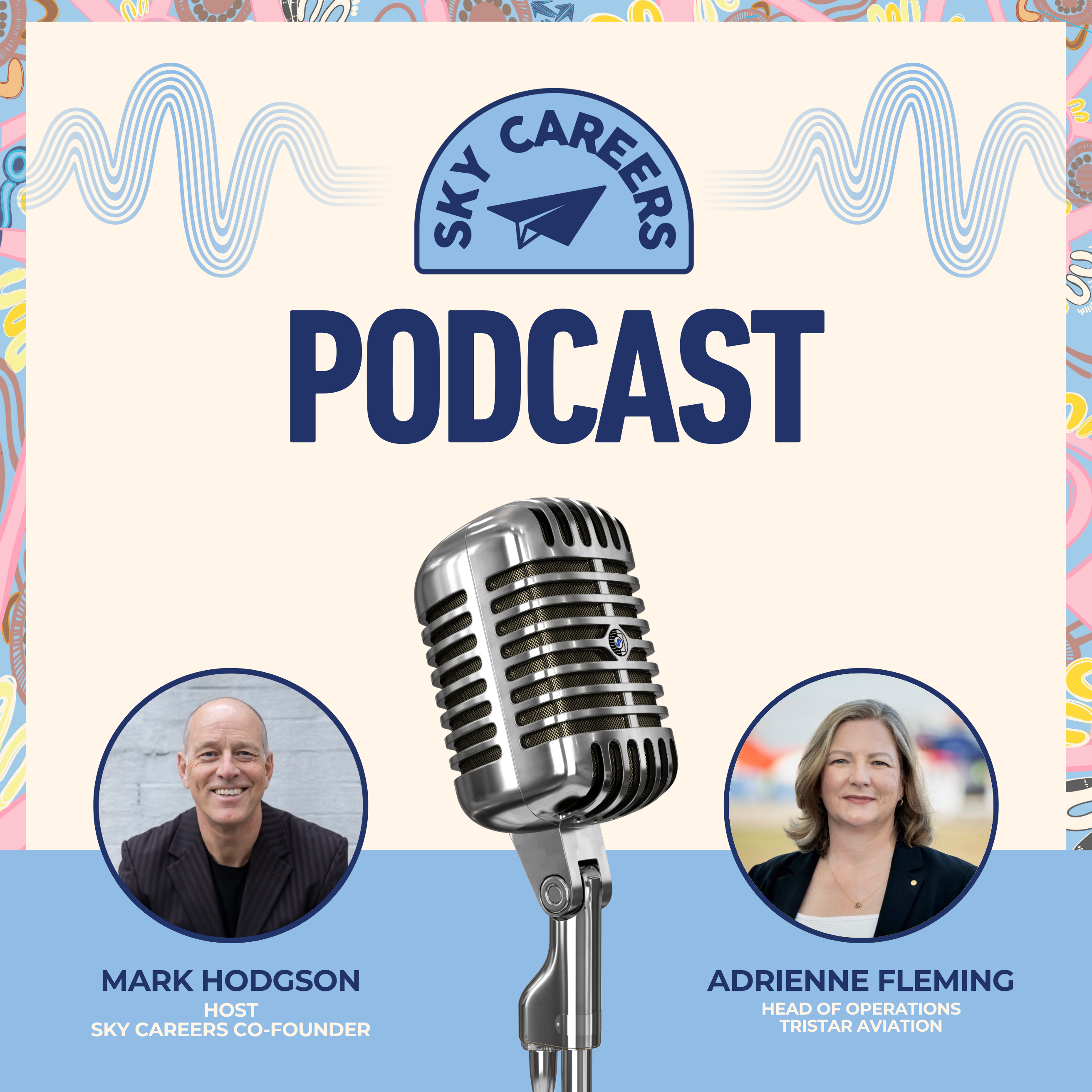
[00:00:08] Speaker B: Welcome to this edition of the Sky Careers Podcast. I'm your host, Mark Hodgson, and it's my pleasure today to introduce you to Adrienne Fleming, who is the head of operations at TriStar Aviation. Adrian has a long and varied career in aviation. I'm really looking forward to learning more about not only what she's doing at the moment, but also her pathway and journey into aviation and advice that she's got for us all. So welcome, Adrian. How are you?
[00:00:45] Speaker A: Great to be here, Mark. Thanks for having me. Always enjoy inspiring the next generation of aviators into the industry.
[00:00:52] Speaker B: Awesome. So tell us, so what do you do and where do you work?
[00:00:56] Speaker A: So, as you mentioned in the intro, I'm the head of operations for a flight training school, which is TriStar Aviation, which is at Moorabbin Airport. My husband and I, back in 1993, set up the flight school with a bit of a name first. We started with, you know, if you build it, they will come. Well, they have come eventually.
And we found that, you know, we had this inspiration, I guess, to sort of improve, you know, what we had experienced in the flight training industry, which, you know, we had. We both had different backgrounds. I had been working as a flight data officer in the Melbourne Air Traffic Control center, and his background was engineering at Qantas and flight dispatch. So we pulled those expertise together and set up a flight school with no experience in business at all. So how could anything go wrong?
[00:01:50] Speaker B: As a fellow entrepreneur, I think that. Don't they say that if you knew what was involved, you wouldn't do it?
So ignorance and enthusiasm are the main ingredients for starting a business?
[00:02:02] Speaker A: Absolutely, absolutely.
[00:02:05] Speaker B: So take us back.
Take us back to a younger version of yourself.
Where did you go to school and what were your favorite subjects back in the day?
[00:02:15] Speaker A: So I went to school in just a primary school in a Catholic primary school.
[00:02:23] Speaker A: It was, you know, in. In Melbourne. I had. My. My cousin was actually there and I thought, oh, we moved house and I went, oh, I want to go to the same school. So I changed schools from a public school into this, this Catholic school. So a lot smaller school than I'd been used to. Favorite subjects were.
I guess I'd have to say maths was a favorite subject, but probably because I wasn't as interested in reading a lot of. A lot of things. I liked creative stuff like craft and things like that. So, you know, maths I could get an answer to. Maths, I think was probably the thing. And, you know, maybe I had some teachers that were.
Were forcing us to read And I wasn't interested. So there was a little rebellious streak in me that they said, you know, you've got to read these hundred books. Here's the challenge. It's like, but maybe I don't want to read those hundred books. So I guess I rebelled against that and focused on maths.
[00:03:18] Speaker B: Love it. And so what was the path from there into aviation? So what was your first job in aviation?
[00:03:25] Speaker A: So my first, my first job in aviation was as a flight data officer in the Melbourne Air Traffic Control Center. So when I finished school, you know, just stepping back a little bit, in year 12, I didn't want to go to university because I always knew I wanted to be a pilot from about the age of seven.
And so what happened was I went up to. You had to fill out a preference card at school to say, you know, where you wanted to go as in the courses you wanted to do at university. And because I didn't want to go to university because, you know, at the time there weren't any university courses for pilots. So I figured that I wouldn't bother filling out the preference card because I'm wasting everybody's time.
And the year 12 coordinator, who happened to be the vice principal at the time, called me up, she was our English teacher, and sat me down and said, look, Adrienne, you've only put your name on the top of the card and you haven't filled it out.
And for me it was like, yep, that's pretty obvious. And she said, well, what is it?
Why haven't you filled it out? I said, well, I don't want to go to university. Of course, a little bit shocking because, you know, I'd gone all the way to year 12 in those days and that was the expected outcome.
And then she said, oh, so dear, what is it that you want to do?
And I said, well, I want to be a pilot.
And she sat back in a chair, rolled her eyes to the back of her head and said, you must mean flight attendant, because girls aren't pilots.
[00:04:46] Speaker A: So hence, you know, I guess that little rebellious streak was still in me. And I wasn't going to listen to what she was going to say. So I left school.
[00:04:56] Speaker A: And I finished school and then I actually did something really unrelated. I went in and did fire technology.
So I was the first female to graduate from fire technology, the only female on the course. And you may ask why.
[00:05:12] Speaker B: I'm going to ask what before I ask why.
[00:05:14] Speaker A: What is fire technology?
So fire technology is.
So the people who had been doing fire technology were operational Firefighters or people in the associated fire detection suppression systems industry.
And at the time, there were no female firefighters in Victoria paid female firefighters. There were some in the volunteer realm. And because my mother was the industrial officer for the country Fire Authority at the time, she.
[00:05:44] Speaker A: I knew through that that they were looking at hiring, potentially hiring females in an affirmative action program. So.
[00:05:50] Speaker B: Oh, my Lord.
[00:05:52] Speaker A: Yeah, Goodness.
[00:05:54] Speaker B: What would they think of next?
[00:05:57] Speaker A: Absolutely.
So anyway, they.
Fire technology was an aside, so it wasn't a requirement to do fire technology, if you like, from a perspective of getting into the fire service. But I thought, oh, this could be a good thing because. And why firefighting? Because it had. At the time I knew they had four days on, four days off, 10 weeks annual leave a year. And I knew that to be a pilot I needed money and time.
So that was my path, which was a little, a little bit obscure.
And then I sort of ended up, I guess, in the higher ed sector that I said, told the teacher I didn't want to do, but I had a purpose for it.
And in that first year, towards the end of the year, they applied. I inquired about air traffic control only because if you look at every career book, it says associated industry air traffic control at the time.
So I applied for air traffic control. They weren't taking air traffic controllers, but they did send a letter saying, we're looking at this junior position as a flight data officer, which air traffic controllers used to do when they first.
When they first started.
And then the idea it would release those air traffic controllers into the air traffic control role and we would be what we call dedicated flight data. So that's where I entered.
Once I got my first paycheck, I finished off fire technology part time and started learning to fly.
[00:07:16] Speaker B: Awesome. And how long did it take you to work through the various licenses to become a qualified pilot?
[00:07:24] Speaker A: It was about three and a half years from start to when I became a commercial pilot.
And.
[00:07:34] Speaker A: From there I had the opportunity to train as an air traffic controller. They were sort of, I guess, upgrading our qualifications if we, you know, passed all the aptitude tests. I went through that process and I had a course start date for air traffic control.
And they were also offering voluntary redundancy. So I had a voluntary redundancy.
[00:07:56] Speaker A: And I knew I didn't want to be an air traffic controller. I'd done all this to be a pilot, so it really wasn't a hard decision.
And then I left, pulled the pin and left to become a pilot. But having said that, I still didn't have my instructor rating So I had to do that.
[00:08:14] Speaker B: Right. And so what was your first sort of commercial pilot, Rob? What were you doing?
[00:08:20] Speaker A: Flight instruction at the flight school that I had originally started at. I was working part time as a flight instructor because I was actually pregnant with my first son at the time.
And so I can say that that year in 1993, three things happened. I completed my instructor rating, I had my first child, and I started a, started a flight school with my husband. But one more thing I guess that happened was that the tragedy of getting my first gray hair that year as well. So I'm not sure what caused, caused it, whether it was one of those three.
[00:08:58] Speaker B: It's worth, it's worth examining. I mean, at that time, am I right in saying you would be, it would be quite unusual to have a female instructor as a pilot instructor? Would that, would that be, would that be, would that be true?
[00:09:11] Speaker A: They were less around, but I would, I hate to use this term, but it was always used that, you know, each flight school would have a token gesture, female.
And so, you know, at the flight schools, when we started the flight school, I think There were about 16 flight schools at Moorabbin. And you know, you knew each of the flight schools had at least mostly one flying instructor that was female. Whereas now, you know, you quite often hear female voices. I would say we're still, you know, we're not tracking in the, you know, in the high 50%, but you quite often hear female voices now.
[00:09:46] Speaker B: Yeah, which is great. And on lots of the podcasts I've interviewed lots of female pilots and.
[00:09:56] Speaker B: We all know the percentage is getting better and higher, but there's still a long way to go. But attitudes, that's what I'm detecting from the various conversations I'm having. The attitudes towards women are much, much better than they certainly were, I'm sure, back in the day.
[00:10:13] Speaker A: I think so.
[00:10:15] Speaker A: Often the pathway people would say to an airline is that go up north, charter company, et cetera, obviously still, probably still is very male dominated, you know, area.
When I was leaving a traffic control environment, you know, often people would say, because at the time many of those air traffic controllers in the room had commercial pilot's license and had been in the, in the system and, you know, trying to encourage me to stay in air traffic control because it's all going to be too hard, you know, in the industry when you get out. So, you know, I have to say I didn't really want to be with those bitter and twisted humans at the time because I thought they were very negative towards, you know, what I dreamed about, so which was one of the deciding factors of me getting out as soon as I could.
[00:11:00] Speaker B: Fantastic. So 93, bit of a year.
[00:11:05] Speaker B: Rated instructor, first child and started the flight school.
Where's the flight school now?
[00:11:12] Speaker A: So the flight school's at Moorabbin. Moorabbin airport, where it originally set up. So just down the road from where I took my first flight, which was at Moorabbin building wise.
And we also now have a base in Launceston, which was our Covid baby. We went down there to scope out a project. They locked down Melbourne. We were down there four and a half months and managed to get everything sorted to.
[00:11:36] Speaker B: And for those of you who've not been like Launceston or Lornier as it's known, Colloqu is a beautiful place to be, isn't it? Great spot.
[00:11:44] Speaker A: Absolutely. And we often find that, you know, weather is actually quite similar. I mean, gets a little bit colder than Melbourne, but as far as usable flying days would be very similar.
[00:11:55] Speaker B: And what's the scale of the business now? How many sort of students, how many aircraft?
[00:12:01] Speaker A: I always hate it when people ask that question because it's such a moving. A moving target, so.
[00:12:05] Speaker B: Sorry.
[00:12:06] Speaker A: It's all right. It's just I never sum that up in. In my head. That's not my, you know, we all have things that we're good at and even though I said like maths, it's not. Is my. Is my strength. You know, aircraft, you know, come in and out, you know, we've got over. We started with one aircraft and there were, you know, three of us because we had to have someone for the. Being the. Where my role is the head of operations because I was only a junior instructor. But, you know, so now we've, you know, we've got, you know, over 23 aircraft, 22 staff.
So it's definitely, definitely grown. Our program that I'm really proud of is our. In 2015, we actually started our aviation in schools program and that's where.
[00:12:52] Speaker A: So the opportunity for children in. And I guess they're young adults because of the age they can learn to fly in year 11 and 12 and sometimes year 10, depending on their age can actually learn to fly and gain credit towards their, you know, the year 12 ATAR score or their TCE in Tasmania. Which is why one of the reasons we went down to Tasmania, because there was interest in that program down there. So that's grown from our initial three students that we had on course one and I think last year at count we had over 70 students on that course.
[00:13:30] Speaker B: That sounds amazing. And.
[00:13:33] Speaker B: How do the finances work for that?
[00:13:36] Speaker A: Yes, sadly it's a fee for service.
So even though they're doing partial, a partial diploma, so they are using, doing diploma units, there is no funding in that space. There is a little bit of vet funding for lower than diploma courses which isn't, which isn't huge.
And so that, you know, it is. Parents have to, you know, pay that money, you know, out.
The bonus we're finding is that for us, we set up a couple of years ago with Holmes Institute a bachelor course.
So many of our aviation in school students, if you like, it's a bit of a prerequisite, they transition really well into that bachelor course.
[00:14:22] Speaker B: Fantastic. So talk us through a typical day.
[00:14:29] Speaker B: In your role, what you're doing today. What does it look like?
[00:14:32] Speaker A: Look, it's varied, which is great because, you know, if I do the same thing, you know, three times in a row, I'm probably really bored.
So for me, you know, it can vary. You know, sitting, sitting on a podcast, numerous meetings. People do say that, you know, there's, there's quite a lot of meetings.
I'm a self declared volunteeraholic which means that, you know, being part of varying, you know, aviation volunteer organizations and positions, they all come with, you know, extra activities. And I'm very fortunate that I've got supportive staff and you know, and husband who lets me go and you know, play in this space in my, in my workday, you know, but a general workday could be, you know, meeting with the staff, looking at, you know, where I'm going to standardize. What thing am I going to conquer the world with today to completing doing a flight test with a student or reviewing student progress records as well.
As far as business side of things, you know, I like the business development side. So it could be, you know, liaising with industry.
You know, we have the bachelor course, so at the moment, the bonus with the bachelor course is we have a aero immersion section which is like an internship where they go and embed themselves in a, in a business for a couple of weeks as part of the course to get them out of that academic bubble.
So part of my role is making connections with industry to be able to support that program as well. So, you know, it's varied, which is great.
[00:16:05] Speaker B: That's awesome. There's so much research that says that you've got to get kids in a physical workspace to work out whether it is, but also whether it isn't, you know, something that's Going to capture their imagination enough for it to be a career for them. And so there's so much theoretical stuff and the rubber doesn't eat the hit the road till too late and kids realize they're in the wrong thing or they've missed or missed the opportunity they actually would have liked. So that sounds like an excellent initiative.
[00:16:34] Speaker A: Yeah, absolutely. And I think it provides relevance. You know, I used to sit there and like I said, I'm a math student but I'd sit there and go, when am I going to use this?
Right. What am I, what am I doing this for? And you know, right. We had at the time geography, which I believe is not necessarily a subject these days, but we had geography. And now I wasn't particularly a fan of geography, maybe it was the teacher. But you know, I look back and go, maybe I should have paid more attention. But if they'd have made it relevant, you know, I would have. And I think aviation has the ability with our Aviation in Schools program. It actually brings together a lot of stuff you do do at school and gives it context and meaning which you know, is often needed because it can be lost in the classroom.
[00:17:12] Speaker B: Yeah.
And oam, what's that about.
[00:17:19] Speaker A: My Order of Australia. Look, I'm very humbled to have received an Order of Australia medal was for services to the aviation industry.
Remember I said I was a self declared volunteeraholic. So I think all those hours and hours of, you know, being on serving on varying committees and scholarship committees and helping run industry organisations, someone put it, recognised that and yeah, very humbled and obviously went to the effort of putting in. I've been involved in other Order of Australia applications for other people. So I know the effort that's involved and yeah, put it together and I was, I guess a proud recipient is all I can say.
[00:18:04] Speaker B: Congratulations, it's a big thing and well done and yeah. And by the way, you are our first OAM on the Sky Careers podcast. So that's, that's, that, that, that, that's another feather in your cap. So well done.
[00:18:16] Speaker A: Thank you.
[00:18:17] Speaker B: So, which is exciting and I know obviously Suanne Moncton, my co founder of Sky Career, she's very much cut from the same, the same, same cloth as you and I know, I recognize, I recognize a fellow, a fellow traveling in that sense.
So tell us, you still do some flying. What part of the job, what part of the, what part of the, the of your work do you enjoy the most, do you think?
[00:18:42] Speaker A: Well, I've just got back from a study on a Churchill Fellowship research Study.
And I enjoy, I guess, the training component. So I'm an examiner and examiner forms a, you know, a part of the, the system that I, you know, that I'm part of. But I actually enjoy the, the training phase and looking and training instructors to be really, you know, good trainers because, you know, as, as I write up in my, in my research paper, it's. Instructing is often an overlooked part of the, the industry, but it's a, it's a vital part.
You know, I grew up, you know, in a, in a world when I learned to fly and you know, when I was in that air traffic control environment, you know, people would say you had to be in an airline by the time you were 27 because they didn't accept you past that. So after I got past the age of 27 and well and truly by then realized that I didn't want to be in an airline, you know, you were what would be considered a failed airline pilot because people who had been in the industry, you know, over that age were failed airline pilots, which is not the case because I never applied to an airline. But, and I've trained multiple airline pilots since.
And so I, it often gets overlooked. So I, you know, I enjoy, you know, making good quality flight instructors, you know, for the industry, which was part of my, you know, looking into, you know, how do we train pilots better around the world. And we do a pretty good job having, having looked at what goes on around the world. But there's things we could improve on.
[00:20:12] Speaker B: Love it. I love it.
What's the least, least favorite part of your job?
[00:20:15] Speaker A: Paperwork.
[00:20:17] Speaker B: Yes, everyone says paperwork.
[00:20:20] Speaker A: You know, paperwork. You know, we, we live in a. What would be considered. We talk about this paperless society and we've got all these online tools which are, which, which are great. So we still call, you know, paperwork administration.
But, you know, I still see more, you know, I think, you know, I do more trips to office works to get paper than we ever used to do when we, you know, didn't live in a paperless society.
[00:20:41] Speaker B: Yeah, no, that's the common answer. And.
[00:20:46] Speaker B: When you're not running this business and volunteering left, right and center, and I'm not sure that that leaves much time for anyone else. What do you do when you're not at work?
[00:20:53] Speaker A: Work?
[00:20:55] Speaker A: Having said that, I guess it's creative. You know, I, you know, I do read as much as I said I didn't like, I didn't like being told I had to read. You know, I do read.
You know, I like to, I like to travel. I've spent a lot of time with work. I would never have thought, you know, I would have traveled to India. We've trained a lot of Indian and international students. I ever would have, you know, traveled, you know, to India on more than 40 occasions as part of that.
But, you know, holidays, I have worked out recently after coming off a cruise that my tolerance to, you know, sandy beaches and blue waters and sunshine is probably about three days. And then I'm, I'm good to, I'm recharged and I need to do something.
[00:21:37] Speaker B: Ready to go? Yeah. Yeah. Love it, love it, love it. And my last question. We could talk forever and I'm sure we'll have you back because I've got some ideas that I'll share with you after the podcast.
[00:21:49] Speaker B: What advice would you give to young women and young men looking for a career in aviation and not just, not just piloting, but the broad sweep of aviation? What advice would you give to them?
[00:22:05] Speaker A: First of all.
[00:22:07] Speaker A: Find out about it. You know, look in and talk to people and don't be afraid to talk to people about it because you don't know what you don't know. The other part is if you think that you want to do it or, you know, or somebody has said no, don't rely on what your school results stated.
Right. So I was, you know, often, you know, told, well, you know, you need high marks to get into this and you need high marks to get into that.
It's not necessarily, don't judge yourself by your school card. All right? So a report card is just a report card.
You know, it's a snapshot. A snapshot in exam is a snapshot in time.
That doesn't mean just because, you know, you may not have been, for example, I was, you know, English, I won't say wasn't my strongest subject. It was okay, but, you know, it wasn't my strongest subject, you know, so how on earth could I write a book, you know, and I struggled with that.
But, you know, now I've written a book and you know, and the art.
[00:23:07] Speaker B: I know I'm sidebarring.
You're an Amazon best selling author. What's that? What's the book?
[00:23:13] Speaker A: So I've got a book called the, the Left Seat, obviously, because it's the pilot seat and it was inspired by those Aviation in Schools, the parents of the Aviation in Schools program. Because often students may have a bit of an idea about how they want to go about learning to fly, but parents have zero idea about, you know, what's involved. So there's multiple ways to reach a commercial pilot's license, whether it's a cadet course, a university course, a diploma course, a flight training school course. There are so many different ways to get there.
And my advice is research about, you know, the systems involved, you know what it's about, and then go and do your homework and actually put yourself in the correct system that suits your style of learning, not necessarily, you know, what the flight school or the university is trying to sell you.
[00:23:59] Speaker B: Awesome. Ajit, I know, I know I mangled your last answer because I asked you two questions in one question. But look.
[00:24:09] Speaker B: Your advice is excellent and we've heard it time and time again, and it's a big thing. Part of what we're about at Sky Careers, to just help people understand all these, so many different pathways.
[00:24:23] Speaker B: Get involved, be proactive, be humble, get your foot in the door somewhere.
We were speaking to had a guest, a leader, a few podcasts ago, and she said she effectively worked around a flight training school for six years doing everything from emptying the bins, making the sandwiches, pushing stuff around. And then when the next sort of junior instructor role came up for a helicopter, she was the natural next person. But she'd paid her dues over six years, which is why. So it's exactly the same principle, isn't it?
[00:24:56] Speaker A: Yeah, absolutely.
[00:24:58] Speaker B: Yeah. Brilliant. So listen, thank you so much for being a guest.
I'd love to have you back because.
[00:25:04] Speaker B: We'Ve skipped over so many areas of expertise just to get an overall picture of what you've achieved. And your passion for aviation and also your passion for growing other other young pilots and young, young professionals also shines through. So thank you. Thank you so much for your time, Adrian.
[00:25:24] Speaker A: Thanks, Mark. It's been a pleasure.
[00:25:25] Speaker B: Brilliant. Thank you.
[00:25:34] Speaker B: Thanks for listening to the Sky Careers podcast.
If today's conversation has sparked your interest in aviation, then head over to our
[email protected].
[00:25:47] Speaker B: Whether you dream of flying aircraft or you're curious about the hundreds of other exciting roles that keep the aviation industry moving, Sky Careers is your gateway to discovering these opportunities.
And if you are already in the industry, check out Sky Careers Connect and Sky Careers Leadership and consider joining our online learning community.
Until next time, keep reaching for the skies.