[00:00:00] Speaker A: Foreign.
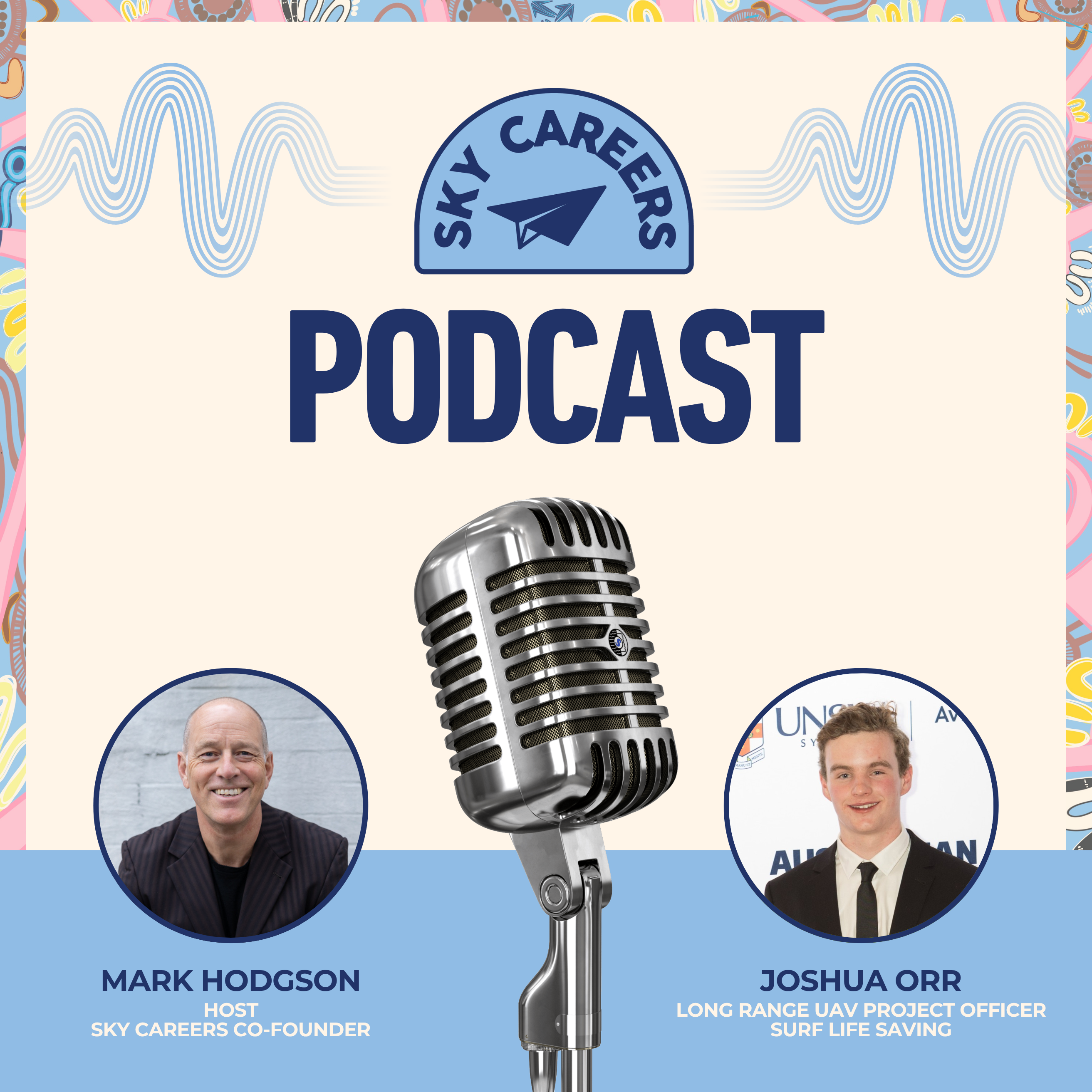
Welcome to this week's edition of the Sky Careers Podcast. I'm your host, Mark Hodgson. And this week I'm excited to be bringing to you someone from the world of drones and UAVs and his name is Josh Orr.
He is the project officer at Surf Life Saving New South Wales. Josh, welcome to the pod.
[00:00:32] Speaker B: Thank you. It's great to be here.
[00:00:34] Speaker A: Awesome. So my friend, now we're locals, I'm in Newport in the northern beaches of New South Wales.
And I know you're a little bit down the road. So tell us, what's your pre aviation journey? Where did you go to school? What did you study?
Kind of. What was your back, what's your background?
[00:00:52] Speaker B: So I went to school out at Barker, which is out near Hornsby. So actually a little bit far from home, but I studied at school. I really enjoyed like the sciencey kind of subjects, a bit of geo design as well. So design tech.
And I also did bio and chemistry, so lots of sciencey subjects.
And then I guess I didn't start to get into the drone world until a bit after school, after I started working with surf lifesaving.
[00:01:25] Speaker A: Okay, and so. And what? Just give us a high level. What's your, what's your current role? I know you do a few things, but what's your current role at Surf Life Saving New South Wales?
[00:01:33] Speaker B: So my current role at Surf Life Saving New South Wales is as the long range UAV or drone project officer. So beyond a quick background on what Surf lifesaving does is within our drone operations we operate around 50 beaches up and down the state, mainly for shark surveillance and then also search and rescue and emergency response.
So we've got 50 pilots on during the summer holiday or each holiday period looking for sharks who also get tasked to looking for missing people and help our lifesavers on the beach. And then beyond that, what my role is is I'm looking at working with the team to build out our capability a bit more, looking at really bigger drones that can go further so we can cover multiple beaches with one drone instead of having to have a pilot on top of that capability of having a pilot on every beach. If that makes sense.
[00:02:28] Speaker A: Yeah, no, it makes sense. Before I go into that in a bit more detail. So what, how did you go from a sort of a, your school years, how did you, how did you find your path into, into this area, the specialized area of aviation?
[00:02:42] Speaker B: I guess initially how I started was I was, I came up through the Nippers program with surf life saving. So I was a Nipper since I was about 10 years old on the beach. And then when you get to 13 you can do what's called your surf rescue certificate.
So that's when you first become like a volunteer lifesaver on the beach. And then as part of that I heard when I was a bit old, when I was about 15, I heard about the drone program that we have this program operating drones looking for sharks on the beach. So that's really where it started.
So I started working at DY on the northern beaches or South Narrabeen looking for sharks myself, flying these drones. So that's kind of how I got into this drone industry and was like, oh, I really enjoyed that part of it. So I began to learn about how there's much more to the drone industry than just flying drones, I guess.
[00:03:40] Speaker A: And what training did you need to do? I guess firstly, I guess for your current, for the current.
What was the initial training you underwent and then how has your training pathway evolved as you've obviously got deeper and deeper and deeper as you've. You've caught the drone bug by. It sounds a bit.
[00:03:58] Speaker B: Yeah, yeah.
So initially what surf life saving puts you through is we do like a two day operator induction program which involves all the things from how you fly the drone to how it's utilized in the coastal environment. So like spotting rips, looking for sharks and how we operate day to day doing our two flights an hour on the beach.
And also as part of that you have to do what's called like your sub 2 kilo operator. Like it's a quiz from Casa which ticks you off to fly small drones commercially.
And then after I'd flown for a few months I also got put through what's called your remote pilot license.
So that's a seven day course which covers all different, a bit more in depth drone operations from like, kind of like I guess your recreational pilot license. It's got sections in meteorology, air law, human factors, all those important parts. And you three then get signed off for me to fly multi rotor drones below 25 kilos. So you can do that with an organization who holds a re up like an AOC for aircraft which surf life saving holds. So that's I guess the initial training.
[00:05:19] Speaker A: Yeah. How did you find that training? Was it difficult?
[00:05:22] Speaker B: Yeah, it was interesting.
Parts of it were difficult. So a lot of it's still actually interestingly related to like the, the crude aircraft industry. So it's got questions on like fuel burn which at the time was quite difficult when I hadn't actually done any flying now. I have done a bit of crude flying as well and questions on like reading aeronautical maps, like your visual terminal chart and stuff, which is not as much to do with the drone industry, but I found it really interesting getting a deeper understanding of how that all works.
[00:05:56] Speaker A: Because it's amazing, isn't it? It's not that long ago from the layperson's view where, you know, I remember for even five years, hey, amazing. In five years time they think that DHL will be able to deliver packages to your house using a drone. And that seemed like real Star Trek stuff. Yeah, that has accelerated massively. Now we're obviously seeing a lot of, I mean anyone can buy a drone, but people use them recreationally. But we're also across a broad range of industries. Surf life saving, search and rescue, construct monitoring, a whole load of ranges where I guess the commercialization of drones is. It's here, isn't it?
It's not coming. It's here.
[00:06:40] Speaker B: Yeah, exactly. And I think that's really what I began to find out through my work from surf lifesaving. I found that, okay, there's this whole industry beyond just flying little drones for photography purposes, being like a hobbyist pilot, that there's all these other companies doing really interesting stuff like in medical deliveries or like you said, cargo agriculture, real professional, commercial, I guess uncrewed pilots flying really big drones.
[00:07:05] Speaker A: Yeah. And I mean how, how have you seen the evolution of drones? Because you've obviously gone from very small little ones that literally just a camera to go and fly over and, and talk and sharks and so forth.
But they're evolving very rapidly and I know you're involved in a couple of projects that are much more advanced than that.
[00:07:22] Speaker B: Yeah. So I guess, yeah, within surf life saving we've seen quite a bit of that. So our initial operations were just like Mavic two little drones, kind of just a bit bigger version of the ones you might go and buy yourself and capture video with. But then down the track now we've got thermal drones so they can help us detect people. Especially helpful more in woods, not as helpful when people are in the water, but on the beach as well.
And then further from that, we've started to get larger drones. We've got like M30s which are closer to a few kilos heavier and they can carry some extra payload looking at thermal and normal video. And then beyond that, we've recently gotten some quite bigger drones like the flycart 30 which can carry 30 kilos of payload.
[00:08:12] Speaker A: Wow.
[00:08:13] Speaker B: So we're Looking to use that in, like, disaster relief operations. So that's been a recent development in the last kind of year.
Um, then beyond that, we've started to look at fixed wing drones as well, so more like planes. We've got an Erase Griffin Pro, which will be really helpful for search and rescue, which can carry a payload and then fly for a few hours at a time. So you could definitely cover multiple beaches with that one as well. So, yeah, it's really progressing really quickly, and we see that through. Like, we'll buy a new technology and then in a few months there'll be another, bigger, better one and available, I guess. So, yeah, it's really progressing really fast through there.
[00:08:52] Speaker A: Josh, it sounds like you're really at the start of an explosion of, I guess, technology and applications and an opportunity, and you sound like you're really excited by that.
Where do you see drones going and where do you see your sort of aviation future?
[00:09:11] Speaker B: Well, yeah, I guess now as we move away from just having pilots on the beach, we move into a space called, like, Beyond Visual Line of sight operation, which I think is really where drones are going. So that's when this is what I was kind of working with in my role at Surf Life saving, where you can have things like a drone in a box, which is like this little drone which sits in this cabinet, and you can leave it somewhere and you can remotely fly it from what's called a remote operations center.
So that means you can cover kilometers and kilometers. You don't need anyone on site. You can fly multiple of these remotely from one central place. And I think that's where it's really starting to go as the regulations start to loosen up. It's pretty difficult to do at the moment, but CASA have recently opened it up a bit more to more operators, but that's really where I think it's going because it's getting.
That makes it much more efficient, so you can cover lots further and you don't need as many pilots. And it means you can do more complex things like flying beyond visual line of sight, cargo operations, like what I started to do with sea flight, what they're trying to do, and then I guess for me, where I want to end up. I'm currently doing a Bachelor of Aviation in remotely piloted systems with unsw.
So I've been learning more about this, and I think for me personally, I just want to end up in the operations space somewhere doing interesting things with drones. So whether I really enjoy the emergency services or in delivery, medical delivery, just somewhere really on the cutting edge, doing new things.
[00:10:49] Speaker A: I guess I was going to ask you what part of your job do you enjoy most? But it sounds like this.
There's so many boxes you can open or piles you can go down.
[00:11:00] Speaker B: Yeah, no, definitely. I think I really enjoy like the operational side of it, like being able to still do a bit of physical flying and testing and then also I guess the real part I enjoy is just doing new things. So the fact that we're working on brand new projects, these cutting edge projects that mean we can fly further and ultimately help more people, I guess I.
[00:11:23] Speaker A: Think it's fascinating and it's actually I've just written down the word that really flashes out to me. Pioneer. This is real pioneering time. And you as a relatively young man, you're joining the, the industry at the start of such, such an exciting.
It's just going to change and advance and increase so quickly, isn't it?
[00:11:46] Speaker B: Yeah, no, definitely. And like we say that like I was talking about, with all the new platforms coming out each year, new companies doing new things like how I mentioned my work for C flight. Delicate bigot.
Building a big cargo drone that can potentially replace planes like the Cessna Caravan down the track to do uncrewed fixed wing cargo deliveries.
So yeah, I think it's a really rapidly evolving space and really interesting to work in.
[00:12:16] Speaker A: Amazing. What's the what part of what part of the world or your job, which what do you least enjoy?
[00:12:26] Speaker B: I'm not sure. I'd say maybe some of the regulatory stuff can get a bit difficult. I still enjoy parts of it, but there's lots of little regulations, not that abiding by them is hard, more that it's quite restrictive in what you can do. So like I mentioned, for all those beyond visual line of sight, so where you fly beyond where you can see a drone, for those more complex operations, you need a long risk assessment assessing both the air risk and ground risk for every single site you have to fly at. And then it can take casa. The lead time is quite long. For example, we've had an approval in for two years to do that.
So I guess that's the real part that's not as fun.
Yeah.
[00:13:11] Speaker A: So the regulatory paperwork and the admin, in short.
[00:13:16] Speaker B: Yeah, yeah, definitely.
It can be quite arduous sometimes.
[00:13:21] Speaker A: Yeah, we've heard that on the podcast from some other people as well. But it's interesting for CASA and other regulatory authorities, they're having to evolve their ecosystems very quickly to drones and UAVs that didn't for all intents and purposes really exist probably 10 years ago.
[00:13:42] Speaker B: Yeah, definitely. And I guess especially with what I'm doing with C flight where they're building a big drone that's more like a plane, they're really looking at different stuff there. Like it's close to planes, like potentially having parts type certified like a plane would. And it's looking at the approval differently that it can also glide for example in normal drones cassette can't consider that in giving approvals I guess but they are starting to open up those approvals a bit more. So there's recently been something come out that you can get a whole area approval for beyond visual line of sight operations.
[00:14:22] Speaker A: One of the things that excited me and probably where we came across each other is you were part of a winning team at the Aviation Industry Awards. Tell us about that.
[00:14:34] Speaker B: Yeah, no, it was really great as a team.
The Australian UAV service. So Surf Life savings UAV ARM or drone army. I won the RPAS Business of the year the second or third time which was really exciting.
But it was really great for the team to be recognized after all this groundbreaking work we're doing within the industry.
And then also I was able to be recognized as RPA's part of the year which was also really exciting and I think especially to be recognised in an industry which I didn't even know existed a few years ago and I was told wasn't necessarily even a career path by careers counselling, Careers counseling at school a few years ago was really crazy to me as well.
[00:15:25] Speaker A: And how are you seeing that change now? I know it still is a young, I guess professional industry as such, but I assume you're pretty optimistic about the future.
[00:15:36] Speaker B: Yeah, no, definitely. Even from like a surface level if you're watching like I have watch like jobs on seek and stuff like that a few years ago when I was at school there would be no like kind of drone related jobs. And now every year I see lots popping up. So I guess that's the most basic in this level of that. But also just the amount of new companies that there are coming up and starting making like drone related products or delivering drone services across basically any industry now as well. If you find a company in any industry like energy, emergency services, environment, agriculture, delivery, logistics, surveying, basically if you name an industry you can use drones in there somewhere. And most companies, large companies do.
[00:16:28] Speaker A: Yeah, it's incredible because drones are so much faster, they're much less expensive, they're more versatile. You know, they bring a level of detail and accuracy that for especially smaller organizations they Couldn't possibly think about, you know, getting a cherry. A cherry picker or a helicopter to take, you know, to inspect. To inspect something. But a drone can be done. That can be. That's all that all becomes possible. We're using UAVs and drones, doesn't it?
[00:16:55] Speaker B: Yeah, yeah, exactly.
[00:16:57] Speaker A: So it's very exciting. Just a couple more questions. Josh, tell us about your Bachelor of Aviation. How are you finding that?
[00:17:07] Speaker B: Yeah, I've been finding it really interesting. I was actually lucky enough to be the first student at UNSW doing that in my year, so I started that in 2023, so I'm in my second year now, but I've really enjoyed it. So it's Bachelor of Aviation at unsw, majoring in remotely piloted Aircraft systems, which is basically a fancy word for like, uncrewed aircraft drones.
But what I really enjoy about it is that it's kind of a mix between they do some aviation management degrees and aviation, like commercial pilot flying degrees. So as part of that, I was even lucky enough to do my recreational pilot license in a plane as well, which was really good background knowledge for when you get into more complex operations with, like, companies like seaflight who do deliveries with a big plane, basically. And all the same rules kind of apply. Like I was saying as part of my remote pilot license, even there's still crude plane stuff in there. So I haven't found overlaps in my crude aircraft theory that I did in my uncrewed, like, drone theory. Um, and yeah, I get to do quite a bit of the management. And it's also a lot about, like, entrepreneurship. So learning how you can use these drones in all different ways in all different companies, learning how to plan operations for them, learning how to run big businesses, which kind of like small airlines.
So, like surf life saving, if you count our. I think it was 30,000 flights a year. It's the biggest airline in Australia, so. I love that.
[00:18:43] Speaker A: I love that.
Look, I'm so excited for you. Congratulations on being part of that pioneering team and winning the award at the Australian Aviation Industry Awards. I think you're at such an exciting place of being a very early expert, if you like, in an industry that's clearly just going to grow and scale in so many ways and you're in such a good place.
I'm fascinated. I'm sure I'll speak to you in a year and three years and five years. And what we talk about, the scale, the complexity, the impact, I think it's just going to be incredible. So I'm really excited for you. I really am.
[00:19:23] Speaker B: Thank you. No, it's really exciting and I'm really enjoying being part of such an interesting field.
[00:19:30] Speaker A: And so my last question, what advice would you give to other young people who are interested in coming to the aviation industry generally, but I guess specifically in the drone UAV space?
[00:19:47] Speaker B: I guess my advice would be go for it. I guess as one part of it, because like I was saying, when I was a bit younger at school, my parents were really supportive, but even chatting to school counsellors, they weren't really aware of how big this industry was.
I think I'm also lucky that now there's that Bachelor's program. So if you're interested, I'd definitely give you the advice to check that out, because it's also great.
It's still generally a Bachelor of Aviation, so you could do it and go and work in crewed aviation if you wanted, on the management side, maybe.
But, yeah, I guess my advice would be, yeah, go for it. It's really interesting field and I've really enjoyed it.
[00:20:26] Speaker A: Brilliant. That's so good, Josh. And as I say, I kind of think you ain't seen nothing yet. You know, I think it's going to be amazing how this scales and how quickly it advances for a whole lot of reasons. So I think you're in a great place. So thanks so much for sharing part of your story with us on the Sky Careers Podcast today. And all the best for the future.
[00:20:47] Speaker B: Thanks for having me.
[00:20:49] Speaker A: Cheers.
Thanks for listening to the Sky Careers Podcast. If today's conversation has sparked your interest in aviation, then head over to our
[email protected].
whether you dream of flying aircraft or you're curious about the hundreds of other exciting roles that keep the aviation industry moving, Sky Careers is your gateway to discovering these opportunities.
And if you are already in the industry, check out Sky Careers Connect and Sky Careers Leadership and consider joining our online learning community.
Until next time, keep reaching for the skies.
Sam.