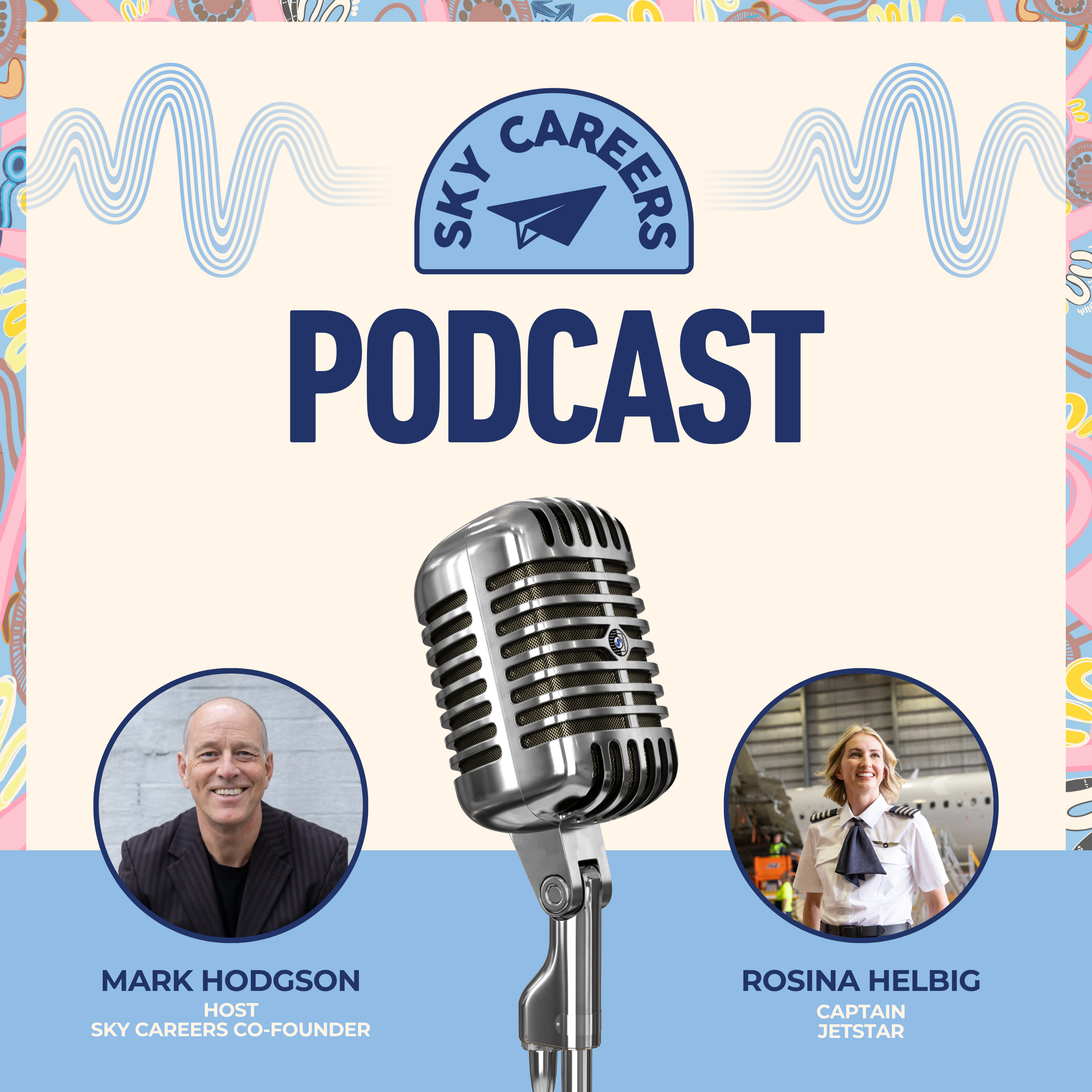
[00:00:08] Speaker A: Hi, Mark Hodgson here, host of the Sky Careers podcast. And this week it's my pleasure to introduce yet another one of our Sky Careers original ambassadors, Rosie Helbig. Rosie works for Jetstar where she is a captain on the Airbus. Can't wait to catch up with Rosie and find out what you've been up to. How are you, Rosie?
[00:00:32] Speaker B: I'm well, Mark, thanks for having me.
[00:00:34] Speaker A: I'm very excited to have our conversation. So, look, we always love to go back to the beginning, before you were a shiny captain.
People around people would be pretty familiar with what you're doing, I'm thinking, with Jetstar. But take us back to a younger version of Rosie, a pre aviation version.
[00:00:52] Speaker B: All right. That was a long time ago.
[00:00:54] Speaker A: What trouble were you getting into? Where did you go to school? And how on earth did you get into aviation?
[00:00:58] Speaker B: Yes. So I grew up in a small town called Kapunda. It's near the Barossa Valley in South Australia and only has a few thousand population.
And that's where I did my schooling.
And I was first inspired to pursue a career in aviation after a visit to the airport with my mum and dad. And mum was going off on a holiday to Melbourne and I just remember seeing the aircraft behind the fence there, Adelaide Airport, and I was just totally in awe of these planes. I just thought it was really cool and something I wanted to be a part of. I had no idea how I was going to map out that path to get there, but I was hooked very early on.
[00:01:38] Speaker A: How old were you here, Rosie? Is this a 6 year old Rosie or a 12 year old?
[00:01:42] Speaker B: It was about that. I was definitely in primary school.
[00:01:45] Speaker A: Wow.
[00:01:46] Speaker B: Yes.
[00:01:46] Speaker A: And that's interesting. One of the things we're finding with Sky Careers, in terms of how the pathways into aviation is how early young girls and boys are making decisions that rule things in but also rule things out. So it's. So it's. Yeah, we're actually doing work and thinking about how we actually need to speak to kids at primary school, which kind of sounds a bit too early, but your own experience says that's not true.
[00:02:12] Speaker B: It was a love from a very young age and I was always going to be a pilot. That's what I told people. So I was very fortunate. My parents actually paid for some flying lessons when I was about 16, so. So I was too young to drive a car. They had to drive me to the airport so I could do some lessons there at Parafield Airport in a little Cessna 152.
[00:02:34] Speaker A: That's amazing. And when you were at school. Did you do any sort of career selection or subject selection that kind of leaned towards aviation, or was it still kind of an idea, but not really sort of fully planned, as it were?
[00:02:50] Speaker B: I did. So I was advised by a careers counsellor to study physics, maths and English, which was probably back then more of a more important requirement. So I selected those subjects for the last few years of high school, and some schools still do this today, where I could use my flying lessons as part of my subjects in year 10 and 11. So credits for my study.
So that gave me, yeah, a great insight into aviation at a young age.
[00:03:22] Speaker A: So you did those subjects, you left school, and then how did you actually enter aviation?
[00:03:30] Speaker B: Well, actually, I hit a bit of a speed bump. So when it came to sky careers.
[00:03:35] Speaker A: Rosie, because they're real, aren't they? Most of us do.
[00:03:39] Speaker B: Very real.
It was a tough time in the industry, so we had September 11th and bird flu, and the aviation industry really, you know, took a downturn. And then for me personally, I think I just, I didn't know how to get there. You know, I didn't know how to become a pilot. I didn't, I wasn't a part of any organizations. I. You know, when you walk through the airport, I didn't see any female pilots. And so I started to have this doubt and me getting there, and I ended up changing my preferences at university from an aviation degree to a business degree.
[00:04:14] Speaker A: Rosie, you. You see, you self doubt seed itself. That's terrible.
[00:04:19] Speaker B: Yes. Yeah. And I worked in human resources for a few years after there, and I found myself eventually working for a new airline called Jetstar and give us a.
[00:04:37] Speaker A: Give us a year here, roughly.
[00:04:39] Speaker B: That was about.
When did they begin? About 21 years ago.
So 2004.
[00:04:48] Speaker A: So 2004. Okay, gotcha.
[00:04:50] Speaker B: Right.
And I found myself, you know, working in engagement, reward and recognition. And then there was a position available in pilot recruitment. And I thought, oh, fantastic, that's a good way to blend my, you know, love of aviation, but also my business degree.
And I was interviewing pilots, and that's where I discovered, I guess, the hard work it takes to get there, but also the different paths people took, the sacrifices that they made. And to me, I started to think, hang on, this is something that I could do. And I even interviewed some female pilots then, too. And it seemed a lot more attainable to me at the time.
[00:05:32] Speaker A: So you kind of realize, hey, maybe I'm on the wrong side of the table here.
[00:05:35] Speaker B: That's right.
And so I took a trip out to Moorabbin Airport and visited the Royal Victorian Aero Club and spoke about starting flying lessons there. And they also had applications open at the time for a flying scholarship and I applied for that and I was successful in gaining a scholarship with the Royal Victorian Area Club which was a fantastic start for me. So I'd be in the office during the day and then at night I'd head to Moorabbin and learn to fly.
[00:06:06] Speaker A: That's. And so. And when was this? What year was this? This is.
[00:06:10] Speaker B: That would be 2006.
[00:06:13] Speaker A: Okay. Okay.
[00:06:14] Speaker B: Yeah, yeah.
[00:06:18] Speaker A: Okay. So what happened then?
[00:06:20] Speaker B: Then after some time I was getting close to doing my general flying progress test and Rex Airlines bought out a, or introduced a cadet ship which we're all familiar with now. And I thought that's fantastic. You know, Rex is a great Australian airline. It's well known for having, you know, skilled pilots. It's a multi crew, multi engine RPT airline. So I put my application in for that as soon as I could and I was successful in gaining a position on the cadetship in their second course.
[00:06:56] Speaker A: Very cool.
I'm just going to jump in on a question here because one of the things that we found through sky careers, there's a, you know, it's not enough just to have a cpl. It's not, not enough just to, you know, just to have the technical flying qualifications.
How much do you think your experience in HR and business in other and other areas was?
How much of a factor do you think that was in you becoming successful in winning these scholarships, for example?
[00:07:27] Speaker B: Yeah, good question. It definitely helped, I think just understanding the business world, what it takes and expectations, it just helped me to prepare but also know what I was getting into as well.
[00:07:40] Speaker A: Perfect. Great, great.
So presumably at some point you qualified with the cpl.
[00:07:46] Speaker B: I did and that was with Rex and I went straight onto their type rating for the Saab 340 and I was posted to Adelaide, which is my hometown. So I was very happy with that and I flew for Rex for five years and I was flying around regional South Australia into Adelaide and it was a fantastic time and I gained great experience there.
[00:08:12] Speaker A: So that's the, so I'm just showing my ignorance here that's.
They weren't jets, were they? Were they? Were they?
[00:08:18] Speaker B: No, just the turbo props.
[00:08:20] Speaker A: Yeah, yeah, yes. Which, and which gives you probably a wider, wider range of experience than so just jets. I know is a really.
But you know what I mean, it's.
[00:08:30] Speaker B: A very hands on operation.
[00:08:35] Speaker A: Yeah.
What was, what did you think you learned from the hands on aspect of it.
[00:08:41] Speaker B: Oh, it's really, you know, it's grassroots aviation operations flying into uncontrolled airports and it's just, it's fantastic for building on those flying skills. Your hand. Flying skills.
[00:08:55] Speaker A: Yeah, amazing. So, so, fast forward because.
Sorry, plot spoiler. Everyone, we've already announced that Rosie works for Jetstars.
We know, we know she doesn't work for Rex anymore and obviously there's a whole conversation about Rex, which we won't have time to get into today. But what was the pathway from Rex to Jetstar?
[00:09:15] Speaker B: I had always wanted to go back to Jetstar eventually, one day.
That was, I guess, the natural progression to move on from a turboprop to a jet airline. And having worked for Jetstar, I.
It felt like a, I guess, family. I knew people there, I knew what the operation was like. I had, you know, there's expectations. I knew that at the time it was mostly out and back flying, so that really appealed to me. So I applied and I was successful. That was just over 11 years ago now, nearly 12 years ago, in gaining a position, and that's on the Airbus fleet and I am based in Adelaide.
[00:09:56] Speaker A: And did you join as a first officer?
[00:09:58] Speaker B: I did, yeah. So straight into the right hand seat.
And after nearly, yeah, just over nine years, I was awarded a command.
[00:10:09] Speaker A: Oh, congratulations.
Tell me about that day. Tell me what that felt like.
[00:10:14] Speaker B: Oh, it, it's one of those days. You knew it would come eventually, but you have to pinch yourself when it actually happens. There's a lot of hard work that went into that and a lot of study and it does feel quite surreal, but it's definitely a very proud moment.
[00:10:29] Speaker A: Fantastic. Just without going into massive detail, because I want to have a different conversation with a separate leadership conversation, but just at a high level in a couple of minutes.
What's the difference between. Between being the first officer and being the captain, given that you can fly an air. You can obviously fly and operate in either seat. What's the difference, do you think? Main difference.
[00:10:55] Speaker B: We do call first officers, I guess they're training for their command.
But at Jetstar, we like to think we have a very shallow cockpit gradient, which means we're a team.
So it's not like I'm, you know, just doing everything, you know, myself. I have rely quite heavily on the first officer to help make decisions. But at the end of the day, as pilot in command, you have that final responsibility.
[00:11:20] Speaker A: Brilliant. Okay, so talk us through what's a typical day for Rosie? Going, right, yeah, as you, as you, as you leave, you arrive At Adelaide Airport. What does the day look like for you?
[00:11:33] Speaker B: Okay, I go to our crew room in Adelaide and there I'll meet with the first officer and we print off our briefing report for the day. We have iPads that have our flight plan on there, so we'll download that and we'll assess the weather forecast, what the forecast is on route, whether there's turbulence and any special, you know, requirements, any maintenance issues with the aircraft. And we come together and make a decision on how much fuel we would like to take for that particular flight.
Then we go and brief the cabin crew and talk to them about, I guess, the expected operations of the day, whether it's going to be smooth flying, what it's like at our destination, and if there's anything else extra would like to add in.
And then we head out to the aircraft. So we prepare the aircraft for the day, so the pilot monitoring, we'll do a walk around, so an external inspection of the aircraft, and then we'll come together and prepare the aircraft's flight management computers for departure. Then in cruise, we're always assessing whether, you know, we could be flying more efficiently or more comfortably and just keeping the operation safe. And then we'll prepare for our arrival.
[00:12:58] Speaker A: Fantastic. And so what's a typical. How many sectors would you typically fly in a day? From Adelaide.
[00:13:03] Speaker B: In Adelaide, it'll be anywhere from two to four sectors, and so that's generally out and back.
So it could be from Adelaide to Sydney and back, or we could go Adelaide and Sydney and back and then to Melbourne and back as well.
[00:13:18] Speaker A: Okay, cool.
What part of your job do you enjoy the most?
[00:13:25] Speaker B: There's a lot I enjoy about it.
I guess it's.
There is some routine about it, but it's also never the same.
So each day can. Even if I was flying to Sydney two days in a row, I could have a different first officer, different cabin crew, different passengers. The weather is always changing, so it's always keeping.
Keeping you on your toes. There's a lot of variety and it's definitely an interesting job.
[00:13:51] Speaker A: Yeah. And what's the. What's the most.
What's what. What, what? We're at a barbecue, people go, what's your. What's your. What's your big drama story? What's your most. What's your biggest adventure?
[00:14:05] Speaker B: I'm very. I think we're very lucky in Australia, you know, that we do have our weather challenges, but we don't have the challenges like overseas where we have, you know, icing and snow and big mountains for Me, it could be just a day where there's storms around and we have to do a lot of weather dodging and holding.
It could be quite windy. We might need to, you know, conduct a missed approach and come around and try again.
So they're the typical challenges I'd say we face.
[00:14:32] Speaker A: That's very cool. And it's. And I, and I know it's sort of come full circle for you because in addition to obviously a practicing active, a captain, I know you're also involved in sort of bringing on and interviewing and the assessment process of bringing on future pilots into jets.
[00:14:53] Speaker B: Yes, I am.
[00:14:55] Speaker A: So about that because.
And again, what's interesting to me in the languages like command, a lot of what a lot of aviation is around self leadership and leadership and teamwork and communication and collaboration, isn't it? And absolutely how core that is to all. I mean, obviously we're talking about your role as a pilot, but more broadly than that, aviation is in many ways it's the ultimate team industry. It seems to me.
[00:15:24] Speaker B: You're right, it is. We have some great opportunities at jetstar. So when you're a pilot, you don't have to just fly every day.
You can work in other areas like being an EPS instructor or a technical refresher instructor.
I, I have put my hand up to do interviews again. So like you said, it is a very full circle moment and we have a team of a number of pilots that sit on the panel and we get rostered whenever we can to interview new candidates and we have a lot of growth at the moment. So I have had the opportunity to do that a lot lately and I still absolutely love hearing those stories of pilots starting out and they're looking for that next adventure and next step in their career.
[00:16:09] Speaker A: And given what you've done and your backstory, including, as you say, it wasn't a straight line and for most of his life isn't a straight line. From this is where I am, this is what I want to do. Straight line, you go back and forth as you did. So you'd be a perfect person to give advice and encouragement to young women and men coming into thinking about whether they want to be a pilot and not just if they can do it, which is a competency and capability piece, but also whether it's actually what, what they really want.
[00:16:42] Speaker B: Right. And we, we still hear a lot of that where people have had to, you know, sidestep or take a step back, but it's all led to them being there, you know, sitting in front of you at the interview. And they're interviewing for, you know, their dream job, which is to, you know, fly the Jetstar.
[00:16:59] Speaker A: Very cool. Now, I also know you're. You're a particular advocate for women and increasing the participation of.
Of women in both as pilots and in the. More broadly in the aviation industry, which, obviously, that's out. That's our DNA. That's the genesis of Sky Cruise, is how we came about.
What are your thoughts? I know. So what, what, how many, what percentage of women would be pilots in Jetstar? Now?
[00:17:26] Speaker B: We've seen an increase recently. I believe it's about 7%.
[00:17:30] Speaker A: Yeah. I think it was 5% a couple of years, so. So up to 6%, which. Which is not enough, but it's great. It's a, It's a good progress. Good progression, isn't it?
[00:17:38] Speaker B: It is progress, yes.
[00:17:40] Speaker A: And what would your general sort of message be to those women and guess thoughts on increasing the participation of women both as pilots and more broadly.
[00:17:53] Speaker B: Right. I'd say if you're interested, go for it. There's nothing about, you know, gender that's going to determine your success as an airline pilot. It's, you know, men aren't better than women, women aren't better than men. It's a very individual thing and it's up to the individual whether they will succeed.
And I feel that, particularly at Jetstar, I am very welcomed as a woman. I'm treated equally and I have wonderful male colleagues who I enjoy working with, too.
[00:18:25] Speaker A: That's very cool. And, hey, I know we've covered a bit of ground here in not much time and I guess we've been quite kind of pilot and flying specific.
What does Rosie do when you're not.
When you're not grilling someone across an entry table or doing an approach into Sydney?
[00:18:45] Speaker B: Right. Well, I could continue on from a typical day in the life if I, you know, work in the morning, I'm often home in the afternoon on time to pick up my children from school, which is fantastic. So I do have two children, two girls, they're currently five and three. And, and, yeah, life revolves around them and it's. Yeah, it's wonderful that I can do both.
[00:19:09] Speaker A: That's. That's very cool. And I'm guessing they're pretty proud of Mum.
[00:19:15] Speaker B: I.
I assume they are. They're very used to, you know, Mum going off and flying planes, so they, they probably don't think it's that special.
[00:19:24] Speaker A: That. That's, that's. That. That's funny. But as you say, it is lovely to. It's I mean, I know one of the, the factors both within aviation and more broadly is the ability for women especially to have more flexibility, more flexibility around their careers both in terms of time of day, but also taking breaks for one or two years maybe to have and raise young kids and then come back into the workplace and how important that is to create enduring careers rather than ones that just stop once you become a mum, for example.
[00:19:59] Speaker B: Absolutely. And we've making a lot of progress in that area. The corners group has fantastic parental leave policies and also part time and carers line rosters. And that's not just for women, that's for men too. We've seen a huge uptick in the amount of men who are also primary carers, you know, on certain days of the week. So I feel like we're making a lot of great progress in that area so that you can have your children and fly too. And we were working on making, yeah, improving that balance.
[00:20:31] Speaker A: Very cool. Do you know what's next.
[00:20:36] Speaker B: For me?
You know, my goal was always that's.
[00:20:41] Speaker A: What we're picking up here. You're only flying, captaining aircraft, landing, coming back, doing the lunches before you go, picking up school and all that. But you haven't got much on. But assume you had a bit of spare time.
In five years time, where would you like to think your career could take you?
[00:20:59] Speaker B: Career wise, it'll be determined on where Jetstar's going.
You know, I'm very happy on the A320 and 321 and shortly, I believe in 2027 we're receiving the A321 XLRs which Qantas have just received their first job and that's going to take us further abroad.
So it'll be new aircraft and new destinations which will keep me on my toes and keep me happy.
[00:21:28] Speaker A: So more long haul destination, potentially, potentially.
[00:21:32] Speaker B: Some slightly longer trips away. Yes.
[00:21:34] Speaker A: Oh, that's so exciting. As long as you're back, still back for school pickup, we won't have a problem, will we?
[00:21:42] Speaker B: Well, we do accept in aviation we do have a few trips away but they're generally short, which is.
Which suits me.
[00:21:49] Speaker A: Yeah, that sounds fantastic. Well, hey Rosie, look, it's been so good to speak with you and I'm going to finish the question that I always finish with, which is what advice? And again think more broadly. The broadly. What advice would you give to young women and young men who are considering or maybe not considering, but maybe it's something that they.
That could be interesting and work for them, who are considering a career in aviation.
[00:22:22] Speaker B: Right. I would say surround yourselves with like minded people. So if aviation is something you're thinking about, you know, go out and have a trial flight, see if it's something for you. There's plenty of organizations and that can be the Australian Women's Pilots association, you know, women in aviation 99s and there's also the Honorable company Air Pilots, which is for men and women and they have regular social catch ups, educational tours, they will offer scholarships and presentations. So it's a great way to, you know, answer those questions that you have and to, to be inspired by surrounding yourself with those people.
[00:23:04] Speaker A: Awesome. We're going, we're going to, we will edit that last bit out because you, the, the only place you need to come is Sky Careers, obviously. So.
[00:23:10] Speaker B: But that's that.
[00:23:13] Speaker A: I'm joking. We just want people to get in wherever they can. It's. Yeah, a lot of it it seems to me is about, it's just, it's as you said, bit like your story. It's finding that first little thing whether you were in being inspired as a six year old looking at, looking through a fence and go that looks pretty cool. Wonder what? Yeah, I'd like to get involved in.
[00:23:33] Speaker B: That and I had no idea how I was going to get there, but it was going to happen.
[00:23:37] Speaker A: Yeah. That's brilliant. Well, listen, hey, thank you Rosie so much for your, your time today and sharing, sharing your story. It'll be very inspiring. A lot of other women and men.
[00:23:48] Speaker B: I hope so. Yeah.
[00:23:49] Speaker A: Yeah. And we'll have you back as I've got a plan for you which we'll talk about after.
[00:23:52] Speaker B: Excellent.
[00:23:54] Speaker A: Thanks for now Rosie.
[00:23:55] Speaker B: Thanks for having me.
[00:23:56] Speaker A: Your story on the Sky Cruise podcast. Thanks so much.
[00:23:59] Speaker B: Okay, thanks.
[00:24:08] Speaker A: Thanks for listening to the Sky Careers podcast. If today's conversation has sparked your interest in aviation, then head over to our
[email protected] au whether you dream of flying aircraft or you're curious about the hundreds of other exciting roles that keep the aviation industry moving, Sky Careers is your gateway to discovering these opportunities.
And if you are already in the industry, check out Sky Careers Connect and Sky Careers Leadership and consider joining our online learning community.
Until next time, keep reaching for the skies.