[00:00:00] Speaker A: Foreign.
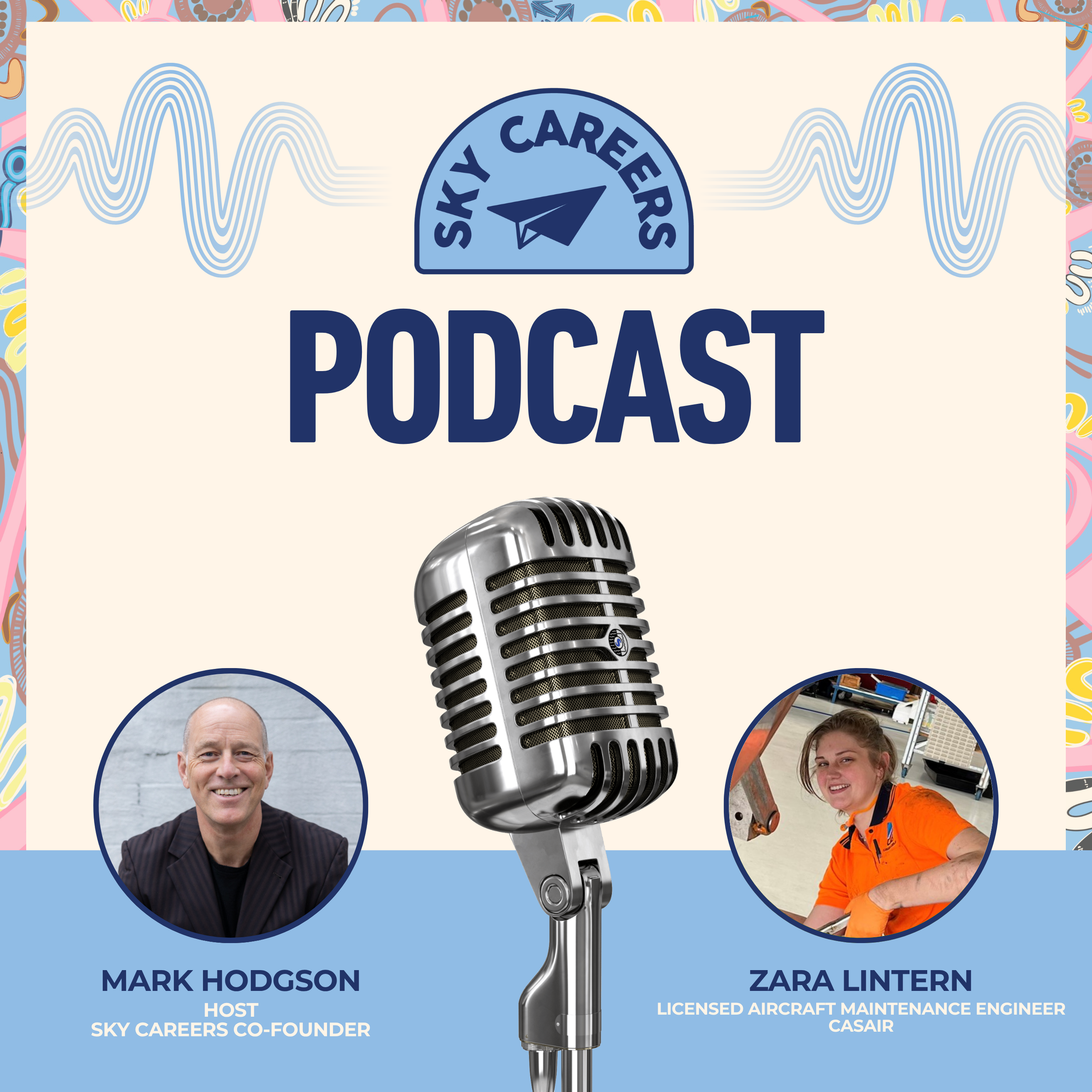
[00:00:08] Speaker B: Hi, Mark here. It's my pleasure to be your host on this week's Sky Careers podcast and my guest is Zara Lintern.
Zara is a licensed aircraft maintenance engineer, which is a bit of a mouthful. Better known as a lamy, Zara works for Cass Air out of Jandaku Airport in Western Australia in Perth. Zara, welcome to the podcast.
[00:00:35] Speaker A: Thank you for having me.
[00:00:37] Speaker B: You're super welcome. Now, you are one of our beautiful Sky Careers ambassadors. So you and I chatted probably almost a couple of years ago now. So I'm really looking forward to going into a little bit more depth and bringing you up to getting up to date on what you've been up to.
But before we get into all that, just give us a bit of a sense of where you came from, where you went school and what life was like for a long a young Zara before you got the aviation boat.
[00:01:05] Speaker A: Well, I come from a place called Ellenbrook, which does have a bit of a bad rep, but I wasn't very scared.
I had a property, well, we had a property up in Musha, so I was a bit of a country girl as well.
Loved to go out, go play with some sticks, tape them together and pretend they're, you know, I'm a wizard or something, go around and pretend I'm a fairy with my younger, two younger sisters.
And basically my dad, he's a mechanic, but he works on motorbikes, boats, cars, and I couldn't keep my hands clean.
I loved to help him fix the next project bike or his boat that he couldn't get started.
And he taught me quite a lot of my hand skills as well in that sort of process.
He taught me how to use a lathe, basic hand tools.
He got me to help build the house because we actually lived in a shed that was built by pretty much all of our family members.
So I learned how to tile and how to grout.
[00:02:29] Speaker B: Well, Zara, now look, you can tell me because no one's listening. Is it true you are the favourite daughter? It's got to be true, right?
[00:02:39] Speaker A: The son that dad never had. Put it that way.
[00:02:42] Speaker B: Oh, very politic. Well done. Well answered, well answered. So you were up to your armpits in Greece and grout and a whole load of other things.
What did you study at school and what, I guess what was the pathway from or the bridge that took you from a general interest in all things engineering and building to actually step into aviation.
[00:03:10] Speaker A: So that probably be year seven, to be honest. I actually wanted to be a mechanical engineer.
So I actually wanted to go off to uni and study engineering and then I had a couple of friends that actually had parents that were in the Air Force.
So I started talking, I became closer friends with them and I actually started wanting to become an aeronautical engineer.
At the time that I decided I wanted to be an aeronautical engineer, we lived quite close to RAF air base, so we had like the Hornets fly over the Hercules and all that sort of stuff. And my dad's a little bit of an aircraft nerd himself.
[00:03:56] Speaker B: I think that. I think most of us are kind of aircraft nerds, especially when the sexy military kits fly, aren't we?
[00:04:05] Speaker A: Yes.
So he used to tell me like how they sort of worked and grew in interest. Dad used to do aircraft cadets as well. So I eventually went off to 701 Squadron in Bullsbrook.
[00:04:22] Speaker B: So that's.
That's the air cadets, is it?
[00:04:25] Speaker A: Yeah, so I actually joined them, which is on Pierce Airbase.
[00:04:31] Speaker B: Yeah.
[00:04:33] Speaker A: And from there I actually met a female Lamy, she was one of my seniors.
So during that period of time I didn't even know what an aircraft mechanic was. I knew I wanted to do something mechanical wise and I kind of wanted to do something a little bit more hands on than just designing.
So she actually gave me a lot of advice on what I should be doing, the sort of people I should be talking to.
My grandfather, he had some contacts at Rackwell, at Royal Flying.
[00:05:20] Speaker B: That doesn't matter.
Another aviation. Who knew there's millions of them.
[00:05:26] Speaker A: Well, yeah, yeah. The best part about being the mechanic is acronyms aren't really on your side.
Yeah. He started talking to a guy there as well and he steered me into the right sort of direction, what sort of courses I should be doing.
So the biggest advice he told me was try and get my cert 2 in aero skills because that's your pre apprenticeship.
[00:05:55] Speaker B: Okay. And how old are your hairs are? Just so I can keep track of 25.
[00:06:00] Speaker A: Oh, sorry.
[00:06:01] Speaker B: No, then ish.
[00:06:04] Speaker A: I think I was 14.
[00:06:08] Speaker B: Okay. Right. So again quite early. So the reason we dig around in this a little bit is that obviously a lot of what we're doing with sky careers is trying to increase awareness, as you would know Zara, about all these amazing exist in aviation and the earlier we can help people to understand the various things that might be interesting to them and the sooner you can start to I guess move towards where you want to get to potentially, which is what you're describing, isn't it?
[00:06:43] Speaker A: Yeah, yeah. So quite a lot of especially mechanics.
It's who you know, not necessarily like. The courses do help, but you need to get your name out.
[00:07:01] Speaker B: Okay.
[00:07:01] Speaker A: Into the aviation business.
[00:07:03] Speaker B: So you went where? What was the pathway from school to your current role?
[00:07:09] Speaker A: So I had a big interest in science, so it being heavily math and science based, I did do a applications course in mathematics which is, it's an atar.
I managed to be able to convince the school that that was the best course for me.
And then I stuck with general science, so that way I didn't just have to stick with physics or chemistry, I could do both throughout the year.
And then in year 12, I did a veterinary program where I was able to go to do my certificate 2 in Aero Skills for free.
[00:07:57] Speaker B: Great.
[00:07:58] Speaker A: The school paid for it and I was at school for three days and that tafed for two days.
[00:08:06] Speaker B: Awesome.
[00:08:08] Speaker A: Yeah. That qualification goes towards my year 12 certificate as well. So it was a massive benefit for me.
[00:08:18] Speaker B: Brilliant.
[00:08:19] Speaker A: Yeah.
[00:08:19] Speaker B: And so was that the pathway to your current job or your first job in aviation?
[00:08:28] Speaker A: That was the pathway that I took to help with my current job. My first job I was at my, at Cassav, but I was doing stores.
So they pretty much told me that they'll put me in stores for now because the current stores person was leaving, but they didn't have a position for me as an apprentice.
So I just basically took whatever job I could get my foot in the door.
[00:08:59] Speaker B: Brilliant.
[00:09:02] Speaker A: And I was in stores for a year and a half and because of school and learning how to use Microsoft, I did a course in computer science because I didn't know if I wanted to be a mechanical or an avionic mechanic. And I didn't want to limit myself just by focusing on one pathway. I wanted to make sure that I was skilled in both.
So that gave me a little bit of background knowledge on how I should be managing stores as well.
[00:09:33] Speaker B: I love it.
You've got a very wise head on your shoulders, Zara.
[00:09:39] Speaker A: Yes.
Best thing about jobs is you will always end up the place that you want to be.
But as long as you get your foot in the door, you can develop your skills. And who knows, you might even create a completely new sort of area that you might not even thought about when you first joined.
[00:10:06] Speaker B: So you're in the stores.
You, you. I'm sure you're annoying everyone saying, when can I, when can I, when can I, when can I basically get on the tools, Am I right? And then finally they released it. Finally, finally, Zara, we've got a role for you.
[00:10:19] Speaker A: Is that what happened during the time While I was at stores, because I knew I had the cert too, they were actually letting me out on the floor to help with, like, taking panels off and all that sort of stuff. So I was kind of doing a little bit of like a trainee sort of thing while I was at it.
And then we.
Senior Lamy at the time actually became chief engineer, and he pretty much said, I actually want you as an apprentice now.
Even though we want the current apprentice to be a second year, I actually want you on the floor now. So he actually personally trained me.
[00:10:58] Speaker B: What's his name? Let's give him a name check.
[00:11:01] Speaker A: Say his name is Scott Squire.
[00:11:03] Speaker B: Well done, Scott. Thank you for recognizing and elevating talent. Love it. Love it. So, and what's lovely about this story, Zara, is, you know, you're showing how clearly you had a bit of a sense about what you wanted to do, or quite a clear sense about what you wanted to do. But you were also very resilient. And you said, I just want to get my foot in the door somewhere, carry on with my study on the job experience, not getting snooty or saying, well, I don't want to work in the stores. I want to want to be, you know, be an engineer, being very resilient and I guess team, team, team minded with a view on making yourself essential in Casair. And ultimately they recognize you and said, oh, we, we, we need you. We're ready for you.
[00:11:49] Speaker A: Yeah, yeah. No, I was. Well, I'm still am, but very much constant improvement.
So even now, when my apprentices, well, the apprentices, they're not quite mine, but when the apprentices come to me and ask me questions, I was like, well, I don't know. I'll always come home and figure out why and then let them know.
[00:12:14] Speaker B: That's good, that's good. When did you qualify, Zara, as a Lamy?
[00:12:21] Speaker A: So I graduated my apprenticeship early 2024.
So that's when I became basic Lamy.
And then I became type rated in late 2024. And this is my first year being type rated. So before I was type rated, I wasn't able to sign anything off complete, But I would still be in a sort of Lamy leadership sort of position. But now I'm responsible for the serviceability of the fleet.
[00:13:00] Speaker B: Talk us through a typical day. What's the day look like for Zara?
[00:13:06] Speaker A: So I come in at 6:30, sometimes a little bit earlier, set, have breakfast, set myself up, talk to my boss, see what sort of job packs are planned for the day.
If I'm coordinating anything. I do tend to have some tasks set for the apprentices.
[00:13:33] Speaker B: Sorry, how many, how many apprentices? How many are in the team now?
[00:13:37] Speaker A: So there are two apprentices, the senior Lamy, myself and chief engineer. So that's what. Okay, five.
[00:13:48] Speaker B: Yeah. Cool, cool, cool. Okay.
[00:13:50] Speaker A: And we manage five aircraft.
[00:13:55] Speaker B: And what kind of aircraft are they?
[00:13:56] Speaker A: So we have.
Oh, sorry, six aircraft. We have three Metro 2s.
We have a Merlin, Merlin 3.
We have a Navajo, and a new addition, we have a Conquest.
[00:14:16] Speaker B: Right now. I don't know what any of those are, but just rough. Roughly what are they and what are they used for?
[00:14:23] Speaker A: So the Merlin we have fitted with lots of like, we call it the executive ship.
It's fitted out with a lot of cream interior and you don't want to be working on it if you're working on the engine. You don't want to walk through it by working on the engines because 100% you'll put some black in it.
[00:14:46] Speaker B: And so that's flying passengers around.
Business, passenger, executive. Is that the idea there?
[00:14:54] Speaker A: Yeah, we've flown politicians.
[00:14:57] Speaker B: Okay.
[00:14:59] Speaker A: If the company is willing to pay a little bit extra. We do fly like normal FIFO people in there as well.
[00:15:06] Speaker B: Okay.
[00:15:08] Speaker A: It's just a little bit more pricier because it's lighter. It's a lot quicker as well.
[00:15:13] Speaker B: Okay.
[00:15:15] Speaker A: And the three metros, they're kind of like freight.
They also hold FAF 14C.
They tend to be our FIFO dogs as well.
[00:15:29] Speaker B: FIFO dogs. And where are they typically operating to?
Zara, paint a picture for listeners who aren't aware of maybe some of the FIFO operations that you're primarily providing aircraft for.
[00:15:44] Speaker A: So most of the places that we fly to wa, every once in a while we might get something in Darwin or over east, but we do tend to fly.
There's the Delta Lithium flight that's a little bit more eastly in wa, we are currently flying to Sharks Clinic quite a lot.
What else do we have?
Quite a lot of the locations that we fly to are actually quite close to the WA border. Like the rapid proof fence.
[00:16:30] Speaker B: Wow.
[00:16:31] Speaker A: Yeah. So quite regional.
[00:16:35] Speaker B: These are like Utes of the air kind of thing. They're flying people and gear around.
[00:16:40] Speaker A: Yeah, yeah. Basically they're probably the biggest planes are on the airport, but they're regional flyers.
[00:16:54] Speaker B: So now with your team, what's your favorite job?
What's the thing you love most to do most?
[00:17:02] Speaker A: Oh, that's a hard one.
I do like quite a lot of my job, probably things that I haven't done before. So I do quite enjoy troubleshooting, just because it's very much like figuring out puzzles and all that sort of stuff.
But I do quite enjoy.
Just before I left my holiday, we changed a pump, which is like a hydraulic pump, and I found that quite enjoyable, despite how messy it was, but because it was different.
[00:17:47] Speaker B: I remember you saying last time we spoke about, you love being up to your armpits in Greece, don't you? You like the dirty stuff.
[00:17:54] Speaker A: I do, yeah.
If.
If I'm not working, if I'm working an engine, I tend to have a little black mark right here where I rest my head on the.
The engine frame.
And I have been made fun of quite a few times.
[00:18:13] Speaker B: That's fun.
[00:18:15] Speaker A: Yeah. The running joke is, watch out if you have a cowl open and Zara walks past, because she might just have, you know, a little bit of black on her elbow.
[00:18:26] Speaker B: And how do you find being a young leader? Because you're leading several apprentices and ultimately you have responsibility to sign off on, the job's been done to the right standard and it's airworthy. That's a big responsibility, isn't it?
[00:18:43] Speaker A: Yeah, it is a very big responsibility. But I'm quite confident with the team that we have and, like, I could give them a task and sort of not have to be over their shoulder the whole time. I hate being that sort of lamy that's basically watching people the whole time.
And being a young woman as a lamy, I don't necessarily have a problem with it.
I treat everyone like the whole team with respect, and they give me respect back because quite a lot of the team actually knew me when I first started being an apprentice.
And the apprentices below me, they have an understanding that I actually know what I'm talking about. So they actually respect me quite a lot because I respect them, I give them challenges and I don't push them into a corner or anything like that.
And I push them to.
In a sort of way that they thought they wouldn't be able to do certain things and they're able to do those things, so they quite appreciate that sort of training.
[00:20:12] Speaker B: You're espousing some very strong leadership. It's good to leave people a little bit of discomfort when they learn and wrestle with a problem, come up with a solution themselves rather than just give them the answer as a leader. So I think you're all over that, which is great. And you touched on this about being a female in what is a predominantly male environment. And as you know, one of the main things that we focus on at sky careers is helping to increase the awareness of the broad range of aviation careers, especially for women.
What's been your experience of being a young woman in what is even statistically still a male dominated industry?
[00:21:03] Speaker A: In my workplace there's no tolerance for that sort of bead whistling. In a way, I have experienced it, but basically, unfortunately, it's something that I very much expected coming into the industry.
It's something that I kind of understood that I needed to have a bit of a thick skin about.
And the whole industry isn't like that.
Very much more of the industry isn't like that. But quite a lot of older opinions are still lurking around, especially civil aviation.
Normally in like the bigger companies like Qantas, all that sort of stuff, it's more pushed out.
But I feel like if I go around and take everything to heart, it's, it's going to affect my job and my perception of the industry.
And I know for a fact that not everyone is like that in the industry. So it's very unfair.
[00:22:18] Speaker B: I think, I think that's, I think that's a one, I think it's a wonderful answer. Firstly, I'm sorry you've had any negative experience being a female, but what you, and I'm absolutely not looking to minimize this, but what you, exactly what you just said from our conversation of having lots of, lots of men and women across the industry, it does very much seem to be that it's getting better.
It's a few pockets of probably old fashioned views probably are, seem to be in the smaller little pockets of the industry and with older people, not younger people.
And I know, for example, I was talking with one of our other guests earlier this week actually, and she's a Jetstar captain and she was talking about how the attitudes are very, very positive and that we're getting increasing levels of women in the industry. So a long way to go, A long way to go but you know, it's definitely getting better. And what I was going to say to you is, I mean you are, and you're probably feel modest about this, I'm sure, but you're a real poster child for the, for the change. I mean, yeah, I mean forget aviation, you know, engineering and certainly rolling up your sleeves and getting covered in oil and grease and so forth. That does, that does, that does tend to be a male dominated area. So you leading as a young woman and being very successful and getting, you know, such qualifications at a relatively early age, I mean, just shows absolutely your post Showed you showing. Demonstrating exactly what could be done. So I think you should be very proud of yourself.
[00:24:08] Speaker A: Thank you. Yeah, yeah.
Is kind of surreal. A little bit. I didn't have a full grasp and understanding on how important it is. I'm just a person doing what she enjoys.
[00:24:26] Speaker B: 100%.
You've got a lovely attitude. So I've asked you the stuff you like. What don't you like?
[00:24:34] Speaker A: I don't like going up and down ladders.
I tend to try and avoid a lot of tunnel work just because I'm having to go up and down.
Cleaning the ice boots as well isn't a very nice job because I have to go up and down a ladder.
So.
Yeah. Which is. It's quite, quite odd considering I'm quite tall. I might be partly terrified of heights, so.
[00:25:07] Speaker B: Me too.
[00:25:09] Speaker A: As soon as that ladder moves, I'm freaking out.
So I did what.
[00:25:18] Speaker B: What do you do when you're not. When you're not up to your armpits in Greece in an air.
[00:25:22] Speaker A: In a.
[00:25:22] Speaker B: In a.
In one of those airplanes you mentioned?
[00:25:26] Speaker A: Like at home?
[00:25:27] Speaker B: Yeah.
[00:25:30] Speaker A: I love to cook.
It's something I'm very interested in, very passionate about as well.
I find cooking brings people together, so I quite like enjoy that sort of cooking.
[00:25:48] Speaker B: And what's your signature dish?
If I'm coming to. If I'm coming to dinner party at your place, what are you wowing me with?
[00:25:57] Speaker A: Probably my homemade chicken Alfredo.
[00:26:01] Speaker B: Oh, yes. Oh, yeah, it sounds good.
[00:26:04] Speaker A: With some homemade garlic bread knots. Oh.
[00:26:10] Speaker B: Let'S put it. After we finish this, I'll fly over to Perth. It sounds worth the trip. It does. So you love cooking. Anything else?
[00:26:18] Speaker A: I do love to draw and paint, so tend to draw in my free time and painting.
I like to paint like miniature figures. Like a. I kind of. I'm a bit of a bit of a nerd in a way.
I like to paint like little, little figures and sort of detailed work.
Kind of sets me into a zone which I enjoy.
And I have a dog as well, so I tend to play with him in my free time.
[00:26:56] Speaker B: We gotta love the dog. And any idea what's next in 5 years time?
Where would Zara like to be, do you think?
[00:27:06] Speaker A: Well, I've just started a training course as a member which is a mentoring group for people in aviation.
So I'm going to become a bit more of a mentor in that sort of respect.
As with sky careers, I'm doing quite well and very much enjoying school talks.
Just recently I did a.
A teacher talk with Suanne that went really? Well, very much enjoyed that. That was really.
[00:27:46] Speaker B: Yeah. One of our present days.
[00:27:48] Speaker A: Yeah, yeah, yeah.
And I do want to try and climb up a little bit more in the company that I'm currently in, become a little bit more of a role model as well in the company.
I don't really have any intention on leaving the company that I'm currently in. Very much enjoy it. The only reason that I can possibly think of at this current moment in time is. Is maybe career development. But I'm very comfortable where I am. I very much enjoy civil aviation, to be honest.
[00:28:30] Speaker B: Brilliant. That's a. Brilliant. And I have. Well, first, I think you. Well, you already are. You're a role model to those around you. You are, I'm sure, a fabulous mentor.
And I think you're going to go a very, very long way. You've already come a long way. And I think just by you doing, you.
I think you're gonna absolutely continue.
I think you're gonna be successful yourself, but also inspire others as you've described to us. I bet you've got a very proud family, I'm sure.
[00:29:03] Speaker A: Yes, yes. Very proud family. They.
I'm a little bit naughty, and I tend to hide my achievements quite a lot from my family. But they. They find out eventually and I get in trouble. But.
[00:29:16] Speaker B: Well, I'm gonna be. I'm gonna be sending this podcast, so we're gonna be.
You've got a lovely way about you, Zara, and you've got lovely modesty, but I love what you're doing.
And my last question, because we've taken up, and I've really enjoyed this conversation, what advice would you give to other young women and men who are considering a career in aviation?
[00:29:45] Speaker A: Half one.
There's a lot of sort of advice, per se.
Probably the big one would be stick your foot in the door.
No matter what kind of job that you're wanting to do, whether that's baggage handling or even, like, let's say you want to be a cook for aircraft meals, but first of all, you need to clean pots.
Let's say you want to be a pilot, and the first thing you should do is maybe help the crew out, be with the backseat driver a little bit, the mechanic that mop floors.
Every little bit of experience that you get in aviation is worth it.
And because you make contacts with people and making those contacts will push further of everyone else that won't have those contacts.
[00:30:59] Speaker B: Yeah, it's a big theme business, a big people business, and who, you know.
[00:31:04] Speaker A: Goes a long way.
Yeah, yeah, it is it is very important to have the correct education for it, but you can get advice from other people if you know them.
[00:31:20] Speaker B: That's that, that's such good advice. And look what I, what I love about your advice, a, it's great advice and B, you've walked your own talk because you started as a, as a stores person whilst they, whilst they worked out that you were the person there who should be the aircraft maintenance engineer in training. And look at you now, qualified, leading a team, doing a great job and signing off on, you know, incredibly important skilled role and incredibly incredible levels of responsibility. So I think you're doing an absolutely fabulous job. Zara, it's been my absolute pleasure. Love chatting with you today and can't wait to see where you get to next. Thanks so much for your time.
[00:32:01] Speaker A: Thank you.
[00:32:10] Speaker C: Thanks for listening to the Sky Careers podcast.
If today's conversation has sparked your interest in aviation, then head over to our
[email protected] au we. Whether you dream of flying aircraft or you're curious about the hundreds of other exciting roles that keep the aviation industry moving, Sky Careers is your gateway to discovering these opportunities.
And if you are already in the industry, check out Sky Careers Connect and Sky Careers Leadership and consider joining our online learning community.
Until next time, keep reaching for the skies.