[00:00:00] Speaker A: Foreign.
[00:00:08] Speaker B: And welcome to this session of the Sky Careers Podcast.
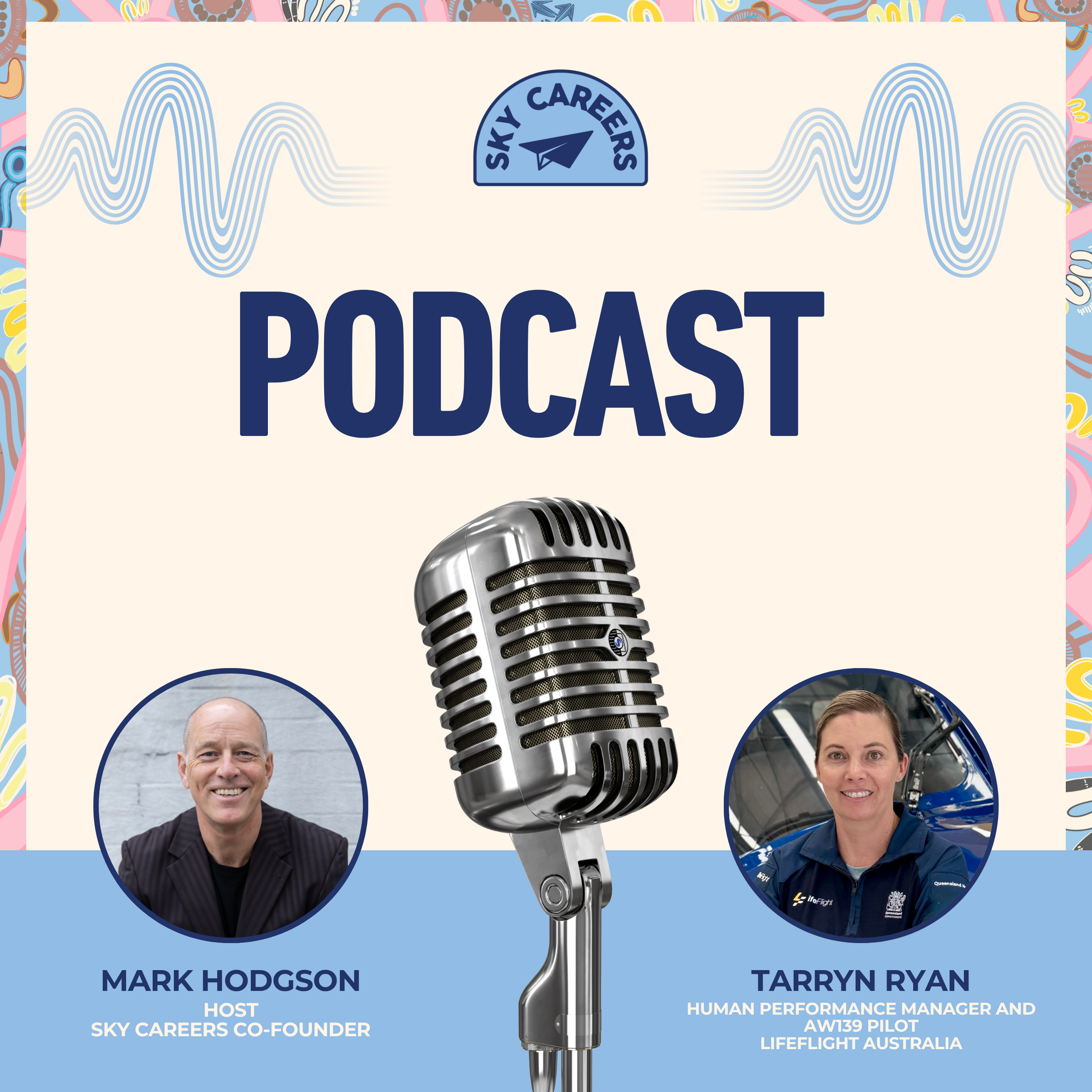
It's my pleasure today to be bringing you a guest all the way from Queensland. Her name is Taryn Ryan. And Taryn is the human performance manager and a very experienced helicopter pilot working for Life Flight Australia. Welcome, Taryn.
[00:00:31] Speaker A: Hi, Mark. Thanks so much for having me.
[00:00:34] Speaker B: You're super welcome. So, Taryn, tell us about before we get into your aviation career.
Where do you come from and what's your background?
[00:00:46] Speaker A: A bit of a. Probably a long story, but I'll try to keep it short.
We've got time.
[00:00:51] Speaker B: Go for it.
[00:00:53] Speaker A: I'm originally from South Africa, so. So born and bred in South Africa, but been in Australia for almost 10 years now and have a journey as a helicopter pilot, which I started in the South African Air Force. And, yeah, now it's brought me all the way to sunny Brisbane, Queensland.
[00:01:13] Speaker B: Fantastic. So where did you go to school? A long time ago. Where did you go to school?
[00:01:18] Speaker A: I don't even remember that. That was years ago.
[00:01:20] Speaker B: And what were your favorite subjects? Because it's interesting to people to know what current aviation professionals did at school because they didn't do aviation things at all. What was your. What was your story?
[00:01:31] Speaker A: That's very true. Yeah. So I grew up in Johannesburg, which is one of the. Which is one of the capital cities in South Africa. And my two favorite subjects in school was geography and history.
Believe it or not, I loved learning about World War I, World War II, because my grandfather was a pilot in World War II, so I had a keen interest in learning more about that. And I just love geography because I just love learning about the Earth, the world and everything in it.
[00:01:57] Speaker B: Okay, so Johannesburg, Primary and Secondary School. So what was the pathway from there into aviation for you?
[00:02:05] Speaker A: Well, when I was nine years old, I went on my very first airplane flight was like the equivalent of a Qantaslink setup. So on a dash eight, that was the first time I'd ever been in an aircraft before. And that was amazing. I just absolutely fell in love with flying. There was. I'll never forget, I was also. I was by myself, and there was the clouds out the one side and the ocean out the other side. And I just sat there going. And in those days, you know, the cockpit door was still open, and I was, like, looking down the aisle and I could see into the cockpit, and I was like, this is incredible. And just the view just sold me on aviation. So, yes, not really having.
You know, my parents were not in aviation at all, but ever since that day, I was like, that's that I want to be a pil.
So, yeah, growing up had lots of posters of airplanes on my wall and my dad. Well, I dragged my dad to any and every air show that came around, poor thing.
But he was great. They were really supportive. Painted my room blue so everyone thought it was my brother's room.
When they came to visit, they're like, why is your room blue? Oh, because it's the sky, of course. And with all my Airbus on it.
Yeah.
And, yeah, my dream at that stage was to be an airline pilot and fly the virgin Atlantic Boeing 747 because it had this Virgin lady painted on the side. And I was like, I want to fly. I want to fly the Virgin Lady. That was my, my dream. And yeah, until they landed a helicopter in our school rugby field one day and I was like, hang on, that's way cooler. I want to do that. Let's do that.
[00:03:46] Speaker B: Fantastic. So what was the, what was the pathway? So how did, how did you go from I wanna. To I'm doing this?
[00:03:55] Speaker A: Oh, that was the tricky bit because my parents didn't have the money to send me to flight school, which is, you know, super expensive, as we know. So I, I applied to both South African Airways, they had a cadetship program at the time which trained you from zero to, you know, first officer, basically, which was a fantastic opportunity. So I applied for that and then I. Well, after they'd landed that helicopter on the rugby field at school, that was the South African Air Force helicopter that had done that. And I kind of realized, oh, hang on, we've got this, you know, whole military that flies helicopters around.
So I land up applying to the Air Force and I was kind of doing both selections in parallel with each other. Not too sure which one I was going to choose if I was successful or not in either of them.
And yeah, we.
I kind of did. Got finished with the, the Air Force selection first because they kind of did everything in one hit. Now still going through the cyber and airways one and eventually a couple of medical dramas on the way, but we overcame those and the Air Force gave me an offer to go and train to be a pilot and literally sat down, made a list of pros and cons of going on both. And I, I was like, well, what do I ultimately want to do? I ultimately want to rescue people, help people, so I can do that in a helicopter. Let's do the Air Force. And that's, that's where I found myself in the South African Air Force. Yeah, Doing military training from A very non military family.
[00:05:27] Speaker B: Yeah, because that, because it's, it's, it's, it's not, it's not just the flying in the Air Force, is it? I mean it's the why and how you're flying it. They see, they see aircraft as platforms for weapons and sensors and a whole lot of other things. So it's quite a different, different mindset, isn't it?
[00:05:45] Speaker A: Yeah, well, yeah. So in South Africa, the Air Force there is, has all the aircraft and not like the Australian military where the Air Force is only fixed wing. So South African Air Force, we had all the helicopters, we had the fast jets and transport aircraft. So joining the Air Force, you weren't guaranteed any one of those. I mean I joined to fly helicopters but starting out on pilots course I was never guaranteed that that's what was going to happen. It all depended on the need of the Air Force at the time and where they were putting pilots and how I, how well I did or didn't do on course all depended on where, where you got sent. So bit of a risk but hey, when you're getting paid to train to learn to fly, it's pretty, pretty good.
[00:06:28] Speaker B: That's, that's fantastic. So you did, you did how many years in the South African Air Force?
[00:06:33] Speaker A: Yes, I ended up doing just under 11 years in the South African Air Force.
Yeah. All the way from, you know, never flown an aircraft in my life to being a senior. We call them aircraft commanders there, you know, flying vvip. So we flew the President around a lot. We did lots of tricky rescue mountain rescues because we were the only rescue at that stage, the only rescue capability really that South Africa had. So we did everything from high altitude rescues to flood rescue refused to anti piracy operations. We had a deployment in Central Africa, the Democratic Republic of the Congo, that we would tour in and out of with volcanoes and rebels and all sorts of interesting things going on. So it was a really interesting couple of years and I honestly loved every minute of it. So yeah.
[00:07:31] Speaker B: Did you, how did you find the training? Did you find the training hard?
[00:07:35] Speaker A: Yes. Any military training is tricky because there's normally that period of time before you even get to the aviation. But we did two years, this was South African Air Force, we two years of purely military training. So your basic military training, your officer training and then we went and studied at the military academy for a year before we even got to touch an aircraft. So lots of internal motivation required to kind of get you through all of this military, the military part of it before you actually Got to the, the flying part.
[00:08:07] Speaker B: So yeah, character form and I speak, I'm a failed Royal Naval pilot. So I, I, I, I passed out as an officer in the Royal Navy and I got 100 hours into flying training, got chopped. So you, you did a lot better than I did. But I understand the environment.
[00:08:23] Speaker A: Yeah, it's really tough. But what made it really good was I think and this is what the military does really well is because you in a group of people and you're going through all these adverse things altogether and I, you know the, the group of people I was on, on flying training with was, you know, we had started day one together so we knew each other really well. We'd form those close connections going through all of that rigorous military stuff together.
So we were quite tight knit and would support each other through flying training. I mean some of the guys on our course, you know, this is Africa, it's a little bit different to Australia but one of my close friends on course, he can even drive a car and there we are flying in a PC7 which is a very similar to the PC9, downrated PC9 really, which Australia has in their training. So there we were doing you know, 250 knots, you know, flying formation, doing formation aerobatics and he couldn't even drive a car. Yeah, unreal.
But we got each other through and.
[00:09:24] Speaker B: Just touching on, on the, the gender piece, what, what percentage of the intake was, was female at that time.
[00:09:34] Speaker A: So we were, we were quite a small course. We were 11 on course that we started and three of us were female, two of us were pilots and one was a navigator.
The courses either side of us which were quite a bit bigger.
I think there was one, yeah, there was one on our senior course and about two on our junior course. So you know, look, bear in mind this is the early 2000s. Not to give the age away but you know, South Africa had gone through a significant transformation period leading up to, you know, well early 90s.
So transformation for us wasn't, wasn't anything new. We'd kind of already gone through it all before.
So yeah, there was definitely, I felt definitely, you know, a big push for females and a lot more female support.
[00:10:24] Speaker B: I think. I mean if you'd asked me to guess, I would have said much lower than that from a general perspective around women in aviation, which is a big part of our story and who we're trying to help with sky careers. But also obviously South Africa is more challenged country in some ways first certainly compared to Australia.
So I think, I think I'M surprised. That's positive. So you're in the South African Air Force. You left after 11 years. So was that push or pull or was that you wanted to do some new things or change countries?
[00:11:06] Speaker A: Not changed countries just yet, it was a little bit of both. So I left for a number of reasons. We'd had a couple of interesting experiences up in the Congo and I was just about to get married and, you know, go on that new sort of chapter of my life. And being in the military, you're away quite a lot.
So I just decided that, look, what I wanted to do, I wanted to wait till I got more than 1500 hours, which is always, you know, that sort of key hour that you need as a pilot. And the other side of it, I wanted to reach the rank of major before I left. So I ticked those two boxes and then started looking, you know, just for some stuff. We'd also, we weren't flying as much in the Air Force anymore just to fleet availability and stuff like that and some economic stuff going on.
So yeah, landed up getting a job as a aeromedical helicopter pilot, which, you know, ticked the box of wanting to help people.
So I was really, really lucky to, to jump into that role straight out of the Air Force.
Yeah, flying pretty much what I'm doing now, just on a small aircraft, flying out to rural regional areas, picking people up and then bringing them back to the bigger city hospitals for treatment and stuff.
[00:12:23] Speaker B: Sounds fabulous. And so how did you go from there to Australia?
[00:12:28] Speaker A: So fast forward about three years leaving, yeah, just under three years leaving the military. So my parents and my two elder sisters had immigrated to Australia.
My, my parents had left like in the early two, in fact, just, just after I qualified as a pilot in the Air Force and ever since visiting them on holiday, on holiday in Australia, like, oh, this place is pretty cool, I want to come live here.
So I had always tried to get in really, really difficult actually to get in to Australia and knew that the military though, the Australian military, you know, look for people with skills and experience that they were short of at the time. So helicopter pilot was one of them.
And applied, applied, kept getting rejected, kept getting rejected until one year I managed to get an interview and that was in 20, must have been 2014.
Then I came over to Canberra, did an interview and I was just, I was really fortunate in the timing of it all because they had a lot of people, a lot of their sort of mid experience level pilots leave, the Australian army in particular, so there was a bit of a gap to Fill and my skill set fitted right in that gap, which was very handy. So, yeah, we started the process and my husband and I and our two Labradors arrived in Australia in January 2016.
[00:14:00] Speaker B: Oh, that's funny. That's funny. And so how long were you, Were you with the. It was just the Army.
How long did you spend with them?
[00:14:10] Speaker A: So I was with the army full time for three and a half years. So I came over into Toowoomba, I did my MRH 90 course conversion and then went up to Townsville and I was based up in Townsville for, yeah, just under three years.
[00:14:28] Speaker B: Wow. And how, how did you find that? Was it having left the military, coming back into the military and obviously change, changing, changing militaries as well. How. How was that?
[00:14:37] Speaker A: Yeah, that was a bit of a shock, not going to lie. Especially going from an air force which was, you know, solely focused on flying and everything, aviation into an army which is solely focused on, well, primarily focused on, you know, infantry and army tactics and stuff. And then flying was like an add in. Or aviation was a bit of an add in to that. So that, you know, I won't lie, it was a bit of a culture shock. But we, you, we, you know, we came over with very open mind going, we're going to make this work. And, you know, I genuinely did because I love the military. I loved my time in the Air Force in South Africa and the military flying is second to none.
The experiences that you get, it's just incredible. So we were very excited to, you know, start this journey.
It didn't quite work out, unfortunately, the way I was hoping it would due to numerous reasons along the way. And I just reached a point where, you know, my skill set, I guess maybe wasn't. Well, it's what they needed, but they probably didn't realize they needed it at the time. And I decided to make a jump for me personally and for my family more than. And we were away from home even more than what I was in the South. So, you know, 10 months of the year I was either doing courses or we were on deployment or exercise. So it was quite tough being away from home so much again. So made the decision after, you know, three, three and a bit years to jump back into civilian flying again. Yeah, just try have that stability before.
[00:16:15] Speaker B: Before we move on. And I want to come up onto what you're doing currently before we.
You've referred to a couple of things and I'll put question without notice.
What was your best day as a military pilot? What was your best adventure or best Mission, do you think?
[00:16:33] Speaker A: So many.
So, because I've been really lucky to serve in two militaries. Can I do one of each?
[00:16:40] Speaker B: Of course you can.
What we love about podcasts is that we can go as long as we want.
[00:16:47] Speaker A: Awesome.
So in the South African Air Force, best day of my life. Or one of them, anyway. We. I was in the Congo at the time, and there was an active volcano, you know, right outside the town where we were staying.
And one night, a fissure, the Earth split open, fissure erupted, and all this lava started spewing out. Luckily, it was on the northern side, the town was on the southern side. So there was, like, no danger to where our camp and where we were staying.
But, yeah, it was night time and the sky just lit up like it was day. And I was actually on, you know, in those days, I think it was Skype or something with my.
He was then my boyfriend at the time, and I was like, oh, the volcano's erupting. I've got to go. And I just slammed the laptop shut.
[00:17:36] Speaker B: That is a good exit.
[00:17:39] Speaker A: And anyway, my poor now husband didn't know anything like what. What was going on.
But, yeah, it turns out, you know, this fissure had erupted and there was all this lava spewing, and we actually got the opportunity to fly past it and see this lava just shooting out of the ground. It was incredible. It was the most amazing day of my life. And I just knew, flying around that day, that I would never get an opportunity like this again. This was like one of those one in a lifetime thing, and it was.
Yeah, it was incredible. So just seeing that was amazing.
[00:18:10] Speaker B: Stunning. And was there any technical. Was there any thermals up? Was there a lot of heat over it? Or did you not.
[00:18:17] Speaker A: Yeah, so much so. Look, we didn't know anything about flying around volcanoes.
Never been trained, never thought of anything. So I think.
[00:18:27] Speaker B: I bet there's a course now.
[00:18:29] Speaker A: There is.
[00:18:30] Speaker B: Be very cautious around volcanoes.
[00:18:32] Speaker A: Yeah, when you're flying around volcanoes.
[00:18:34] Speaker B: Do not fly around volcanoes.
[00:18:37] Speaker A: Yeah. So I think I damaged the perspex because we had these, like, ash balls. The Perspex of the windscreen, because we had these balls of ash dropping on. On the windscreen and they left permanent marks. And that's where, I'm sorry, to. You know, and we also. We flew over what I thought was, you know, the furthest point of the lava, which, you know, I thought would be the coolest part. And we were at least 1,000ft over it. But flying over it, I could see still feel the heat Temperature gauge of. On the, on the. Where I was flying a super puma at the time. The temperature gauge like spiked and as we came over we could feel the heat and we, I thought we were so high above it did not think we would feel it at all. And I thought I'd melted the tires of the helicopter. I was like, oh my gosh, this is, how am I going to explain this back to the engineers at base? This is so embarrassing. But anyway, we hadn't, thank goodness. But wow. I was like, okay, note to self, yeah, there's a couple more dangers when flying around volcanoes but that was best day ever.
Just that incredible experience. So that was the one, the other one then if I, I'll be fair, best day in the Australian military was we deployed to the Solomon Islands to support the election over there and we self deployed with 4Mrh 90. So we flew all the way up from Townsville, up over png, past Bougainville and into the Solomon island chain and spent six weeks flying around the Solomon Islands which was incredible experience. So yeah, Solomon Islands was always on my bucket list as a scuba diver. So it was great to be there, flying around there. So those are my two best times.
[00:20:17] Speaker B: That sounds gorgeous. Well, when we finish I'm going to ask if you've got any pictures you can send us that we can, we can share that. That'd be gorgeous.
So bring us up to speed because you've got, you've done a lot. Bring us up to speed, tell us about your current role.
[00:20:33] Speaker A: Current role. So I am a human performance manager, which is a fancy way of saying, you know, I ran all the human factors training. Human factors, anything to do with human factors.
[00:20:48] Speaker B: Can you, can you. For the, for the uninitiated, just what do you mean by human factors?
[00:20:55] Speaker A: So human factors is everything about us. So in, as a pilot we work in a, you know, much bigger system. There's a lot of facets to us, you know, not only how we feel, how well we've slept, how well we haven't slept, are we stressed, are we not stressed, what's our workload like etc. But you know, there's a lot of other things that kind of influence the way we work, the way we rock up at work, the way we work, the way we do our job.
And the study of human factors I guess takes all of that into account.
You know, your inter personal relationships. So how you interact with other people, how you interact with your aircraft, your tools, your equipment, how you operate in the environment. You know, for example, you Know, working in extreme heat or extreme cold all influences how you as a human do your job. And that's basically what human factors is all about. So we as a, you know, aeromedical part, it's, you know, complex environment.
Every day, you know, you're facing weather, you've got, you know, you know that you've got that phone call because somebody needs your help.
So there's that, you know, it's important to not have that pressure put on you or you don't. Yeah, don't feel that pressure. I guess so.
And we, you know, we fly with medical crew, highly trained, highly experienced medical crew and that, you know, crew dynamic, that crew interaction.
So we train a lot of skills about, you know, things like communication, decision making, situational awareness, you know, just being aware, not having that task fixation, stress response. We talk a lot about fatigue because we're 24, seven operations. So shift workers, how do we best cope, manage, deal with fatigue?
Yeah, that's so yeah, I manage all of that sort of training for air crew, medical crew, as well as.
[00:22:50] Speaker B: As well. As well as, as well as flying. You. So you, you still, you still operate as well?
[00:22:54] Speaker A: Yeah, still. I call it my dad, I still dabble in flying.
[00:22:59] Speaker B: What's kind of the ratio to how, how much flying you do at the moment versus, versus time in the classroom and other places?
[00:23:06] Speaker A: At the moment it should be a 50. 50, but at the moment it's probably about an 80. 20. So 80% in the classroom doing my human performance job, 20% flying.
So yeah, it's tricky because obviously flying is a skill set that degrades. So I'm really lucky that I get access to our139 simulator. So I generally jump in on any flight that I can, any training flight that somebody's doing in the sim, jump in with them and you know, just to keep my sort of skill set, my head in it, in the game.
But I think as the role settles a little bit, it's definitely next year I think I'll be able to kind of expand the flying again at the moment. It suits me though because I am a mum to a four year old too. So I don't want to be on a roster, I don't really want to do night shift. I feel like I do enough night shifts at home so, you know, it's important to find that balance and I feel like I have that balance at the moment, which is really, really lucky. Don't get that often.
[00:24:07] Speaker B: It sounds great.
Just a quick side question. How do you find, obviously you Know, a sim is a sim, but how do you find, how much value, I guess, do you get out of sitting in a sim and flying missions in a sim compared to the real thing, inverted commas.
[00:24:26] Speaker A: Our sim is pretty well connected with the machine. So it definitely what the beauty of the simul is that you can do anything in it.
You can stuff up as many times as you like too. And there's, you know, no consequence at the end. So you kind of rather want to stuff up in the simulator than in the real aircraft. So it is. There's obviously tiny little differences, like you. Some of the aerodynamic, the physical aerodynamic effects that you feel on a helicopter when you're flying it. The sim kind of doesn't quite have that, but overall it's. It's quite similar.
Um, yeah, I find it pretty good, actually. We're really lucky to have a really, really good. The visuals are fantastic. It's not real life, obviously, but it's really good.
So I do it definitely. It is definitely something that keeps your skills sharp.
The aircraft, yep, is. Is the ultimate. But the summer is a pretty good close second, I'd say.
[00:25:26] Speaker B: So in your current role.
[00:25:38] Speaker A: Sorry, Mark, can you just ask your question again?
[00:25:40] Speaker B: How big is the team at Life Flight? So you're working with the team on human factors. How many people are you working with in terms of. How many, I guess people are you coming through your classroom, as it were, if that's the right way to think about it.
[00:25:53] Speaker A: Well, by team, it's me and no, I've got a couple of sort of casual human performance instructors. But this year, so far, I think I've trained over 200 people in the last count.
There's a lot.
[00:26:09] Speaker B: That is a lot.
[00:26:10] Speaker A: Yeah, the doctors, the paramedics, the nurses that fly on board are classified as medical transport specialists, so they're required to undergo human factors training too. So, yeah, it's all of them. You know, we've got, oh, my goodness, 50, 60 pilots and. And then, you know, also air crewmen, rescue crewmen on the aircraft. So, yeah, and yeah, that's not even counting, you know, all the engineers and that. So, yeah, there's a lot.
[00:26:40] Speaker B: That is a lot. That is a lot.
[00:26:42] Speaker A: Yeah.
[00:26:43] Speaker B: So looking at the two sides, just generally your job. What's. What's. What's the favorite part of your job at the moment?
[00:26:50] Speaker A: Getting into the classroom and talking all things human factors. I love it. I'm a little bit of a nerd when it comes to that stuff. So, yeah, I really enjoy mixing with the crew. No matter who they are. You know, it doesn't matter if it's pilots, doctors, engineers. I just enjoy getting out there because my passion comes from, you know, losing friends in aircraft accidents. And I don't want that to happen to anyone. I don't want anyone to have to experience that. So that's the driving force behind me doing what I do.
And so, yeah, getting into the classroom and obviously getting into the cockpit too. But at the moment I'm in the classroom more than the cockpit.
[00:27:28] Speaker B: So, yeah, we'll work on that. What's the least favorite part of your job, Taryn?
[00:27:33] Speaker A: Paperwork.
[00:27:36] Speaker B: That didn't take long.
[00:27:38] Speaker A: Manual updates.
So good.
[00:27:41] Speaker B: Oh, wow.
[00:27:43] Speaker A: No, I mean, you got to take the good with the bad, right?
No one likes admin, right? Come on, I can't be the only one.
[00:27:49] Speaker B: No, and I've got to say, I mean, having interviewed lots of aviation professionals, the answer is pretty much always something along that. Yeah, along those lines, admin, paperwork, updating manuals, all that sort of thing. Yeah, for sure.
[00:28:05] Speaker A: Very good.
[00:28:06] Speaker B: So what do you do when you're not at work?
[00:28:09] Speaker A: Oh, geez, I've forgotten.
[00:28:10] Speaker B: You've talked about four. You've talked about four year old night shifts.
[00:28:14] Speaker A: Yeah, so, yeah, I've got it, you know, I've got a tiny human that needs looking after. So when we are not at. Well, when I'm not at work, what do we do? Yeah, we hang out at the beach. We love the beach.
The ocean is our vitamin C, as we call it. So we try to spend as much time as we can doing outdoorsy stuff and yeah, swimming in the pool. We put a pool in a couple of months ago, so that's being well used at the moment in this sticky Brisbane weather.
So, yeah, just spending time with the family is pretty much all we've got time for these days.
[00:28:53] Speaker B: Fantastic. And then my last question, and thank you so much for your time. And we could talk for hours, but we've got to keep some kind of time limit on this.
What advice would you give to other young people, and perhaps especially women looking for an aviation career? Not just pilots, but any sort of, any, any one of the many roles you've talked about in aviation? What advice would you give them?
[00:29:21] Speaker A: Yeah, advice, man, there's so much. But you know, 20 years ago if you told me that you need a support network around you, I would have gone, I can do this on my own. I'm, you know, I'm a tough woman and yes, I did it on my own, but these days I value the support Network, the community that I've built around me.
So that is really important.
And that's what I, the advice that I would give other women is, you know, build your networks, build your support system and have that in place, because that's what gets you through the tough days. Because they are tough days.
Even today in 2025, there's, you know, it's, it's a tough industry to be in. And so having that network, cheer squad, I like to call it my girl, my girl squad, my cheer squad around you is really, really important.
[00:30:13] Speaker B: Love it. I love the cheer squad. That's, that's very cool. Hey, Taryn, I'm gonna, I'm gonna ask you to do some other stuff for us, but for now, thank you so much for appearing on the Sky Careers podcast. You've painted a lovely picture of someone who's come out. Come out of, you know, come out of a South Africa, joined the Army. Probably not really wanting to join the Army. You wanted to be a helicopter pilot. You knew that, so you joined the army to become a helicopter pilot. Did fabulous things there, did some dodgy flying around volcanoes and probably took, took the aircraft back and then denied everything. Wasn't me you're talking about.
And then came across, you know, came across to Australia. And again, what I love about the fact that, that you've recycled experience and also displayed your resilience and tenacity, because I think that's a big fact that we've seen in lots of conversations using tenacity. So, well, if I want to get to Australia and it's not easy, so I'm going to go the military route, which worked and as you said, it wasn't first time, and I love that. And then you've worked your way through that, done some amazing things.
Now you're working at lifelight, doing some very cool things, obviously continuing as a senior helicopter pilot, but also growing your sort of understanding and sharing all that human factors piece, which is fascinating because the biological soft people in the middle of these machines are still the ones making the decisions. And we're not robots, are we?
[00:31:44] Speaker A: No, we're not, unfortunately.
[00:31:48] Speaker B: Which is fascinating. So thank you so much for your time on the podcast.
It's been awesome. So thanks. Thanks, Taryn.
[00:31:55] Speaker A: Yeah, thanks for having me, Mark. Been great.
[00:32:05] Speaker B: Thanks for listening to the Sky Careers podcast.
If today's conversation has sparked your interest in aviation, then head over to our
[email protected] au whether you dream of flying aircraft or you're curious about the hundreds of other exciting roles that keep the aviation industry moving. Sky Careers is your gateway to discovering these opportunities.
And if you are already in the industry, check out Sky Careers Connect and Sky Careers Leadership and consider joining our online learning community.
Until next time, keep reaching for the skies.