[00:00:00] Speaker A: Foreign.
[00:00:08] Speaker B: It's Mark Hodgson here, your host for this edition of the Sky Careers podcast.
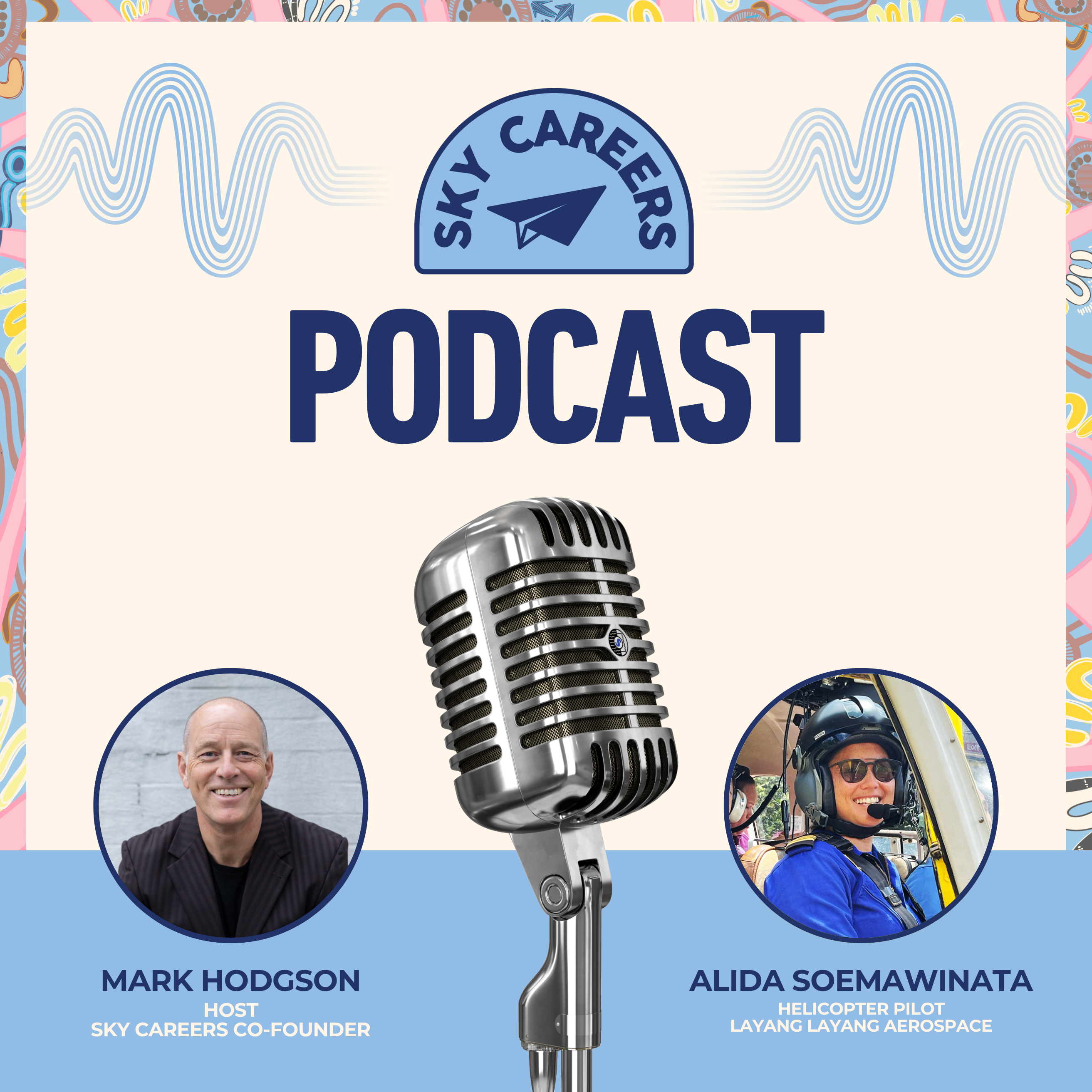
Today it's my pleasure to welcome one of our Sky Careers original ambassadors, Alida Suma Inata.
And Alida is a helicopter pilot. Got some great stories and I'm really looking forward to going into, to a bit more depth with her again. Alida, welcome to the podcast.
[00:00:37] Speaker A: Thanks for having me, Mark. Good to see you.
[00:00:39] Speaker B: Yeah, awesome. Where are you joining us from today, Alida?
[00:00:42] Speaker A: I'm back in Melbourne today actually. Yeah, sunny, rainy, both cold, but sunny.
[00:00:49] Speaker B: At least that sounds very well for those who don't know, if you don't know, Australia, Melbourne is famously erratic in its weather. Four seasons in one day is, is the, is the story. But so a leader, we always love to start in the early days. So tell us a bit about your background, where you went to school, what you studied, those kind of things.
[00:01:13] Speaker A: So I'm one of five kids and we lived, when I was born, we moved to Baldwin. So I went to Baldwin High School and during that time I, I went to Air Force cadets, which is where I solidified my love for aviation and military and all that went with that. And I did that until I was 20 and then I left and I was just working.
I went to uni, did a science degree, biology degree, and then backpacked around Europe for a year and a bit, came back and then committed to flying. Yep.
[00:01:59] Speaker B: Wow. Okay, I'll take you back a little bit. So you, you had the flying bug from an early age but didn't quite find your way into it for a little while by the sounds of it.
[00:02:09] Speaker A: Yeah, yeah. Because through the cadets, I spoke to many members of the defence force. They included camps and, and recruiting days and stuff. And I was also in cadets with others who were particularly keen and all they wanted to do was fly jets. And there was a difference between myself and them and I just thought these are the guys that are gonna really make it. And I'm not actually that keen on the military side. I just want to fly. So I, I realized that after high school that was not going to be my pathway.
[00:02:47] Speaker B: Okay. And when you, when you, when you're at school, what kind of subjects, what were your favorite subjects?
[00:02:54] Speaker A: I really enjoyed practical subjects and I enjoyed subjects that you can bring up in conversation where, you know, you seem like you're the smartest person in the room, but not really. It's just a fact that you've learned along the way. So, so I did chemistry, physics, legal studies, maths, English.
I didn't do Biology in high school, besides your basic science. I didn't do it for vce, but because I wanted to be a pilot, I chose. When I got to uni, I knew that I really wasn't going to use my degree for anything. It was to get a degree, have the lifestyle, go to university, learn some social skills, basic computer laboratory, you know, sort of work, research skills, that sort of thing, rather than here's my degree and I'm going to use it because I really want to be a scientist.
So yeah, when I got to uni, I picked all the subjects that had labs, excursions, you know, hands on things. And so that led me to biology because they went away for the weekend down to the beach and studied, you know, snails and sharks and rays and they.
We went to Malaysia for two weeks to study the tropical terrestrial biology. That was one subject I took. And, you know, so I just had all these really David Attenborough moments of like, oh, you know, which is what I really enjoyed life, you know, and that's why I think I like flight.
[00:04:32] Speaker B: But from the way you said that, it sounds like you, you kind of knew in your heart that aviation was where you wanted to go. Was that, Was that true?
[00:04:40] Speaker A: 100. Yeah, it was just that I needed to find a way to fund it basically and once you commit to it, you're in it. So I needed to enjoy my twenties, my friendships and traveling and university. You go to uni and then you've got a three month holiday essentially over the summer. So, you know, it's work and travel and that sort of thing.
[00:05:02] Speaker B: So how, how, how old are you when you started? So, so you, so you started helicopter training. So get a helicopter license. I think I'm right.
[00:05:15] Speaker A: Yes. Yep. I got my commercial pilot license. I started that training in April 2010.
So when I was 21.
[00:05:26] Speaker B: So 21. So. And so, so there's. And for those who don't know, was I 21?
[00:05:31] Speaker A: Hang on now. I don't even know.
[00:05:32] Speaker B: I don't know. You're you.
[00:05:34] Speaker A: I was, I was 23.
[00:05:38] Speaker B: So 2010.
It's 2010. You're 23.
[00:05:43] Speaker A: Yeah.
[00:05:44] Speaker B: You've decided you're going to embark on becoming a professional helicopter pilot. So you're starting with your CPL and you're scurrying around madly to pay for it. How much is it? How much was a CPL costing back then?
Ish.
[00:05:58] Speaker A: Ish for me because I drew it out over years.
It was about 70 to 80,000.
I do know some people that did it in under a Year full time and it was about 65.
[00:06:13] Speaker B: Yeah, yeah, yeah. And I think, I think I've got 150 or something like that in my head at the moment. Is that roughly hours? No, no, sorry for. I think what they cost a CPL today costs.
[00:06:24] Speaker A: Oh really? Wow.
[00:06:26] Speaker B: Yeah, yeah. I'm not, maybe I'm not. That's adequate. Anyway, the point is they cost plenty. So how did you fund that? Because it's really interesting. I know, I know. We've, we've had several people on the pod who are pilots and some have been fortunate to, you know, have join airlines where it's been, the training has been paid for but that's the exception rather than the rule. I think most people are self funding. So how did you go about doing that?
[00:06:54] Speaker A: I worked in hospitality, so cafe jobs, what do you call it?
Agency work. So like spring racing, carnival marquee work, golf pro, filling in for events at the convention center, Those kind of roles.
[00:07:14] Speaker B: Yeah, well see that's, that's, that's, that's a lot of drinks. Drinks carried and served to pay for that.
[00:07:22] Speaker A: Specifically. Yeah, specifically. So a lot of cups of coffee.
[00:07:25] Speaker B: Yeah, that's a lot of cups of coffee. So how many years did it take you? So you, you said it was part time. How many years before you qualify for the cpa?
[00:07:32] Speaker A: Six. Six years. So I had two years where I didn't fly and I just did my theory. The seven theory subjects.
[00:07:39] Speaker B: Yeah.
[00:07:40] Speaker A: Yep.
[00:07:41] Speaker B: So in was it 2016?
[00:07:45] Speaker A: Yeah, just the end there. So start of 2017 I got my CPL.
[00:07:50] Speaker B: Brilliant. And then what happened? So tell us the story about how you go with a shiny new CPL to actually getting a job. And what was your first job?
[00:07:58] Speaker A: So when. Well it actually started back before I even started my lessons. I just had to research where I wanted to do my flying and that was seeing people who were in the job that I wanted to do and how they got there. And so I chose the school that had a career pathway already.
So when I was studying at the school I was also volunteering for all of the events that they actually operate joy flights at.
So I was volunteer working for them for, for that entire six years as well.
So when, when it came to one of the front office staff actually was going on maternity leave and because I'd already been around the flight school and the office for so many years making a nuisance of myself, they asked if I wanted to work in the front office.
So I started there before I finished my license.
But then I was able to complete My license while I was working for them. And then once I completed my license, I was then moved jobs onto the fuel truck and as a hangar assistant or hangar rat as we call them.
And yeah, so I started driving the fuel trucks for them on the jobs like power line surveying or bushfires or whatever it was, and helping anywhere around the hangar, whether it's cleaning or engineering or this flight school, prepping aircraft, that sort of stuff. Yeah, was how I started. And then their entry level pilot jobs were at Uluru doing scenic tours in Central Australia. So when there was a position open there, after a year, I was moved up there.
[00:09:58] Speaker B: Awesome. That must, that must, that must have been such a, such a, such a, such a great period of excitement for you after all that hard work. Hard work, hard working. You know, as you say, how many tens of thousands of cups of coffee to take training. But also the, I mean, there's a little bit of.
No, there's not a little bit. There's a lot of sort of paying your dues and being very practical and pragmatic about the fact that obviously there's lots. One, it's one thing to get the training. Yeah, nothing to get a job. And I know we've talked, you and I have talked about it and we talked with a lot of other people on the, on the podcast about how. Yeah, the, the challenging bit. Obviously the training's challenging, but the, the, the, in some ways the most challenging bit is to actually get the job. So everything you've talked about that six years of volunteering up, being a team player and doing any job, big, small, menial, whatever, is what ultimately is. You're seen as, you're seen as a team player and the reward comes later on.
[00:11:03] Speaker A: Yeah, so it was a lot of that. And it works from their perspective because they know you, so they've trained you and then they've worked with you or seen how you operate in the team environment, and then they go, okay, yep, they'll do, you know, so they don't need to. So the company I was with actually had quite a reputation for only hiring from within their students.
And so the progression went from Uluru Scenics and then Kings Canyon Scenics, which is part of the NT base, to doing other sort of odd jobs out there like survey work or fires and things and rescues, to then coming back to either Melbourne or the Gold coast, doing your instructor rating, becoming an instructor for a year or two, and then feeding into their, their power line, surveying the contract work of firefighting, power lines, lifting, whatever, other jobs and scenics around Melbourne or Gold Coast.
So that was that sort of. I could see the next few years later, you know. Yeah. And all the people before me who had done exactly the same thing, you know.
[00:12:18] Speaker B: Yeah. So that, that's like, that, that's. That's the career path pathway and just, just take us back. So you, you've talked about flying a ruler for some. Some of those. Some of those. You must have done some amazing flying.
[00:12:31] Speaker A: Yeah, that's definitely one of my favorites. Lots of photos and videos from my.
I actually whipped out the.
The facts the other day at dinner when we were talking about camels. I was like, well, let me hang on, here's my commentary.
[00:12:47] Speaker B: Tell you about camels. I'm half baby and I'm a helicopter. I've seen this stuff for real.
[00:12:52] Speaker A: Yeah. So that was funny. I could just slip on my pilot hat for tours and I give the commentary.
[00:13:02] Speaker B: Oh, that's very cool. And so. So how long were you flying at Uluru? The scenic work?
[00:13:08] Speaker A: Well, by the end of it, about four years, but eight months of it was COVID lockdown where we. It was all shut down. So I flew back to Melbourne, brought one of the helicopters back with me, which was fantastic.
And then, yeah, flying. It took three days from Uluru to Melbourne.
[00:13:30] Speaker B: Wow.
[00:13:31] Speaker A: And then or two and a bit. But I took my time and yeah. And then I was locked down at my sister's place with her and her family, so.
[00:13:43] Speaker B: And I'll also encourage.
We'll post into the pod notes some, some pictures because Alida, you've sent us some amazing pictures from, from various places and just they're fabulous and they capture. I remember, I remember some of the Uluru shots. But you, you also went overseas, did you not?
[00:14:00] Speaker A: I did. So I returned to the rock after Covid. After it opened up again.
Obviously it was quite slow going as people were starting to travel and get money because a lot of people ran out of a lot of their savings over that time. So it took a while for that to build up again. And there was only a couple of us out there that went back because the operation had shrunk.
So I was doing a lot of the senior pilot work, so some photography gigs and some doors off sort of tours and rescues and indigenous land surveying and stuff like that, which was really interesting to me. I was like, oh, I'm not doing the same 15 minute circuit or the, you know. So I was like, oh, this is great. And so when it came to progressing in the company, I just didn't want to go back to A little two seater helicopter and do lessons and do that. It's just not what I wanted. I was excited to be out and about, especially after lockdown. I was like out in the outback doing my own thing. I was like, no, I want this.
So a friend of mine had gotten a job in East Malaysia, in Borneo, flying The Bulko, the BO105 helicopter, twin engine for the flying doctors search service for the government.
So they needed two more pilots. So myself and another colleague of mine, but from the competitor at the Rock, they're two helicopter companies, so he was from the other one.
We both applied and the hiring was based on us getting the aircraft rating before going overseas.
Basically, if you get the rating, come over three months trial and that's it.
[00:16:00] Speaker B: Yeah.
[00:16:01] Speaker A: Okay. So that was my next big commitment.
[00:16:04] Speaker B: So I just, and just, just for, just for those of us who don't know what's the. So you, you had a CPL on a single engine, I assume, and then the rating up to, to a more complex, larger, larger aircraft. Is that a small thing or is that a big thing?
[00:16:20] Speaker A: It's a big thing. So you start in a two seater piston engine. Piston engines run on avgas. It's about 2/3 of the price of jet fuel. Right. So to run those helicopters, it's expensive, but it's manageable, which is why a lot of the Robinson 44s, which are four seater aircraft, are used in private use because they're much more affordable to run.
And then from there.
So I got rated on that as well, because we use those for scenic tours.
And from there you can then get your gas turbine endorsement, your gte so you can fly jet engine, aircraft, turbine engines. So we, we start on the Bell 206, which is a single engine jet Ranger. We use that for tours and all sorts of things. That's like the original workhorse around the outback and in Australia. And then you've got a 206L which is a Long Ranger, which is a six seater helicopter. Well, six passengers plus the pilot. So it's a little bit longer.
[00:17:32] Speaker B: Quite important though here.
[00:17:33] Speaker A: Yeah.
So that's a little bit longer, a little bit more powerful, still a single engine.
And then our next one we did was the AS350 squirrel.
You'll see that that's very common now for doing tours, lifting fires. It's a really versatile machine. And there's lots of different versions of the AS350, lots of different engine upgrades as you, as you go. So but that's the next rating. Then after that they offered me the EC130 or the H130 as it's called now.
And I declined because I really liked flying the squirrel and that was, that was what I wanted the time in because I thought it would help me with my next step, which was I wanted to do fires at the time and get into lifting. So I thought I'd get the squirrel time. They're the machine that they use for these jobs. Yeah, but yeah, so I went through all that. So still on single engines and then when this other job came up, as I said I didn't want to go back to flying piston engines. I wanted to be in the big machines doing my own thing.
So I found a helicopter company that had one of these machines on the east coast and I went over there, did the rating to get my multi engine and then also got the BO105 ready. And then after I got that I waited a couple of months until the paperwork came through and my visa came through and then I left and I went to Malaysia.
[00:19:16] Speaker B: Yeah, but again that's off your own bat. That's you. You had to self fund that.
[00:19:20] Speaker A: So every person has their own journey and their own way of wheeling and dealing and covering expenses.
[00:19:30] Speaker B: Yeah.
[00:19:30] Speaker A: So you'll find some people pay 100% out of pocket, some people get loans, some people borrow from the bank of mum and dad, some people get scholarships.
And now a few years ago they started offering vet fee help, you know, assisted loans for helicopters. It's existed for planes for many years but helicopters have a more recent addition so now you can do it that way. There's a couple of schools.
But yes, for me I was upfront as you go now with the COVID situation.
I was quite poor, having not worked for eight months essentially.
However, they did let you access your super.
[00:20:18] Speaker B: Oh, okay.
[00:20:19] Speaker A: During that time. So I used that. I thought, well this is an investment in myself which will get me the career and the money later on to pay back into my super and retire on. So for me it wasn't just me taking money out and spending it on the pub or whatever. It was actually an investment in myself. So I took out the money from my super to cover the multi engine because then I was guaranteed the job. I earned it back straight away, so fantastic.
[00:20:50] Speaker B: I just, I just sort of make an observation, Alita. You display a lot of tenacity and I love it. I think, I think it's, it's congratulations to you for that. Just that determination and, and pragmatism and ability to wrestle with the challenge and make it make your own luck to an extent. And I know, and again, I know that's from a lot of our conversations. It's such an important part. And I think for advising other people listening this may where they want to come become a helicopter pilot or have another career in aviation is that it's much more than getting the qualifications and bits of paper, isn't it? That's kind of, that's the easy bit.
[00:21:31] Speaker A: So with, with the single engine things that all came off from my company paying for it. So once I was in the job, if they wanted me to complete a new role, well, they would have to train me on that helicopter if they wanted me to. If not, I'm then still stuck on the smaller helicopters, you know.
However, some people who could afford it, who maybe didn't have the job yet but had finished their license or just had their private hiring building hours trying to get that commercial job.
Some people did pay for the GTE and five hours in a Jet Ranger so they'd be more hireable, you know, building those qualifications and tick some more boxes. Yeah, because when you go out into the world, the more tickets you have, the more attractive you are because the company doesn't have to spend money on you training. Right. You've spent it already. So you got to be, you got to be careful as well because.
[00:22:28] Speaker B: Yeah, yeah.
[00:22:28] Speaker A: You don't want all the companies suddenly seeing they can get away with not paying for training because lots of, you know, people start paying. So it's a.
[00:22:38] Speaker B: Tell us, tell us. So after all that tenacity, you got your twin engine rating and you went out to the job in Borneo. Tell us something about that.
[00:22:48] Speaker A: Yeah, so I went to Malaysia.
I was quarantined there for a couple of weeks in kl, the capital. And I had to go. The morning I got released, my 14th day or my 15th morning, I had to catch a taxi to the exam center and write the exams for the local air law and operations exams. So I had two weeks of studying.
[00:23:16] Speaker B: Full time, which wasn't you. Yeah.
[00:23:22] Speaker A: And so, yeah, did those exams and then went back to the airport and went over to East Malaysia over in Borneo. And yeah, just waited for the results and that was all good.
Did some training there with the chief pilot because the environment is a lot different there because you're also flying with government agency doctors, nurses, the health service.
Their standard operating procedures were quite, you know, strict and, and you have to make sure, you know, image and, and care and insurance and all that sort of stuff is quite Rigid. So just learning all of that.
And the biggest thing was learning.
Yeah, learning where everything was. Like, we have GPS and we used OZ runways over there, which was amazing.
But getting all the valleys look the same. Your first few months out there and you're looking for a needle in a haystack in the jungle.
So even with gps, you're sort of flying around the jungle looking for that hole where you go and put your helicopter in to get to the village. So that was really interesting.
[00:24:37] Speaker B: And. Sorry. So, Lita, this is. So this is. This is providing both routine and emergency medical.
[00:24:44] Speaker A: Yeah, that's right, yep.
[00:24:45] Speaker B: So.
And also emergency work.
[00:24:48] Speaker A: Yeah, so we do ems emergency medical service and we did the flying doctor service fds. So we'd have.
We had two bases from my company and another, our parent company had one helicopter far down south at the Capitol doing the same thing.
So on each of our bases we had one seven days a week on standby for ems. And then five days a week would be the FDS where we took a doctor, two maternal health nurses, and a medical assistant with all the equipment and medications out to the villagers for clinic.
[00:25:20] Speaker B: Yeah, sounds like there was a lot of flying.
[00:25:23] Speaker A: There was actually. Yeah, I did about, I don't know, about a thousand hours out there. Yeah.
[00:25:32] Speaker B: What was your best.
I know there'll be lots. What was.
Paint a picture of your. Of your sort of most memorable or favorite or most dramatic sort of flight or so.
[00:25:48] Speaker A: So the thing I love is helicopters are very fast, so you can go A to B or you can go A via BCD to get to E.
So. And it maybe only takes two minutes or three minutes.
So the detours that we would take to go via the waterfall or the rock formation or the cave or the, you know, seeing these things and, and speaking to the locals, it's. I mean, just the sheer cost of it is. Is a lot, but the remoteness is huge. So I went to so many places that people would never go to in their entire lifetime and it was great showing the friends that I made in the locals, showing them photos and videos of places that I went to that they've heard stories about kind of thing. And it was really just.
It was incredible, the scenery out there. So, yeah, just seeing the waterfalls and stuff, those were some of my favorite flights. And my staff, their. Their favorites as well because they go on rotation sometimes, so you wouldn't always have the same staff. And so we'd meet someone, you go out and say, oh, we're just. There's a bit of cloud over There, we're just going to go this way, take them past this massive waterfall and it's just, you know, trip of a lifetime for them, you know.
[00:27:17] Speaker B: So that sounds magnificent. And again, I know you've sent us some, some, some fantastic pictures and I know there's some lovely pictures I think of. We have used doing some, some recovery work with very, very grateful recipients of medical treatment.
[00:27:36] Speaker A: That's probably. That was a big thing too, is once you land at the helicopter, they set up the clinic, there's hours of waiting around. Sometimes it would be four or five hours at one village. And so there were some villages where I'd land and the kids would come out.
Can't speak the language at all because there's 23 languages, I think, in East Malaysia. So English and Bahasa Malayu are the national languages, but only in the cities really.
So, yeah, couldn't speak anything. But the kids would come and get me and we'd go walking off into the jungle somewhere and they'd take me to their little creek, waterfall, whatever. I'd roll up my pants, take my boots off and go walking. And then we'd be picking fruit, you know, rambutan, straight out of the jungle or whatever it may be. They were pretty fun. And then they go, oh, they'd get a call or like a signal or something that we could go back because they were finished. And then we'd be sitting on the floor eating lunch, you know, that they'd prepared and just. Yeah, so living like a local was really, really cool as well.
[00:28:43] Speaker B: That's that, that's. That sounds very special. And so you did that for, I think you said for a couple of years.
[00:28:49] Speaker A: Nearly three.
[00:28:50] Speaker B: Yeah, nearly three years. And what made you leave that? What was the next opportunity?
[00:28:56] Speaker A: I could have quite happily stayed there for a decade.
The money was good, the lifestyle was good, I love the heat, the people were amazing.
The job was really rewarding.
But that was only my second job.
There was so much more to learn.
So I had always wanted to get into firefighting and sling loading and aerial crane work and that sort of stuff. So I really needed to start building that experience and trying to get, um.
[00:29:30] Speaker B: So you reluctantly, you ripped yourself away going, oh, I love this, but I know I gotta leave kind of thing.
[00:29:36] Speaker A: Yeah. Um, at the time as well, my parents weren't well, they're having some health issues. So another thing was that I wanted to get back to Australia, so I was within distance, a little bit more reasonable, um, to be able to get home if I needed to as well.
[00:29:54] Speaker B: Um, cool.
[00:29:55] Speaker A: Yeah. So living in the desert for so long and then living in Malaysia and then you know, I was essentially away for eight years, so.
[00:30:03] Speaker B: And it must have been quite weird going back into a big city like Melbourne or something after all that. The concrete towers, not many waterfalls, no kind of dodgy river called the Yarra. But bring us up to, bring us up to speed with your. And where your current and your current role because I know you kind of, you've fulfilled your ambition to an extent.
[00:30:23] Speaker A: Yeah, yeah. So I got a job interview, went to the company headquarters.
I had the minimum hour requirements to go on fires with my multi engine hours. That's what they wanted. They needed at least 500, so I had that which was good. And then I also had total time of 2000 hours which they wanted as well. And now I was missing a couple of things like the fire rating I didn't have, which is a type of flying with the bucket and everything. So I didn't have that which wasn't required for my role. But in general it's required. So that was okay. They said no, that's all right for you not to have that. And then the 50 hours of on fire experience which is required by the government to go and fight fires.
So I didn't have that. But they said look, we've got fires burning already.
We'll just put you in the, in the co pilot seat, whatever. When the fire is burning we'll send you out there and you can sit there and have a go and fly around and just back seat as well. Sometimes I was just in the back seat watching, getting that experience on firefighting so that the company helped me build that 50 hours and then, then I could work for them as a, as a bushfire response pilot. Yeah. So I did my first season last season over in Perth and I'm back there again for this fire season. Yeah.
[00:32:00] Speaker B: So take us through what's. Take us through a typical day of a bushfire response pilot.
[00:32:07] Speaker A: So there's a couple of different roles when it comes to firefighting in Australia.
We have air attack supervisors which will have the pilot and then they'll have a member of the firefighting services or parks who will sit there with you. And your job as an air attack pilot is to go out to the fire and sort of be like air traffic control. So you're listening and talking to the overarching radio. Maybe it's Perth center or Melbourne center or.
And you're listening for traffic around and you're also listening for the bombers that are coming in and the heli tax that are coming in to drop water on the fire. And so as the pilot, you're listening for who's going for fuel, who's picked up water, who's coming in and organizing what height they're coming in at, because there's all different sized aircraft, so it's a safety thing. And then their supervisor, once they've arrived on site, the supervisor is in coordination with the ground control, and they tell them where to put the water.
So I don't do any of that. I just tell them who's here, what they've got, and then the supervisor will talk to them from there and say where they need to go. Okay, so that's one role. So that's what I've done.
Yeah, So I just do circles around the fire for the. For the whole time.
[00:33:32] Speaker B: So you're effectively a coordination platform and you can see stuff and. Yeah, you know what? Yeah, okay.
[00:33:38] Speaker A: Yeah, yeah. So then another role you can do is air intel, which sometimes an air attack will do it.
If there's no specific intelligence machine in the area you're in, that air attack supervisor will do the mapping.
Um, so we also. We have a dedicated machine in Perth for that. So I'm flying air intelligence as well, which has a big camera on the front that can help identify hotspots. So maybe they've put out the fire, but you go back the next day and to stop it reigniting, you know, you might map some hotspots and say, oh, yeah, that's where you need to get back in there.
[00:34:22] Speaker B: Or.
[00:34:23] Speaker A: Yeah, and you're feeding it back to the ground control as well on live fires. And so they can see where to best put the water and foam and how to develop a strategy. Yeah.
[00:34:35] Speaker B: Wow. And how does it work in terms of are you out there permanently or out there for a couple of weeks at a time, or how does it work?
[00:34:42] Speaker A: Everybody's on different rosters, so flight and duties is a big thing.
With aviation, just like truck driving and stuff, you don't want to be too fatigued.
So some people are offered, you know, four weeks on, two weeks off, or three weeks on, three weeks off. It's all mixed. It depends because, you know, some people have families and other commitments that they're doing.
For myself, I do 18 days straight work and then I have nine days off.
So that's why I'm back in Melbourne for the week.
[00:35:14] Speaker B: Oh, and. And when you're on, are you flying every day or how does that work?
[00:35:18] Speaker A: Standby work.
So we sit at the base and we wait until they call us and then from when they call us, it's 15 minutes to airborne, so we've got to be ready to go.
[00:35:30] Speaker B: Yep, fantastic.
[00:35:32] Speaker A: And so, yeah, it's. Yeah, it's been really interesting and learning a lot.
[00:35:37] Speaker B: It sounds like you're enjoying it.
[00:35:39] Speaker A: Yeah, yeah, no, definitely.
[00:35:41] Speaker B: That's very cool. Now, I don't think we've got any pictures of that, so we'd love you to send us some pictures of your latest adventures.
And, Alida, listen, we've got. We've gone long and I've done this deliberately because you've got such a. You got a lovely sort of set of experiences that tell their own picture. And both in terms of the various pieces of flying you've done and how your career has evolved, but also especially about how you've kind of forged your career, which is which. And they're obviously, they're very. They're parallel things, but they're all so separate.
And I think, you know, as we've said, you're sort of commitment and you're picking your way through has been a really important part and I think very useful to other people who maybe have a certain view of how you do these things. And it's a bit idealistic because. I know, and one of the big things, big reasons we started Sky Careers and we spent a lot of time trying to develop resources to help people actually map a real world pathway and understand all the bits around that in terms of developing their network and developing their interview skills and being useful and being a good team player and all those things, not just getting the qualifications which are necessary but not sufficient?
So I will close with the question I often ask, which is, what advice would you give to other young women and men who are interested in pursuing a career in aviation and not just as a pilot, but also in the broader aviation world?
[00:37:13] Speaker A: Go and see and experience what it is you want to do.
If you love aviation and you're not sure how to get in, go and experience it. So you might call up your local air traffic control tower and see if they do visits. Sometimes they'll say, oh, we've got 15 minutes in the morning if you want to come up and have a look. Or they'll have an information setting, you know, where they'll be able to say, oh, actually, we've got an information session on this date. And then, you know, that's how you find out. So same with pilots. Pilots go to a flight school, go to a firefighting company, go and talk just talk. Most people are happy to give you 10 minutes, 15 minutes of their time and, and, and talk to you. And, and maybe with flying in particular, they do trial introductory flights. So it's, you know, it is expensive to get in and to do and commit to, but that's a cheaper way to just get in, have a 30 minute go, see if you like it, see if it is something that, you know, you're really passionate about and you want to start and then there's a bunch of ways to get there. But go and figure it out first and try things and talk to people. Yeah.
[00:38:27] Speaker B: Love it. Hey Alita, we could talk for hours. We've already talked 35 minutes, which is, which is I've enjoyed every minute and I'm sure I'll listen.
Thank you so much. We can't. And we'll thank you for your time today. I'm sure we'll have you back to learn about your next adventures.
And thanks so much for sharing your story on the sky.
[00:38:45] Speaker A: Pleasure. Yeah, nice to see you.
[00:38:47] Speaker B: See you next time.
Thanks for listening to the Sky Careers podcast.
If today's conversation has sparked your interest in aviation, then head over to our
[email protected] whether you dream of flying aircraft or you're curious about the hundreds of other exciting roles that keep the aviation industry moving, Sky Careers is your gateway to discovering these opportunities.
And if you are already in the industry, check out Sky Careers Connect and Sky Careers Leadership and consider joining our online learning community.
Until next time, keep reaching for the skies.