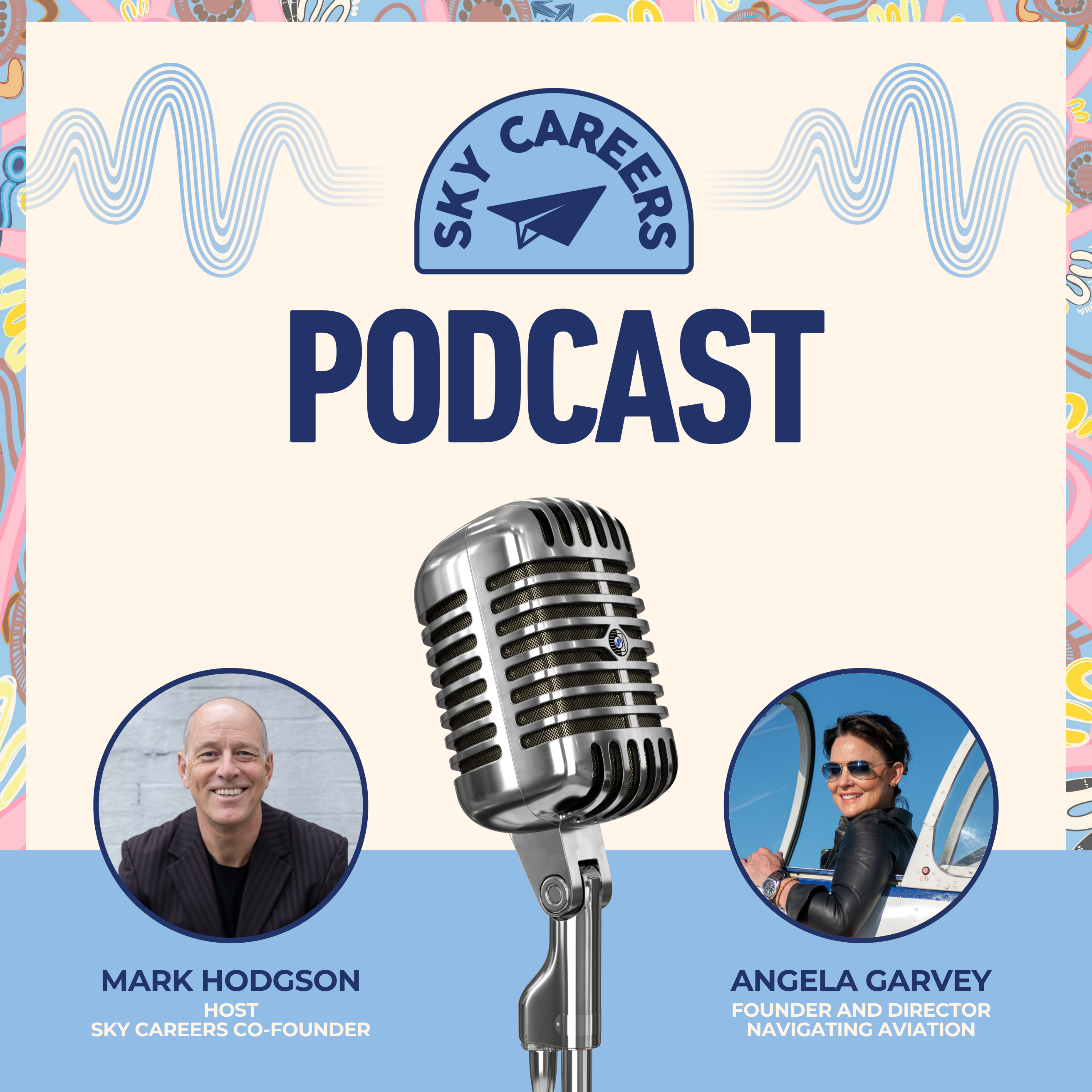
[00:00:07] Speaker A: Hi and welcome to this edition of the Sky Careers Podcast. This week we have very special guest. Her name is Angela Garvey. She has led a very interesting and varied aviation career. Angela is the founder of. Of Navigating Aviation, which is a counseling and wellbeing support service specifically for aviation.
She's also a pilot, and not only a pilot, she's an air show display pilot. So I think we're gonna have a little bit to talk about. Angela, welcome to the podcast.
[00:00:43] Speaker B: Thank you. Thank you for having me.
[00:00:47] Speaker A: You're super welcome. And thanks for persevering with that little techy stuff that we've been doing before we've gone live. So I always start with the same question. Tell us about your. Your early years. So cast your mind back to a younger Angela Garvey. Where did you go to school and what were your favorite subjects?
[00:01:03] Speaker B: Well, I went to a state high school.
It was called Oxley State High School in Brisbane, which is not far from Archerfield Airport, in fact.
And I was actually not great at school. I was very good at sport, but not overly great at school. I was a little bit preoccupied looking out the window, looking at the aircraft flying past from Archerfield and not paying too much attention, which I don't encourage people to do or students to do. But I just want to demonstrate that if you have a desire and an ambition, you can focus that to what you actually want to do.
[00:01:44] Speaker A: So and even if, even if it's after school, even if you weren't a straight A student, even if you're not.
[00:01:49] Speaker B: A straight A student, as long as you have passion and discipline and focus.
[00:01:55] Speaker B: You can achieve whatever you want to achieve and find the right people to surround yourself with.
So I went to school. I think I finished year 10, didn't finish year 12, but I did have to go back and finish year 12 as an adult. So I'll talk a little bit about that later.
So whatever path you take, you can, you can pick up those skills later on. So it's no problem at all.
[00:02:24] Speaker A: Awesome. So what was the connection from a distracted Angela Garvey looking out the window to, I guess, your pathway into aviation?
[00:02:33] Speaker B: I guess it was sports. So I was very good at competition, barefoot water skiing. And it was actually my coach who had spent time in the army doing parachute jumps in the army, and he always sort of talked about parachuting.
So when I.
[00:02:52] Speaker B: Finished doing competition water skiing, I actually took up skydiving. So that was my entry into aviation. So what I discovered with skydiving is that it was a Very inclusive activity. There were almost equal numbers of men and women even 30 years ago in skydiving, but also equally, there were a number of female pilots.
[00:03:14] Speaker A: So.
[00:03:15] Speaker B: So skydiving was quite progressive and more progressive than aviation as it is today. They were very encouraging of women and I never experienced any kind of difference. It was very inclusive.
So from there I ended up in a relationship with someone who had already owned and operated a skydiving business.
So then we got together and for the next 17 years we owned and operated a skydiving business, a very large business.
And then I went on to flying my private pilot's license, my commercial pilot's license. So that's where my aviation and flying career started.
And I discovered that I actually enjoyed flying and I was quite good at it, more so than the skydiving. So my focus shifted from skydiving to actual aviation.
[00:04:12] Speaker A: That's amazing. And how long in that sort of 17 years at the skydiving business, when did you sort of start to do the flying piece? And do you have qualifications?
[00:04:24] Speaker B: I actually didn't learn to fly until I was in my early 30s, so I wasn't actually an early starter. I also had two children at the time, so I was just waiting for them to sort of start school and so I could focus 100% on the flying, which is really important.
And then I went on to get a commercial pilot's license because I actually wanted a career in flying.
And with that you needed a commercial pilot's license?
[00:04:53] Speaker B: Yeah. So that's where it all started.
[00:04:56] Speaker A: And was it hard?
Did you find the flying training difficult?
[00:05:00] Speaker B: No, because, you know, even as I said at the beginning, I was never overly academic at school, but it was just I'd never found my passion. So the minute you put a.
[00:05:11] Speaker B: You know, an aerodynamic book under my nose, or anything to do with meteorology or anything to do with engines, I was completely absorbed and I sort of came, came alive and thought, wow, you know, this is fantastic.
So I had was focused on an airline career or at least a finish my airport transport pilot's license, my atpls.
But I knew that if I wanted to pursue a career in actual flying or a career flying jets, I needed to have both maths and physics.
So I actually went back to night school at QUT Queensland University of Technology.
And so, whilst raising two children, running a business, finishing off my commercial flying, I was also studying maths and physics.
And to my surprise, as an adult, I was really good at maths and physics, but yet I was not interested at school. So I Guess what? I just want to say to the young people out there that you are smart. We are smart. It's just that we have to focus our attention on what we're really passionate about. And you can absolutely do it. I was hideous at maths.
You wouldn't even been able to, I mean I was able to do quadratic equations, which I would never have thought in my wildest dreams.
And even physics, working out the formula of time and distance to the moon and back.
Never in my wildest dreams as a year 10, Angela, would I ever thought that I would be able to do that. Yet with no academic background or no real, no great schooling, I was able to do that.
[00:06:57] Speaker A: I think that's such a fabulous message, Angela. I think especially for those people listening who maybe haven't sort of smashed it at school or felt like they've been particularly successful in their traditional school career.
When you're telling a great story. And.
[00:07:15] Speaker C: One of my colleagues and friends.
[00:07:17] Speaker A: He has a very similar story. Not in aviation, different field, wrong side of the tracks. Left school at 16, was all over the place, you know, always tells me the story. He was either going to end up in, in prison or dead or something. And, and he ended up very late.
[00:07:31] Speaker C: But 23, 24, coming across an inspiring teacher along the Southern simulator, what you're talking about, and ended up being not only a professor of neuroscience, but an.
[00:07:41] Speaker A: Award winning professor of neuroscience.
[00:07:43] Speaker C: So I think the message, especially for those who may be listening here, maybe 15, 16, 17, 18, 19, 20, or that in some way you've labeled, either been labeled or, or you've self labeled yourself as I'm not academic or I'm not this or I'm not that, I'm not the other thing. I mean, what Angela's telling you is it's never too late. And I think if you, and we hear this again and again with the Sky Careers and the Sky Careers podcast and the aviation conversations, there are so many different pathways into aviation and where you go and where you start doesn't necessarily.
[00:08:18] Speaker A: Dictate where you end up. And I know we're going to talk more about your, your journey, but that's, that's such an inspiring and inspiring message, I think, Angela.
[00:08:24] Speaker B: Yeah, yeah, exactly.
[00:08:27] Speaker A: So you went, you, you did your atpl.
What happened then? Did you, did you, did you, did you end up flying commercially with passengers or what was that, what was the next phase? I know, I know you bring it, you bring us forward. You're now, you founded your own business. So without going into massive detail, because I know we could speak for hours. What, what was the sort of the pathway?
[00:08:49] Speaker B: Well, I had two kids and was in a business partnership that was, that was good for a while. But with business partnerships, especially if you're in a relationship with your business partner, things can break down. So unfortunately our relationship. Break down, broke down. So with that, obviously that was a business partnership that dissolved. So I, I had to now as a single mom, had to reinvent myself and work out, well, what is it that I can do? You know, I hadn't finished my ATPLs at that stage and I did my instrument rating exam, but hadn't finished my multi engine instrument rating. And then all of a sudden I'm on a very minimum income raising two kids. So for about 10 years my aviation career was actually quite.
[00:09:38] Speaker B: So I did have to put that on hold, obviously with the responsibilities of being a single mom and all the rest of it. So I did have to put my career on hold, which is just something that I had to accept and it was very hard to accept, but I did so during that time I did safety management roles, I worked in the regulatory space in aviation. So I still kept my hand in aviation, just not flying. And I did step back into flying whenever I could, but I found it really difficult to keep that going consistently just through the distractions of life and responsibilities.
So once my kids were old enough.
[00:10:23] Speaker B: There was a period of my life where I actually just went and wanted to have a bit of a break. So I knocked on the door at Ballina Byron Bay Airport and asked if there were any jobs.
And they said, yeah, what do you like at being an aerodrome reporting officer? And I thought, you know what, I'm going to give it a go. I just, you know, I want to step away from the corporate aviation sort of side of things and I want to have a bit of a break.
So I became an aro, which was fantastic because it was in, you know, there was elements of aviation safety. I was working around aeroplanes, but I was also driving tractors and mowing grass and having a great old time.
But you wouldn't believe it by just doing that job as an ARO where all I needed to do was a two week Aerodrome Reporting Officer course and then I was a qualified aerodrome Reporting officer.
From that job I actually went on to managing an airport. So I was managing Armidale Airport and I did that for, for just over two and a half years, which was a wonderful job. So I've had a varied career.
[00:11:35] Speaker C: But what did that involve? Angela, what does managing an air for those of us who don't know what does managing a regional airport, what does that involve?
[00:11:44] Speaker B: Managing a regional airport involves having a really good understanding of the CASA regulations when it comes to aerodromes, which is part 139.
And having said that, I didn't have a really great huge understanding of it, but I knew where to find the information.
I knew the right people to call.
[00:12:09] Speaker B: The airport industry is a very supportive industry. So you could literally phone any airport manager in Australia and they would certainly give you a hand. And it was very inclusive. The airport industry is very, very inclusive of women and there are a lot of women that do manage airports.
So I'm a little bit sad that I didn't continue managing airports because I really did love that. It was really great fun. But I thought, you know what, there's a real need in aviation to support people with their mental health and well being. There's a real need to support people who are struggling in their jobs.
[00:12:49] Speaker B: And so I went, I decided that I would start a business and it just the name Navigating Aviation just dropped in because it means.
[00:13:00] Speaker B: I'm supporting people to navigate the aviation industry.
[00:13:05] Speaker B: And so Navigating Aviation name dropped in and I went and did some counseling qualifications.
I registered the business.
[00:13:18] Speaker B: With some support with a website designer, built the website.
[00:13:25] Speaker A: When was this? Angela, Give us a time.
[00:13:27] Speaker B: Lani, this was, oh gosh, early January 2023, the business was launched.
[00:13:35] Speaker A: So very new, very new. So you're coming up to your two year birthday.
[00:13:39] Speaker B: Yeah, exactly, yeah.
But I had been working on it previous to that for about a year and a half. So it took me about a year to sort of get my counseling qualifications. Mind you, I was still working full time.
So the other thing I want to say out there to young people, that it is very good to work hard so you can have a full time job, you can study once you put your mind to it.
[00:14:09] Speaker A: So I think that's. Sorry, sorry to. That's such an important piece I've actually got written on my desk here.
There's a quote from one of my favorite podcasts is by a guy named Mike Rowe, you might know him, used to be in Dirty Jobs. And he narrates, he's an American guy but he narrates a whole lot of things. And he runs, he runs a podcast in the UK and really, really encouraging especially blue collar people to work in blue collar physical the trades effectively.
And as he said, work is not the enemy. It's great to work hard and so much good stuff falls out of that. And I think sometimes there's a bit of a confused message around that in the current sort of zeitgeist around it's all online social media and it's cool to do not too much and to be on holidays all the time. And those things aren't all bad, they're not all good either. And I love that it's good to work hard in your life. I think that's really important.
[00:15:15] Speaker B: One message I really want to get out there is that it's you have to have purpose in life and your purpose is to.
[00:15:23] Speaker B: Has to be beneficial to everyone in humanity. So it can't be all about you. It's going to got to be about serving humanity and making this place a better place for everyone else and yourself.
And I've always worked hard, I've always.
Looks can be deceiving, but I've just about always had two jobs and nobody's paid to put food on my table.
I've done it all myself.
[00:15:53] Speaker A: Well, three jobs as a single mom as well, right?
[00:15:56] Speaker B: Yeah, exactly. And you know, absolutely it's important to receive support from people and have supportive people around you. But at the end of the day, you're the one that is going to be driving the direction in your life. Specifically for women and young girls. It's so important to have a career, have a job, to work hard and to continue working hard, you need to build up your superannuation and keep that money coming in and don't rely on anyone else to be able to support you or provide for you. Because one day you might be out on your own with two kids wondering what am I going to do now? And all of a sudden you don't have qualifications or anything to be able to provide for you and your kids. So very, very important to work hard, to have purpose, have two or three jobs.
[00:16:58] Speaker B: The reason why get stuck in, right? Get stuck in. And don't complain about being fatigued. The only reason that you'll be fatigued is because you haven't.
[00:17:09] Speaker B: Addressed your lifestyle and going to bed early and eating well and sleeping well and exercising. And the only person that governs that is yourself.
[00:17:18] Speaker A: We're in violent agreement and again, we could talk for ages in this.
[00:17:22] Speaker C: But just so.
[00:17:26] Speaker C: You'Re new and congratulations on starting your own business. I've started a few and it's not easy, but it's incredibly rewarding. So tell us, what does navigating aviation, what's a typical day in your life at the moment? What do you do?
[00:17:42] Speaker B: So primarily I love supporting Businesses. So I do an aviation specific employee and student assistance program. But really it's designed to also support businesses, business managers and business owners with employees and students.
So that can be some consultancy helping them with.
[00:18:10] Speaker B: What'S called, there's a new term at the moment called managing psychosocial hazards in the workplace. And that's really just about supporting their staff and their people and also their leadership teams and their management. So it's really risk mitigating and managing that into their already existing safety management systems.
And counseling also. I do a lot of counseling with, with a lot of people in the aviation industry.
It doesn't have to be aviation specific. It can be things going on in their family or in their relationships, but it generally ties into something to do with work or relocating or something like that.
The first thing I do when I wake up in the morning is I exercise. So I walk to the gym, go to the gym.
[00:19:03] Speaker B: And my day starts at 4 o' clock in the morning. I'm up early and I go to bed early. So if you want to be successful in life and.
[00:19:15] Speaker B: Cram as much as you can into this life and into the day, you have to be up early and up and at em, up.
[00:19:22] Speaker A: And atom and make your bed.
[00:19:25] Speaker B: Always make your bed.
[00:19:26] Speaker A: You want to change the world? Start by making your bed. Hey, what part of your job do you enjoy the most, Angela?
[00:19:33] Speaker B: I really love supporting people and seeing results.
You know, when they give me messages that they're back flying or they've got a new job or they're doing well, it's just so, it's so unbelievably rewarding. It just brings me so much joy. But also the business owners really appreciate what we do too because we're able to work with the person and get them back at work, you know, within weeks. And they could end up being work cover claims or insurance claims or, you know, having to go to, you know, some kind of tribunal or whatever. So it just takes the risk out of business owners as well and in the industry. So it's, it's, it's lovely to be able to see that what I do and what we do supports businesses as well.
[00:20:22] Speaker A: It's lovely because I mean, life's tough generally, isn't it? I think, especially at the moment. And aviation within that aviation, as you say, there's a lot of travel and people living remotely or in two weeks away from home or fly in, fly out. There's a whole lot of variations around aviation. So it's probably less of a nine to five traditional employment role than many or most. And there's plenty of challenges even in, if you like, a conventional 9 to 5 role. So when you add in some of the extra complexities of aviation, I can see that there'll be a lot of.
Not a need for those kind of increased support.
Increased areas of support around mental health and wellbeing and counseling. So it sounds like a fabulous service.
[00:21:10] Speaker B: It is, yes.
[00:21:13] Speaker A: What's the least favorite part of your job?
[00:21:15] Speaker B: Oh, gosh, I was trying to. Yeah, it's hard to actually say that at the moment. I'm adjusting to the amount of travel that I'm doing.
[00:21:25] Speaker B: And it's taking me a while. I've normally had jobs where I kind of stay put and don't do that much traveling at all. So.
[00:21:35] Speaker B: The least favorite part is.
[00:21:38] Speaker B: Just trying to do, not trying to do too. I want to support so many people, and I guess it's hard to kind of stretch myself.
I'm very busy.
I feel like I need. There needs to be more of me and what I do, but I just have to keep it really simple and support the people that I can and just be kind of happy with that.
[00:21:59] Speaker A: Yeah, I mean, I've done a bit of flying race. It's exhausting domestic flying in Australia.
It's certainly not glamorous anymore. And it could be quite tiring. And with delays and just the whole into and out of airports and, you know, big ones, small ones, medium ones, it's, it's, it's, it's quite fatigue. And that's just to get your bum to somewhere when you actually do the doing. Right.
[00:22:25] Speaker B: But I, look, I really appreciate it and I'm just really lapping up everything that I'm doing. I, you know, I still find a lot of joy, you know, when the, When I see the pilots and they, they come to the door, I always say hello.
I love seeing female pilots. And I always, you know, I always say something to, to them or, you know, thank you for flying and just so glad that they come out and say hi, because quite often as pilots, they just sit there and keep the door closed. Obviously, they've got things to do, but I think it's really important to stand at the door and connect with the people, the passengers, because at the end of the day, without passengers, they wouldn't have a job.
[00:23:03] Speaker A: Sure. And we, and we. I mean, I've interviewed, I've. I've interjected lost count. I've interviewed lots of female pilots on the Sky Careers podcast and some of our Sky Careers ambassadors and yeah, they're a great bunch. And luckily it is. Whilst it's still a relatively small. I think it's about 5, 6%, depends on the specialization. It is increasing. And I think there's a.
From what we're told.
[00:23:30] Speaker A: There'S an increasing percentage of female pilots and other specializations as well, which is encouraging. Yeah.
[00:23:37] Speaker B: And I think if I. If I weren't doing this, you know what else I would really love to be and what I've always wanted to do, because even as a kid, I was quite interested in anything mechanical. I used to have a motorbike. I was quite a tomboy. Not that you have to be a tomboy to be mechanical, but if someone had walked into my classroom in year 10, when I was that person who was constantly looking outside the window and said, who wants to be an aircraft mechanic?
I would have absolutely done that and done an apprenticeship. And still at my age, I walk into an aircraft hangar with the aircraft engineers or the aircraft mechanics and I just can just be there all day. I just absolutely love it. And I think that's such a wonderful career for women. Because if there are young men and women out there listening, if you just Google World War II and the women who maintained and put together and manufactured aircraft and also ferried aircraft In World War II, you know, they will realize that this is. We've been doing this for a long time. It just hasn't been recognized. So when the war finished and all the men came back, it was all kind of brushed under the carpet and the women went back home to being housewives and all the rest of it. And a lot of them really struggled with that because they had purpose, they had a job, they had relationships, you know, friendships with each other. And all of a sudden, when the war was over, they had nothing then and they couldn't continue those jobs. So we've been fixing aircraft and maintaining aircraft for a very long time. And I would love to see one day, 50, 50% women in aircraft engineering, because it's such a great job and there's such a demand for it.
[00:25:31] Speaker A: And you hear that all the time.
[00:25:34] Speaker B: The numbers.
Yeah, the numbers in Australia for aircraft engineering.
[00:25:40] Speaker B: Honestly, if you want a great job.
[00:25:44] Speaker B: Honestly, I could do that tomorrow. I wish that I could.
[00:25:48] Speaker C: Maybe you can.
[00:25:48] Speaker A: Maybe that's. Maybe that's.
[00:25:49] Speaker C: Maybe that's. Maybe that's your next chapter.
Right. Couple of final questions.
[00:25:55] Speaker A: And this.
[00:25:55] Speaker C: Yeah, we're going to have you back.
[00:25:58] Speaker A: Because there's other things I want to.
[00:25:59] Speaker C: Talk to you about, but not today. What do you do when you're not at work, Angela?
[00:26:03] Speaker B: Well, I fly an aircraft that looks like this. I'll just get it for you.
[00:26:09] Speaker C: Lovely. Okay, well, we'll get some pictures of you and we'll put them in the show notes so people who aren't watching us live can actually see. Okay, that's cool.
[00:26:17] Speaker B: So I fly in an air show display team called the Freedom Formation Air Show Display Team, and we go to air shows.
[00:26:28] Speaker B: Particularly the Pacific Air show last year, and next year we'll be at the Pacific Air show, and it's a formation team, so we fly very closely together. We have to go to training camps.
So I fly when I'm working, and I find it quite cathartic and relaxing, um, but also learning all the time and. And quite disciplined.
[00:26:54] Speaker C: Fantastic. And last question, Angela, what advice would you give to other young women and men looking for a career in aviation?
[00:27:03] Speaker B: You have to be hardworking and you have to also be humble, because aviation, even if you become a pilot and there's a lot of ego attached sometimes with being a pilot, but the ego only drops in if that's what you attach to.
But you have to be very humble because it has a way of sorting you out if you're not humble and very hardworking. So.
[00:27:30] Speaker B: Turn up on time, be prepared. Be prepared the night before. Be disciplined, be focused. And if you're going to go into aviation.
[00:27:41] Speaker B: You have to. It's something that you're forever learning and forever growing and forever upskilling. It's not something you learn and then you just park it. You are forever being tested. You are forever being challenged. And so you have to be able to adapt to change.
You have to be able to accept constructive criticism, and you have to be able to dust yourself off and stand up and move forward and be better.
[00:28:11] Speaker A: Fantastic. Good advice. Good advice for young aviation professionals. Good advice for everyone. Good advice for life.
[00:28:18] Speaker B: Absolutely.
[00:28:19] Speaker A: And very much. I say amen to that. Angela Garvey, it's been amazing to have you on the podcast. Thank you so much for your time. We'll have you back because I know you've done so many things and so much experience, and I think it's really interesting to also explore the mental health and wellness aspect, which is increasingly important. So thanks so much for your time.
[00:28:40] Speaker B: No problem. Thanks for having me.
[00:28:50] Speaker D: Thanks for listening to the Sky Careers podcast.
If today's conversation has sparked your interest in aviation, then head over to our
[email protected] au whether you dream of flying aircraft or you're curious about the hundreds of other exciting roles that keep the aviation industry moving. Sky Careers is your gateway to discovering these opportunities.
And if you are already in the industry, check out Sky Careers Connect and Sky Careers Leadership and consider joining our online learning community.
Until next time, keep reaching for the skies.