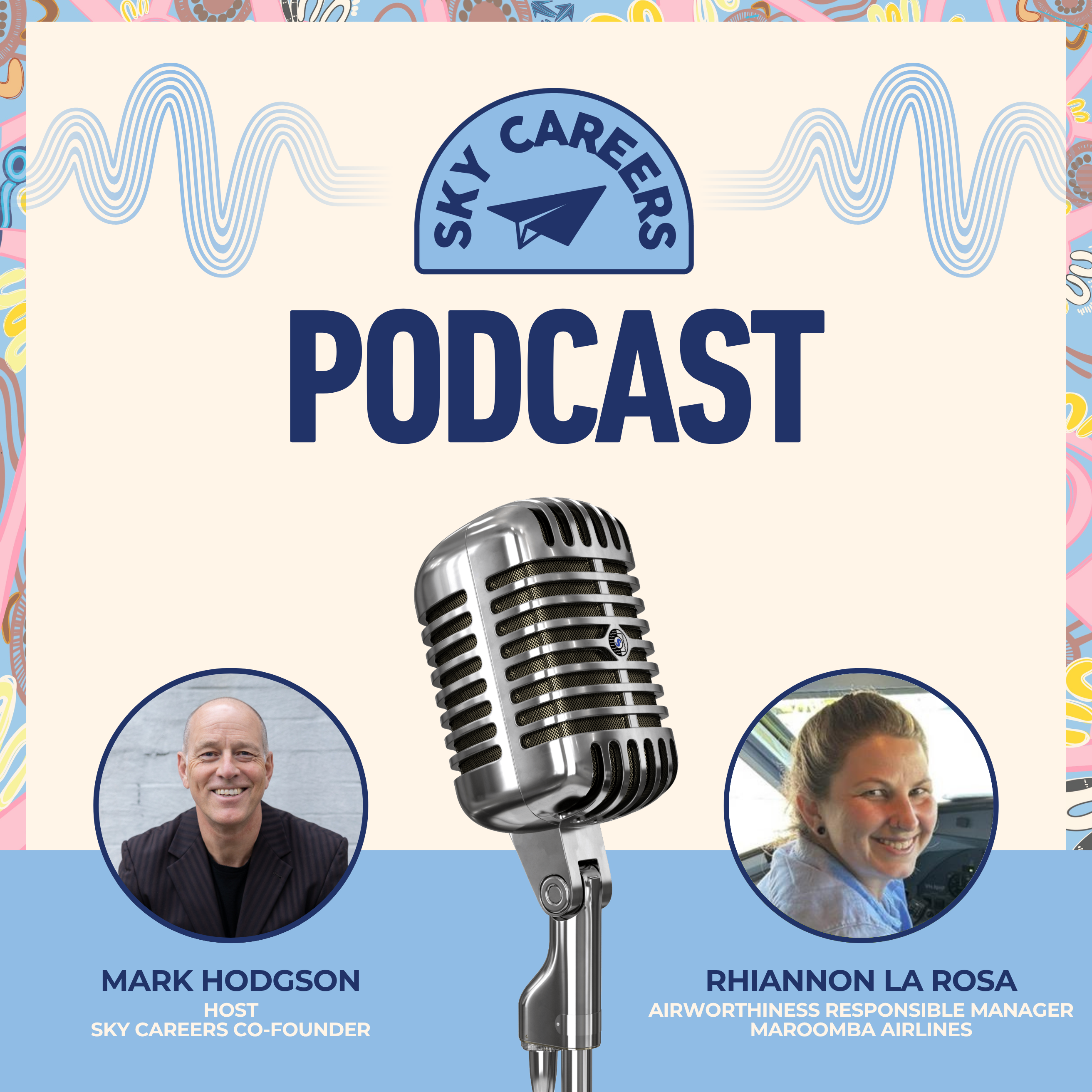
[00:00:07] Speaker A: Hi and welcome to this edition of the Sky Careers Podcast. My name is Mark Hodgson, co founder of Sky Careers and I'm your host. Today I'm excited to be having a chat with Rhiannon LaRosa. Now, Rhiannon is the airworthiness responsible manager at Marooba Airlines based in wa. We're going to dig around a little bit more and find out exactly what an airworthiness responsible manager is. If you don't know, and I don't by the way, and really looking forward to a chat. So, Rhiannon, welcome to the Sky Careers Podcast. How are you?
[00:00:46] Speaker B: I'm good. Thank you for having me.
[00:00:48] Speaker A: That's our absolute pleasure. Now, re we always start in the same place, so tell us a bit about your.
[00:00:56] Speaker A: Current title and where you work.
[00:01:01] Speaker B: Okay, so, yep, I am the airworthiness responsible manager for Maroomba Airlines.
[00:01:10] Speaker B: In short, that just means that I deal with the regulations in which our fleet need to comply with to be able to fly and fly responsibility and safety safely.
[00:01:27] Speaker A: So fantastic. So let's go back in time.
Where did a young Rilarosa go to school and what were your favorite subjects?
[00:01:37] Speaker B: I went to a school called Hamilton Senior High.
My favorite subjects were.
[00:01:46] Speaker B: Not maths or English.
They were more of the social side. So I loved spring sport, I loved music.
[00:01:56] Speaker B: And I just loved really being the social kind of butterfly.
I didn't really know what I was going to do or what I wanted to be when I grew up.
And I probably still don't know what I want to be when I grow up.
[00:02:15] Speaker A: So what was the, what was, what was the, what was the pathway? What, what, what got you from sort of sports and being fun and not really being sure about what you can do to dipping your toe in the aviation pond?
[00:02:29] Speaker B: It was pure luck.
[00:02:33] Speaker B: My background from my kind of previous career was planning.
So I planned.
[00:02:44] Speaker B: Movements of bricks. That was my first job.
[00:02:49] Speaker B: And then that moved on to fleet planning for a metal company and then just smaller kind of courier companies.
Then I went into planning maintenance on heavy machinery that went to the mines.
[00:03:07] Speaker B: And I just applied for this role and got an interview.
And the manager that hired me with no aviation background is still my manager today, which is 11 years, I think.
So, yeah. So I had zero aviation background.
[00:03:30] Speaker A: So when, so what age were you when you got into aviation? Having spent quite a few years doing different types of sort of project planning and logistics planning.
[00:03:39] Speaker B: I was 34.
[00:03:41] Speaker A: Okay, so it's so you. So you're kind of what we'd probably call a mid career aviation Career entrant or something like that.
[00:03:48] Speaker B: Yeah. And.
[00:03:51] Speaker B: I hate to say it, but I'm not an aviation buff. I don't really know a lot about it. I know about the planes that we kind of fix and fly, but outside of that, I'm not one of those people that grew up thinking, oh, I want to think about planes every single day.
That's just where I fell into. And my niche isn't. Well, it wasn't really anything to do with, like, the regulation side. It was literally planning.
[00:04:25] Speaker A: Okay. When you finally came into aviation, what. What. What new training did you need to do?
[00:04:32] Speaker B: So I had the background of planning. So it was just maintenance planning for planes.
And then I got into it, and I was in it maybe a couple of years, and my boss back then, or the supervisor said, we need a maintenance controller. Would you be happy to put yourself forward? Or we put you forward through casa We. You have to do a little bit of reading, a bit of research, and it's all about the regulations and.
[00:05:06] Speaker B: You know, just simple stuff.
And then we'll send you through to do the exam. And that's how that happened. And then I was given an instrument, and that's kind of where that maintenance control came from.
And then I just kept really.
[00:05:30] Speaker B: Thinking about where I could go next. And the next step was a HAM C. So that's Head of Airworthiness and Maintenance Control. So it's just a big, big, long title that they kind of put down into letters.
And that's where I ended at Murrumbah. I then left for a couple of years and. And came back, and that's where I'm now. Because we're going through the regs to kind of expand our business and.
[00:06:00] Speaker B: Just become better at what we do, the roles kind of change. So the airworthiness responsible manager is kind of hand in hand to a HAM C. It's just.
Yeah, that's. That's kind of where we go, and we'll see what happens next.
[00:06:15] Speaker A: Okay, so it sounds like you've got in. They've worked out you're pretty good at what you do. And they said you need to get a few more qualifications to do things. Tell us about. Just specifically about the aviation training. Those two things you just mentioned was that. Did you find that hard?
[00:06:32] Speaker B: Yes, a little bit. Only because I'm not a huge.
[00:06:38] Speaker B: Study person. So CASA make it very easy for you to go through the process if that's what you want to do.
All I can say is.
[00:06:51] Speaker B: I have this funny little niche that planning, which usually Sends people nuts.
For me, it brings out a creative thinking side. So it's great for people that really want to push themselves and really want to test themselves.
I won't lie. There's not a day in aviation that's really, really easy. There's.
It is easy for the most part, but there's always something that's sticky.
But yeah, the training that I had to do for it is really accessible, especially when you've got a really great manager or a great team behind you that want you to do it as well. But it does take time. You do, you do need to put in the time and effort.
[00:07:41] Speaker A: Yeah, sounds like. So just. Just pulling back this. Putting back the lens a little bit. Tell us a little bit more about Maroonba Airlines, because a lot of our podcast listeners probably wouldn't have heard of Maroon, but tell us, what does Maroon do?
[00:07:55] Speaker B: So Maroonba Airlines is a business that's just turned 50.
[00:08:01] Speaker B: It was originally.
[00:08:04] Speaker B: Kind of brought to Perth or like born by a guy called Steve Young.
[00:08:11] Speaker B: He basically was everything. He was the owner, he was director, he was just everything pilot.
And he kind of just built this airline and then wanted to retire. And then new directors bought it.
[00:08:30] Speaker B: They're Phil Garcia.
[00:08:34] Speaker B: And his wife and Mike and Katrina. So they're. Yeah, they bought it and now they're functioning in part of the business. So Phil is kind of engineering and Mike is pilot.
And we started off as just like a charter company for the mines.
[00:09:00] Speaker B: And we just really.
[00:09:03] Speaker B: Kind of grew. So now we're opening up just to keep going forward because directors obviously have new visions and. Yeah. So we just see what comes next.
[00:09:14] Speaker A: Yeah. So this is. So again, mainly what you're doing is flying, serving the mining industry. And so fly in, fly out, kind of work, that kind of stuff. And how big's the fleet at Maroon? What aircraft have you got?
[00:09:28] Speaker B: We fly Dash eight.
We've got Dash eight one hundreds and Dash eight three hundred.
[00:09:36] Speaker B: The fleet is growing. So we've got.
[00:09:42] Speaker B: Four, three hundreds, one one hundred and.
Yeah, so that's where we kind of primarily fit.
The 100 is just a 36 turboprop.
36 seats.
300 is 50 seats.
And.
[00:10:02] Speaker A: Yeah, fantastic. So you're. The, you're, you're moving. Is it mainly passengers or also. Or also material you're moving?
[00:10:10] Speaker B: No, just passengers. Yes.
[00:10:13] Speaker A: So you're. So you're. So you're. You're serving the mining. Mining industry. And so with all that lot sounds like lots of moving parts. Grow the businesses. Business is growing, which is exciting.
[00:10:24] Speaker A: You're Adding to the fleet. So talk us through a typical day in your role.
[00:10:30] Speaker B: Okay, so a typical day in my role is I get to work and I have to be caffeinated. So that happens first.
[00:10:39] Speaker A: And coffee.
[00:10:41] Speaker B: Yeah, yeah, coffee. I need that now.
And then I kind of go around and check out with the engineers and see where they're at.
[00:10:52] Speaker B: We do all our maintenance in house.
We never did. That's one thing I forgot to mention. So when Maroonba first started, we weren't a engineering.
Well like we farmed out our engineering.
We don't do that anymore. So I'll check in with the engineers and check that all this, their kind of maintenance plans are great.
[00:11:14] Speaker B: Sometimes they're not.
[00:11:18] Speaker B: But yeah. And then depending on that, we go forward from there. My day then looks at planning for the next kind of.
I don't know, it can span out to the week, to the month, to the year.
[00:11:34] Speaker B: And I just look at that and see where we're at and if there's going to be any hiccups.
I then go through any kind of ads and SBS that come in overnight just to make sure.
[00:11:46] Speaker A: Sorry, what's an ad and sb.
[00:11:49] Speaker A: Sorry, that's right. I know how jargon laden aviation can be but luckily, luckily I'm not deep in it. So I, I get to ask the, the, the, the dumb questions for.
[00:12:00] Speaker B: Never a dumb question.
[00:12:01] Speaker A: Pros.
[00:12:03] Speaker B: An ad is an airworthiness directive and an SB is a service bulletin.
[00:12:08] Speaker A: Great.
[00:12:10] Speaker B: Ads come out by the regulators. That could be casa, it could be FAA and it basically gives you an instruction and if we need to comply with it based on what kind of plane we have or anything like that.
[00:12:29] Speaker B: So that's where though they kind of sit.
[00:12:34] Speaker B: So yeah, like they don't come out often. But there's also non mandatory ads or non mandatory kind of bulletins and they are kind of things that you look at to see if it's going to better your fleet.
[00:12:47] Speaker A: Yeah.
[00:12:49] Speaker B: So yeah, I'll go through them.
[00:12:52] Speaker B: I'll probably have a few meetings and see where or if we need to do anything to be better.
[00:13:01] Speaker B: But my days changed. I could be a planner one day I could be a manager the next day I could be, I don't know, tech records. I could beat all of that together.
[00:13:15] Speaker B: So yeah, you kind of just jump and just see where the days kind of head.
[00:13:20] Speaker A: Yeah, it sounds like you're working depending on the situation, both the planned situation and stuff that just happens.
Sounds like a lot of teamwork's involved. Would you say that's true?
[00:13:30] Speaker B: Yes. And you have to have a really great team.
That's one thing I'm big on.
Although I sit at a level I never really want to be that person that doesn't chip in.
Like I said, the manager that hired me my first day, and he's still my manager now, and really great friend.
[00:13:57] Speaker B: His name's John White and he has so much experience, but he operates the same way. He, he doesn't let his team fall in.
But, yeah, you've got to have a great team and you have to have laughs.
[00:14:15] Speaker B: There's nothing worse because the aviation industry is stressful. So if you can't come to work and have a laugh.
[00:14:27] Speaker B: It'S not the right kind of place for you. Kind of.
Yeah, like, I'm, I'm where I am today because of my team.
[00:14:36] Speaker A: That's lovely. So, yeah, it's, it's, it's, it's a, it's a recurring theme with all the conversations we have on the podcast. You need people who are ready to. Ready to pitch in.
Not. Not above themselves.
Good commute, good communicators, resilient, able to, able to change rapidly. Agile, not go.
[00:14:55] Speaker B: You.
[00:14:55] Speaker A: You said we were doing this and. No, no, that's all changed because that's. That thing's happened and then, you know, we need to adapt and get on with it and, and stay on top of the stress. Right. Because ultimately, it seems to me, the two key drivers of aviation, for most people, the first one is obviously safety.
[00:15:10] Speaker B: Yeah.
[00:15:11] Speaker A: And, and, and the second one is money. Because your aviation businesses, you've got to make money, you've got to do things for clients and do it profitably, and there's always a project, time pressure, and time is money and all that and all those kind of things. So.
[00:15:24] Speaker A: The importance of having the right people on the team is, it seems to me, is very important and probably more important than having just, just. I mean, you need the right piece of paper. Yes, you do. You need the right qualifications. It's a very regulated industry, obviously, and understandably, but it seems from all our conversations that the people who really thrive are the people that. That's kind of. That gets you a seat at the table. But it's, it's, it's, it's, it's, it's the easiest part, however hard it is to do the study. That's the easy bit. Right.
[00:15:53] Speaker B: Yeah. And you, you just, I think you do need those people that come in and offer a little bit of a.
I don't know how to say it, like, maybe a little bit of why are we doing it that way? Because you do need those conversations. You do need those things to come up that kind of get a team together to talk and to think about things in different lights. We've all got different experience, we've all got different strengths and different weaknesses.
[00:16:29] Speaker B: And yeah, you do need those people that bring up the conversations, that have the chat, that maybe push those little bit, you know, of the hard chats, because it does very much then highlight how your team works.
And I think as well, like, aviation is so split up, but when you think about it, there's not really much chat about what goes on in airworthiness or. And I think that's why I like it. It's. When you speak about aviation, you.
The first thing I get asked is, oh, do you throw the bags or do you see what comes in? Or, like, do you get to check the bags? I'm like, no. And then the next question is, oh, do marshall the planes in? Like, no. And they're like, what do you do? Then I was like, oh, I just check if the planes are airworthy to fly.
Oh, you work on them then. No, it's, it's.
[00:17:28] Speaker A: It's fascinating. I was listening to a very interesting. So I did a bit. I was on the road all day yesterday, driving, and I listened to a fantastic podcast by a guy called Mike Rowe out of the States, and he was interviewing a guy who has an autistic son, and he's run a. He run. He runs a program to help more autistic people on the spectrum to work in the trades.
And one of the really interesting, fascinating program. Whole other subject, so much to talk about there. But one of the really interesting things he was saying was from the employers who place.
[00:18:07] Speaker A: The young adults who come out of this program is that because of depending on where they are on the spectrum, some of them add so much value because. And he said on day one, this kid was working in a big brewery and he just said, you're doing it the wrong way. You should do it this way. And imagine the boldness of, I guess, not having that sort of social fear about, well, on the first day job, just be quiet.
And the employer was saying he was absolutely right. He. He'd seen some. Because to your point, the neurodiversity, the ability to look at things and processes differently, they just look at the process, oh, you're doing it the wrong way or that should be done differently. And I can imagine that kind of thing in what you're just talking about where people come in and challenge the thinking and say, why do we do this? Or we've missed that or that that. Or that that real focus on that component's been put together wrongly or things like that. It's so, it's, it's, it's so fascinating. Which is, which is what you're talking about as well.
[00:19:09] Speaker B: Yeah, you need it and you need that. The autistic side of things and the spectrum is a lot of people may say it's a disability, but I think it's a, it's a magic thing to be able to be that direct, non emotional. Call it as it is. That is a huge, huge thing that I support. Like, it's great. And I think that it's something that is just.
Yeah, it's going to be huge for businesses going forward.
And I'm glad that those kinds of things are being recognized now because aviation do need people like that and they need to be a little bit quirky. We, we all have that quirkiness.
[00:19:54] Speaker A: Yeah, that's what this podcast was saying. And, and, and, and it's not, it's not. And it was arguing it's not from a deficit perspective.
[00:20:01] Speaker B: You know, no way.
[00:20:02] Speaker A: People are normal and this is the deficit to normal on the spectrum said. No, no, no, no, no. You got to think completely differently. Some of these guys are going in and they're not, they're not just holding down a job verdict commas. They're actually excelling and becoming promoted to management, which is for exactly the reason. But they just look at things slightly differently. They call stuff out and, and organizations are finding incredibly powerful, refreshing and also profitable. So it's a fascinating, fascinating area. So we might talk about that more. Right. Tell me, what part of your job do you enjoy the most? Ree?
[00:20:36] Speaker B: I enjoy that it's not the same every single day. I enjoy that little bit of stress.
I enjoy the planning side of it. I will never give that up, regardless of where my role goes, because planning is just my niche. I have that part of my brain.
[00:21:00] Speaker B: Yeah, it just, it makes me think outside the box and I love it.
[00:21:04] Speaker A: Yeah, it's your jam. I can tell. You can see when you, when you are you. If anyone watching the video watch Re's eyes when she talks about planning, they kind of, they kind of glow. It's, it's, it's a bit of a.
[00:21:14] Speaker B: Freak of nature really.
[00:21:16] Speaker A: That's just, just fine. If we can find out what we love doing. That's it. That's, that's, that's such a blessing, isn't It. What's the least favorite part of the job?
[00:21:28] Speaker B: The least part of.
The least favorite part.
[00:21:34] Speaker B: The least favorite part of it would be that.
[00:21:40] Speaker B: Oh, I don't know.
I guess the least favorite part is when I see things that could be better.
But.
[00:21:53] Speaker B: But kind of people don't. Not people, but I just don't like non cooperative kind of ways about things. We're all here to get a job done. We're all here to get the same outcome.
So I kind of, I think, yeah, maybe close mindedness.
I think, I think yeah. I just love easy and that's where I want to go for the rest of my life and world. So I just want everybody to work together and it to just be an easy breezy job.
[00:22:25] Speaker A: That sounds like that. Sounds like that sounds a lovely ambition. So. And following on from that, what. What do you do when you, when you. When. When you're not at Maroonba Airlines? What's. What keeps you busy? How do you relax?
[00:22:38] Speaker B: I relax by signing up to things that don't usually make people relax. So swimming to Rottnest from Perth. Or I train Muay Thai as well. So like I am.
[00:22:53] Speaker A: What, so you train which, sorry, Muay Thai. Okay. You know my next. What's Muay Thai?
[00:22:58] Speaker B: Muay Thai is just a form of martial arts.
[00:23:03] Speaker B: I got into it maybe three years ago and it's. Yeah, it's just kind of opens a new respect for that sport. So if anybody's listening and wants to release a bit of stress, look into Muay Thai. And how do we spell that?
[00:23:21] Speaker A: How do we spell that? Reed?
[00:23:23] Speaker B: It is. M U A Y.
M U A Y T H A I T H A I.
[00:23:32] Speaker A: Okay, cool. You have to send us some pictures that we can put in the podcast notes.
[00:23:36] Speaker B: Okay.
But yeah, that's what I do. I kind of set up myself to kind of reach for little goals. So I do that and I play music, play guitar. Just a lot of little things.
[00:23:51] Speaker A: And a bit of travel as well. We were talking about just your latest trip before we started recording.
[00:23:57] Speaker B: Yeah. Yeah. A little bit of impulse traveling to Mexico.
[00:24:02] Speaker B: That.
Yep. Everybody jump on board. Just go book an impulse trip. It'll make you grow in ways that you didn't think were possible and you'll come back and nothing will seem hard.
[00:24:15] Speaker A: I like that. What a lovely attitude. Okay, well, and then last couple of questions. Now, what advice would you give to other young women and men who are looking for an aviation career? Or maybe not looking for an aviation career, but maybe, maybe, maybe on hearing this or hearing about some of the different options might be interested in it. What advice would you give to people about the aviation?
[00:24:40] Speaker B: I would just say if you have no experience.
[00:24:46] Speaker B: Just apply. If you have kind of a goal and it may not be aviation based, aviation have so many like avenues. You don't have to be aviation focused.
[00:25:03] Speaker B: I would just apply and just see what happens. And like we've just said before, like there's a niche for people that think outside the box.
And that's the great thing about aviation. It's everything is outside the box.
So I would just do it. Just jump in and just know that if you do and it's something that opens up a level, just put everything into it because you will go so far. Like there's so many spots that you can go and you can go overseas.
[00:25:41] Speaker A: Fantastic advice. Hey Ray, thank you so much for your time. For your time today. I'm excited to see how how Maruma keeps on going from strength to strength and where your your planning mojo takes you because you clearly love it. You obviously part of a great team and I'm sure a great leader as well. So thanks so much time on the Sky Careers podcast today.
[00:26:01] Speaker B: No thank you for having me. And yeah, I am looking forward to hearing all your other podcasts and all the episodes to see just how crazy this little aviation world is.
[00:26:15] Speaker A: Crazy it is.
I certainly love having the conversations. Thanks Rick.
[00:26:20] Speaker B: No worries.
Foreign.
[00:26:29] Speaker A: Thanks for listening to the Sky Careers Podcast. If today's conversation has sparked your interest in aviation, then head over to our
[email protected] au whether you dream of flying aircraft or you're curious about the hundreds of other exciting roles that keep the aviation industry moving, skycareers is your gateway to discovering these opportunities.
And if you are already in the industry, check out Sky Careers Connect and Sky Careers Leadership and consider joining our online learning community.
Until next time, keep reaching for the skies.