[00:00:00] Speaker A: Foreign.
[00:00:08] Speaker B: Welcome to this edition of the Sky Careers podcast.
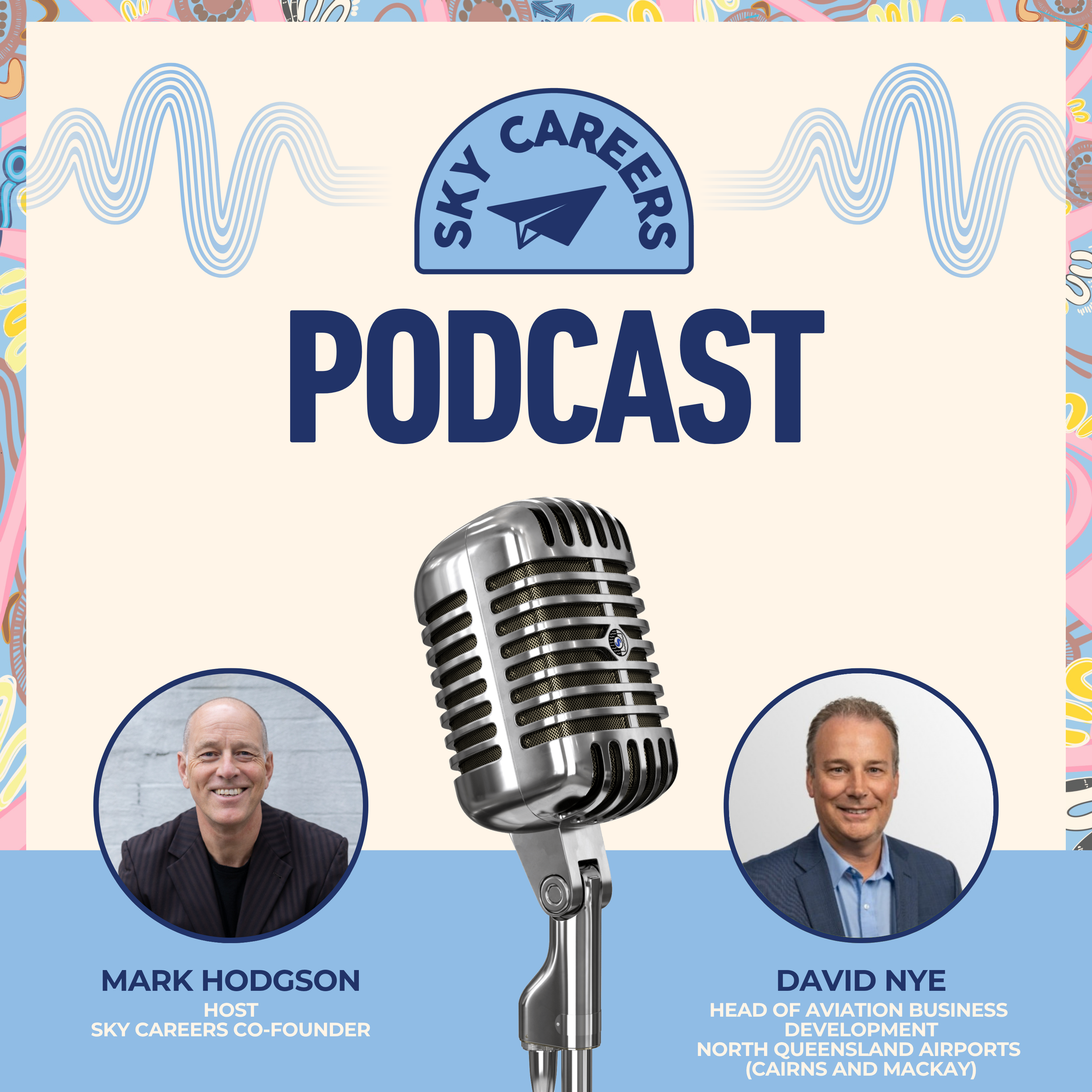
And this week we're going up to the very far north of Australia. We're meeting David Nye now. David is the head of Aviation Business Development at North Queensland Airport. So looking forward to hearing from a new expert in something we've not touched on in the podcast before. David, welcome to skycareers podcast.
[00:00:34] Speaker A: Thanks, Mark. Looking forward to a chat.
[00:00:36] Speaker B: Fantastic. So you're head of Aviation Business Development at North Queensland Airport. You probably already know that, but for those of us who don't, tell us a little about what the role involves.
[00:00:47] Speaker A: Yeah, sure. North Queensland Airports, we manage Cairns Airport and Mackay Airport in Far North Queensland.
And as Head of Aviation Business Development, my primary role is to grow the business by getting more airlines to fly to our airports and those airlines that already fly to increase their services. So obviously KPIs around passenger growth and airline growth and so spend a lot of my time out in the region and internationally selling the dream, convincing airlines why they should be considering Cairns and Far North Queensland and Mackay in their future plans.
[00:01:27] Speaker B: Yeah. And for those who don't know, paint a picture for where these two airports are in Australia and the kind of key business they have.
[00:01:36] Speaker A: Yeah, sure. Cairns is the furthest north, so in Far North Queensland, well known as the gateway to the Great Barrier Reef and also the world's oldest rainforest. So very much a tourism destination both domestically and internationally with a lot of international visitors coming to our region.
Mackay is a bit further south and is very different. It's a much smaller airport and it's more corporate. It's driven by the mining sector in terms of where it is. And so we see a lot of high vis passengers and a lot of fly in, fly out passengers coming through those airports. So a little bit of a different story.
And again, just for context, the closest capital city to Cairns is Port Moresby and not Brisbane. It's Port Moresby and Brisbane is actually closer to Melbourne than it is to Cairns. So just gives you an idea of the distances that we see in Far North Queensland.
[00:02:36] Speaker B: I think that one, the second one is that, I mean, for someone who lives in Australia as I do, that's the eye opener, because we forget that. So, yeah, I think you're, you're also a fellow Brit, aren't you? Originally?
[00:02:52] Speaker A: Yeah, that's right. Yep.
[00:02:53] Speaker B: Yes.
[00:02:54] Speaker A: I grew up, grew up in the, in the UK and started my aviation career in the uk.
[00:02:58] Speaker B: Yes. So you share, you share the royal blood. So you've already won in life's lottery. I love to Say so actually. Well, pull on that string a little bit more. How did you first find your way into aviation, David?
[00:03:09] Speaker A: Well, it was via the travel industry. So I was always sort of at school interested in geography and sort of the world in general. You know, always had a sort of map app open and interesting to sort of learn about what's going on in the rest of the world. And so I wanted to get into the travel business and it was hard back in the, back in the 80s trying to make a breakthrough in the sector because you go and speak to the travel agents and they'd say, oh, we want people with experience. Well, yeah, but how do I get experience?
And so at that time, travel and tourism as a sort of training area, there weren't as many courses, and I'm talking obviously in the uk, but there weren't that many courses as there were these days. But fortunately, quite close to where I lived, there was a travel and tourism diploma course at one of the colleges, which was a two year course. So long story short, I threw my hat and did that for two years, got the experience that was opening the doors and walked straight into a job in business travel. So I was a business travel agent for about four years in London and then decided I like the look of the other side of the coin in the airlines and met a few airline sales reps back in the day and thought, yeah, Cathay Pacific, that looks like an interesting one. Hong Kong, Asia, bit of flair in there. Threw my hat in the ring for a reservations job at Cathay Pacific and got accepted.
And that was where I sort of started my aviation journey, grassroots level in reservations, which I'd still recommend to anybody in terms of learning the industry is a great place to start.
[00:04:57] Speaker B: That's a good backstory. But there's quite a long journey, isn't there, from that to your role today. So carry on the story. What are some of the other turning points?
[00:05:08] Speaker A: Carry on the story. So, yeah, I worked for 12, 12 years for Cathay Pacific, initially based in the UK and worked my way through the ranks. So again gaining that experience and sort of was the sales manager in the uk, so very much on that sort of commercial sales journey.
Then there was an opportunity within Cathay to take a stint overseas and this wasn't something that was readily available to, to sort of Cathay Pacific employees.
Again without going through the whole structure of Cathay, there was a level of senior management from the owners, the Swire Group, and they used to rotate around the world as airline sort of senior management do.
And by Default, you could say, or by fate was to dictate that one year they were actually short of people on this rotation. Somebody had got their sums wrong and they were short of a person. So they actually threw an application or they threw a job ad out there to internal cafe staff. Anywhere in the world, would anybody be interested in a two year secondment to. Or it wasn't a second, a two year post to be the manager of Denpasar in Bali. And for somebody in the uk, sort of that had been through reservations and everything else and yeah, had traveled to Hong Kong and had spent some time in Asia, fam trips and leisure and everything else, it kind of ticked a box, let's say.
So I threw my hand.
[00:06:47] Speaker B: When was that time wise, David, where are we date wise here?
[00:06:50] Speaker A: That would have been in 1996.
[00:06:56] Speaker B: So 30 years ago.
[00:06:58] Speaker A: Yeah, that's right.
And it was an interesting. So, yeah, long story short, I threw my hat in the ring, as did quite a few other people from Vancouver to.
From London to Vancouver to Paris, other people on the Cathay journey. And I was fortunate to get the nod. And in terms of a sort of turning point in your career, that's clearly one of the major ones for me. And it was at a really interesting time because it was port manager, so it wasn't just a sales role. And again, Bali, very much a service role in terms of tourism and making sure that the local staff are doing the right thing.
But it was also at a time when there was any viewers or listeners that can remember back to that time, there was the monetary crisis in Asia going on at the time where the bottom was falling out of currencies. So there were lots of issues going on. There were lots of issues going on in Indonesia at the time, having had one president for 30 years and then all of a sudden three in one year. So there was a lot of sort of unrest and dynamics going on. So it was a steep learning curve, but one that, you know, if I just stayed as the sales manager in London, you would never have been exposed to that. So. No, not at all. Yeah, so it was a great opportunity to learn something else about the business.
And that stint was extended.
It wasn't extended in Bali, unfortunately. It was extended into Jakarta, which was another great experience, very different to Bali. And that was more in an operational role, as, let's say it was called Airport Services manager for Indonesia. So I was there for my leadership skills. And in somewhere like Indonesia, you've got a lot of capable people that have been in their aviation roles for A long time, but had never taken that step to sort of management or leadership themselves. They never had the confidence. It's a cultural thing. So they had the Westerner there to basically work with these people and actually bring out the best of them. So that was, again, it was a great role and again, it gave me a different perspective on parts of the industry. So I think the theme is you're constantly learning in the, in the industry and that's, that's, you know, that, that's how that is. And I then I did leave Cathay after that stint and took on a role with Qatar Airways back in the uk, where I was the head of the uk, the UK operation that also led to an overseas stint which again took me down to the Maldives.
So I was the manager for Qatar Airways in the Maldives. And again, we're talking 20, 20 years ago here, where Qatar Airways was a very different airline to what it is today.
[00:09:48] Speaker B: Yeah, I mean, it's massive today, isn't it?
[00:09:51] Speaker A: Yeah, that's right.
Still very much the new player, very much in the shadow of Emirates. So it was an airline with huge aspirations and it was great to again be part of that, that journey.
I then opened the operation for them in Singapore in the early 2000s. And again, great, great experience. Something that you don't get the chance to do every day is to actually open an airport, an airline operation in a port from Strat, from scratch. You're recruiting the staff, you're finding the office, you're appointing the lawyers, working with ground handlers. So again, you know, great experience to, to do that. And again, when people speak to you about, oh, you know, what are some of the, some of the things that you look back on your career and, you know, you're most proud of, you know, that's certainly one of them because it's something I would think. So, yeah, you don't get the chance to do, to do all the time
[00:10:49] Speaker B: and bringing it, bringing us forward. How did that, how did that, how did that get you to Far North Queensland? And yeah,
[00:10:59] Speaker A: so after, after that, again, there's always a personal driver in there, but my, my wife was Australian. And another string to your podcast is we met while we were working at Cathay Pacific. So aviation, Aviation does that to you. Yeah, you spend a lot of time, you know, working around airports and airlines and meet our partners there. But it had always been a plan to relocate to, to Australia.
And so that happened. In 2006, I joined Newcastle Airport in New South Wales as the manager of corporate affairs. Again, a growing Regional airport.
They wanted somebody that knew how to talk to airlines.
And so I was that person. I was recruited from the UK to actually go down there and do it. So that was great.
And then did that again for 10 years or so and then moved up to Cairns with this job which I've been doing for just six and a half years now.
And again, it's as I said before at the start, you know, my job is a sales job. Ultimately you're selling the airport, you're selling the region and you're selling the opportunity to an airline. So having been on the other side, that helps.
But also again, my role primarily is always kind of being on that commercial sales side with the operational stuff thrown in. So very much an all round skill set, you could say.
And that works really well in a regional environment where you're dealing with lots of different factors in aviation.
[00:12:38] Speaker B: So when you're trying to attract a new airline, for example, to establish a new route into North Queensland, what's going on behind the scenes there?
[00:12:47] Speaker A: So as you'd imagine, everything's number driven. An airline wants to know, well, why should I, hey, why should I fly there? So you give them the tourism spiel in terms of why people are visiting this region. You're presenting them with data. So we obviously know how the visitors that come here already.
So if we believe that this airline can tap into some of that visitors that they're not getting already, we present that information to them.
We also obviously make sure that they're aware of the competitive landscape and where there's a particular market that they could, that they could benefit from.
And we work closely with our tourism partners.
At the end of the day we can actually convince them to fly to the airport. But the passengers have got to come here for a reason.
And so very much a sort of stakeholder proposition where we go and present the numbers and the opportunity. And it's a long term, it's a long term process.
It's, you know, we're not a Sydney, we're not a Melbourne where airlines are potentially queuing up to fly. We have to pitch. We're in a competitive environment globally for airline fleet. And so therefore we have to present a compelling case as to why an airline should choose us.
[00:14:11] Speaker B: Because for those who don't know, I mean, Cairns really is, I mean you talked about the gateway to the Barrier Reef, I mean, both in terms of proximity, but Cairns itself, when you go there and every other shop is some kind of attractions or an experience or a hotel or, you know, it's And I remember going there well 30 years ago and it was, it was much smaller. So the whole, the whole thing's growing enormously. So. And so the, the airport and the quality of the airport and the infrastructure will be a massive part of the, of that, of that conversation, wouldn't it?
[00:14:44] Speaker A: Yeah, that's right. And as I say, we're a major international destination and so therefore we have to be international ready both as an airport and as a large town or city. So when you're attracting visitors from the US or Japan or China, they expect the restaurants to be of an international quality, the tourism product to be of an international quality. So yeah, there's a lot of investment that continues to take place that's both, as I said, around the airport and as a tourism destination.
[00:15:20] Speaker B: Yeah. What's been your most, either your biggest win or your most recent win that you're very proud of someone coming to Cairns who wasn't before.
[00:15:29] Speaker A: I'll take two if I can.
The most recent one is Fiji Airways and everybody thinks, oh yeah, that's great, but why, you know why? The tropics. To the tropics.
Fiji Airways is more about the us.
Their connectivity through Fiji to and from the US gives us a one stop product to a huge market for us as opposed to passengers having to come through Sydney or Brisbane or Melbourne. They can just take a long way
[00:16:01] Speaker B: south to come north again.
[00:16:02] Speaker A: Exactly, exactly. And again, I spoke earlier, Mark, about how long these things take. That was a conversation that was over two and a half years before they actually committed.
And that was various factors in terms of fleet availability, risk appetite. Because any airline that chooses to fly somewhere new.
Yeah, they either have to take the aircraft from somewhere else or they have to be confident that there's a risk sharing and there's incentives and things like that.
The other one I'll say as well, Singapore Airlines flew to Cairns before the pandemic or they Silkair did with a 737. But again, another big win for the region was when they upgraded that service to an Airbus A350. So major commitment by Singapore Airlines to choose Cairns. They could have flown it to pretty much anywhere in Europe, but they chose Cairns for that operation four days a week.
And that's a great outcome, not just from a tourism perspective, but also gives us freight capability.
We keep talking about the tourism region, but freight is another big part of the business here in Cairns with exports of seafood and fresh produce.
[00:17:17] Speaker B: I'm hearing a lot of moving parts and patients and contacts and building business cases, but also leadership and you just pulling on the leadership lever a little bit. You mentioned your experience and growing a team.
If we look at, I guess, some workforce challenges. So changing tack a little bit, what are some of the biggest workforce challenges you see facing aviation more broadly?
[00:17:46] Speaker A: I think there's several layers to that and I think if you go back to again, the pandemic, I mean, we try and avoid talking about it, but it's unavoidable. There was a lot of skills lost to the industry around that time, both in terms of flight crew, flight deck crew, who left the industry, engineering crew, etc.
But even down to ground handlers, et cetera. In terms of an airport environment, it's been, I think, a challenge for the industry which did recover quite quickly with again, aircraft coming through and growth to really backfill some of those roles. You clearly can't just train a pilot in six months and expect them to get out there and fly.
It's a long term goal and it's positive that when you look at the predictions for Airbus and for Boeing, Southeast Asia or the Asia region is where they see huge growth in the next 20 years in terms of aircraft delivery.
And they have to ultimately fly these machines, they have to maintain them and they have to have cabin crew, et cetera. And so part of the challenge, I think from more so from an airline perspective, but obviously we're only as good as the airlines.
It's a challenge for them to actually make that transition into those aircraft to come into the fleet.
So, yeah, I think they're some of the challenges.
And also making sure people still think the aviation industry sexy.
It isn't what it was 30 years ago, 40 years ago when I started.
It's different.
But I'm still here. There's lots of my colleagues still here. There's obviously something which keeps.
[00:19:41] Speaker B: You're still David, that's what you're saying.
[00:19:43] Speaker A: Yeah, yeah, exactly.
But yeah, it's, as I say, it's a different, it's a different industry to what it was, but it's still compelling enough to, to keep lots of people interested and, and you know, people should be, should be looking at opportunities to jump on board.
[00:20:00] Speaker B: Yeah, I'm interested as well, because a very current conversation which is not aviation specific is around AI and how AI will cause a lot of people to lose their jobs potentially and other specialties. And I think there are a lot of opportunities, seems to me there are a lot of opportunities in aviation for people with transferable skills, both coming out of, I guess, training, college and the younger Younger people, but also mid career people to come into aviation. Because it strikes me that a lot of the many of the roles you talked about, some maintenance roles and certainly ground crew roles, flight deck roles and pretty much all the roles around an airport. Funny, I've just, I've just flown back from Europe through China and you know, you go through any airport, they're just, there's a whole lot of, there's a whole lot of functions and roles that couldn't possibly be done by computer. I mean they need physical people to do that. Yeah.
And I think it's probably one of the few industries that's, you know, those opportunities are growing and as you said, you know, with the pandemic, I mean the pandemic closed down the industry more or less for what, the best part of two years, put a lot of businesses out under and those that have come back massively, you redesign their organization, cut out costs, cut out people. So there aren't, I don't think there are too many fat and flabby, overstaffed airline and airline adjacent businesses around. So you know, I think it's a very good, it's a very good, they're good organizations to join and there's lots of job security that, that's possibly disappearing in other areas. So I think, yeah, part of what we've been doing in sky careers today is trying to tell that story and broaden the understanding both in schools and that area and also with careers advisors, those kind of people, parents, colleges and more broadly in the work. But more broadly, I think the workforce conversation for aviation, it's a bit of a hidden gem, it seems to me.
[00:21:59] Speaker A: Well, I mean fundamentally we're a people business. I mean, you know, people are passing through airports, they're traveling on airlines and customer service is still a differentiator in how we choose to fly or whatever. Yes, cost is clearly an issue, but yeah, you look at it online and people commenting about different airlines and you know, the airlines are proud to have their five star awards and things like that. And so are we as airports. You know, we need to make sure that, you know, we're delivering, you know, customer service as a differentiator and that has to be done by people.
Yes, there are developments in automation.
Any airport these days has the self service kiosks and go and shake your bag and do that.
That's kind of progress. And there's, there's, you know, an element, a degree of people that prefer that rather than the human interaction. But the human interaction is still, you know, you know, what people look for when they're traveling on, on, you know, a short haul journey or a long haul journey. That's, that's where journeys, you know, stand up or fall over.
And that's the same. And that's the same in terms of, you know, security screening. You know, every airport has, or majority of airports have security screening.
And that's very much a compliance job. It's very difficult sometimes to deliver customer service in that environment when people sometimes feel a bit intimidated. But if you can, if you can win those people over, that's where you can make a difference.
[00:23:26] Speaker B: Yeah, and I was actually, I was, I said this to, actually I was talking about this this morning to someone else. I recently went through Budapest airport and they had done the best job I can remember seeing of, of the, of explaining in two languages and using a really clear sort of video graphic thing. What went in, what didn't go in the trays, laptops in, laptops out, all that. And it was so beautifully done. I thought that is so elegant. They've answered all the questions in a short period of time.
And you know, you see that. So I thought that was superb. And then you see other, other airports where people are yelling at you and why do you, you know, and it feels like you're being, being run through a cattle. Yeah, being. Being run through a cattle. A cattle process. And it feels really terrible.
So I think it's a really good example of, of, of just a little bit. I mean, the end result's the same. Everyone goes through in a compliant fashion and the checks are done. But the, the actual customer experience of the first, it was calm, smooth, felt professional, low stress. And the other one is, oh, what's this? And you've been going through various.
And also.
Which is not something you can change. But even coming back into Australia, I've just traveled extensively through five or six different countries. The first time I had to pick up a pen and paper is coming into Sydney yesterday morning to fill in that stupid card. That feels like something.
It's funny, it feels increasingly analog and dated, almost quaint.
You know, in a world where you're going to all these other different countries that are much less developed. In Australia, for example, it's to your point, I know you can't change that. That's a federal government compliance. It's a good example of the customer experience though, isn't it? Everyone's suddenly scratching around for a pen, they're half asleep. It's a disaster.
[00:25:12] Speaker A: Yeah, that's right. I mean, it is changing. There Is progress. It's been slow over many years and it's being trialled on New Zealand, et cetera. And it will.
[00:25:21] Speaker B: Well done. Australia, you'll finally do something that's been done in every other country in the world for decades.
[00:25:25] Speaker A: That's right. And yeah, and some of those. And some of those countries that are ahead of us in that you. But you'd scratch your head and say, how do they do it? But, yeah, but yeah, it's.
Yeah, but it's, it's part of the journey, it's part of the experience. And you're right, it is something that people, people, you know, they don't push back on it, but it just.
Yeah, it leaves me. People with a question mark.
[00:25:48] Speaker B: Yeah. And I mean, the other thing I was going to say before I went off my rant, apologies for that, is the, I mean, the fundamental thing, though is that, you know, aviation is a significant growth industry, you know, both in Cairns specifically, but generally it's a massive growth industry. I was reading the newspapers today. You don't anywhere in the world, you know, the economy is poor, people are struggling, businesses are struggling, AI et cetera, et cetera, et cetera.
In terms of a good news story, aviation is a very good news, growth, business and industry level, isn't it? So there's a lot of good news there.
[00:26:20] Speaker A: Yeah, there is. And you know, it's been the backbone of countries, economies for many years. And whether that's driven by tourism or whether it's driven by business, and people have said for many years, you know, teams, meetings, zoom meetings, et cetera, would be end of business travel and far from it.
As you said, airlines can't get fleet quick enough. They're looking for modern aircraft so that they can connect more places, more effectively and more efficiently.
Who would have thought a few years ago that again, not in our part of the world, but from the US that you'd be able to fly from New York to Faro in Portugal or, you know, Mallorca, you know, the United Airlines flying to Mallorca. I mean, you did scratch your head a few years ago, but now, because of the changes of aircraft technology, some of these places are viable and they connect in places that haven't been connected before. And that's great for regional economies in particular.
[00:27:24] Speaker B: It's extraordinary. Coming back to people, I've got two more questions for you.
I guess continuing the career conversation, what qualities do you think, what attitudes do you think help people build a successful career in aviation? You've done a great story in the brief Time we've had to tell us how you've. You've taken opportunity, you started here, you've gone there, you've moved internationally, you moved back to the uk, you've taken the advantage of learning, lots of learning, lots of different skills. But also, I think the thing that shines through for you, David, is you've sought opportunity and when it's popped its head up, you said, yes, please, I'll have a go at that.
So there's some stuff in there, but generally, what qualities do you think or attitudes will help other people to build a career in aviation?
[00:28:15] Speaker A: I think one of the key things is flexibility.
And whenever I'm sort of interviewing team members that are maybe not from the industry but are looking to a role here, I sort of always say, if you're looking for a job where you can come in at 8:30 or 9:00 clock and you're going to go home at 5 and you're.
Your day is mapped out for you, you have a few things to do and you can tick those off, I said, aviation is not for you.
If you're looking for a job that's varied, that's going to provide challenges, it's going to provide opportunities, no two days are the same, then aviation's a good. A good one. And as I say for somebody that's actually been in the industry for a reasonable amount of years, and I said before, I think that, you know, it's very different to when I started, but that's part of what keeps us motivated, that's what keeps us interested in the industry. Nobody ever knows everything.
There's constant changes, technology wise, you know, just talking about some of these other destinations that, you know, potentially new business opportunities that we should look into. So I think people need to have a flexible approach and be open to opportunities.
And, you know, you get people like, maybe like me that have sort of taken a sort of jump here and a jump there and have broadened their experience. But you just look at an airline like Qantas, you know, there are people there that have been in the same role for 40 years and, you know, they still enjoy their job, they still are motivated to come in and be part of that. So you don't have to get the satisfaction, you don't have to be a sort of, you know, multitasker that's prepared to take a bit of a risk and go to the other side of the world.
But if you want that steady job, and people are still proud to work for the aviation industry, whether it's an Airline or an airport. Airports are significant economic drivers wherever they are.
And you know, we see that in Cairns in particular because, you know, the tourism industry wouldn't be anything up here if it was. It wasn't for air access. So people are proud to work for the airport because they know that other people rely on that for their, for their livelihood.
The same with airlines. To say that you work for Qantas or for Virgin, you know, comes with a bit of prestige and you're making a difference to people outside of the industry. And I think that's where people should understand it doesn't have to be like me going out there and getting new airlines and bringing passengers in. It can be somebody in the finance department and that's, you know, getting airlines to pay their bills or whatever it is everybody contributes to, you know, the airline or the, or the airport or their particular sector.
You know, it can be an mro, it can be, you know, a ground handler. You know, everything, everything that you do has a contribution in there. And I think people should, you know, value that and embrace that in the industry.
[00:31:19] Speaker B: I think you partially answered my last question, but I'm going to ask it anyway.
You sound like you've been in it a while. You're a seasoned industry professional, you're clearly a fan. You're helping to keep aviation sexy. By your own admission. David, what advice would you give to someone who's thinking about starting a career in aviation or potentially and maybe pulling on some of what we've talked about earlier, making a career mid career change into the industry.
[00:31:47] Speaker A: I think it comes back to a little bit of what you said just now, Mark. It's a growth industry.
It's an industry that's constantly changing. So you shouldn't be bored because there's always opportunities and there's always things happening. And again, just look back over the last 10, 20 years, how the industry has changed from where, from an airline perspective. Everything was about the A380 and how double decker airlines aircraft were going to be the way forward and now they're almost.
[00:32:18] Speaker B: Well, they are getting rid of them.
[00:32:19] Speaker A: Yeah, yeah, that's right. You know, and people are flying much further on, on, you know, you know, other single deck aircraft. So you know, there's constantly opportunities that come out and, and I think, yeah, it's, people stay in the industry for a long time or some people find it's not for them and it's a, it's a short time and that's, and that's fine. That's, that's, that's okay. And you know, I, I still keep, you know, in contact with people from, you know, Cathay Pacific back in the UK in the, in the 90s and even people that I went to college with. And this is what the industry does to you. You know, you may only be colleagues for a short period of time, but you're friends forever. And you can pick up a phone to somebody that you haven't spoken to in 10 years, ask them an aviation question and they'll help you. It's, it's that kind of community. And you know, people talk about, you know, the aviation fuel in the blood and you know, the avgas and the avgeeks and everything else. Yeah, sure, that's, that's what it is. And if you can come to work and sort of live out your hobby as well, then it's not a bad position to be in.
[00:33:30] Speaker B: Yeah, that's, that's great. I mean ultimately I'm summaring that up to an extent. It's the ultimate team game, isn't it? Like you say an airplane cheating it specifically to, you know, to, to an airport, you know, everything's as important as everything else. If the parking's not working or the, you know, or the, or the, the luggage, the conveyor belts are working or the loading's not working or the check in piece isn't working or the air traffic guys aren't there or something stuck somewhere in the like, you know, case. Everything kind of grinds to all because it's a, it's a, it's a whole system. It's, it's an ecosystem, it's a system and everyone, yeah, everyone's important.
Either from a physical thing that I've just talked about or from a customer or from a general feel. I mean, I don't know if this is a weird thing to say. I'm often impressed. I can't speak about cairns, but I'm often impressed when you go through some of the Asian airports where you go to the gents or the, or I go to the gents. But yeah, I'm sure it's same on the girls side as well. Yeah, how clean they are and usually have somebody looking after them and the pride, those uniforms and they're taking pride in that. And I hope people take this in the context, in the, in the spirit's men, you know, it's a job well done and it makes a big difference as opposed to going somewhere where no one gives a.
I would say no one gives a. But you know what I mean? And, and it feels daggy and all the uncared for, same thing, but completely different experience and everything, you know, everything. So everything reflects very positively. So it's the ultimate team game. So I think, you know, I think it's a really, really interesting industry and as you say, fundamentally, it's a growth industry.
You. And thank you for your time today. You've done a great job of. Obviously, we've spoken specifically about your role in terms of drawing new or making the business case to bring new airlines specifically to Cairns and mackay, but a fundamental story about growth and also the other thing that shines through, Dave, and I love it is your, your love of aviation and as you say, as a seasoned professional, similar age to myself, you know, because a lot of people that get older in their careers and they kind of fed up or they're over it or they kind of, they're counting down the days and, you know, that's. That I don't speak to many people in aviation or get that experience, so that's got to count for something as well.
[00:35:45] Speaker A: Yeah, yeah, yeah. I mean, people say, oh, you know, what is.
What do you do and how long you've been in aviation and yeah, I'm a lifer, basically. That's what I, that's what I, that's what I do. That's all I've done, you know, you know, scared of the thought when I have to stand at the front of Bunnings, you know, but keep it, you know, keep, keep the aviation industry coming. And as I said, it's, it's the reason, I think that, you know, we don't get stale in terms of what we do is as the point I made earlier is that you're never really on top of everything. There's so many different things changing and, you know, newsletters are our friends in terms of, you know, a lot of people get newsletters and they delete them, you know, have them on continual delete. Well, for us, that's where we get the source of information and new data,
[00:36:30] Speaker B: new story to tell, story to sell.
[00:36:33] Speaker A: Yeah, there's an airline that we've never heard of that's actually applied for slots to fly to Cairns. You know, you know, I'm clearly not doing my job, but.
But then you start digging and finding out what, what it is that they're up to. So, yeah, it's never, never a dull moment.
[00:36:48] Speaker B: Love it. David, Love that We've, as usual, we've gone long. I said it'd take 25 minutes and here we are, 36 minutes. So it's been great speaking you thanks you thank you.
Really looking forward to hearing about, you know, the future strength to strength story that is Cairns and MacKay and your partners. Thanks so much for giving us your time today.
[00:37:11] Speaker A: No problem. Cheers. Mark Cheers David.
[00:37:21] Speaker B: Thanks for listening to the Sky Careers Podcast. If today's conversation has sparked your interest in aviation, then head over to our
[email protected] au.
Whether you dream of flying aircraft or you're curious about the hundreds of other exciting roles that keep the aviation industry moving, Sky Careers is your gateway to discovering these opportunities.
And if you are already in the industry, check out Sky Careers Connect and Sky Careers Leadership and consider joining our online learning community.
Until next time, keep reaching for the skies.