[00:00:00] Speaker A: Foreign.
Welcome to this edition of the Sky Careers Podcast.
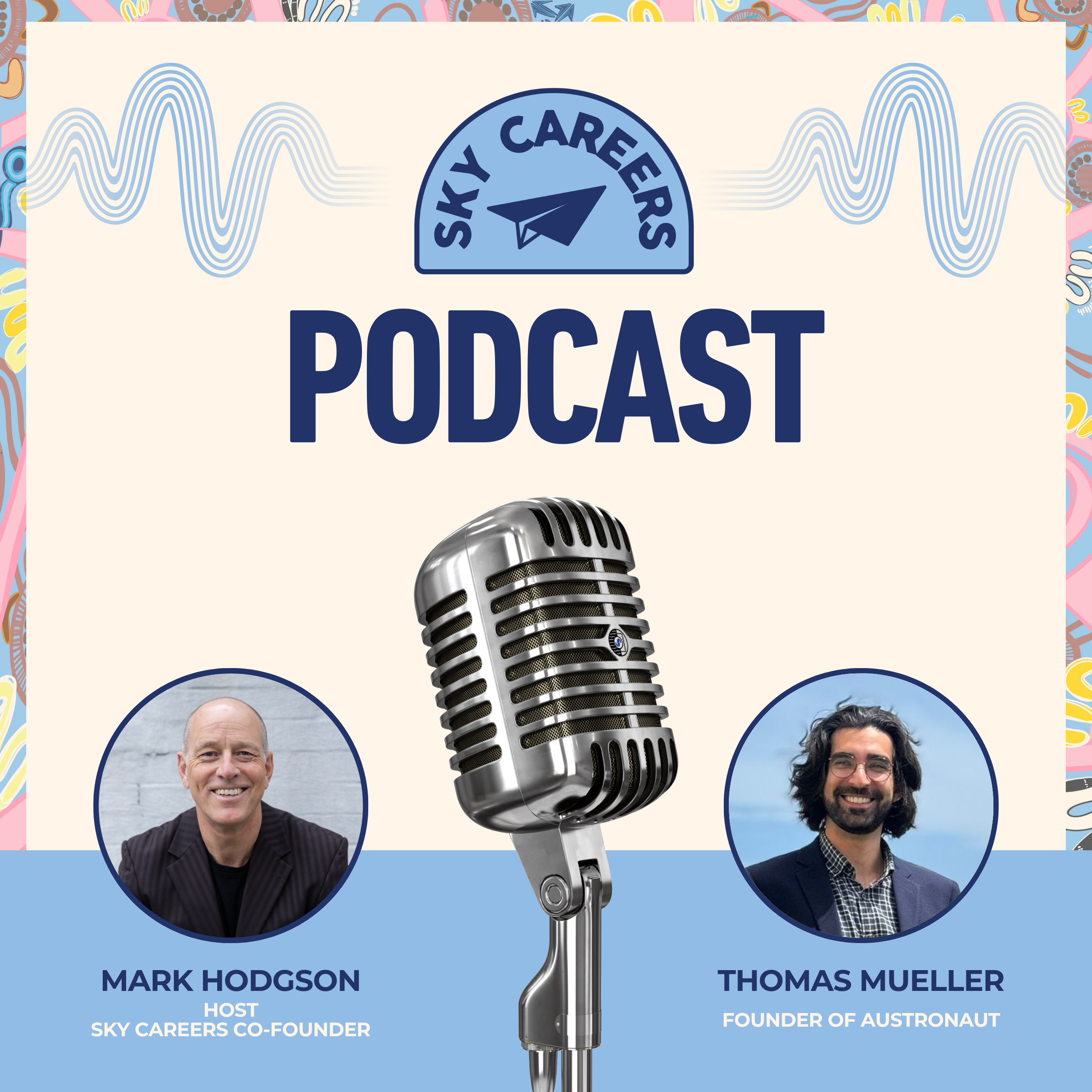
My name's Mark Hodgson. It's my absolute pleasure and privilege to be your host today. And today we have a slightly different type of guest. We're going above aviation to the world of space.
And today I'm joined by Thomas Mueller, who is the founder of Austronault. I don't know much about it either, but we're going to find out. Thomas, welcome to the Sky Careers podcast.
[00:00:38] Speaker B: Thanks, Mark. Thanks for having me.
[00:00:39] Speaker A: You're super welcome. Right, before I go back to your school day, just give us a little bit of a sense.
What does astronaut do?
[00:00:47] Speaker B: Sure, yeah. So amongst several different things that I'm working on at the moment, one of the main things I'm doing is workshops and training programs that teach the skills and capabilities that astronauts have.
And that may be for the broad public to take those skills and apply them to their everyday life and whatever they're doing to become, you know, a better performer or, you know, more, more capable of dealing with difficult situations. But also I'm doing it for the people that are interested in becoming astronauts and, and want a pathway or a stepping stone to, to that objective.
[00:01:25] Speaker A: Fantastic. That sounds like something we're going to enjoy unpacking a little bit over the next 20 minutes or so.
[00:01:32] Speaker C: Because, you know, I'm a lot older than you, Thomas, and it's funny enough
[00:01:37] Speaker A: I was reading a thing at the
[00:01:38] Speaker C: weekend about William Shatner, who you probably
[00:01:40] Speaker A: remember as the original Captain Kirk, who
[00:01:42] Speaker C: I believe is 94 or just something like that.
[00:01:48] Speaker A: Back when I was a little kid, we were all watching Star Trek and
[00:01:50] Speaker C: space then really did seem an awful long way away. And Star Trek was a fiction and obviously we had the first moon landings and you know, the Kennedy man on the moon piece and all that. But that was back an awful long time ago. But fast forwarding to today, space and aerospace are much more part of the, I guess the reality satellite Starlink, just that recent thing to the, to the far side of the moon. So it's not as far out of sight as it used to be, is it?
[00:02:28] Speaker B: It's definitely having some, some big exposure at the moment in the last few years. I mean, even just the news in the last few days about the SpaceX IPO and potentially being the most valuable company, you know, ever.
I think since, you know, the original Apollo missions and Mercury and things like that, it's always been, been there, but I, I would think that it's maybe having a big renaissance in, in the last decade probably. Yeah.
[00:02:57] Speaker A: Okay, let's go back to go forwards. Tell us about a young Thomas Mueller.
Where did you go to school? What were your favorite subjects?
[00:03:05] Speaker B: Sure, sure. Yeah. So I went to school mainly in, in Sydney where I am at the moment at a Jesuit boys high school called Saint Aloysius.
My subjects, yeah, a lot of, you know, physics and maths and things like that towards the end, towards the hsc. But I also did subjects like French and I also did, you know what else I mean, we had to do English. I was always kind of interested in also alternative types of subjects from the STEM stuff to balance it out.
I also continued that at university. I went to the University of Sydney. I finished with a Bachelor of Science in mathematics, but I did a lot of like political philosophy.
I did several like anthropology subjects and psychology and things like that, but lots of physics and all that type of stuff. Yeah.
[00:03:57] Speaker A: So what was the gateway from those studies through to your, your, your fascination with all things space and, and, and
[00:04:05] Speaker C: to ultimately founding your own business?
[00:04:08] Speaker B: Yeah, yeah. I suppose that the main gateway from that period of my time was the International Space University.
So as an undergraduate I went and did a course in Adelaide, a four week course called the Southern Hemisphere Space Studies Program.
And then I went from there onto being a staff member and they run, well, they were running an annual Northern Hemisphere version of that program which went for several months and I was a staff member on that program a few times.
And that was one big pillar. The other pillar that I think kind of created my interest at the moment was my, my first kind of job outside of uni was working in a neuroscience research lab as a mathematician.
I personally think I was way out of my depth, but it also gave me a lot of insight into how the brain works on a cellular level.
So we were looking at how basically the tau protein forms inside the cells and potentially contributes to, to Alzheimer's disease and other neurodegenerative diseases.
And that's so, so kind of like both of those aspects, like looking at space and this huge kind of like perspective about the universe and then the nitty gritty detail of like what's going on in the cells of the brain. And kind of connecting those two things is, is actually what I'm trying to do in astronaut. You know, how does, how does the individual kind of change and develop themselves on, on the smallest of tiny scales so that they can be capable of doing something like going to space and exploring the universe.
[00:05:44] Speaker A: Wow. So we just, that's all we've got to unpack in the next 15 minutes.
Thank God. Thank God. It's not far reaching or profound. Otherwise we might be, we might be in trouble, Thomas.
So link me. So explain to me if you'd be so kind, the, the work you were doing. So you said you were on staff in the northern hemisphere. Where was the northern hemisphere campus?
[00:06:08] Speaker B: Yes. Strasbourg.
[00:06:09] Speaker A: Strasbourg. Strasbourg. So you're up there.
What does that campus look like? What does experience like?
What's the range of subjects you do? Because I think you said that's three or four months.
[00:06:22] Speaker B: Yeah, that's right. Yeah.
I'll just start with the subjects. And one thing that ISU has done really well is to tackle space education in, I guess, for lack of a better word, holistic. Interdisciplinary might be the better phrase.
So they tackle, you know, engineering, but they also do space law, space science, space humanities. I was involved in that department when I was there, which was, which was actually really valuable in terms of how do you communicate what's happening in the space industry to people and get them interested.
Policy they cover and human performance and the medical side. So like quite a broad range.
The actual campus itself is, it's a, it's a nice building in sort of like an industrial park of Strasbourg supported by the, the local government there. And it's a little bit of like a, I don't know, I don't want to say the wrong way, but it's a little bit of a temple type of place. I, I find that, you know, like, it's like a big hall with a rocket engine at the end and sort of like, you know, the pictures of famous space fairies and it's called the Pioneers Hall. It's sort of like the main hall. So it's, it's. Yeah, I hate to say, but it also feels like a little bit of a spiritual experience when you go there, I think.
[00:07:45] Speaker C: Yeah, it's, it's, it sounds fabulous.
[00:07:48] Speaker A: I've just put it on my bucket list. I'd love to, I'd love to go and love to go and check that out. It sounds amazing. And what kind of, what kind of
[00:07:54] Speaker C: people sort of going on the, the program or studying at the isu?
[00:08:01] Speaker B: Yeah, I think one of the amazing things about the, the ISU programs is the, the broad variety of people that you have. So it starts with undergraduates usually like towards the end of their undergraduate degree, but they're really trying to appeal to a broad range of interests. So people can come from arts disciplines, they can come from technical disciplines, but as long as they have an interest in space and are demonstrating, you know, that they're performing pretty well then, then they probably have a place there. But also the age range. So you had people who were, you know, at the beginning of their career, but you also had people who were like to war, like towards the middle of their career, maybe looking for a career transition. So they had worked maybe 15, 20 years in a certain industry and then had all of a sudden gone. You know what, actually I really want to work in the space industry. Where do I go to like professionally develop?
And then they did a pivot. And I know several people that have gone on to have really successful careers in like high profile space companies.
I have one particular friend who worked in waste and recycling for 20 years and then went on to be a professional astronaut recruiter for Axiom Space after he went through the International Space University.
So you get to do this program with all these people and yeah, that's a really wonderful experience to learn from such a diverse group of people.
[00:09:25] Speaker A: And that's obviously impacted you. And so from there you, at what point did you decide, you know what, I don't just want to be a, and initially a student and then on faculty. I actually want to bring that back to Australia and set up my own version or a space specific training experience business. When, when did that happen, Thomas?
[00:09:47] Speaker B: Actually I had that, that idea before I even started at the Space University. I, I did cadets when I was in school, army cadets. It was attached, attached to my, to my school itself. And that was one of, for me, one of the most significant experiences of my sort of teenage years. And I really love the idea of participating in something that wasn't necessarily classroom focused, was all about developing adjacent skills to academics, teamwork, leadership, even field craft. And, you know, how do you cook meals when you're not in the kitchen and stuff like that. I loved all that stuff and I thought, wouldn't it be great to have that? But a space version. So all of the skills are based on what astronauts have and can do that makes them successful to, you know, go on, on space missions. So I actually had the idea before, before the, before I started the ISU and I went to the ISU programs also wanting to find out like, okay, what is, what is. This is an example of something that's already been constructed. What are they doing that I like and what are they not doing that I would like to see in something that I, I'm building.
And I love the isu, but I personally felt there wasn't enough astronaut related stuff. I was like, it's a lot to do with Space education and, and space skills, but not specifically about what does it take to make someone capable of doing, you know, a space mission.
Understandably, it's not a huge market of people, but I still think it's a growing market and people are really interested. So. Yeah.
[00:11:24] Speaker A: So is, is another version of what you're talking about.
[00:11:26] Speaker C: It's Astronaut Boot Camp. Would that be horribly appropriate or misappropriate or am I kind of in the right kind of ballpark?
[00:11:33] Speaker B: No, no, no, that's in the right kind of ballpark. And what's actually happened throughout my journey is I started with one particular vision in mind. I was like, it has to look like this. And as I've developed, I've gone, okay. There's actually a lot of people out there that have a thread of interest in this topic. And some people might want Astronaut Boot Camp. There are certainly some people out there that want to go away for like two weeks or whatever and just do things that challenge them physically and technically and, you know, make them develop as an individual. Other people just want to learn about what is going on with astronauts, what is going on in human spaceflight. Some people want to just specifically learn the technology.
So I've started to develop different products with different aspects and qualities for those different types of people so that it can kind of, you know, meet people where they're at as well.
[00:12:31] Speaker A: Love it. So I'm going to ask a question. I don't know where the answer to this is bleeding obvious or whether it's a good question, but. Yeah, what are the main differences?
So if I'm doing Astronaut Bootcamp, what are the considerations?
What are the considerations that are space specific that we need to think about that you've kind of catered for in your curriculum or your offering?
[00:12:53] Speaker B: Okay, yeah, for sure. So the medical side is obviously like a huge threat of astronaut training or astronaut preparation.
First of all, the ability to prevent injuries from occurring if one was to go on a space flight also aligns pretty well with basically anti aging exercise. So like, how do you maintain, you know, muscle mass? How do you prevent bone density loss?
[00:13:22] Speaker C: And that's, that's to primarily with the abs. Well, mainly with the absence of gravity.
[00:13:27] Speaker B: Yeah, yeah, that's basically, basically it. Yeah.
Cardiovascular deconditioning is an effect of again the microgravity environment. So Astronaut Boot Camp or Astronaut Boot Camp would include.
What do you need to know if you wanted to go down the career pathway or put yourself in the game for becoming an astronaut, you should probably be doing these types of exercises before long before you get selected. Right. So you're familiar with them. So you know that you have a certain minimum cardiovascular capability, that you have a certain minimum muscular strength that you can do. The compound exercises, bench press, squats, deadlifts, they basically do on the exercise equipment that's on the space station. So that could be one that's like one core aspect, you know, for that.
And then I would say you'd want to know how to operate in a small team in an extreme environment. Like that's, that's really important. Like, you know, if, if you've never been camping before, then I think that's the first place to start. Like how do you, how do you know what it's like to sleep in a small environment? Be on, you know, limited equipment, limited rations, dealing with the same three or four people across a 72 hour period or something like that. So stuff like that is I think, one sort of type of product that Austronaut can offer.
[00:14:49] Speaker A: Yeah, yeah. So the psych.
[00:14:51] Speaker C: So, so the, the, the, the medical, the physical and also the site, the, the psychological piece. I mean, you know, I can't remember, I've just watched that movie. I can't remember what it's called now where they, they, they saved the planet by going out to Mars or something or. And it's. Yeah, that. Deep space travel and in, in space or some kind of suspended ammunition for 20 years.
[00:15:10] Speaker A: And those are very real challenges and studies, a lot of study in those areas aren't there about how you actually cope with the kind of long periods of time that sustain space travel.
[00:15:21] Speaker B: For sure, for sure. Just before we go on to the next point, I just want to say the psychological aspect opens a huge door to different types of, I don't know, for lack of a better word, products and services that people might be interested in. Because you know, especially in Covid, people were using astronauts and space stations and space missions as an example of what, how people can be resilient to isolation and confinement.
How, what kind of behaviors and, and attitudes do you need to make sure you can, you know, like deal with that situation in a mentally healthy way? So like once you open that door, like what, what makes astronauts psychologically resilient to dealing with such a stressful environment in an isolated and confined environment? And that can apply to so many different areas and moments in people's lives. So you know, there's like the boot camp type of stuff, but there's also the more general, like how do you make yourself more psychologically resilient to just the Stresses of life in general.
[00:16:25] Speaker A: Yeah, yeah. And I can see how it's interesting. I can see how that looping back, I can see how that would draw on your relatively broad. I know you did quite a lot of STEM stuff at school. We've also done some other sort of more arts and humanities style study where philosophy and sort of ethics and arts, I mean they're all going to be important, aren't they, in sustaining ourselves or self sustaining in say often as you say, in extreme isolated and also lonely environments where there aren't thousands of people
[00:16:56] Speaker C: and lots of, lots of change and things naturally happening.
You've got to kind of create, remain, remain balanced and centered in a relatively sterile many senses. A completely sterile environment.
[00:17:11] Speaker B: Absolutely. Yeah, absolutely.
In terms of the subjects, why I went between mathematics and things like political philosophy, the bridge there, which might also be relevant for the careers aspects here, which I think is really important.
Like I came across for example Rene Descartes and I, I knew Rene Descartes from Cartesian mathematics. I was like the XY coordinates.
[00:17:35] Speaker C: Who doesn't stuff him for sure.
[00:17:37] Speaker B: But then I didn't, I didn't know that he was also a philosopher and he wrote kind of works like Discourse on the Method where he was describing his way of thinking. And that was a real eye opener for me. I was like, okay, so the same people who are talking about like these really black and white mathematical. Yes. No, rigid concepts are also kind of like hypothesizing and philosophizing and trying to explain their way of thinking. And I was like, oh, okay. So mathematics is also a language, you know, it's also about communication. It's about how effectively you can explain your ideas. And that was a real eye opener for me in terms of like thinking, trying to think holistically, trying to bring other concepts and other fields of knowledge into what I was already doing.
[00:18:24] Speaker C: So it's interesting you say that's the thing that springs out to me and I'm scraping through some old memories here. So a good astronaut in many ways, or someone who's a person who understands space well, is something of a polymath, an expert in multiple disciplines, whether.
[00:18:42] Speaker A: Yeah.
[00:18:43] Speaker C: So when we do this very sort of arts and sciences or STEM and humanities kind of bifurcation, don't we? But it sounds like we need to be more broad minded and draw on a whole host of different. For one of the better disciplines.
[00:18:59] Speaker B: I absolutely think so. I mean when you look at the astronauts resumes basically there's nothing that they haven't tried to do at the very least and get sort of qualified in some level. There's quite a few astronaut resumes I looked at recently where not only did they have their like engineering or test pilot qualification but they often had a business masters or they had like a, even a. I think I saw someone recently who had like a legislative policy masters and that was before they became selected as an astronaut.
[00:19:35] Speaker A: Yeah, but a lot of those guys are also, I think it's fair to say most of them are incredible high achievers and over performers. They've got four degrees and you know, they, they're in and out of the military often and then they go and get a. Speak seven languages and yeah, much as we aspire to qualifications and bettering ourselves on sky careers, I think that's, it's reasonable to say that's not probably within the grasp of most people.
So that being said, with what you're doing in Ostronal in Australia, what's the, I guess how do we make space and everything around it more accessible for if you like the averagely interested sort of listener who might be interested in exploring some aspect of space. Whether that's as a, to work in the industry or to understand more potentially about the pathway. I mean one of the things I'm minded is. I know, yeah. Suanne, the co founder of Sky Careers, she, she wants, she wanted to be an astro. I keep, I keep saying to her well it's not too late.
It's probably more possible now than it was, you know, 20, 30 years ago when she first had that dream as a little girl.
And it seems to me, I know there's, there are some commercial space flights and obviously they're very high end at the moment, but there's also talk of that being made easier to access. So I know there's a lot, a lot of different questions in there but what's your, what's your view on how do we kind of, how do we make space and the space industry more accessible and what are good pathways for people who might be interested in space
[00:21:19] Speaker B: so more accessible in terms of just enabling knowledge and information to be out there in the public or like the ability for people to participate in it?
[00:21:33] Speaker A: Both, whatever.
[00:21:34] Speaker B: Okay.
[00:21:36] Speaker A: It's a big topic.
[00:21:37] Speaker B: We just, it's a big topic.
[00:21:38] Speaker A: We can go, we can go anywhere. Thomas.
[00:21:39] Speaker B: Yeah, okay. Look, I think for me if, for people that want to get involved in the space industry starting there, I think it takes perseverance, I think it takes longer than most people imagine and that's sort of the filter I Think that's one of the big filters is it's not easy and therefore if you, if you really really want to do it, you have to go through those stages of trying something and not just necessarily getting the results that you want. Trying something else kind of regrouping and persevering and that, that's why, you know, it's quite I guess prestigious is because you have to really try to figure out how to, how to get there. I often don't even really think that I'm in there myself. Like I, I'm still trying as, as from my perspective to get a sustainable foothold in there.
And how do you make it more accessible?
I think the opportunities are there with the space industry.
The money may not be. So there's really a lot of ways to get involved if someone is interested. There's lots of public events, there's always panels going on the p. I find one thing. Is the people in the space industry really accessible? Either that's through social media or through, through events because it's quite a community. So and people know how like how hard it is to, to trying to get it get in there, that they really want to do outreach and make sure that the next generation of people that are interested can get in. So for me, for someone who's interested it's just try, try, try, go to everything, talk to everyone, be confident, be courageous. You know like things happen. Things do happen. They take time but they do happen.
I personally from the side of the organizations and, and the government for example, I feel like they've almost done everything they possibly can with limited resources to try and make it at least in Australia, I give them the benefit of the doubt and if it doesn't feel like the public really gets to participate as much as they could, I'm not really sure I can point at. Bless you. Really point at the, the fault of the.
Of the powers be in my opinion.
[00:23:59] Speaker A: Yeah.
My, my sense, I've got to say I, I do I. One of, one of the things I do is I judge the space industry wards ramps around leadership.
There is some fantastic submissions and it's. I always find it amazing what's going on around rocketry and research in human systems and a whole lot of different, different things in weird and wonderful areas. Communication satellites, navigation. Satellite navigation software, a whole lot of stuff. And there's a big overlap also with defense and it does seem to me that Australia has a, has a reasonable reputation in this area. Would that, would that be true do you think?
[00:24:35] Speaker B: I think so, yeah. Definitely. I personally think Australia punches above its weight in this industry.
There's several really good, more than several really good startups come out that have come out of Australia and are selling their technology into the global supply chain.
I personally think often the negative perspective about Australia in the space industry is usually around we don't have sovereign capability, we don't have end to end satellite manufacturing and launch capability and things like that.
I don't really know if that's realistic.
I think we participate in international research collaborations with other universities and we have our niches that we're doing really well at.
[00:25:20] Speaker A: Yeah, yeah.
Turning to Austronau, your, your business. Tell us a bit about, a little bit of it, more about that and how you're, who you're working with and tell us about some of your customers.
[00:25:31] Speaker B: Sure, yeah.
So astronaut is developing quite well at the moment. You know I, I think in terms of it's, it's, it's every month it's, there's something new and what have I been doing? So I've started working with Dr. Jim Green who's a former NASA chief scientist.
He worked for 30 plus years in Planetary science at NASA and then became the chief scientists around about 2017. I, I think it was, he started a virtual reality space education platform with space environments based on real data from the Mars, from Mars and the moon.
So you can kind of through virtual reality be transported to a location on Mars and the terrain that you're looking at is the real terrain that Curiosity rover has been scootering around.
And the same with Mars, sorry, the same with the moon.
So I've been working with him and his organization called Meta Visionaries on some virtual reality programs, sort of like actually open to the general public but kind of focused on university students.
I've been working pretty closely with Australian polar explorer and astronaut Eric Phillips.
He went to space with SpaceX last year on a basically a four day mission, Polar orbiting the Earth.
And with his career in exploration I try to extract that mindset, the kind of the courage that it took for him to go down that career path as a young person and sort of say, yep, I'm gonna be a polar explorer.
And so I try to like kind of extract that in the workshops and sort of pass that on to people
[00:27:27] Speaker C: if I possibly can because there are quite, there are quite coming back to your definition about small team and extreme environments. So that polar exploration is similar.
Absolutely, yeah. Very, very similar.
[00:27:43] Speaker A: What do you love most about your job running and growing astronaut?
[00:27:51] Speaker B: The thing I love the most is seeing A piece of the vision come to reality.
I think that's one of the most satisfying things that anyone could possibly have.
You know, the difficulty obviously, being you can have as many ideas as you want, but getting the resources to actually put them into practice is very, very difficult. But when you have an idea, and this is actually also kind of what I try, I want to teach through the workshops, is that when you have an idea that's kind of feels like your own at the very least, and you make it happen, and it gives you that confidence to be like, I can. I can actually create something and execute it, I think, yeah, that's really satisfying. And value of that is beyond, you know, anything financial or status. You know, that's like. That's really deeply satisfying.
[00:28:47] Speaker A: Yeah, I love that. Good, good, good for you. You haven't. You're having a crack, my friend.
[00:28:51] Speaker B: Yeah.
[00:28:52] Speaker A: What's the least favorite part of. Of your astronaut business?
[00:28:58] Speaker B: I think not knowing, you know, not knowing that anything you're doing is really going to result in the bigger vision coming to reality. Because there's sort of like a critical mass that you need to reach for things to work. Like all those little pieces that work, you're like, okay, great, that's a little 1% here, a little 1% here. But you kind of have an idea like, this is only going to work if, like all of those things work at the same time, the whole machine starts working.
And I think that uncertainty is something. For example, I was working in a corporate job before, which was also really interesting.
You can still, you still show up to work and you're still going to get your salary that month, no matter what the outcome in some cases of. Of what you're doing is. So that's kind of scary. Yeah.
[00:29:46] Speaker A: Well, I admire, I admire your tenacity and bravery and have. In having. Having a go.
[00:29:51] Speaker C: I've started several small businesses. Sky Careers is one of them.
[00:29:56] Speaker A: And yeah, it's.
[00:29:57] Speaker C: It's not easy. It's never easy, but it's massively satisfying. There's a creative aspect to it. There is a courageous courage aspect to it. You've got to be brave. You will take lots of knocks, but it builds your resilience and, you know, you won't die wondering. I think that's so important to have a crack and whether it's in this or in other areas, to our audience, it's so important to chase your dreams and follow your dreams and try and create something that doesn't exist and what inverted commas success looks like on the Other side of starting something will vary, it will evolve. In my experience, it's rarely what you think it's going to be and it's found in different places. Just the satisfaction of having a crack is often underestimated.
[00:30:43] Speaker A: And a lot of people never try these things or they're too. They lack the courage to step out and they regret it. So I applaud you on that.
[00:30:52] Speaker B: Thank you.
[00:30:53] Speaker A: Are you going to get to space, Thomas?
[00:30:57] Speaker B: I don't think so, but I still love supporting this industry.
[00:31:02] Speaker A: I'm going to give you a better answer. I'm not having that. I am not. Sorry. I'm not having that answer. Let's ask that question again. When are you going to space, Thomas?
[00:31:10] Speaker B: When am I going to space?
[00:31:11] Speaker A: You're a young man. You got so many things are changing in this, in this whole space world. I can't believe you won't have the chance to achieve your.
I mean, it's the obvious next thing or the obvious thing, maybe not the next thing is the obvious thing that you would love to do.
[00:31:27] Speaker B: I'm sure I, I would definitely love to do it, absolutely.
I think there were so. There were many, many years where I was really, really passionate about that exact idea, where everything I was doing was about achieving that goal.
But I think I, I think, I feel, I feel like I have observed myself enough to sort of know, at least through the government pathway, I'm probably not the guy. But yes, who knows what could happen.
[00:31:56] Speaker A: I didn't, I didn't.
I guess I, I think, I think we're agreeing. I didn't mean particularly, oh, you're going to become an astronaut and, you know, sit in the front of some rocket. I mean, as, as in actually in some way shape or form experience space. Because in the next, you know, you, you know a lot more than I do. But I, it would seem likely in the next few decades and you're relatively young, that that's going to become much more accessible in the same way as, you know, flying was now, now flying is now every day. But I remember even when I was much younger that flying, you know, certainly commercial flying, I know I was at the age of 15, so 45 years ago. I know I was the first one, my brother and I were the first ones in our family to fly anywhere because international travel from London and York was seen as, you know, the thing of rock stars. So to actually get on a very old 747 absolutely seemed, seemed, you know, seemed remarkable. And yeah, it seems so everyday, doesn't it?
[00:32:52] Speaker B: Well, I don't know how deep you want to go into this particular topic, but I, I do have some reasons why I temper. My answer is because I personally think there are some reasons why aviation took off in a different way than space travel will take off. I think one of the key reasons is with aviation you're flying somewhere to see people, to be with people. Yes, there's like exploration, but the main bulk of aviation and air travel is because I'm going to visit people, I'm going to do business, I'm going to say something. There isn't really that outcome in space. You go to the moon. Yes. To develop something, maybe in future, but it's kind of more like going to Antarctica.
[00:33:34] Speaker A: Yeah.
[00:33:34] Speaker B: And you know, that had a different timeline, I think, but nonetheless, I definitely think it's great.
[00:33:43] Speaker A: Skirting on space tourism and, and versus boldly go.
[00:33:47] Speaker C: Which is, which is.
[00:33:48] Speaker A: Yeah, a whole other thing.
[00:33:49] Speaker B: Yeah, yeah, yeah, yeah.
[00:33:52] Speaker A: What advice would you give to other young men and women who may be considering exploring space and aerospace as, as, as, as a, as potential career?
[00:34:11] Speaker B: Yeah, I think so. There's, there's, there's actually, there's two things I want to mention which kind of tie back to some things we've already talked about. So we were talking about the degrees and how, you know, astronauts have all these different kind, may have all these different kinds of broad degrees and things like that.
I think the best thing you can do, especially when people have this objective of wanting maybe to become an astronaut. Right. I see a lot of like Internet forum posts about it. They're saying, I need to do this, I need to do that.
You know, what if I'm not capable of doing high level engineering, blah, blah, blah. I personally think, and many astronauts would say exactly the same thing because I've asked them do something that you love because you're never going to be the best at something or really, really good at something if you don't love it.
And if you, if you can, if you can find something that really resonates with you and excel at it, you've got a better chance of finding that opportunity down the line. And Eric Phillips is a perfect example of that. So he did, he wanted to be an astronaut as a kid. He set out to do polar exploration as the next best thing. He went, okay, well, I'm gonna, I love exploring. I'm gonna be a polar explorer. Okay. He's a sample size of 1. But by pursuing the thing that he believed in, he actually ended up going to space.
So I think that's One thing is pursue something you're passionate about because that's what you'll excel at. And the second thing is the having a crack.
So we talked about you have to find the courage to have a crack and get used to that exercise, that muscle. It's a muscle to be comfortable taking that, taking risks, you know, within reason.
And you kind of dial that in. I think over time. You kind of know where the right places to take risks are. And I want to just quickly tie that into.
There are several astronauts that have stories where they never. They almost didn't apply to become an astronaut.
I think Thomas Pesquet, French east astronaut, is one of those people where he, he.
It was on someone else's suggestion that said, why don't you apply for this? You would actually make a really good astronaut. And he didn't think about doing it. And then he was like, you know what? I'll just throw my hat in the ring and see what happens. And he got it. And it's that, that, like, kind of that final 1% of like, let me give it a go, that actually may result in an outcome. And often people, I think, give up before that moment. So to me, those are the two key things.
[00:36:41] Speaker A: Yeah, that's. That's brilliant advice. Brilliant advice, Thomas. That's, that's really good. And I couldn't, I couldn't agree more. Those are, those are great things. Do something you love and, and have a crack, you know, don't die wondering. Don't just.
Yeah, don't just sort of bury your ambition or bury your dreams and. Yeah, you never know.
One thing you do know, if you never apply, if you never try.
[00:37:08] Speaker B: Yeah.
[00:37:09] Speaker A: One of my. One of my favorite sets of lyrics is from Coldplay, the song Fix you. And it says, it's this. If you never try, you never know just what you're worth.
And I think that's, that's a sort of. Some sums that up.
What do you do when you're, when you, when you're not. This last question. I've got to let you go because we're rolling and rolling, rolling. But I'm gonna land the plane now. When you're not. When you're not running astronaut. Excuse me.
What other stuff are you up to, Thomas?
[00:37:40] Speaker B: My. My big other passion is music.
Some. I love producing music and I like DJing.
I've had limited success as a. As a wedding DJ and a corporate DJ, but I love producing music. And actually my, my passions collided. I made a showreel for Eric to promote, you know, Giving public presentations and stuff like that. I edited the video and I was like, well, we need to put some music in there. I put one of my songs in there and he loved it. So, you know, the music production is going somewhere.
[00:38:17] Speaker A: Do you know what I, I love, I love that answer because, you know, just looping back to some of your, your earlier answer. I mean, I think when we think, when we talk space, we think astronauts and we think, you know, men and women, but mainly men based on history, you know, in, in sort of big
[00:38:34] Speaker C: massive space suits and glass, glass domes
[00:38:37] Speaker A: on their bowls, on their head.
But as you and I have talked about this today, I, I much more get the sense if we put space in the middle, write the word space in the middle of a piece of paper, put a circle in it and then draw lots of lines.
[00:38:49] Speaker C: There's so many aspects, you know, medicine,
[00:38:52] Speaker A: health, isolation, leadership to exploration, you know, science, arts, philosophy, all those things sit around it.
[00:39:00] Speaker C: And the actual mechanical astronaut piece is actually, and the technical aspect is whilst it, whilst it, it obviously touches everything,
[00:39:11] Speaker A: you know, in, in one, in one sense, in another sense, it's actually the least important part because all those other things, once you've got them built this, built the thing and got somewhere on the way to somewhere in a space environment, all these other things become much, much more important. So I love the, I love the connection between your, your, your sort of, that side of that sort of piece. So that side of the things you've spoken about. But then you talk about a passion for music which is again, that sort of other, other, other side. So I, I, I, I love that. Hey, Thomas, I've got to let us go because otherwise we'll ramble on forever.
But I wish you all the best with Ostronor.
We'll include the link to your website in, in the, in the show notes. Is there any, is there any. How, how can people just, apart from using, how can people contact you if they're interested in finding out more about what you, the work you're doing?
[00:40:05] Speaker B: Yeah, sure. So feel free to connect with me on, on LinkedIn. There's an astronaut Instagram, astronaut space. There's an astronaut Facebook. I believe there, I mean there is. I just can't remember the, the URL for it, but my email address is available through the contact page on astronaut.
More than happy to receive communications.
[00:40:25] Speaker A: Yeah, we'll put all of that in the show notes. Dear Listener, I met Thomas a few weeks ago at ShellHub. We had a good conversation and I thought Thomas would be a great guest for the podcast. And I wasn't wrong, was I? Thomas really enjoyed our conversation.
We'll have you back in a few years, see how you're getting on. But in the meantime, thanks so much
[00:40:48] Speaker C: for being a guest on the Sky Careers Podcast. Cheers.
[00:40:51] Speaker B: Thanks, Mark, and good luck with you for everything as well.
[00:41:02] Speaker A: Thanks for listening to the Sky Careers Podcast.
If today's conversation has sparked your interest in aviation, then head over to our
[email protected] au whether you dream of flying aircraft or you're curious about the hundreds of other exciting roles that keep the aviation industry moving, skycareers is your gateway to discovering these opportunities.
And if you are already in the industry, check out Sky Careers Connect and Sky Careers Leadership and consider joining our online learning community.
Until next time, keep reaching for the skies.