[00:00:00] Speaker A: Foreign.
[00:00:08] Speaker B: Welcome to this edition of the Sky Careers Podcast. My name is Mark Hodgson and it's my pleasure to be your host.
Now today we've got a little bit of an unusual guest.
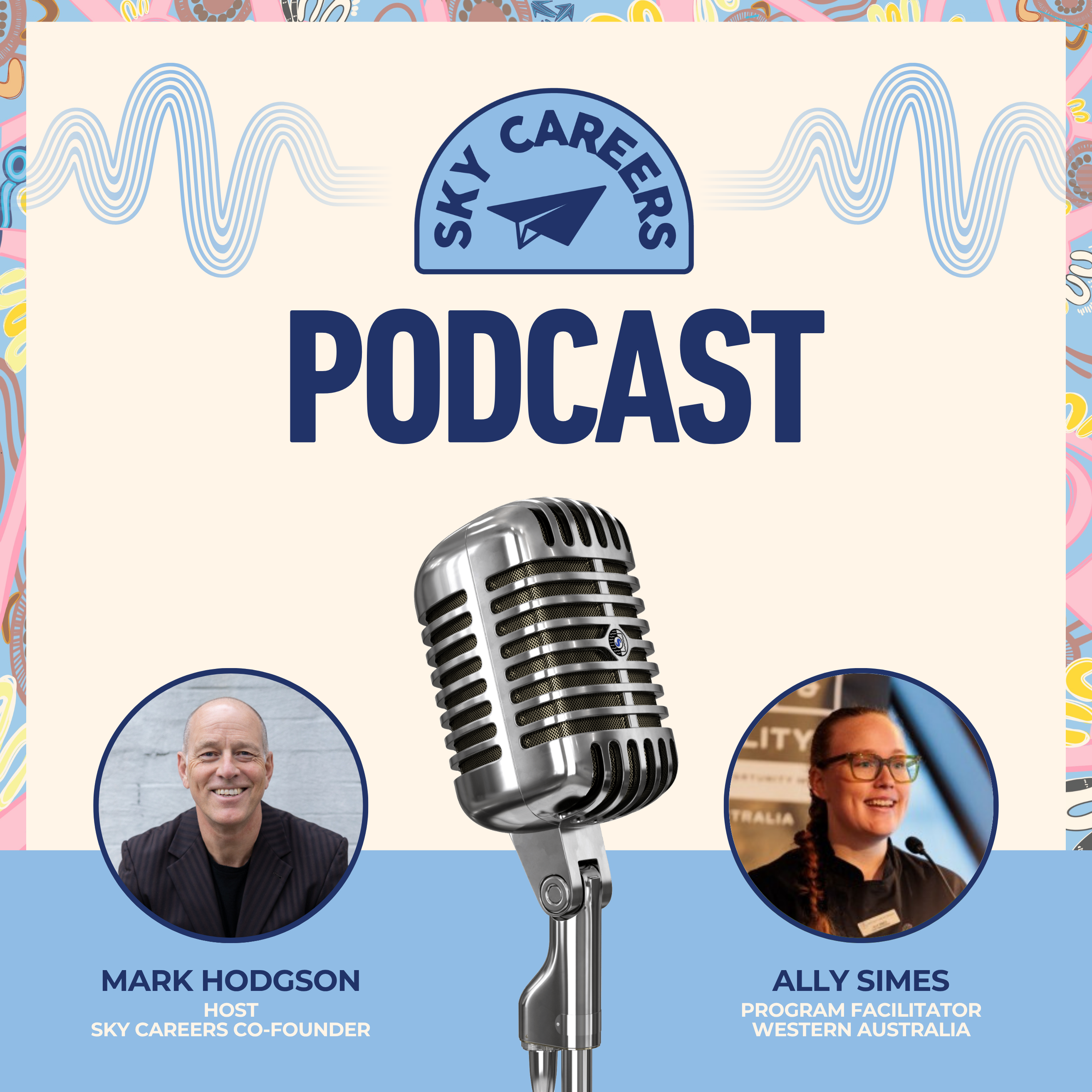
Her name is Ali Simes. Ali is not, is not of aviation, but we came across Ali when we were out and about in Western Australia. The team, the Sky Careers team out there doing a lot of work, going into schools and colleges and working with employees.
And we came across Ali on sort of the, on the school's careers circuit. And Ali is the program facilitator for the Tourism and Hospitality Schools Career program which is a function and sponsored by Tourism Western Australia. So it's a hell of a mouthful. So, Ali, welcome to the Sky Podcast.
[00:01:03] Speaker A: Thanks for having me. It is, yeah, it's definitely a long title to have, that's for sure.
[00:01:09] Speaker B: Yeah, we were joking that a conference. Your name badge must be about. It must be about 30cm long.
So tell us, Ali, we always start at the beginning and I know you're not, I know you're not aviation specific, but let's go. But let's go back to, let's go back to your early days and you're joining us from Western Australia. Where did you go to school and what were your favourite subjects?
[00:01:31] Speaker A: So I went to school in the northern sort of suburbs of Perth back when the freeway only went to Joondalup and it didn't continue on any further than that.
And for me, school, and I say this to all my students too, school wasn't necessarily for me at that point. I enjoyed all my subjects and things like that, but usually it was the creative sort of stuff as it seems we all end up just there by the sounds of it.
Yeah. So things like food, technologies, anything sort of hands on sports, that sort of stuff. Dancing to get me through the day. But yeah, and just not a sit still kind of person.
[00:02:12] Speaker B: So not a sit still, not, not necessarily academic and no. What was your own. Before we get into what you're doing in your current role, what was your pathway from. From that kind of school background into your current role?
[00:02:29] Speaker A: So I actually started as a chef and that's how I ended up in hospitality, starting out in high school as well. So, you know when they make you do a little bit of work experience, things like that, around sort of year 10, year 11, I went and did that and I did it in a kitchen up in the northern suburbs and it was just utter chaos and that was what did it for me.
It gave me something to sort of focus on and Start with that again. I could use work with my hands and try different things and be active as well as being at school and finishing school.
So that's kind of how I got my start was through a school based apprenticeship pathway with hospitality group training. So it's slightly different to what I do now, but sort of in the same realm of tourism and hospitality.
Yeah. And that's kind of what started my career, I guess.
[00:03:22] Speaker B: So how long were you a chef for and what was that like? Because it always strikes me as incredibly, and I know some chefs, it's incredibly. It's a mixture of creativity, of planning, of finance, of team building. And we've seen it done well. We've also seen it done badly. I mean, there's lots of famous sort of TV celebrity chefs who come and fix broken kitchens and so forth. So what was your experience?
[00:03:48] Speaker A: So I started out, I was very young, I was about 15 or 16, and I'm not going to lie, it was a lot. It was a lot. And I find that it's one of those spaces when I was mentoring chefs and things like that a few years ago that, you know, it's not, it wasn't just my experience that is for everybody. It's a chaotic environment depending on what type of kitchen that you work in.
So I, yeah, I still work as a chef now, just not obviously full time anymore. So that's going on 10, 15 years now.
But I was working as a full time chef up until maybe about five years ago and then I went more into the recruitment and mentoring of apprentice chefs and running the in schools programs through that, which is kind of how I led.
[00:04:36] Speaker B: Is that a world? Is that a word? It is now.
[00:04:37] Speaker A: Right, chefs.
[00:04:38] Speaker B: Yeah, I love that. I've heard apprentice chefs. That's great. I love that. Sorry, that's new on me.
[00:04:44] Speaker A: Yeah, it's, you know, it's one of those things where you've got to work your way through and work your way up and thankfully I was able to do that whilst, you know, doing a bit of travel and things like that too, and then trying to just find out what's next at that point.
But yeah, it's, it's a chaotic world. But if you love it and you're passionate about it, probably much like aviation, I assume, you know that if you put the focus into it, you can really make something for yourself and you can make yourself quite a long career. I know some incredible chefs who, you know, in their sort of 50s and 60s and they've been doing it for their whole life and they just, they love it. But then I know some people who also do it for 10 years and then something else.
[00:05:27] Speaker B: Okay, little sidebar. What's, what's, what's your hero dish? What, what, what's, what's your favorite thing?
Ah, Ali's insert thing is to die for. What is it?
[00:05:37] Speaker A: Did you know what? I get asked this question all the time, but my favorite things are the simple stuff. So pastas from scratch, dumplings from scratch, things that you can make with like four ingredients that people think it's really fancy, but it's actually very simple. You know, good home cooking, that sort of stuff.
[00:05:55] Speaker B: All right, I am going to ask you send some pictures in of some of your, your so we can, we can put it in the YouTube versions. Okay, so you've come out of school, you've, you've found a passion which is for, for, for hospitality and specifically cooking and running a kitchen and being a chef now in, in also. But you've now gone from that. I know you're still doing that as like, that's now your side hustle, I guess, but your main game is really helping other people to discover and explore various pathways into the broader hospitality world, which as we said has got a lot of parallels with pathways into aviation. So how did that go? How did you go from being a chef to your current role?
[00:06:42] Speaker A: So I was working out in the Swan Valley and hospitality group training, who I did my apprenticeship through first. They were looking for a chef ambassador and so somebody to go into the schools and do live cooking demonstrations for high school students to push them into the industry to show them what it's really like. And I'm a very non sugarcoating, honest kind of person.
And so I put my hand up and went, yep, let's give that a go and see, see how it goes. I'm not a public speaker, I'm not someone who likes talking to very much either.
Yet you know, I gave it a go and that's sort of how I ended up into recruitment and mentoring of these apprentices because I had an events management background as well. So I could take on all of these sort of different, I guess, office based tasks when it came to the transfer of skills and things like that.
And then I did that for four years up until January this year was when I went into and moved over to this role which is the sister program to the chef ambassador program.
And it's not got as much of a fancy title as chef ambassador, but it's just as definitely as important.
So now I talk on the whole industry from tourism and hospitality to again these schools to high school students from years 10 to 12.
I do a lot of teacher professional development work within the area as well.
And the cool thing is I get to learn now more about the tourism side of the industry like aviation and all these other things as I go around, you know, through the circuit and all of that as well. So that's kind of how I ended up here. But tell you right now, and I say this to my students, if I had have known when I was 15 that I was going to be doing this, there is no way that I would have like agreed to it or said that I would have been here or anything like that. So it is cool to see the progression of different things kind of coming in and out and how it can shape, you know, someone's career.
[00:08:42] Speaker B: Yeah, I'll pick up on this later on. You sound like someone who's, who's, who's happy to take a chat, take on a challenge and step into new things. Even if, even if you're not super confident that you can know what to do or be successful, which I think is a fantastic trait.
But just tell us. So take us through a typical day or a typical week to give us a sense of kind of what you're doing and also where it takes you. Because I know you do quite a lot of travel as well in the role, don't you?
[00:09:10] Speaker A: Yeah, I'm really fortunate and grateful that I get the, that I'm allowed to do that basically as part of my role. So in terms of typical day or typical week, I don't really have one to be completely honest. But it's because it's so varied. It depends on whether I'm in a school and doing so. Like yesterday I was in up in a school in the Hills doing three back to back presentations to year 11 and 12 tourism and hospitality students.
And then last week I was at a big four day expo in the city.
Two weeks ago I was in Broome again doing presentations to students, seeing people at expos, everything from, I think it was year six all the way up to year 12 for that broom Expo. And I'm fortunate enough that I got a bit of travel while I was up there as well.
And in two weeks I'll be down in Albany to do a similar thing.
Yeah, I'm a little bit here, there and everywhere when it comes to my weeks, I guess. But it is super fun being able to kind of be remote I guess in a way and be able to travel and See these schools and meet these students.
It's currently career expo time, as I'm sure you've probably heard from Kate. So I get around to a lot of schools for that. And then at the same time I'm doing presentations, seeing, yeah, as many students as I can, telling them stories, talking about industry and trying to share the word on industry and get people into the workforce.
[00:10:39] Speaker B: What's the main thrust of your message? I mean, you're obviously representing a certain sector, but I guess what are the, I guess barriers or misconceptions that you find, that you find you're addressing that help young women and men, those students. So actually take that first step and maybe, I know in the aviation equivalent we'd spend a lot of time busting myths like you have to do with the things, or there's only two jobs in aviation which are pilot and cabin crew and girls can't do this bit.
There's a whole lot of myths we bust and just try and make it both lay out to people what's actually the reality and also the vast array of opportunities, but also the fact you actually need to take a step and we almost, we love to give them the first, the first breadcrumb, as it were, to get them moving, get them moving. So what are the sort of, the main things you're identifying in your work?
[00:11:38] Speaker A: It is actually very similar, to be completely honest with you, specifically hospitality side of things. There's this massive stigma, I guess around that hospitality jobs, whether it is chefing or front of house work, working in events, whatever it might be, is the job that you do whilst you're waiting to do something else.
So the job that you do while you're studying or, you know, getting going to uni or whatever it might be. And yes, it absolutely can be that. And I think that we're fortunate enough to have flexibility around that to have, you know, casual jobs or part time, full time, whatever it might be.
But that's the stigma that I'm trying to change and have been trying to change for a long time. Obviously I'm only one person, but it's telling parents, you know, that hospitality is not the same that it used to be.
You know, chefs aren't the same. Definitely not that it used to be. And that industry is changing because it has to.
And it can be a full time, very fulfilling career for you if that's what you want to do. And much like myself, you can chop and change into other areas if you want to and give something a go. So, yeah, myth busting is Something that I quite enjoy doing, especially around, similar to you guys, the degrees and the actual pathways and training into whether it's becoming a chef or within the tourism space, especially things like tour guiding and stuff like that. Because sometimes you actually don't need higher education or formal higher education and you just got to get out there and give it a go and find an employer that would be willing to take you on and train you up in the space.
[00:13:09] Speaker B: Yeah, that's really interesting, Ali. And I think at a general level there is a. I think there's an increasing question mark over that sort of assumption that.
And that sort of. And it is a snobbery. It is, it is a snobbery that a. Universities are superior to vocational training and that. And that university is the way to go.
And I think there's lots of people questioning that. Not just, not just from, From a. From a. Whether it's the right. Whether it's the, you know, whether people have the right temperament or learning styles.
Successful in Bertie. Commerce at university, but also whether it's a good use of three or four years.
There's so many things. I mean, I interview. I interviewed another guest on the. On the podcast earlier this week and they, they. They don't. They. They left school, I think it was 16 or 17, and now a flying school and work for. Work for Qantas. So, you know, there's so many things that can be possible through those alternative pathways. You mentioned quite a lot about regional and remote. So I'm interested.
What, in addition to the general barriers to entry or barriers of understanding, what are the additional or are there any additional, I guess, barriers or attitudes that you need to. That you find you need to address when you're speaking with students in regional and regional and remote location?
[00:14:36] Speaker A: Yeah, well, there's obviously the barrier of the fact that they are regional, remote. You know, a lot of these.
I shouldn't call them kids, students.
They haven't been out of their town, they haven't traveled to a bigger city. You know, I'm talking the very small remote areas that I've been into. And so they, they don't understand. And so that's when people like myself, we come in. We have to change the way that we speak.
Not in. In the normal sense, just in the type of examples that we use and stuff. Bring it down to their level of what they would understand.
This actually happened to me last year when I was up in Wyndham. And it's just being able to have that conversation and open their minds up a little bit to the possibilities of what they could do and where they could go if they want to leave their town, of course or their city and be able to go out there. The barrier of not having a lot of opportunity or the same opportunity is probably better to say than you know, someone in a city. And I think a lot of metro kids do sometimes not understand or take it for granted that they do have all these opportunities.
You know, I have a lot of friends who had to move for university or TAFE studies to be able to actually do it.
And they had. Depending on where they are, sometimes they might have that opportunity but it might be a smaller scale and they, yeah, they might have to actually move to be able to do that or travel really far to do that. And a lot of the kids are willing to do it because they've got the work ethic that I found over time. But yeah, it just depends on the person.
[00:16:11] Speaker B: Yeah, that's fascinating because. Because hospitality, like aviation, I mean it's, it's a national, it's an international job. It's a very portable skill set, isn't it? You can get, you can go anywhere in the world literally with the right, right. Some degree of qualification and skills working a chef or hospitality or the aviation.
[00:16:31] Speaker A: That's why I got started. That's why I got started was so that I could travel with it. I knew that I'd always have a job. People need to eat around the world and if I needed to I could fall back into it and you know, even now I could go back into it if I needed to.
So not only was it, I guess a passion but also a safety net in a way.
[00:16:50] Speaker B: Yeah, I'm a big fan of. A big fan of this line of thinking because in my other work, you know, I do a lot of work with corporates and executive mentoring and so forth and yeah, yeah, the, the 30 year corporate career is. It doesn't exist anymore. That sort of idea and predictability and ongoing, an ongoing income and increase just not true anymore.
And so a lot, A lot of what? A lot of the skills we're talking about, the industries we're talking about are incredibly attractive and in many ways are actually provide greater security and. And variety so called inverted commerce professions.
Following up on the regional remote question, one of the, I guess one of the founding reasons for sky careers was to increase the participation of women in the aviation industry.
Is there a male, female sort of factor in hospitality? Is there a prejudice you have to overcome or is it less of an issue?
[00:17:57] Speaker A: No, there definitely is. Especially As a chef, it is getting better and there is much more amazing women within the industry now.
But it is still a male dominated industry at the moment and it, you know, it's encouraging people to be able to, to get in there and give it a go. A lot of female chefs obviously leave the industry quite, or sometimes leave the industry early, you know, whether it's kids or whatever it might be families and stuff like that. And thankfully it is starting to get more, I guess accommodating to those to be able to, you know, see their families and that sort of thing.
And it is getting better. But there is still quite a big male dominance within specifically chefs which, which
[00:18:42] Speaker B: if you think about is completely bizarre and counterintuitive. Yeah, I know, right, because how many men, and I know chefing, I know cooking's not the same as chefing, but how many men cook versus women? I mean you would say it must be three or four times as many women cook as men cook, I would have thought and I'm sorry, I'm aware I'm sounding potentially misogynistic. I really, it's not my intention, it's just an observation that I think in most households that most, most of the cooking is done, is done by women on average. I'm not saying everywhere of course, but on average. So isn't it, it's kind of perverse that the world of chefing is dominated by men?
[00:19:21] Speaker A: Yeah, and I think it's always had this stigma. You know, you watch the TV shows, you know, and it is glamorized obviously, but you watch this very, I guess, dominant male dominated sor TV shows and things like that.
[00:19:35] Speaker B: The shouty prima on a chef waving. Yeah, yeah, yeah.
[00:19:39] Speaker A: And then that's the idea of, of the industry that people get and that's the thing that you know, we've been trying to change for so long to say in an honest way that is. Well, I say here in Perth that is not what it's like. You know, of course there's going to be certain people out there, but it's. Yeah, no, that's all for show and that's where we need to get more people in the industry.
But on the front of house side, from what I've seen, you know, even in events management and that sort of stuff, it is actually more female dominated. So it's interesting whether or not it goes down to the type of skills and things like that that is being used at the time. Anyone can do it, of course, and everyone who does it, you know, can be great at It. But it's just. Yeah. Making sure that there's that sort of even. And encouraging people into industry as well. Much like other trades too.
[00:20:28] Speaker B: Yeah. I love the sound of the work you're doing. What's the part of your job you enjoy the most?
[00:20:33] Speaker A: I think when.
And I actually had this happen the other day at an expo where I'd spoken to a student a few years ago, and she came back up to me and I recognized her. I didn't know her name or anything like that, but I just recognized her. And she came up to me and said that I spoke to you last year and I didn't know what I wanted to do. And you took the time to actually, you know, speak to me like a human and help me pathway through different areas because it's such a broad industry, both industries, that is that I decided to go into tourism and study tourism through school because of you. That, you know, that stuff doesn't happen very often, but when it does, you know, you don't often see the outcomes. I've had it happen with chefs before, too. Unless they're sitting right in direct, like front of me at an interview and saying, you came to my school and you spoke to me, I wouldn't have a clue. But when it does happen, it's a really nice feeling that I'm getting to, you know, help somebody and help them get into something that, you know, I loved and I love as well.
And getting them to. Yeah. See their own career and that sort of thing too, because I had that support. It's nice to actually get along too.
[00:21:45] Speaker B: I love that. Ali. It's, It's. And I can identify with it. It's something I get occasionally. You don't. As you say, you often don't know. You'd like to think you're helping people you don't know, but sometimes you won't have a conversation like. And you just realize you maybe a little. You provided that little spark of inspiration or help them just move. Move beyond the sort of fears or maybe other people speaking, oh, you don't want to do that. This is. It's a terrible idea and so forth and got people moving. And then you actually. You're actually helping people change their lives, which is such a blessing. It's a blessing to them, obviously. It's. It's a. It's a. It's also, I think, a blessing to. To you as well. So I think that's wonderful.
[00:22:22] Speaker A: Definitely.
[00:22:24] Speaker B: Second part of that question, of course. What's the part of your job you least Enjoy.
[00:22:28] Speaker A: Oh, is it bad to say that I have one?
[00:22:34] Speaker B: No, no, don't make one up, please. No, that, that's great. I mean, you, you know, I've met you for half an hour, but you, you, you, you, you're one of those wonderful people. You just, you exud.
And that sense of possibility. And I think both in one of the things we try and imbue in sky careers, but just generally in life and the people like the people I work with in leadership and so forth. I mean, I love that positivity and possibility mindset, that abundance mindset, and it saddens me immensely that the world is full of people with a victim mindset and that it's actually actively encouraged, I believe, by a lot of people without getting my soap off. So meeting you, Ali, it's such a pleasure because you're very.
Not that when you aren't doing what you do as the tourism and hospitality schools career program program facilitator.
Got that off. You've got that right.
[00:23:30] Speaker A: Is it rolling off the tongue yet?
[00:23:32] Speaker B: Exactly.
What else you do outside of work? What are your interests and hobbies?
[00:23:37] Speaker A: Oh, gosh, we could be here forever. I have 5,000 different hobbies. I can't sit still in terms of like, you know, I picked up sewing in January, you know, painting. At some point. I tend to like to pull walls down in my house and try and DIY something when I get bored, you know, reading and things like that too. So it's. It's whatever's least destructive to my house and least cost is going to be most cost effective.
So, yeah, sewing and things like that seems to be that at the moment, but who knows? It will probably change in the next sort of six months, I reckon.
[00:24:13] Speaker B: I love that. I love you pulling down walls and sewing. I'm not.
All right, I love that. So, just. Just starting to bring. Bring out. Bring our chat to. To a close.
What advice would you give? I guess what general advice would you. Would you give to young women and young men? I mean, look, not just moving into a hospitality career, but I guess generally starting, I guess, that transition from.
From education to employment, given the work you're doing and you're having a lot of conversations, you're seeing a lot of young women, young men. What would be your. Some general advice you'd give to them?
[00:24:54] Speaker A: I think just starting somewhere and I know that sounds so broad, but just start with something that you enjoy and see what you can make from it. You know, it doesn't matter what it, what it is, you know, Give it a go. Because you never really know where you're going to end up.
And as long as it fits within yourself and it feels right, just say yes. So, yes, give it a go. Because you never know. You could end up on an aviation podcast at some point when you've never worked in the aviation industry before.
But that's what I mean. Just say yes, because you never really know what opportunities might come to you and just, yeah, give it a go, see what happens. And then if you don't like it, change it and give it a go somewhere else or something else. When they're in school, if they give the opportunity to do work experience or anything like that, find the most out there crazy place that you can go that you think you might enjoy, whether it's on a boat or in a kitchen or whatever it might be, and just see what happens. You know, that's the whole point of work experience, is to give it a shot and see if you can get in there. And if you like it, then that's.
Yeah, I think a lot of people, like you've mentioned before, have this fear and are scared to try something new. And I'm exactly. I'm exactly the same. But sometimes you just got to kind of just do it and see how you go.
And yeah, like you said, if you don't like it, change it.
And we are fortunate enough that we can do that.
[00:26:25] Speaker B: That's gold, Ali. That's absolutely beautiful. Just say yes.
I'll tell you what, we might even call this podcast Just say Yes with Ali Simes. Because you're so. I mean, I talk about this idea from a more highfalutin way of saying the same thing, is that momentum precedes clarity. Unless. Until you start.
Ye. You. You know, you. And that doesn't. Yeah, until you start moving, you won't know whether something's right or wrong for you. But once you do that move, you say, okay, well, that wasn't right, but maybe that thing over there might be right.
[00:26:57] Speaker A: Or.
[00:26:58] Speaker B: Or I now know that I. What I thought I liked, actually didn't like. Okay, so now I know some more. So then you. You keep moving, Keep. Keep refining. So I think that's a really interesting principle. And the other principle is, is. Is that I love that idea of failing forwards. You move, fail, learn, repeat and fail. Fail, fail and learn. Rather than sit there trying to work out your perfect pathway on paper, online, or talking to people and never actually committing to anything, because you're trying to find the perfect starting point, which I think for Most of us doesn't exist. And you can spend a lot of time in your head and in your house trying to work it out and say, no, just, just go. As you say, just turn up, go and do something, go and speak to someone, go to a kitchen, go to, go to, go to a hangar, do, go volunteer at a flying club, volunteer at a kitchen, whatever. Just get some hate it. And that's okay because you can then learn why don't want to do that. Or you, or you might say, I can do that, but for a little bit. But I thought I wanted to be a chef, but actually I see that person organizing the front of house.
I didn't know really that role existed. And that's exciting as well. That's interesting. Bit more organization and more creativity and so forth and so forth and so forth. So I love that. That's a golden piece of advice. Hey, Ali, considering you know nothing about aviation, I think we've had a really good aviation podcast. I've really enjoyed it.
[00:28:14] Speaker A: It.
[00:28:14] Speaker B: Have you enjoyed, have you enjoyed having our chat?
[00:28:17] Speaker A: I have, definitely, yeah. The only thing I know about aviation, and that's because suanne told me about it when I spoke to her, was about the snotbots for the whales and the drones. And I like to use that as part of my presentation when I'm speaking to students. But I did have to check to make sure that she wasn't pulling my leg about the name that they gave it, but she wasn't and you know, they love it and I talk about that.
[00:28:39] Speaker B: Sue Ann, my partner in crime at Sky Careers is the font of all, all knowledge on aviation, from, from sustainable aviation fuel to whale snot bots to, you know, CASA rules and regulations to running a flying school and everything in between.
She's a legend. Hey, Ali, I've really enjoyed hosting you on the show. I think whilst I say we haven't been aviation specific, I think it's so much general good advice and information that provides context that's useful for young people, whether it's aviation or other things about just starting out in life and having a crack and doing new things. So I think you're doing an amazing job out there in Western Australia and, yeah, look forward to hearing about your continued success. So thanks again for your time for appearing on our podcast.
[00:29:28] Speaker A: No worries. Thank you so much for having me.
[00:29:39] Speaker B: Thanks for listening to the Sky Careers podcast.
If today's conversation has sparked your interest in aviation, then head over to our
[email protected] au whether you dream of flying aircraft or you're curious about the hundreds of other exciting roles that keep the aviation industry moving. Skycareers is your gateway to discovering these opportunities.
And if you are already in the industry, check out Sky Careers Connect and Sky Careers Leadership and consider joining our online learning community.
Until next time, keep reaching for the skies.