[00:00:00] Speaker A: Foreign.
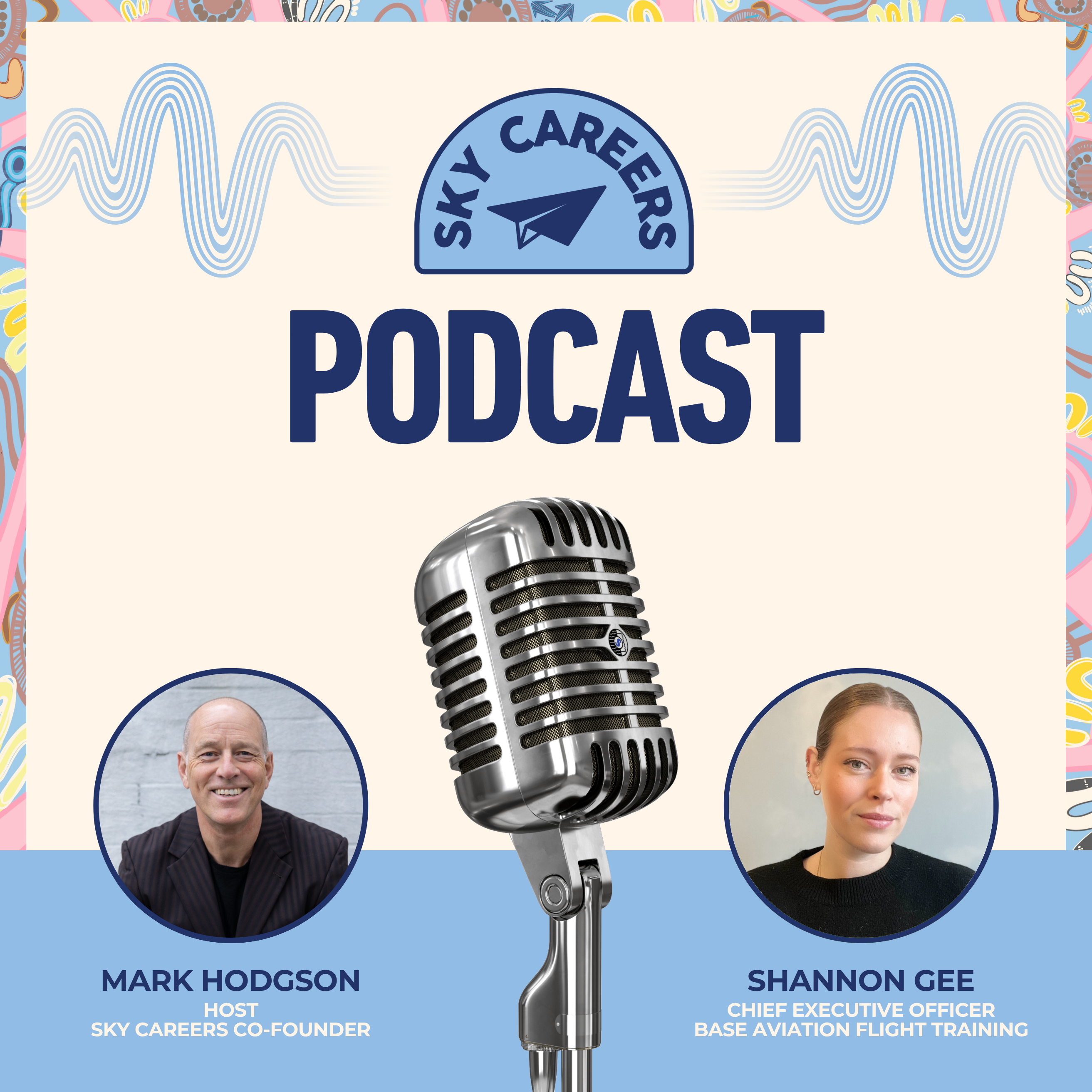
[00:00:08] Speaker B: Welcome to this edition of the Sky Careers Podcast. My name is Mark Hodgson, I'm the co founder and it is my absolute pleasure to welcome you. Now, today's guest, we've just had a bit of a preamble working out because I said, Shannon, you can't possibly be doing both these roles. But she is. So our guest today is Shannon G. Shannon works for Qantas. She is the ground operations training Instructor for Boeing 737s, but also she is the chief executive officer of base aviation flight training school in Victoria. So I asked her when she sleeps. We've got to meet this lady. Here she is. Shannon, welcome to the Sky Careers pod.
[00:00:49] Speaker A: Hi, Mark, how are you going?
[00:00:51] Speaker B: I'm really looking forward to this, Shannon, because you are clearly a hell of an overachiever. So let's go back, as we always do, to early days when you went to school. A very young Shannon.
Where did you go to school and what were your favorite subjects?
[00:01:05] Speaker A: I went to school in Pakenham, which is like regional or it's not so regional, but it was regional Victoria at the time.
And I really loved psychology and English and absolutely hated maths and physics.
[00:01:17] Speaker B: Wow, you sounded like the poster child for aviation. So clearly you've got some crazy aviation gene in your blood or something in it.
What was the link? When did aviation come into your world?
[00:01:32] Speaker A: It was a complete accident, to be honest. I wanted to be an autopsy surgeon. Completely, completely different career first, I can declare.
So I was at a careers expo to try and look at early entry into universities and things. And my dad, of all people, went up to the flight school that I trained at and booked himself a trial flight. And I am a raging daddy's girl. So if dad did it, I was doing it and that was the end of it. So I was fortunate enough to start flying at 14 and I have been hooked ever since.
[00:02:05] Speaker B: Oh, my Lord.
Let's just. There's a bit to unpack there. So you cut. You were kind of off on a completely different tangent, but at 14 you started doing some flying. So at what point did that go from, obviously something you were doing with your dad and you enjoyed? When did that happen? Become the thing you realize, you know what, I actually want to do this for a career,
[00:02:26] Speaker A: honestly. Probably that first flight, I had such a fantastic instructor and he was the reason that I wanted to be an instructor. And that's always been, always been my career goal. And once you step foot in the plane, honestly, if you love it, that's really the end of it. You've got to make a life out of it.
[00:02:42] Speaker B: Let's name check him. What was your instructor's name?
[00:02:46] Speaker A: Julian Warf. I think he's in the States or he might be in Europe now, but he's had a fantastic career.
[00:02:52] Speaker B: Oh, that's gorgeous. So talk us through from there to actually going from the idea of aviation to how you actually entered it as a paid role, as a career.
[00:03:03] Speaker A: Yeah. So I did a vet in schools program, which was fantastic. So my private license counted towards my. My final atar, not that I sat my exams anyway.
Got my commercial license when I was 18.
[00:03:14] Speaker B: You follow any rules, Shannon?
[00:03:15] Speaker A: No, it doesn't seem that way.
Got my commercial license when I was 18 and then quickly followed it up with my instructor rating. So I've been instructing since I was 19, which is absolutely crazy.
So. Yeah, so.
[00:03:31] Speaker B: So you've been a flying instructor. I just wanted to make sure I heard that since you're. Since you were 19.
Okay. And where were you doing that?
[00:03:40] Speaker A: It was Melbourne flight training at the time. Unfortunately, the school no longer exists and has gone through a couple of name changes at the time, but did my instructor rating with them and then they gave me a job at the completion of that. So.
[00:03:51] Speaker B: Wow. So how, how, where from there. And you're. And you're still. You're still in.
You're still relatively young.
What was the.
What took you from there to where you are today? Because you've already, as I said at the top of the show, you've already done. You've got a couple of big. Pretty big roles just how many years later on.
[00:04:11] Speaker A: Yeah. So I worked for them for just under a year and was approached by another facility on the airport that did charter as well as looking into wanting to open an instructing sort of part of their operation.
I had access to a cirrus and had been flying that, and that was the aircraft that they were using for their charter.
So they gave me a call, said, hey, we've got this position open. Would it be something that you'd be interested in doing? I wanted a foot in the door when it came to charter work, so I absolutely jumped on the opportunity.
We actually ended up flying a mobile dental clinic around Australia, which was really cool. So we did a lot of trips into Tassie in New South Wales and South Australia, as well as through regional Victoria. And it was brilliant because I also got to instruct whilst having a bit of fun and going here, there and
[00:04:57] Speaker B: everywhere and learning a bit about dentistry, presumably, knowing you.
[00:05:00] Speaker A: Yeah. The things you see I do, yeah. Absolutely mental.
And then Covid hit and kind of really put a spanner in the works. And I was approached by another person and asked if I'd then be interested in possibly looking at opening a flight school with them because they'd come into sort of ownership of an aoc.
I thought, oh, that'd be AOC Shannon. An operating certificate. So pretty much the green ticket you need from Cassidy to open your doors.
[00:05:29] Speaker C: Okay.
[00:05:32] Speaker B: They found it under, under the back
[00:05:33] Speaker C: of the sofa today or something.
[00:05:34] Speaker A: Yeah, it was crazy. They bought an aircraft and in the sale of the aircraft, the. The owner just handed over the AOC as well. It was a bit of a. Bit of an odd situation,
[00:05:45] Speaker C: just.
[00:05:45] Speaker B: So, just for the uninitiated, I'm having
[00:05:47] Speaker C: a bit of a guess here, but getting an AOC is quite a rigmarole. I would, I would assume it is
[00:05:54] Speaker A: a right pain in the bum. Yeah, to say the least.
So, yeah, I started looking into the process under the guise of working with this person and thought, oh, stuff it, I'll just do it myself.
Which 23, 23 year old me was maybe not the sharpest tool in the shed, it would seem. But yeah, utilized my COVID lockdown time well and wrote our training manuals and started the process with CASA to get our approvals.
[00:06:23] Speaker C: So our is base aviation flight training, am I right?
[00:06:27] Speaker A: That's correct, yeah.
[00:06:29] Speaker B: So just tell us a little bit, little bit about.
[00:06:32] Speaker C: How do I call it? Base.
[00:06:35] Speaker B: Yeah.
[00:06:35] Speaker C: Okay, so tell me, tell me a
[00:06:36] Speaker B: bit about that today. How many aircraft, what's involved and how much time. How much of your time does it take given you've got a full time job at Qantas?
[00:06:47] Speaker A: Yeah, so we run two aircraft full time and then we hire other aircraft as we need. Our training is really geared to be tailored to each student's needs, sort of pending where they want to go in the industry. So we have access to quite a varied fleet, which is absolutely fantastic.
Thankfully, I'm able to take on another role with Qantas because I have absolutely brilliant staff who keep the company going for me while I'm not there. So I have a head of ops who works his absolute ass off and just does a fantastic job of it.
[00:07:18] Speaker C: That's great.
[00:07:18] Speaker B: How many, how many, how many in the team? How many in the base team?
[00:07:21] Speaker A: There's five of us.
[00:07:23] Speaker B: Wow.
[00:07:24] Speaker C: And how much time do you get to spend? Are you still instructing or are you
[00:07:29] Speaker B: running the thing or what's your sort
[00:07:31] Speaker C: of, what's your involvement across an average week or so?
[00:07:35] Speaker A: So I do all the background paperwork, so all the fun bills and stuff that no one likes to do.
[00:07:41] Speaker B: And as we know, there's quite a lot of that in aviation.
Well, there's a lot of that running any business, but when you layer on
[00:07:46] Speaker C: the complexity of compliance.
[00:07:49] Speaker A: Yeah.
[00:07:49] Speaker B: Aviation, understandably, that's that. I assume that you.
[00:07:52] Speaker C: There's quite a lot of paperwork.
[00:07:53] Speaker A: There is, yep. So my. My days are typically spent at Qantas, and then my nights are spent running through the paperwork and making sure that everything's where it needs to go.
And if I'm fortunate enough to get a spare weekend, then I jump in the plane and do some instructing.
[00:08:06] Speaker B: Yeah.
[00:08:07] Speaker C: What do you.
How do you go with instructing in the sense that you would. I'm guessing, Tell me if I'm wrong.
[00:08:15] Speaker B: You would have quite a lot of
[00:08:17] Speaker C: students who are older than you. Would that be correct?
[00:08:19] Speaker A: That is correct.
I think it's one of those things that as I've sort of gotten older, I've managed to deal with it a lot better. When I first started instructing, there was definitely some cockpit conflicts when it came to understanding the authority gradient.
[00:08:35] Speaker C: I love that.
That's a great term. I'm going to be using it. Authority grad. Radiant. Yeah. Who's the boss here?
[00:08:43] Speaker B: Yeah.
[00:08:44] Speaker C: Me. Not you.
[00:08:45] Speaker A: Yeah, yeah. Look, I think issues tend to stem more from me being female than being young. And I think when you. You put them together, it does certainly catapult a certain pedigree of thought, which is fine.
Yeah. Like I said, as I've. As I've gotten older, I've just gotten, I guess, maybe a bit sterner with understanding that my voice is the final voice to hear in the cockpit, and that's the end of the conversation.
[00:09:11] Speaker C: Well, you convey a great confidence, I've got to say, which is fantastic. Now, switching that up, tell us about how you got into Qantas. We're having, like, two conversations.
[00:09:24] Speaker A: You're like two guests, really multifaceted.
Yeah.
Pick your side.
[00:09:33] Speaker C: No. Psychopath, isn't it? Yes, I know which is one or other.
[00:09:39] Speaker A: Yeah. Look, I've never had a huge interest in going into the airlines. In all truth, instructing is my bread and butter, and I don't think I could handle sitting in a plane and not really having active conversation or being in a learning environment. But this role came up, and it's very much a teaching role that just provides a little bit more, I suppose, stability in my day to day in terms of knowing exactly what I'm going to be doing. And less weather driven and whatnot.
And it just seemed like a fantastic opportunity. It opens a lot of doors should I choose to go into the flying department.
And I love it so far, which is fantastic.
[00:10:18] Speaker B: And how long, how long you, how long have you been doing the work?
[00:10:22] Speaker C: Qantas.
[00:10:23] Speaker B: And again, remind. Just talk us through a little, tell us a little bit what the job is. It's a ground operations instruction on a Boeing 737.
[00:10:30] Speaker C: What does that entail?
[00:10:31] Speaker A: Yeah, so we're referred to as GOES because everyone loves an acronym in aviation and essentially goes. I know.
Essentially the airline will hire its pilots and put them on their select fleets. They'll go through their induction process and do their emergency procedure training as well as a few other required courses.
They'll do a bunch of online learning and we pretty much act as a bridge between the online learning component and then the actual flying component. So we're a bit of a knowledge checker, I suppose might be the best way to look at it.
So we go through all the systems, consolidate information and then go through Qantas specific procedures as well.
[00:11:09] Speaker C: Okay, it sounds like you've rehearsed that before.
[00:11:12] Speaker A: I get asked all the time. It's a very, very unusual job. I don't think it's a job that a lot of people are aware exists in the industry.
[00:11:20] Speaker C: So as I understand it. So my brother's been on the podcast. He's a captain with
[00:11:30] Speaker B: pilot captain with Virgin Atlanta. I know he does a lot of sins and so forth. So I'm assuming when people are.
But they're coming from either a theoretical environment to a hands on environment, at some point they need to touch the plane and see stuff in physical reality as opposed to in a book or online. And that's kind of the interface. Is that kind of where you're operating?
[00:11:50] Speaker A: Yeah, similar. So you've got sim instructors specifically who do things like your cyclics, which is your currency training and stuff that your brother would be doing. Yeah, kind of the step before them. So we're designed for anyone that's new to the airline, regardless of what aircraft they've flown previous to. Just make sure that they're up to the standard that we want them to be.
[00:12:12] Speaker B: Do you fail many people?
[00:12:14] Speaker A: No, it's pretty hard to fail. Thankfully everyone's already qualified and capable, which is nice.
[00:12:18] Speaker B: Sounds good. Now the obvious question. Were you to, were you to wish to.
Would you be able to become a Qantas pilot? Is that something that's potentially attractive to you? And if so, how much of the Current work you're doing would be, would be beneficial to you because you're not flying for Qantas, are you, at the moment?
[00:12:39] Speaker A: No, I'm not flying. Look, it's certainly not something that I'm looking to explore now, but it is something that can potentially be done in the future. The process would be the same for me as it is for anyone that's looking to apply for Qantas. So I'd have to meet the hour requirements on particular aircraft type. Put your application in when the applications are open and then I'd sit in a hold file just like everybody else.
[00:13:00] Speaker B: So talk us through a typical day in your.
Maybe talk us through a typical week.
That's probably a better example because you're doing Qantas by day, base admin and paperwork and shuffling bills around by night and then other weekends or when are you kind of in the CEO role at base especially, I guess, is the question.
[00:13:23] Speaker A: Yeah, look, I'm probably always in the CEO role more than any other role in all truth. My mind is always on something base related, I'm sure. But typically, you know, I'm out at Essendon west or airport west at 9am on a weekday and I head home at 4. Once I get home, I check all the paperwork, see what's going on. I love to have a look at our bookings for the weeks because I either get really excited or a little bit like, oh, maybe we need to fill in some more time.
[00:13:49] Speaker B: Yeah, bookings equals money, right?
[00:13:51] Speaker A: That's it.
And I especially love looking and seeing if I've got any students that I can potentially pinch for myself if I've got some spare time.
[00:13:58] Speaker B: So selfish.
[00:14:00] Speaker A: Absolutely.
[00:14:01] Speaker B: That's good. How do you, how do you promote the, the, the base? Because, you know, we know from talking to various other people, you know, it's pretty competitive world and flying training is expensive and the economy's not great and there's quite a lot, quite a lot of people trying to get to get students.
[00:14:21] Speaker C: How do, how do you go around the recruitment process?
[00:14:23] Speaker B: So the business development, how do you
[00:14:26] Speaker C: get, how do you get customers who want to learn to fly with bay?
[00:14:28] Speaker A: Yeah, yeah, look, it's, there's been a pretty big shift sort of in the last three to four months as we deal with this sort of changing environment that we are working within.
We're pretty fortunate with our selling point being that we are one of the only operators, particularly at Moorabbin, that offers quite tailored training.
It just puts us in a slightly different training bracket than other providers.
Word of Mouth is always going to be your best friend, especially in aviation. And we are very fortunate that that works quite well for us. Our building is also very nicely positioned and it's just one of those things I've learned in aviation that you're going to have really good years and really bad years and you can't pick them. You've just got to make do and work with what you've got.
[00:15:10] Speaker B: Well, Summers does in my day job, sort of executive mentoring a business advisor. That's very true. You just got to keep doing what you do and understand you can't always, you know, it doesn't always happen like you want to happen. You want it to happen, but you keep doing the right things and it tends to even out over time.
[00:15:29] Speaker A: Absolutely.
[00:15:30] Speaker B: What part of your job do you enjoy the most, Shannon?
[00:15:35] Speaker A: Ah, that's a hard question.
I just love my students. I love it so much. I love seeing their success.
It is the most privileged thing to be part of, truthfully. I've had some students go on to have absolutely fantastic careers and knowing that I was part of that is just.
It's just brilliant, honestly.
[00:15:57] Speaker C: That's a great answer.
[00:15:59] Speaker B: Split of students, male, female, Relevant question or not?
[00:16:03] Speaker C: I'm kind of interested in the answer.
[00:16:05] Speaker A: You're fine. They are mostly male. It's just the demographic of the industry. We do have a couple of young female students, which is really exciting. I've got two under 18, which is just really, really brilliant to see coming through.
But yeah, they are typically male and that's tends to be the case at most facilities.
[00:16:23] Speaker C: Boys too.
[00:16:24] Speaker A: I know.
[00:16:26] Speaker C: How do most of them go about funding their flying training?
[00:16:30] Speaker A: So whereas a pay as you go facility, so you'll do your flight and you'll pay for it and then you'll book your next one.
Being self funded, we do find that the demographic of our students is typically a little bit older. Just, you know, they've had their careers, they've got their money kind of saved.
So we don't offer any veteran schools or HECS programs or anything like that at the moment.
[00:16:48] Speaker C: Okay.
[00:16:49] Speaker A: So. Yeah.
[00:16:50] Speaker C: Okay. And is the. Is the price, is the current fuel situation, is that putting. I presume that's putting the price of avgas up.
[00:16:58] Speaker A: Yeah. Yeah. We've seen pretty.
[00:17:00] Speaker C: Keeping you awake at night.
[00:17:01] Speaker A: Oh, without a doubt. We've seen some pretty substantial increases in the price of our gas just per hour.
It's just one of those battles that we've got to deal with and hope that we come out the other side nicely.
[00:17:13] Speaker C: Okay, I'm going to let the second part of my. What do you enjoy the most? Is what's the least favorite part of your. Let's say it's not. That's not the Bills and Avgas. But what is it apart from that?
[00:17:22] Speaker A: Oh, it still goes back to the students.
As nice as their wins are, when they struggle it really hits home and it can be really hard to sit there and for the most part be the bad guy in those sorts of situations.
[00:17:37] Speaker C: Yeah.
What are the main areas would you say that people maybe under prepare or struggle in bike training?
[00:17:47] Speaker A: It's in an adult learning environment is really different to I think what we see in our younger students. Our younger students are usually pretty eager to learn and really good at the study aspects of things, but then can sometimes struggle with the hands on sort of motives behind it. Whereas our older students typically can show up and be really ready in the physical aspects but really struggle when it comes to that theoretical training that they need to really put in.
[00:18:13] Speaker C: That's interesting.
I think I've shared before. I'm a failed Royal Naval pilot, but ultimately I got chopped after about 100 hours of actually hands on flying. But I think I came second in ground school out of 35.
Yeah. So I was good at ground school. I was good in theory, but yeah,
[00:18:31] Speaker A: it's hard to be good in both.
[00:18:32] Speaker C: So I found I think I needed to be better in the system rather than just scrape through ground school. My theoretical navigation was awesome.
My actual application was left a bit be desired as was pointed out to me quite explicitly.
What, what do you do when you're not at work? Shannon, I'm. I'm curious. I'm not sure when you're never at work. But let's, let's assume there's a time when you're not at work. In your two job, in your two job world, what do you do?
[00:19:04] Speaker A: You're not going to believe this. I have a third job.
[00:19:08] Speaker B: I think we've all got to know you by now. Of course you have.
[00:19:11] Speaker A: I live on a farm. It's a working farm. So we run a herd of cattle. So if I'm not working in the sky, I'm dealing with the animals.
[00:19:20] Speaker B: Wow. Tell us a bit more about your
[00:19:21] Speaker C: farm and who's on the farm.
[00:19:24] Speaker A: So my husband and I live on it and so do my parents, which is really nice.
It's a couple hundred acres, it's in the most beautiful area, but we've got every animal you can possibly imagine and it is chaos and I love it.
[00:19:39] Speaker B: Wow.
If this was podcast bingo.
You're the first one who wanted to be. Was it, was it an autopsy surgeon?
The first one who works on a farm and also works for Qantas and also is the CEO of her own, of her own flying school. So you'd be a very good. Top trumps.
Top trumps carded.
Shannon, we can go on forever. I'm going to ask, I'm going to start to land the plane here. What advice would you give to other young men and women looking for a career in aviation? And aviation clearly runs through your veins, as does farming. But let's just keep it to aviation for now.
[00:20:30] Speaker A: Yeah, look, it's hard, it's a hard industry to train in and to work in, but the reward is so unfathomable. It really, truly is worth every ounce of effort that you're going to put into it.
[00:20:44] Speaker B: Great. And you've touched on it.
Where do you think we are in terms of attitudes to women?
[00:20:54] Speaker A: Look, we can never get worse, put it that way.
There is certainly a lot of growth to be had still, but there is a lot of growth that has been done.
It's not just aviation. I think it's in any single sex dominated industry that there is always some kind of prejudice, unfortunately. And it's just going to take a long time as a society to really, to break that down. It wasn't that long ago that women couldn't vote. So in the scheme of things, I think we're doing all right.
[00:21:24] Speaker B: Yeah. Okay.
[00:21:25] Speaker C: Well, Shannon, look, I say that I can't wait to see where you go. I know. I'm sure we'll have you back on the podcast in five years or so and I'm sure you'll have added a few other jobs and roles.
[00:21:35] Speaker B: You're clearly, I love.
[00:21:36] Speaker C: You're very optimistic, you're clearly intelligent, you're clearly driven, you clearly get good shit done, which I love.
And I can only wish you all the best. And yeah, if you're looking for tailored flying instruction in and around Melbourne, Victoria, we can, I think we can, we can highly recommend base flying training school and give Shannon a call. I think you can find her on LinkedIn. So we'd love to help you like that because I think you're doing such good work, Shannon. So thank you so much for being on the pod.
[00:22:10] Speaker A: No, thank you so much for having me. It's been a pleasure.
[00:22:12] Speaker C: Brilliant.
[00:22:21] Speaker B: Thanks for listening to the Sky Careers Podcast.
If today's conversation has sparked your interest in aviation, then head over to our
[email protected] au.
Whether you dream of flying aircraft or you're curious about the hundreds of other exciting roles that keep the aviation industry moving, Sky Careers is your gateway to discovering these opportunities.
And if you are already in the industry, check out Sky Careers Connect and Sky Careers Leadership and consider joining our online learning community.
Until next time, keep reaching for the skies.