[00:00:00] Speaker A: Foreign.
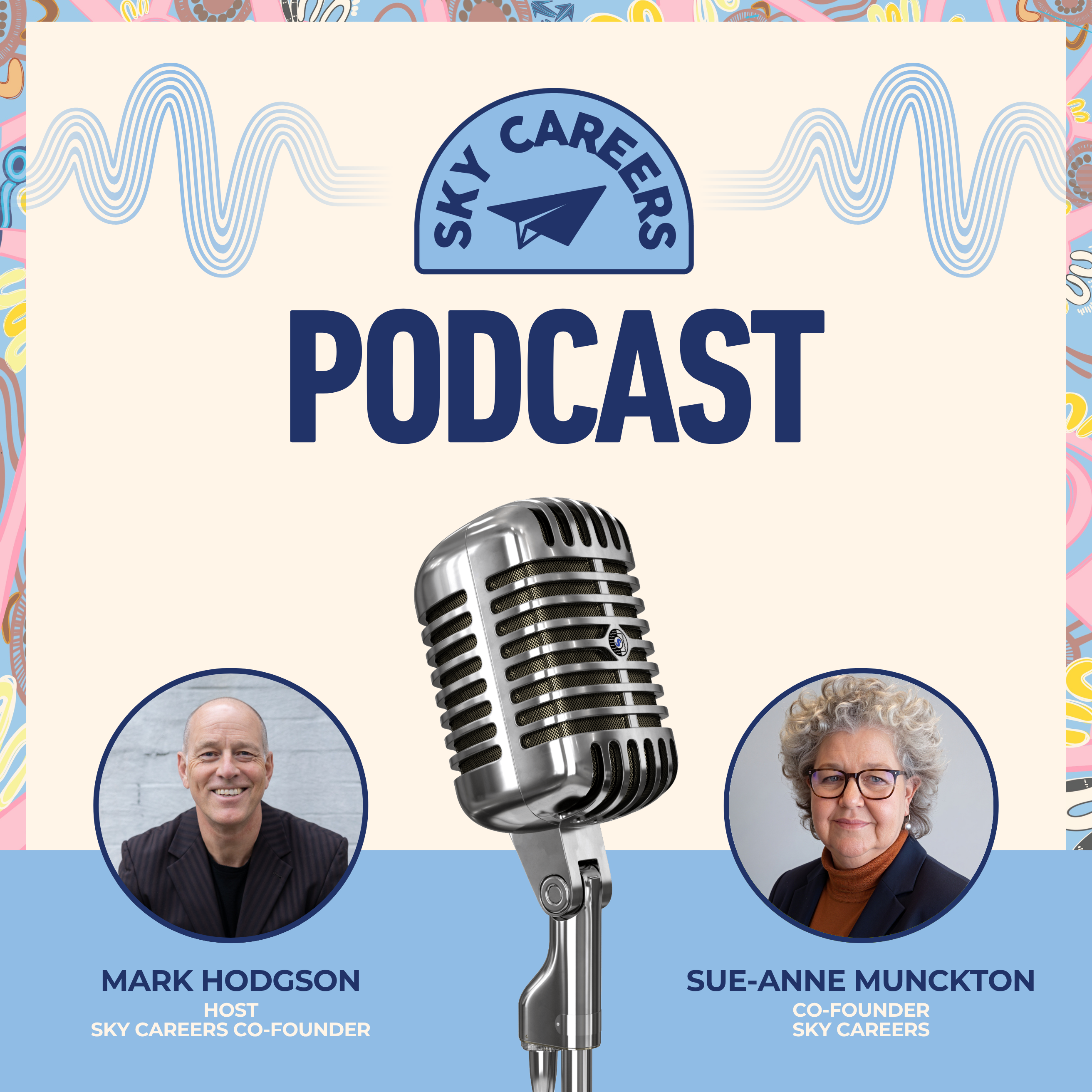
[00:00:08] Speaker B: Welcome to this edition of Sky Careers podcast. I'm your host, Mark Hodgson, Sky Careers co founder and we've got a very special edition of the podcast today because, and very belatedly, I finally managed to convince my partner in crime and the other co founder of Sky Careers, Sue Ann Monkton, to join us. Sue Ann, welcome to the pod.
[00:00:33] Speaker A: Hi Mark.
[00:00:34] Speaker B: It seems a bit weird. Hey, you and me podding together.
So what we're going to do, dear listener, because Sue Ann has got an amazing story and we're going to break it into a couple of parts. So this will be one of two podcasts. So we're going to have a chat today, get you to know Sue Ann and her early career, how she fell in love with aviation, and as you'll hear her amazing story into aviation. And then we'll set up a separate podcast where we'll talk about larger aviation themes, aviation education, increasing the participation of women in aviation, all that stuff. We'll do that in a separate podcast. So, Sue Ann, today we're going back to basics and as you know, well, I always start with the same question.
Where did you go to school and what were your favorite subjects before you, before the world of aviation knocked on your door?
[00:01:31] Speaker A: I went to school in wa, in a place, Mount Helena. I went to Easton Hill Senior High School and before that I went to the primary school across the road. We literally walked across the driveway and went to high school with pretty much all the kids that I went to school with. So I was a school nerd. I was a sit at the front seat, seat close to the teacher, you know, did all my homework assignments and things.
I ended up doing humanities subjects, so I didn't touch physics. I did love maths, but I did do a math subjects, but I did human biology, economics, history.
I played the flute in the school band. I and I did music for year 12.
So nothing really that pointed to a career in aviation. Traditionally, you know, none of those subjects.
[00:02:30] Speaker B: Okay, so where was aviation in your world? Was it in your, is it in your world at all as a young girl?
[00:02:37] Speaker A: Totally. My baby book actually says my first outing was to the airport to pick my dad up because he was an airline pilot.
[00:02:44] Speaker B: Oh, okay.
[00:02:46] Speaker A: So yes, my dad flew.
Well, he flew lots of things, but his favorite was the DC3. He flew that around WA and worked for MMA McRobinson Miller Airlines, which then became Airlines of WA. Answer all sorts of things. And he ended up overseas working for Air France and Singapore Airlines doing a lot of, a lot of different things. So his background was, was airlines so we were very much an airline family. Dad being away, odds and sod times and know not being around birthdays, Christmas, but then he could pick you up from school when he was home. So that was quite a lovely life. But it was our life. That's just what we, what we knew and we lived in Derby for a period of time when my dad had to do his country time and flew twin otters to all the stations, delivering all the mail and the food and things like that. And my mum was a school of the air teacher so I had a great time going to kindy in Derby while all that was happening. It was just what you did. Dad was a pilot, Mum was a teacher.
[00:03:56] Speaker B: Love it. Was it kind of an obvious and assumed thing for you to get involved with? Were you passionate or was it kind of how did you go from being a daughter of an airline pilot and an aviation family to actually making your first inroads into aviation yourself?
[00:04:12] Speaker A: I didn't ever as a kid think of myself being an airline pilot. I was going to be an astronaut
[00:04:20] Speaker B: and anyone knows Suanika cool.
[00:04:23] Speaker A: I used to lay out the back on the grass. We lived way up in the hills so it was quite good. We didn't have a lot of background lights and I just watched the satellites coming over and just imagine what it would be like to look down on earth and to be in an aircraft that can leave the earth and return.
And the space shuttle wasn't a thing then but that was just amazing to me that we could perhaps do this one day. And then it kind of was a dream and then reality kicked in and I thought well one day when I've had a real job and I've got a house in the suburbs and the picket fence and two kids in a station wagon, I might go and get my pilot's license one day.
And then later in high school I decided no, that's I was going to space or I was going to the. I was going to fly jets, I was going to do all these amazing things and then went to a career day and went to the ADF or you know, bright eyed and how do I get into this? And I couldn't. I was a little bit being female I was a bit too early in the scheme of things. I could do the training here at Pierce, that was fine but couldn't fly jets. So women couldn't fly jets in those days. I my choice
[00:05:39] Speaker B: for the military, for the role for the defense force.
[00:05:42] Speaker A: So that was kind of my route into being an astronaut, you had to go into the Defense Force and then I have to get states. And I kind of knew the, the progress part of it. I mean this is a 16, 17 year old me and my choices if I had joined the Air Force would have been to fly cargo types of the larger aircraft or fly politicians around as VIP. And my 16 year old, 17 year old self went bah humbug to that. If I can't fly jets, I'm not going to do it because it's not what I want to do.
And I applied for law at uni instead.
[00:06:20] Speaker B: Oh, okay. Didn't see that coming. All right.
[00:06:23] Speaker A: So I did the traditional TE in those days with all those, you know, economics and history and music subjects and was waiting for my TE result to see if I could get into uwa, which was the pathway I wanted.
And a friend of my dad was an air traffic controller and an instructor and he and my dad bumped into each other when I was standing there and, and Dick Welborne was his name and he said, come down to the, to the club on a Sunday, I'll take you for a fly.
And I did. And I can still remember that flight in a little 152 around Pierce Airbase because they use the air base at the weekend.
And I landed and my dad just looked at me and he went, oh, you want to fly? And I went, I want to fly, I die.
So he said, well, you can tell your mum, she was very supportive but it kind of wasn't a discussion that we had had about flying.
[00:07:24] Speaker B: And funnily enough, because she's thinking law school, right?
[00:07:26] Speaker A: She's thinking law school. You know, first person in the family to go to uni. You know, I mean my mum went to teachers college and my dad did flying, but you know, it was the first uni student.
And I went, not deferral that I'm going to go fly airplanes. And I started the week after and
[00:07:45] Speaker B: sorry, I'll just, I'll just make this point for, for those who, for, for listeners, it is a common misconception that to be a pilot you need to have a degree. And it's just, it's just not at all, as Suanne's telling you, my bro, my brother's, my brother is a captain with Virgin Landing. He's been on the Sky Careers podcast, flies. You have hundreds of people for, for, you know, 20 years now, hasn't, has not been to university, you don't need a degree.
[00:08:11] Speaker A: And when I did it, which is the late 80s, early 90s, you had to self fund it, you had to self study. There were some flying schools that taught the theory.
It wasn't until a couple of years later that TAFE even started doing the classes. And I actually started working at TAFE as a part time lecturer at the time. But it just wasn't, there wasn't options. There was one way to do it. You paid for it, you studied.
I did some commercial classes. There was a lovely gentleman who ran commercial theory courses and I did those.
And you just, you know, handed over your money after every flight. And it was a lot cheaper then, but still an expensive thing to do. Certainly more expensive than it would have been for me to do law.
And funnily enough, Dick Welborne, who was the instructor that I flew with for the first time when I became a chief flying instructor and chief pilot. He was the chief flying instructor and chief pilot at a different school at Jandicot.
[00:09:18] Speaker B: Beautiful.
[00:09:19] Speaker A: So that's. Yeah.
[00:09:21] Speaker B: So, but take us back. So you, you decided you want to be a pilot and how long did it take you to do the training to do your commercial. So your private pilot's license, your commercial pilot's license and, and, and I guess the pathway into you actually having your first job, because there's several. There's, there, aren't they? And they're all important.
[00:09:43] Speaker A: Yeah. So when I was doing the training, all the licenses were, were separate and you had to logically work your way through. So I got what was called a restricted pilot license and that probably took me nearly a year. And that meant that I could take passengers into the training area.
And that's had all sorts of different names and changes over the time, but the, the hours and the qualifications still stayed the same. So I did that pretty much in 1988 and then spent 89 getting my private license. So then I could take family and friends as long as I really didn't get paid for it anywhere in Australia. And I did some amazing trips to Darwin, Alice Springs, flew over Ayers Rock, the Bungle Bungles, just down the Prince Regent river into just magnificent. I mean, we're so lucky in this country to have these places to fly over.
So I did that to get all my hours up. So that culminated in a lot of theory exam study. And I must admit I wasn't great at the study and I never was at school. I was really good with assignments but really bad with exams.
[00:10:57] Speaker B: So when I did, surprise me, Suanne, tell me, we've been in business for two years now.
[00:11:04] Speaker A: You tell me, give me an assignment. And I will blitz it. And I can still remember my, my history teacher handing me back my mock exam in year 12. And I'd failed my mock exam and he put it on my desk and he said, Ms. Roberts, I could not be more disappointed.
[00:11:22] Speaker B: The D word. He got out the D word.
[00:11:24] Speaker A: And he was my best friend's dad, too.
He completely answered questions that we hadn't covered in our syllabus. And I didn't notice.
That's actually how bad I was at exams anyway, so I did not pass my commercial theory exams, all of them. The first time. Flight rules nailed, you know, me, a rule for headphones.
But I really did struggle. And it wasn't uncommon for people to fail. There were six individual exams and then you had what was called a finals examination. And in those days, you used to get an envelope posted to you with your results.
So you would not only have to go and sit them physically in the office in the city, you would then have to wait for the mailman. And the finals was a yellow envelope.
So that was. You had to wait for that yellow envelope and open it and it would give you a pass or a file on it. And I can remember the day I passed because I think it was about my fourth attempt and I had a little Datsun 180B and my dad and granddad had gone into the bush to chop wood and bring some wood home.
And I decided to bush bash in my little Datsun 180B. I was so excited, I went down all these tracks looking for my dad to show me this piece. And I was actually waving this yellow piece of paper out the window of my car. I was.
Because it meant I could then commence my commercial training and.
[00:13:02] Speaker B: Right. Yeah, and I'll, I'll, I'll look, I'll loop back to the fact you didn't just whiz through the training and, and, and, and find that easy, because I suspect that's going to be an important part of your story. So you've got your yellow envelope with your. You've passed. What, what happens next? How, how do you actually move into.
[00:13:20] Speaker A: So then you have. So you had to get flying hours up in command, so solo in the airplane or with friends, like not under instruction. And then you had to do your commercial training. So you had to go and do navigation exercises, drills, emergency procedures, simulated commercial flights, like charter flights or photography runs, like that was a very big thing here at the time. We'd simulate a flight that you had to go and take a photo of the jetty at Perth City and then this shopping center. And you had to be able to negotiate that with air traffic control, slow the aircraft down and position it so that your instructor, if they were taking a photo, so you kind of had to maneuver. It was all.
Yeah, it was, it was simulating those first job scenarios.
[00:14:12] Speaker B: Yeah, lovely. That's very smart. I like that. That's good. Yeah. So, and so, and so you, and so you did qualified and you got a job. What was, how did, how did that happen? How did, when did, when did it start? From you giving people money to fly? To people giving you money to fly?
[00:14:26] Speaker A: So I got my commercial license and then like every other commercial pilot at the time, you begged and begged for, you know, a 20 minute flight over the city or, or anything that was a, was a paying flight.
And the flying school that I did the, my commercial license at spoke to me and said, look, you know, you might not have passed your exams the first time, but your knowledge is amazing. You're just no good at exams.
So they actually asked me to teach theory and funnily enough, the, the first finals course that I taught, all eight passed the first time. And I felt like, well, that's because I know this exam so well, I just couldn't pass it. But I knew, I knew how used to pass it. So, so I started teaching theory, teaching at night, doing private pilot theory and some commercial theory.
Because I was there, I'd get a couple of joy flights, that type of thing.
I looked at going up north. So I looked and almost got myself a job in Kununurra, which was pretty much the place to go in the 90s because of the bungle bungles, the number of tourist flights and that sort of thing that would happen similarly in Ayers Rock, that was a huge center for people from Perth to, to go in and get jobs.
[00:15:52] Speaker B: I've just realized. So, and I forgot to say at the beginning, Sue Ann lives in Perth.
[00:15:56] Speaker A: Yes, I live in Perth. Everything is WA for me. Born, bred and stayed with great bias, great bias towards the mighty state of wa. But anyway, that's a different story.
And then I decided due to just my parents moved overseas at that time I had a younger sister here. I thought now is probably not the time to move away.
Discovered that I loved teaching, I loved helping people and getting to know people and seeing them click, you know, being able to go, well, that explanation is not working for you. How can I explain it differently or draw it differently or, you know, you're not somebody that can read from a book, so let's Go sit out in the aircraft and learn about aerodynamics by sitting under a wing and looking at it and that. And I loved, I didn't realize that I did until I did kind of thing.
So I did my flight instructors rating and loved it. Loved it. Best, best thing in the world.
So I got my instructors rating, moved through the different grades of instructor. So that is a great way of getting hours up and staying in a big center is doing.
But when I became a senior instructor, I would always say to people, don't do it unless you want to teach because it's very difficult and it's so important that we teach properly. That's just a massive passion of mine. And a lot of people did it just to get their hours up and, and weren't good teachers. So then we don't get good students and, and people even leave because they're just not getting a great experience as a result. So I did that and then ultimately became what was called in those days a chief flying instructor and chief pilot. They now call it a head of flying operations. And ahead of training and checking, there's been a name change. It's the same role.
And then the flying school in the China company where I was holding that position came up for sale.
[00:18:05] Speaker B: And so how old are you now?
[00:18:07] Speaker A: 22, 23.
[00:18:10] Speaker B: Oh, so you're, you're, you're, you're very. Still, still very young.
[00:18:14] Speaker A: Still there. I was one of the youngest, if not the youngest, chief pilot and chief flying instructor at the time, which was a little bit of consternation from a few people that said, no, you don't know what you're doing, you're not old enough, and you're a girl. That was a bit of a, an issue at the time.
[00:18:32] Speaker B: We touched on that a lot on the podcast, as you know. Yeah.
[00:18:36] Speaker A: So, but I, I got it and, and had a fabulous mentor and, and that's something. As you know, I'm very passionate about everybody. No matter who you are and where you are in your leadership journey, mentoring is beyond valuable. It's just, it should just be in place for everybody. And she was very supportive and my boss was very supportive and my partner was.
And I just went in and did my best and actually corrected Cass's theory exam because they had some questions wrong. So.
[00:19:12] Speaker B: Oh, she did. So you bought, you, you bought a flying school?
[00:19:16] Speaker A: I did.
I had a share in a flying school and then I took over the flying school and I have worked for myself since I was 23.
[00:19:25] Speaker B: Yeah, well, we both, we both know, like, you're like me, you're unemployable. You know, I can't imagine us, I swear you very much, but so just paint a picture for us. So this is a young, young Suran Moncton. You're flying out of Jandicot. Would it be.
[00:19:39] Speaker A: Yes, yes.
[00:19:40] Speaker B: Yeah. What is a flight? What is your flying school? Is that one plane?
[00:19:44] Speaker A: 20? No, we. We had a couple to start with, so we only had two or three to start with. And we ultimately built that up until we had eight different aircraft. We actually also put online an aircraft called the Eagle, and that was actually designed and manufactured here in WA down at Henderson in the shipyards. It was built down in the shipyards. So we were the first school in Australia to use the Eagle aircraft as a training aircraft.
So we had facilities, we did, you know, all, all the things that flying schools do. You taught the theory, you taught the students. We had students who were doing it for fun. We had students that were doing it full time for a commercial license, those that were doing it for fun and then change their mind.
My area that I loved mostly was the instructor rating training. So getting young, or not necessarily young, but young in hours. Like they, they didn't have a lot of flight hours. They had commercials and they wanted to be instructors. So I did the instructor rating training and then I, at this time, as a chief flying instructor, you were also a testing officer. So I was that person that did the flight test.
So I loved that. I loved, you know, seeing people's bucket list items, you know, people that, like, one gentleman said to me, I've wanted to learn to fly longer than you've been alive.
And I always remember they like the number of times I cried and the person would cry and we'd be sitting in the aircraft and say, when we both stopped crying, we'll go back inside and tell everybody that you've passed. But it's a lot of pressure and it's a lot of money and it's a lot of commitment. And a lot of people were doing it on weekends, so it was time away from their family. And obviously money being spent was money that wasn't being used for, for other things. You know, it could have been. So many people would say, I've wanted to do this since I can't remember when. And, you know, they're now in their 50s, their 60s, even in their 70s, finally doing this thing that they have dreamt of their whole lives. And I was there when it all kind of fell into place and they could finally hold the license. So it was very emotional for a lot of people and you know them and that's what I loved about being at the flying school. You, you actually got to know these people and you got to get involved in their, their lives just because you just saw them so often, you know, and that's anybody from my youngest student was 10 and my oldest was, you know, in their 80s when they got their license. So that's a huge gamut of people. And, and it was, it taught me a lot because now looking back at it and I look at 23 year olds and I go, oh my goodness, you shouldn't have a driver's license.
Do you know what I mean? Like, it's just perspective when you look at that. But, and you know, I look back and I was very confident and, and I, and I, and I do believe I knew what I was doing as, as an instructor and that was obviously what, what my thing was like. I really, I was passionate about it and it was everything to me. Have I learned a lot about being, you know, and I know this is a different conversation, but leading people, running businesses? Oh, absolutely. Like if you know, lots of things learned, Lots of things learned. But I had a 23 year old head on my shoulders, mid-50s one soon.
[00:23:22] Speaker B: So a couple of things that I guess. So a couple of questions. So how long did you, how long
[00:23:29] Speaker A: did you run the flying school for nearly 15 years. 12.
[00:23:33] Speaker B: So nearly, nearly, nearly 15 years. And as they were really probably in our second podcast. Talk more about your, your post post flying school ownership years. But I guess there's two, two questions that. So first, Ian, it's obvious. I mean I, I know you, I know you well, you've got a great reputation in the industry and I think even if people, the first time they come, the first time they're coming across you is in this podcast.
The thing that shines through, suanne, is your absolute love for love. Love, love for teaching, your, your love of learning and teaching and connecting with people.
And I think that's, you know, that's such an important, that's such an important gift. And then, But I guess part of my question is that shines through. That's a statement, not a question. But the question is, do you think in addition to your love of, your love of teaching, do you think the fact that you weren't a sort of straight A, found it all very easy, just flew through learning yourself to do the exams and all the various things that it made you a better teacher?
[00:24:39] Speaker A: Yes. Yeah. And, and I don't think you have to have had that experience to be a good teacher. But it certainly gave me a lot of patience because I realized just, you can't all learn the same way. I, I can't pick up a book and just learn, you know, I. I'm very fortunate I have twin girls. So when we did all the, you know, bed building and cradle building and little bike building and all that sort of stuff, I kind of worked out the first one, first bike, and then the second bike. I just wanted to build it because I knew how to build it. I. I didn't like. I don't like using instruction books. I like people to show me things and talk to me. And I think that's why I really enjoyed the flying, because every. All the theory related to the practical and then you could actually get into the airplane.
You know, I was constantly, when I was in my classes, like going out to the airport and going, well, here's the flat, you know, this is where the gear lever is. Whereas I knew other instructors that I don't think they even knew where the gate to the airport was, you know, from the classroom. And that's fine, you know, it's horses for courses. But I think, I mean, from a flying point of view, I definitely went through sort of on minimum hours and, and, you know, I really loved it and I. And I was good at it. Do you know what I mean? Like, and that's just not me. That's the examiner saying, you know, you need to do your next upgrade as soon as possible because you've got the ability to do it.
But I think I also knew, because I hadn't always passed, that when you do get it the first time, you know, that is an achievement and you've got to be grateful for that. But then when, you know, somebody just doesn't click and somebody fails. Like, I really knew what that felt like. And I knew, you know, that that's not a great feeling. And it can be very embarrassing, I guess, depending on who knows what's going on and what I mean. I had one poor gentleman who failed his flight test for his ppl a couple of times and, and really found, really did silly things that you just couldn't kind of go, well, we'll just do a bit of revision and you'll be okay.
And I didn't realize, but his wife was holding a surprise, you've got your license party.
[00:27:06] Speaker B: Oh, my Lord.
[00:27:07] Speaker A: And he'd found out, but hadn't said anything. So not only was he under the pressure that, including I was invited, like all These people were going to his house that night and his wife was spending the time that he was doing it prepping all the food.
But then he would fail and have to ring and tell her that he'd failed so that everybody had to pretend nothing had happened.
Yes.
[00:27:36] Speaker B: So I think we can all. We can. We're all cringing inside.
[00:27:40] Speaker A: I know. And being invited to the party, knowing the party was happening and failing him and going, oh my gosh, how are we going to get hold of his wife and everybody else to say, please don't turn up and go, congratulations? Because he's actually really. Anyway, it was one of those.
Yeah, he did. He did brilliantly and, and should have passed. And I think when all the other pressure came off, like anything in life, you know, we can put ourselves under.
[00:28:07] Speaker B: Yeah.
[00:28:07] Speaker A: And you know, there's lots of things going on in people's lives, but yeah, that was.
[00:28:14] Speaker B: I, I usually ask what part. What part of your role you enjoy the most? I think that, I think that you've already. To describe it's the teaching and connecting people. What was the least favorite part of your. Of your job of running. Running a pilot training business, flying training.
[00:28:33] Speaker A: And I, and I don't think it actually has changed. I think it's the politics of aviation, the politics of small businesses at an airport and all of the things that everybody else does and says about you that you know is not true, but just gets done and said about you. Do you know what I mean? Like there's always the, the, oh, well, they're only doing well because all that's. They're about to go bust or that, you know, that it's all just all of that negativity because it's people in small business vying for, you know, we at Jandicott Airport, it's very different now, but they're at the gate. Used to be a cattle grid and it was literally a cattle grid in the road between the two fence posts. And we used to, you know, always joke, you know, who's going to get the next person with a wallet that comes up.
You all, you know, there was half a dozen flying schools and one person would drive over the cattle grid. And at the.
Where you were positioned, your reputation. Did you have the biggest Yellow Pages ad? I mean, that, that was a huge thing at the time. You know, who's going the biggest ad and you know, have we got in in time? Because, you know, whoever's first you get, you know, it's like a featured thing on Google these days thinking about the
[00:29:59] Speaker B: yellow Pages the other day. And again we're going to sound like older people reminiscing to see some younger listeners here. But for those who don't know, the Yellow Pages was a big, a big directory of business. This was pre Internet or certain. It was certainly free Internet and ran for quite a lot of time. And now you wouldn't, you wouldn't use it. Everyone would use the Internet to look up businesses or look up pilot training or flying training. But back in the day, the only thing anyway, you found out people's phone numbers and business. You looked under the Yellow Pages and there were ad, you could either have a listing or as you say, the bigger and bigger the ad, obviously the more eyeballs it drew. And yeah, that was an incredible. The Yellow Pages made a lot of money for a very, very long time.
So yeah, I can imagine. There was, it was like a wallet comes over the cattle grid and everyone's going, me, me, me, me. Because you know, you've got a, it's an expensive business to run, isn't it? You've got planes, you've got maintenance, you've
[00:30:54] Speaker A: got people, you've got instructors. And yeah, I think, and I think that's still the case. Like I, I'm very fortunate in what I do that I can work in a lot of businesses and I hear of the, the politics and the, the business side of it and go, oh, that's fine, I'm just, I'm just here to help you with your manuals or I'm just here to, to do an audit. And it, it hasn't changed but that's, I imagine it's the same in any industry. Yeah, you know, the politics and the, the business side of it.
[00:31:24] Speaker B: Yeah. And just picking up a small thread that you've mentioned a couple of times and obviously one of the sort, one of the things that Sky Careers is about is helping young people to get a great understanding of aviation and increased participation. But specifically women and interested in your thoughts and how big a factor was you being a female in those years in terms of acceptance and getting on. Was that a small issue or a significant
[00:32:00] Speaker A: day to day?
To me it was insignificant. But then you kind of just get a slap in the face that reminded you and you know, like when my boss put me up to be a chief flying instructor and chief pilot and you had to go and do your exams and, and do interviews and, and things like that. I mean he, he got a phone call to say, look, put it, put an ad in the Australian newspaper which was where the Ads went on a Friday was the aviation special for a 43 year old male and will consider it.
So you kind of go, oh, hang on a minute, you know, that's. And then, you know, I mean I've had passengers flatly refuse to get in an aircraft with me.
Just I'm not flying with a girl. I used to work part time as a waitress and the chef was quite young, quite, I would have thought, very liberal in his thinking, you know, all of those sorts of things. And he just said one night after work when we were all just having a drink, he said I'd get off a plane if there was a female pilot. I said, but it makes no difference because it makes all the world of difference, you know, and he was only two or three years older than me at the time, so you know, he was early to mid-20s and that was still his, his thinking. So.
And I think, you know, there was a lot of things and it makes me cringe when I think of things that would get said in front of me and other women having two teenage daughters now I would be mortified if they were treated and spoken to the way that I was and witnessed other female pilots being spoken to and just, you know, be just innuendos and you know, all of, all of that sort of thing. It's not acceptable. And, and society has changed. Society has changed, definitely. I mean I am talking 30 plus years ago and, and even in society that is no longer acceptable. But it was, you know, it was kind of like the pie. You'd all come back from flying and people would just turn around and go, oh, white with one thanks to Ann.
[00:34:21] Speaker B: Yeah.
[00:34:22] Speaker A: And you go, why am I?
Yeah, you know, what? Why? But then, you know, and I'll tell a story because I think this really typifies how women can actually be our own worst enemies as, as well.
And you know, at that period of time there was a lot of push. You know, we've got to have more women in the industry and you know, women can do these things and I think you can push that so far that then people push back. And I remember I was at the school and I come back from a flight, it was one of those 45 degree February Perth days. I was absolutely exhausted. And you pull the aircraft in and you, you pull it forwards because you're going to then get out and push it back into the flight line and tie it down and everything else.
And I was sitting in the aircraft, I was recording all of the times and everything else and friends of mine that were flying, they're still friends, like their honorary uncles to. My daughters came past and said, do you want us to push you back? And I went, I love you, too, because all I want to do is get out of the heat and the sun, and I'm exhausted. So they pushed the aircraft back for me, started tying it down. I got everything out. We covered up the aircraft and went inside, and there was a lady, quite a bit older than me at the time, doing her private license there, and she caught me in the car park and she said, I cannot believe you allowed that to happen. You have put back the fight of women years by letting those people push your aircraft back. You should have said no and done it yourself. I said, no way.
Yeah, Yeah. I would have done the same for them.
[00:36:09] Speaker B: Yeah.
[00:36:10] Speaker A: So they weren't doing it for me because they didn't think I was capable of putting my own aircraft back. They were doing it because they're a friend.
And.
And I said I would have done. If they were sitting in the aircraft, I would have helped push back their airplane, too. I seen it as a boy girl thing. I saw it as a. Everybody's hot and tired and we all want to go home.
[00:36:36] Speaker B: Yeah. Get it done quicker. But, yeah.
[00:36:38] Speaker A: Does that make sense?
[00:36:39] Speaker B: No. And it's. It's, It's. It's. It's interesting, isn't it? I think that. I mean, you've touched on. You, You've. You've touched on a lot of things here, and it's clearly getting better. But also, we know from other conversations, and one of the main reasons that you know, Sky Creek, Sky Careers exists is because it's still an issue. It still is an issue. It's, It's. It's less of an issue than it was. And I know from having spoken to lots of people, both through our Ambassador network and also on the podcast, it remains an issue. It's probably a lesser issue than it was, but an issue it is still. So we've still got work to do. But, yeah, it's fascinating to hear your take on it and just moving us forward because I'm conscious of time. I knew we'd go along. I don't want to go too long. And we'll pick up on the broader themes and your leadership in your later career in our second podcast.
Just give us a sense. So you. After 15 years, what happened? You, you, you, You. You left the flying school, then started something else.
[00:37:42] Speaker A: Yeah. So I had already started a separate business, the Civil Aviation Academy, which has been going from 2001, so decided that I, I hadn't tired of flying. I had just tired of doing the same sort of flying all of the time. Like flying in the same area. Yeah. Circuits and to know them on flight tests and, and to do something very different.
The other partners in the business, which is something that had happened over the time, wanted to take the business in a very, very different direction and, and that just didn't appeal to me. I had the Academy and that's when I gave up the flying and went full on into working full time at the. The Academy, doing the, the work of the Academy and have been doing that for 25 years. So really.
[00:38:37] Speaker B: And just, just in, in, in, in, in 30 seconds. What does the academy do?
[00:38:42] Speaker A: Approved training by CASA for dangerous goods Crew Resource manager. So online training, that's compulsory through the unregulatory body.
I do a lot of manual work, so compliance, writing, opera. So that rule head again. Yeah, that for the rules. The only exam I could pass is the first time.
And yeah, we just contract work depending, depending on what, what people need. And then of course putting up the, the Sky Careers project, which has now become an entity unto itself, which is fabulous.
[00:39:15] Speaker B: Has it ever, has it ever? So it's, it's interesting. So pulling it, pulling it together, Sue. And what, what I love about that is it's another example and we've heard this again and again and again in the podcast.
It's, it's how you can evolve your aviation.
Your aviation career can take so many different.
[00:39:31] Speaker A: Absolutely.
[00:39:32] Speaker B: Yeah. And obviously you, you started off as a pilot, but you've in the, in the process because you're not just as a pilot also running a flying school. And so that, that takes you in so many different directions as a small business owner and finance and maintenance and a whole lot of, a whole lot of other things which is much broader than just being a pilot. So for example, my brother, my brother who we've had on the pod, you know, he was a military pilot and now he's an airline pilot.
He knows about those things, but he's never had to interact. He doesn't pay for the fuel. He doesn't.
[00:40:01] Speaker A: Yes, yeah.
[00:40:02] Speaker B: He doesn't get involved in the logistics of anything or small business owners or.
Yeah, he's a pilot.
So it's interesting for you how you've evolved and done different things and how aviation's allowed you to do this and there's multiple iterations, which is a common theme. So I'll ask you, closing off on. I say this is the first part and listeners, we're going to do a second podcast. We're going to be much broader and talk about leadership and aviation themes. We've touched on a few of them here. But just finishing for today, suanne, what advice would you give to other young women and men who might be considering a career in aviation in any role?
[00:40:48] Speaker A: Go for it.
Look, I know a lot of people that have come into aviation and then the skills and the expertise has led to other opportunities.
So I think if you're, you want to test the water, you know, there are casual jobs, part time jobs, all sorts of things. And, but don't consider that if you, you start as a ground handler or a baggage agent or cabin crew or even a pilot, that that's where you're going to stay. I mean, I never, I thought I'd get my license, become an airline pilot and that would be me for life.
And I now know if I'd done that, I would have been bored to death because that's just not my personality. As I got older, I think give it a go and then keep your eyes wide, wide open because there's going to be an opportunity out here or out here that's going to enable you to go in a completely different direction that you never would have, never would have anticipated. So just, just, just don't say no. Just think about it and see where an opportunity might take you. But give it a go. Just try it out.
[00:41:55] Speaker B: No. So the, you know, I was reading before I came on the podcast, the idea that the, you know, the 30 year career is dead, you know, that, that and that no longer exists. So the, you know, we are going to get multiple iterations, people are going to do multiple careers. And even if you, and that might be an aviation for a little bit and doing something else. So even if you go into aviation for five years and leave, that's, that's still an opportunity. But it's also the kind of, because there's so many things, so many aspects of aviation and it's changing and evolving so quickly. You can imagine where you have, it's like you've done from pilot to running a flying school to regulation, run your own business.
That's three or four different steps and we can see that increasingly. And I think aviation is just such a rich marketplace or industry area where so many of these things are possible and so many new technologies and ideas.
[00:42:49] Speaker A: There's new things coming that we can't even, you know, unmanned aircraft is, is the future. Do you know what I mean? Like that's, it's not going to be the only future, but it is going to be part of it. And drones and different types of fuel and, you know, they're relooking at hydrogen and all sorts of different things. So the infrastructure and vertical takeoff aircraft and, you know, flying Ubers and Amazon packages, landing in your driveway, I mean, it's not, not just the people that are going to pilot those, but the designers and the operations people and the maintenance and, and it's just going to be massive. And you and I have this conversation all the time, but AI is not going to get rid of the number of people that we need.
[00:43:35] Speaker B: No, especially, especially in aviation. All right, suanne, you've been, you've been magnificent. I thought we'd, I thought our 20 minute conversation would be you with a
[00:43:44] Speaker A: few things that you didn't know about.
[00:43:47] Speaker B: You did surprise me. You failed exams. I'm, I'm staggered. I'm staggered. But hey, listen, you've been, you've been, you've been a brilliant, brilliant, brilliant guest. Suanne, thanks so much for being part of the Sky Careers podcast and we will get this one out there and then we'll look, look at doing part two. So thanks so much for your time.
[00:44:03] Speaker A: No worries. Thanks, Matt.
[00:44:12] Speaker B: Thanks for listening to the Sky Careers Podcast.
If today's conversation has sparked your interest in aviation, then head over to our
[email protected] au whether you dream of flying aircraft or you're curious about the hundreds of other exciting roles that keep the aviation industry moving, Sky Careers is your gateway to discovering these opportunities.
And if you are already in the industry, check out Sky Careers Connect and Sky Careers Leadership and consider joining our online learning community.
Until next time, keep reaching for the skies.