Episode Transcript
[00:00:00] Speaker A: Foreign.
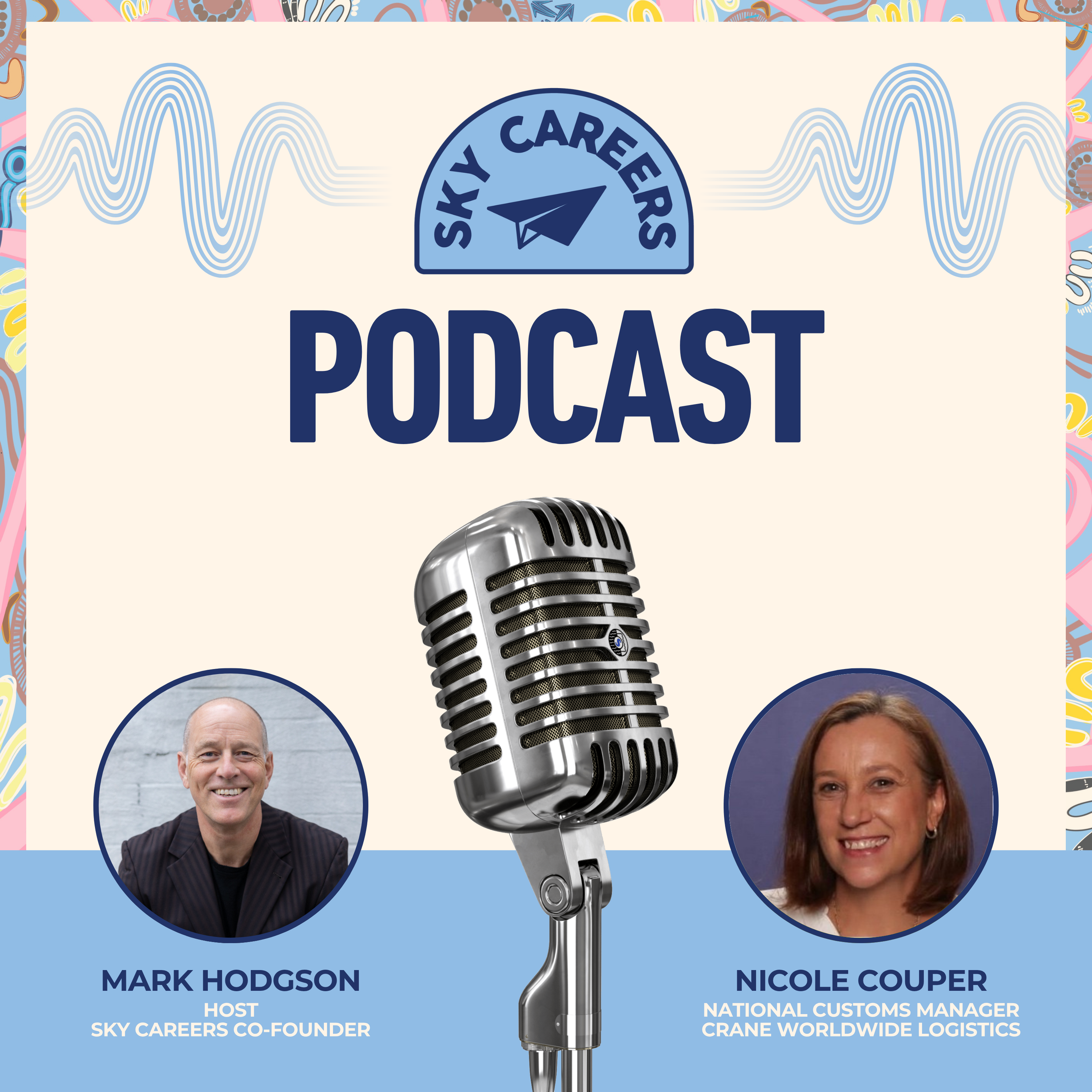
[00:00:08] Speaker B: Welcome to the latest edition of the Sky Careers podcast. It's my privilege to be your host. I'm Mark Hodgson, co founder of Sky Careers and today we've got a really interesting guest on the pod, Nicole Cooper. She is the National Customs Manager from Crane Worldwide Logistics, joining us from wa. So a slightly different story and specialization to what we're used to. So I'm really looking forward to my conversation. Nicole, welcome to the pod.
[00:00:38] Speaker A: Thank you very much for having me on today. I'm looking forward to having a chat with you.
[00:00:43] Speaker B: So. So am I. Very much so. Just, just tell us, National Customs Manager, what do you do?
[00:00:48] Speaker A: Okay, so I'm a licensed customs broker, which means that I am licensed by the Department of Home affairs to conduct customs clearances on behalf of importers importing a range of.
We have quite a number of clients here at Crane Worldwide. We are based in Perth, but we do have an offices on the east coast. We are 17 years young, probably a lot bigger than what we expected as a company when we first started in 2009.
And so I lead a small team here in Perth, which is.
I've got some customs brokers and some compiler classifiers which are I guess the p platers in training, the customers brokers in training.
I've been here for eight years now.
[00:01:36] Speaker B: Awesome. Now that's going to be a mystery to not just myself, but many of us. Give us a little bit more sense, if you will, about not just what you do, but I guess why you do it. Because a lot of us, you know, we go to buy something at a shop or pick up something at a DIY place or go, go to an organization and stuff just appears.
But yeah, there's a lot more to it than that, especially if it's come from overseas, isn't there?
[00:02:00] Speaker A: That is correct. It's probably one of the hardest things to explain to people what we do.
We're the invisible part of the supply chain, so to speak. So we're kind of like the that little O ring on a motor that when it falls off, the motor stops. So we tend to keep trade moving through, making sure that shipments are cleared at the border in compliance with the likes of regulatory bodies such as Department of Agriculture, Fisheries and Forestry or Biosecurity as we like to call them. Quarantine in the old days, Department of Home affairs. And that encompasses the border Australian Border Force as well as other government agencies. So we deal with the likes of most of your regulatory bodies like the Therapeutic Goods Administration, Department of Defense, most of your government agencies Have a touch point at the border and it's usually a regulatory requirements. So part of our learning in being a customs broker is not just to understand values and tariff items, which is a big hot topic at the moment, but also understanding how trade works and the barriers at the border and how to navigate those on behalf of our clients. So we provide a lot of advice to our clients in terms of whether they might require permits or whether there might be anti dumping matters with regards to imports of commodities that are subject to trade barriers. So we tend to do a fair amount. We call as a broker. Many of us say that we are, we're like a lawyer and an accountant but we don't get paid as much. So it's a very rewarding career that I didn't know existed when I first started. It was a thrown in at the deep end and I realized that there was such a variety about the types of careers in this industry and I chose customs clearance. But yeah, it's, it's one of those things that we are, we just do our job and things get on the shelves.
When toilet paper ran out in 2020, you know, we had changes to legislation that allowed for duty free importation of medical goods. So we, we were at the forefront of that, you know, the, the trade stop. It was like a halt of everything around the world for a few months. So throughout my career we've had many instances like that.
[00:04:31] Speaker B: So I often, I often say that aviation is logistics with wings. Because the most obvious, when people think of aviation or the general public think of aviation, I think most of us think of passenger freight and getting into aircraft and flying around and flying around Australia and maybe flying internationally.
And there's also a massive part of the, of the, of infrastructure with wings. Sorry, sorry, logistics. Wings, sorry, logistics with wings. That is not people, it's freight. It's the things you're talking about. Hazardous goods, drugs, building materials, all kind, all chemicals, all kinds of things. And I think, you know, to you when we think, when we travel individually we probably know, you know, we've got to do our own paperwork to go through customs and sometimes we get searched and things to declare and all that sort of stuff. So what you're doing is the, is the non human aspect of that, isn't it? And in all its complexities.
[00:05:27] Speaker A: That is correct, yes. So sorry.
Yes it is. It's one of those.
As crane worldwide we actually do have quite a large footprint in the air freight sector. So a lot of our clients require time sensitive freight. So things that need to be Delivered to a particular mine site or medical goods that have a very short lifespan need to be delivered within certain time frames.
So as a customs broker, one of the things that we rely on is obviously having that information before the aircraft leaves its port of departure.
And so over the years, you know, airfreight has evolved.
It was one of those things that, you know, it wasn't as big as what it is today. Air freight back when I first started in the mid-90s was a specialized freight.
Most people would ship goods via containers and sea freight.
So air freight started to really build, especially in WA when the mining boom hit in those, you know, the early 2000s, we saw rise in being able to get large aircrafts into Perth for mining infrastructure, charter flights and obviously things like bands and concerts and things like that. They don't generally come in on a boat because obviously the time frames, they tend to fly that stuff around the world. So over my career I've had some pretty awesome experiences with different not just standard box freight that fits in a 1 cubic meter space. It's more that big stuff that just makes it your job rewarding when you get to see it delivered and know that something like that happens. So yeah, over my years I do enjoy the air freight. It's quite fast paced.
You have to be on your ball. You can't drop the ball when you're doing air freight because dropping that ball means somebody might choose another air freight forwarder to, to carry their freight. So we have to be very like
[00:07:28] Speaker B: all logistics, time is money, right?
[00:07:30] Speaker A: Correct, Absolutely.
[00:07:32] Speaker B: So Nicole, take us back to a younger version of you. So where did you go to school and what were your favourite subjects?
[00:07:41] Speaker A: Okay, so I was a country girl first.
I was born in Wagin, so I did my first nine years in the upper great southern very small town. We had about a hundred kids in the whole school.
[00:07:55] Speaker B: Wow. Is that in wa?
[00:07:57] Speaker A: Yes, yes. So it's a very small country town. I think it might have been about 200 between primary and secondary.
My favourite subjects were I actually liked maths, I loved English, Science was okay, but I didn't mind also, you know, the social studies and the human side of things. So when I came to the city in 1990, moved around a fair bit. Mum was a single mum, so we tended to be put in a school that was close to where we were living at the time. So unfortunately my first few years of secondary schooling in the city was changing schools every couple of years. So when I hit year 11 and 12, I stayed at Willerton Senior High School. And that's where I completed my senior high school certificate.
And it was actually my, my vet teacher had come up to me and said, oh, you need to think about what you're doing after school, Nicole. And I just thought, oh gosh, I know that I was never going to go to un.
I knew that, you know, there were certain pathways that I knew I was not going to go down. Even if I felt like I was a smart person. I just didn't want to financially bog myself down with something that I would spend the rest of my life paying off. So I picked up the TAFE book and decided to just look at what I could do. I applied for a couple of different courses and I think it was my last one that I applied for, which was a certificate for in silver service. So I learned how to wait on people, flambe pancakes at a table, run a POS system, pour a beer and make cocktails. And so, you know, life skills, Nicole.
[00:09:41] Speaker B: It was life skills.
[00:09:43] Speaker A: I actually think it was one of the reasons I got into this industry because I used to work in Fremantle. I was working for Kalis and I used to make the coffees and serve ice creams and cake to the lovely people who would frequent Fishing Boat Harbour back in the 90s. And I would pick my sister up from work afterwards and I would often finish work much earlier than her. So I hung out at the old surf shop in High street in Fremantle, which back then was the hub of international freight. It was every second building was either a freight forwarder or a customs broker or a shipping line. So we, I, I moved around the city like I'd already been there. And the lady who owned this souvenir shop next door to me, her husband ran a company called Variant Agency.
And she said to me one day, she said, would you like a full time job? And I went, yep. I'd love to be able to have holidays. I'd love to be able to, you know, have all of that job security that working part time or as a casual, you just didn't have. And I wanted to move out of home. I had, you know, I didn't want to be at home all the time.
And so I had my interview at Variant Agencies. I had no idea what I was getting myself into.
I just knew that it was a full time job working in the shipping industry.
And I got that job. I started my first day on Halloween, 1994, which I should have probably looked at that as a portent to how tumultuous the industry can be over the Years and so I worked in the sea freight office of variant. We also had an air freight office of variant agencies and we were fairly big in the live export trade for rock lobsters. So we did a few with the rock lobster fisherman's co op. So we would on a Friday have mass running around getting all the airway bills, inspections, making sure the flights went out, there was no craze left on the tarmac and things like that.
[00:11:44] Speaker B: So that was probably them on a Monday, would you.
[00:11:47] Speaker A: No, certainly not.
[00:11:49] Speaker B: Australian sun for two.
[00:11:50] Speaker A: Two days indeed. And especially because the crazy season runs over the summer as well. So that was my first foray into I guess time sensitive freight and how important it was to meet the requirements of the airlines.
Lodge your documents on time, ensure that all of the customs export reporting was done. So I had a little bit of a snippet of air freight at the time. I then went off and had a couple of kids, came back to the industry and I had been working on and off at a couple of different companies. But I got my broker's license in 2004 and that's where my brokerage career went in a different direction. I worked for a company called Menlo Worldwide which was purchased by ups.
So being there as a customers broker, I went into management of UPS in the mid 2000s. So I ran the small package division, supply chain logistics. So we had obviously our brown vans and SE freight. Sorry. And you know, the small, small package is definitely people.
[00:13:04] Speaker B: I'm not sure if I think of ups. I think of it probably mainly from movies and seeing it in, you know, in, in, in, in. In the background. Mainly in the. In the background.
But in. It's so people would know. That's quite a, quite a well known organization. Certainly wanted to backtrack a little bit your broker's license. Tell us a little bit about what that is and why you needed to have it.
[00:13:31] Speaker A: Okay.
So as a customs broker we have a requirement to be a fit and proper person. But we also have to have a level of education and training before we can even apply to be a customs broker. So one of the things that we have to undertake is a diploma of customs broking.
That is a.
We run that through the IFCABA International Forwarders and Customers Brokers association, the IALC, which is an international RTO.
So we run the diploma online each semester. But when I did it it was through tafe. So it was every week we would all rock up to the local tafe, sit in a room and have someone tell us we didn't have the computers that we have today. We didn't have the technology, so a lot of it was books.
Smart. You had lots of paper. We killed a few trees, quite a lot.
As a customs broker, there was no such thing as recycling paper.
After completing my certificate four back in 2003, I then had to sit a national exam. So that was run once a year. And as a customs compiler or a student, you would make a. You would have to get your entire office, put it in the back of your car and take it to customs and sit there for three or four hours to do a national exam.
So that was how I got my license. And there was seven, seven or eight of us in the room on the day that we went in.
The.
Our teacher, Kevin Beatty, who is an ex customs officer, opened the old warehouse doors and we had a trolley full of books and anything that I thought I might on the day I brought along.
And so we had, you know, a lot of mock exams before that. To get myself in the groove of, you know, I've got a very short window of time to complete all these answers.
And so it was probably one of the most daunting things I'd ever done in my life was to sit there in the customs offices and do this exam. And I did finish early and I was a little bit petrified thinking, oh, oh, what have I missed? So, and when one of the other guys had got up and walked out of the room, I went, oh, phew, I'll just get up now. And I handed my exam in and the rest is history. I got the call to say that I had passed the exam with flying colors and then I applied for a license. So as a broker, once you finish your qualifications. So even now with the diploma, there's no formal test that you undertake. So the diploma is at a higher level, I think, than what we did when we were back in the 90s. Obviously there's a lot of changes to legislation that's happened over the years as well. So now with the diploma, once they complete the diploma, the next process is to look at acquired experience.
So that involves working like a broker, but not actually doing the broker's job. So that might mean talking to clients about their tariff advices, understanding how to do an import declaration and what are the mechanics behind that. So when you apply to be a customers broker, you now have to actually sit and interview with the National Customs Broking and Licensing Advisory Committee, which is a bit of a mouthful, but for short, it's nacbalack.
And they ask the students a number of questions relating to the job of a customs broker.
And for those that have never been like this in an interview, it can be quite daunting for some of those younger ones who've not had to, I guess, face a strict panel like that. So I've been fortunate to be a part of a couple of those panels on behalf of some students who are now customs brokers themselves.
And it is definitely a different process, but I think what it does is it allows the student to show their knowledge and experience in a way that we didn't have that opportunity. We just passed an exam and got our license. So quite different to how we do it today, but the process is still the same. You still have to undertake a period of, of learning before you take your P plates off and your training wheels and get to lodge a customs entry and hope that customers don't pick it up to look at it, because that can be even scarier, especially for new ones.
[00:18:06] Speaker B: Your passion and your smart shines through. And it sounds, I was gonna say the thing that signs through more than anything. And you're talking in a lot of detail about something that clearly you've got. Have deep subject matter expertise in and the rest of us have, have some degree of understanding greater or lesser. But the thing that shines through is your passion.
And you know, if I try to create a parallel, I guess some principles out of this for listeners who don't necessarily want to become a customs broker, but actually understand your pathway from, you know, as you've described so beautifully from a small country town to not really knowing what you want to do, to starting a job to someone saying, hey, do you want a permanent job? And have a think about this and just picking up little breadcrumbs, as it were, and taking opportunity and moving forwards and then I guess almost falling over into what's turned into your passion and a great profession because I think a lot of kids leaving school are young people.
They feel that everyone else has got it worked out and they haven't. And reality. And I know from talking to you today and so many of our other guests on the Sky Careers podcast, almost no one does.
And aviation and aviation adjacent professions like, like yours, you know, it's just show up with a good attitude and, and, and, and be curious and be a little bit brave and look where you end up.
[00:19:35] Speaker A: Absolutely.
[00:19:37] Speaker B: So Mike, so I'm going to bring us. We, we are, we are time challenged because we, you and I talk for hours. So bring. Because I want. There's a couple of things I want bring us fast forward up to your current role.
What does a current day in the life look like for you?
[00:19:52] Speaker A: Okay. Lots of emails.
Generally we don't know what's going to happen when we get into the office on a daily basis we have regular shipments. So a lot of the work of a customs broker is monotonous and similar jobs. It might just be a different shipping line, but the commodities are still the same. So thinking along the lines of you've got an importer that brings in air conditioning parts, so they're going to have continual imports of those types of commodities. So a lot of our stuff is repetitive but there are challenges throughout the day. So this morning I had a challenge with a quarantine entry. So we deal with anything that kind of is too hard. We solve problems that people don't even know are there. It's probably the attitude that we have.
We can have any number of emails that come through to say, I would like to explore this opportunity, opportunity to look at importing this particular product.
So my role as the manager is often looking at those projects.
What are the mechanics about the customs clearance element at the border? And so a lot of my stuff is advice, but I also do a bit of education with my team here. So when something new crops up my training background, it just peaks my interest and I will go and show the guy in my team. This is something that has just come across my desk and whilst it might be a high level thing, I think it's important that my team and anyone that's learning in the industry has that visibility over some of those things that you're not going to see every single day. So that's the joy of my job. Nothing is the same.
It can be. One day I can be flat out with accounting stuff for end of month and then the next day I will be sitting talking to someone about moving 500 ton pieces from Houston to Australia and how do we do that? So we do have.
Variety is the spice of life, they say.
And as a customs broker, we don't put any expectations on our day. We just roll with the punches and hope that nothing goes pear shaped for our clients.
[00:22:13] Speaker B: I mean, the variety again is a very common theme we talk about on the Sky Careers podcast. But also problem solving, which is so important. Showing initiative, being creative, collaborating, teamwork, reaching out to find answers when you don't know them and so forth.
So clearly a big element of your role is going to be paperwork based and compliance based.
Do you get to get out and about and look at stuff and pull stuff around occasionally.
[00:22:46] Speaker A: Not so much these days, but back when I was first in the industry, that was probably one of my biggest roles, was to go out and see the inspection. So I would have to pick up a customs officer and take them to. Down to the wharf or up to the air freight terminal to do an inspection of goods.
I do get out to see clients occasionally when they let me out of the office. I do tend to prefer to be in the background.
I'm not someone that. That loves to just be on the road all the time. I think that it's not something that suits my personality. I like to be that person in the background.
But yeah, it's interesting because we do try and give as much exposure to everyone in the organization about what we do and how we do it. And customs being such a unique element, it's really hard to show people what we do.
But when we do have those inspections or the opportunity to go out and see something. So we had a freight charter last about a year and a half ago where we had to get one. I think it was a C130 to bring in this huge piece of equipment.
And so I had the opportunity to go up to the airport, watch my plane come in, and then watch it getting unloaded, which was a really cool thing. And you get all those, the skyscanners, the people that love to. To watch the planes coming in. And they were all talking about this big plane. And I said, that's my plane, so that's my freight. That's my freight. So, you know, we've had lots of instances where we've explored, you know, moving freight on the Antonobs and stuff like that. So, you know, our job is not just small freight. And I love it when we do get a challenge that makes us think outside the square on how to get something in for a client.
[00:24:36] Speaker B: So what, what, what's the. Across the years, what's. What's the thing you've, I guess, either most memorable or the one you're proudest of.
[00:24:44] Speaker A: Probably my most.
My proudest memory, actually, going back to 2007, I had a mind shutdown.
I was going through a bit of, you know, I had a lot of things happening in my personal life at the time with my mother passing away. So I was, you know, probably burning the candle at both ends, which was a challenge, but I got through it and I think I'm a lot stronger for it. But we had a large piece of equipment being manufactured in Tulsa, Oklahoma, and we had a very short window to join the boat in Houston.
And when that time came, they hadn't finished doing the fins on this big piece of equipment. So we just said, get the bulk of it on the boat. The problem was there was a couple of hurricanes that came through, so we had bridges down. We had to find a solution at 7 o' clock in the morning of how we're going to get this to Houston. If there's no roads, there's no bridges. So we had to put it on a barge and barge it down to Houston. But then the other element was, what do we do with the fins? How are we going to get those fins to Australia on time in order to meet the charter vessel coming in so that it could go up to the mine site? So we then explored a number of different large air freight opportunities and we did end up putting it on a charter.
We had it come into Perth airport. I think by the time we'd negotiated everything, it was finished manufacturing. We ended up getting it in about a week and a half before the boat arrived.
So we were able to get these massive fins, which were huge. They were like 4 or 5 meters wide, but they were narrow. So, you know, they're only like 20 mil thick.
But the challenge of loading those on an aircraft and getting them off. So I was down at the airport watching these being loaded onto a truck and then they were taken to Quinana to the manufacturing facility where the heater was going to be put to finish. And, you know, just getting it here on time and before that boat came was one of the most critical elements of that project because the shutdown needed to have this piece of equipment, otherwise the shutdown was just not going to work. So, and you know, we were working with our project team in the us. US as well as, you know, locally here. We had so many balls up in the air that if one of those had dropped, it would have just gone pear shaped. So, you know, that was probably one of the more rewarding air freight projects that I'd been involved in and knowing that it got there on time.
[00:27:17] Speaker B: So what, what, what a, what a, what a great, what a great story, Nicole. Now say, and it just, it, as I say, logistics with wings or, or, or, or. And you mentioned there, it's, it's by, by sea, by, so by air, but also by sea, obviously that's, that' of bringing stuff in just, just whilst we got you, we've got a bit of a logistics supply chain disruption at the moment, don't we, with the, with the, with the oil crisis caused by the Iran War. What's. How's that showing up in your world?
[00:27:46] Speaker A: Well, I think that the flow on effect of that is likely to start showing in the next couple of months. We as a business and everyone else in the industry would agree that when there is disruption like this, they do tend to limit what vessels, what aircraft is coming in. There might be routes that will no longer be viable because they've got to conserve the fuel. So I think in the next few weeks, we'll probably start to see a lot more of that flow on effect. At the moment, not so much because everything's moving. I guess the reserves are there, people have the fuel. But given that complexity, we're already seeing price increases on the ground through our vendors, we're seeing price increases through freight. So that itself is already an impact. But I think the routing, the availability of flights and vessels to bring stuff, especially to the Asia Pacific region, is likely going to see some of that disruption in the next couple of months. So we are seeing a downturn in stuff coming in, but that's kind of normal as well. There are true ebbs and flows in the industry as a whole, but it doesn't help when fuel is something that is required for everything to move so well.
[00:29:06] Speaker B: That's a fascinating perspective. I've got two more questions for you, Nicole, and. Yeah, I told you we'd only speak for 20 minutes. Here we are half an hour in, and I do have to help us, as I say, land the plane.
What do you do when you're not at work?
[00:29:20] Speaker A: Okay.
I'm a jack of all trades in terms of. I have quite a few hobbies that I like to partake in. I think because I'm such a person that likes detail.
I have a very, very large LEGO collection. And when I say LEGO collection, I have a build room. So I like to build things. It keeps my brain and my fingers active.
I find it challenging.
I love it for the fact that my grandson can sit there with me and we both play lego.
[00:29:54] Speaker B: Favorite grandparent for sure.
[00:29:57] Speaker A: Oh, yes. He already knows. When he comes, he goes, can I go to LEGO room? So yes. Hell yeah.
[00:30:04] Speaker B: Do you know, Nicole, it's funny, I've been doing this quite a long time.
It's the first LEGO room guest we've had. So you get a golden brick for that.
[00:30:15] Speaker A: I tell you what, I'd love a golden brick.
[00:30:18] Speaker B: Is your ambition to get on LEGO Martin Masters?
[00:30:20] Speaker A: That's why I'm training my grandson up. You know, I'm. I'm emulating some of the Wap Absolutely.
[00:30:26] Speaker B: Grandmother, Grandson. Q angle. I like it.
[00:30:28] Speaker A: I. I think he would. He does tend to play very well in my Lego room. He does try to climb up, but I make sure that there's something there
[00:30:36] Speaker B: for him that is gorgeous. Now, one of the things that I always ask our guests to do at the end of the podcast is to send us through pictures about their life and yes, so their profession and airplanes and how you do what you do and sort of memorable pics. But we need to include, I think, a picture of the LEGO room, if that would be okay.
[00:30:55] Speaker A: Well, I have a fairly extensive minifig collection, so maybe I can send that.
[00:31:00] Speaker B: We'd love to see that. And the last question. I really, really enjoyed this conversation, Nicole. It's been so informative in so many senses.
Whilst it's not, if you like core aviation, inverted commas, it touches aviation and the logistics of aviat and, but, but for me, the thing that, that sings out is that there's so many of the common qualities, you know, teamwork, you know, taking it, taking a chance, working hard, doing some study, but also on the job study, because you say you did not, you went to university and came up with a degree in this thing. You've worked out on the, on the way through, you've picked up, worked out where you want to go and worked out, worked out also what study you needed to do and ended up in a really good role. So my last question is, what advice would you give to other young women and men looking for a career in logistics and aviation or maritime or any of those kind of related industries?
[00:32:00] Speaker A: Don't segregate yourself to one area of the industry. There are lots of jobs available.
We have so many different career paths within the international transport and logistics area. So there is a lot of people that work at the Qantas terminal doing your paperwork, ground handling. You've also got freight forwarding. There's quite a lot of companies that are looking for young people in that freight forwarding area. And freight forwarding touches on both air, sea and an element of ground.
But the industry is so varied.
We are an essential service. So there is a job for anyone and everyone. I think when I go to schools and I talk to them about the different careers, I, I put it into the perspective.
If you like talking, if you're a talker, maybe sales is the perfect place for you. Customer care or you like numbers. Every business needs finance. You want to go to uni, great. Get your degree and come back and work for us in the industry in a finance role. If you're someone who likes to look and deep dive into just about anything and everything, then customs brokerage is generally the area for you.
[00:33:15] Speaker B: You're a bit nosy.
[00:33:18] Speaker A: I guess the, the thing that we kind of pride ourselves on is we know a little bit about just about everything.
So the roles are varied. There is transport roles, there's warehousing roles, there are administration support roles as well as, as you know, the people that run the offices. So you can get a job doing anything in this industry. If you can pick a career on say, an ATAR list, chances are there's a job that aligns with that in our industry already. So those people who are doing economics in year 11 and 12 and thinking where is my job going to, where is this going to take me? If I decide to go down this economics path and understand all about trade and whatnot, what can I do?
That's what customs brokers do every day.
It's an economical role. So I think the key to anyone wanting a job is there are hundreds and hundreds of jobs in this industry and the pathways are so diverse that once you're in, the doors will open for you. If you're a keen go getter, if you're someone who really enjoys just being the best that you can as a person, then you're going to go far in this industry.
And I've seen a lot of people over the years rise to senior management positions, traveling overseas and people that like myself, didn't know about a career in this industry and have found our home, the thing that gets us.
[00:34:48] Speaker B: I love that Nick. And you are, of course you've walked your talk. You're a poster child for exactly what you've just described in.
Yeah, you're such an engaging guest. I've really enjoyed our conversation. Nicole Cooper with a U.
[00:35:03] Speaker A: Thank you Mark. It's been a pleasure to be here today.
[00:35:13] Speaker B: Thanks for listening to the Sky Careers podcast.
If today's conversation has sparked your interest in aviation, then head over to our website at Sky Careers skycareers.com au whether you dream of flying aircraft or you're curious about the hundreds of other exciting roles that keep the aviation industry moving, Sky Careers is your gateway to discovering these opportunities.
And if you are already in the industry, check out Sky Careers Connect and Sky Careers Leadership and consider joining our online learning community.
Until next time, keep reaching for the scuff wise.