[00:00:07] Speaker A: Hi, my name is Mark Hodgson and it's my privilege to welcome you to the latest edition of the Sky Careers podcast.
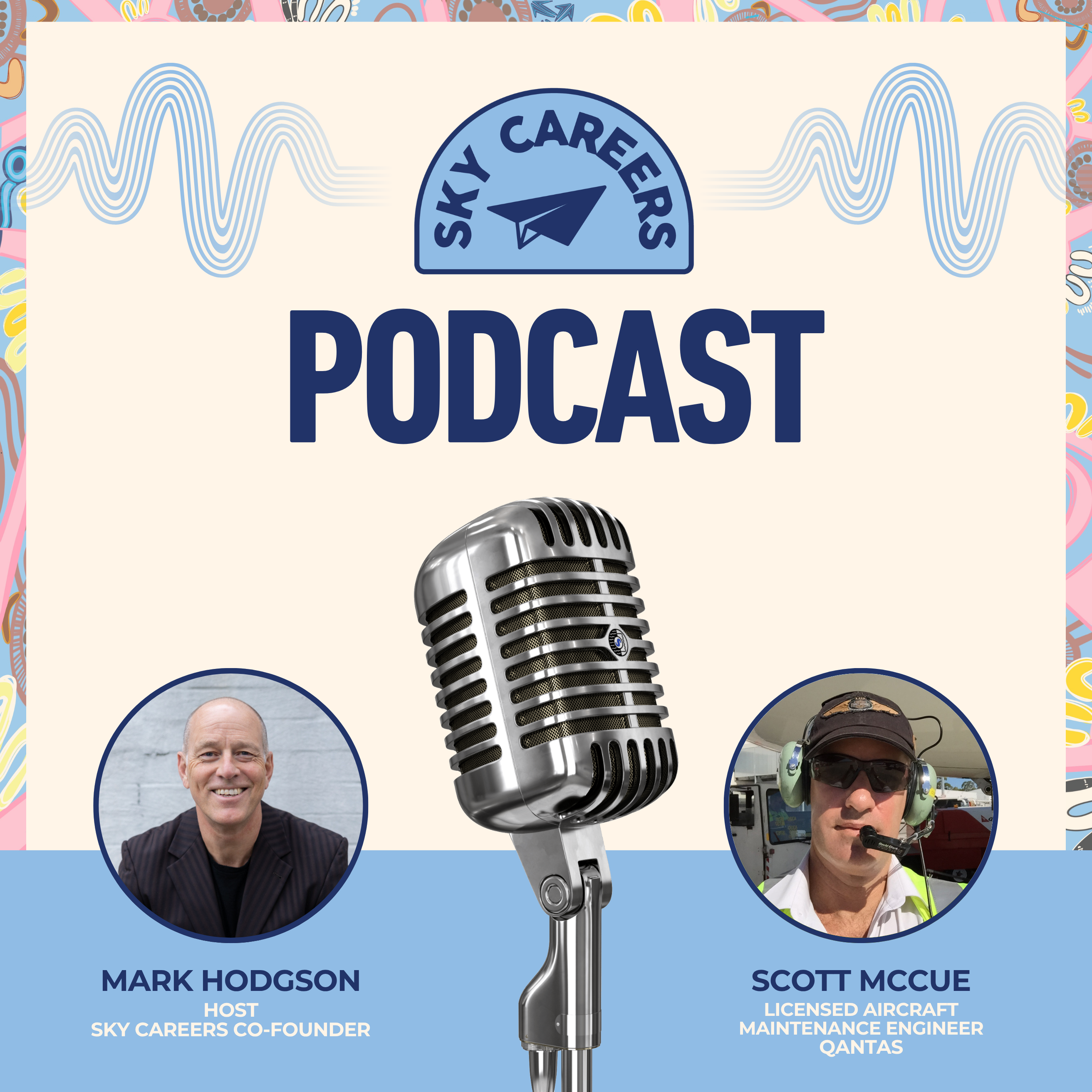
And my guest today, I'm really looking forward to this conversation, is Scott McHugh. Now, Scott is a licensed aircraft maintenance engineer, or a lamy, and he works for the mighty Qantas, the Flying Kangaroo, based in Perth. And he's been doing this for quite a while. We've just been chatting before we came on for 36 years. So, Scott, I think you've got a bit you can tell us. Welcome to the podcast.
[00:00:45] Speaker B: Thank you very much, Mark.
[00:00:47] Speaker A: You're super welcome. We always like to start right back at the beginning. And for you, that's a little while ago, Scott. So tell us about your early years, where you went to school, and maybe a little bit about what you study in your favorite subjects.
[00:01:02] Speaker B: Okay. So I'm originally from Sydney and that's where I went to school. And my high schooling was in a school called Genali Boys High School.
And from there I just had a real interest in all the industrial arts, metalwork, woodwork and so on. They were probably my favorites. I didn't mind a bit of science and geography and the math interested. The math was difficult and one way I hated it. But it also intrigued me about how metrics and math was very precise, which is a little bit like engineering. There's no gray areas. It's either right or wrong, yes or no, black or white. And so the math sort of, it intrigued me as much as it tormented me as well.
And then I just, I just really had a, an interest in the, like dad's lawnmower and when it wouldn't start and troubleshooting it and things like that. I just loved machinery. I love to fix my bicycle and just changing tires and things like that again also. And bearings were flogged out in it just to work out what was going on and to just be around the garage and around the shed experimenting with, with the toolkit. Not necessarily being a great on the tools, but it was just good to have them in my hands and to be just playing around with it. That's really where my curiosity about engineering and mechanics and nuts and bolts came from.
[00:02:35] Speaker A: So. Sound like, sound like you're a young man who walked around with a bit of, a bit of oil and, and stuff under your fingernails.
[00:02:41] Speaker B: Yes, definitely.
And I think we're.
Yes.
Where my curiosity really came from was. Yeah.
Where we lived in Sydney, there was the main road to get. Well, I lived in southern Sydney and to get to the city the main road sort of went around the perimeter of the Sydney airport and at times when we would be out at some special occasion in the city and we'd come back around the airport, I'd always ask Mum and Dad if we could stop the car. And it was brilliant because right where the aircraft came over on their final approach, before they touched down, they went right above the roadway and we weren't supposed to stop there, but dad would just stop for a minute or two and a couple of times we timed it perfectly that a 747 was coming in and there's four engines roaring and you could look up.
Quite often it was at night time and they had the landing lights on and all the landing gear were down. It was just so dynamic and a really spectacular and exciting. There was so much energy involved and that just really sparked my curiosity about, like, what's going on inside those engines and how do those engines propel the aircraft and all that landing gear, how it retracts and disappears inside the aircraft after they take off and then it comes down again for landing and the wing as well, like, how does the airplane fly? That was still all. All those things were a real mystery to me.
And it's really where my thoughts about being a mechanic or engineer really came from, was some of that childhood dreaming and a sense of wonder, really.
Yeah.
[00:04:32] Speaker A: Oh, fantastic. And what was your pathway? What did you do next to go from, I guess, school into ultimately joining aviation?
[00:04:43] Speaker B: Right. So in high school it was kind of similar, but things have changed a little bit now. It was six years of high school. If you're going to do your high school certificate and go on to uni. And it was a. I think it was called a TR or something, the tertiary entrance score then it was out of 500 in New South Wales back then. And I had zero interest, really, in going to university.
I wasn't. I was really more of an athlete at school. I wasn't so much of an academic and I really didn't enjoy school that much either. But I really. What I did know was that I really didn't want to be inside an office and four walls for the rest of my working life and my career. It had to be something outdoors.
And I considered motor mechanic and some of the other motor trades and things like diesel fitter, things like that. And then it was actually a good friend of mine at school, his older brother had done the aircraft maintenance engineering at Qantas, and I got speaking to him and I just went, oh, I think now I might have found My niche, what I'm really looking for. And so that's when my whole dream about getting into aviation and as an engineer began from there and off it went.
[00:05:59] Speaker A: And so what was the leap from, I guess from your study to actually your first job in aviation?
[00:06:06] Speaker B: Okay, so I, when I got to 16 in year 10, so that was after doing four years of high school, that's when you can leave. And in that era, I know there's now waste where you can they encouraging people to stay on and do the full high school six years. But it's people like, designed for people like me that have no real intention of going to university.
Most of the people that were going to get a trade because what I do, aircraft maintenance, engineering, it is a trade, it's not a degree at university.
So you go to a technical college. So most of the plumbers, carpenters and so on, motor mechanics, would all leave school in year 10 and not do their high school certificate.
I could have done that if, and attempted to join if I wanted to. But I just felt like a couple of things. I just felt too young to be leaving school and going into the workforce. And the second thing was I thought you only get one chance at high school. I'm never coming back to have this opportunity ever again.
So I felt it would be best use of my time for only two years because you're out of school for a long time, the rest of your life, basically.
So in the big scheme of things, over a lifetime, two extra years at school was not a big commitment. So I stayed on and did my hsc, did those higher levels of science, math and English, which incidentally that did help me a lot in my career is having that higher level of math, even though technically I didn't really need it. So that was very, very helpful by default. And then did some work experience in year 10, some work experience in year 11, was not able to get work experience in aviation, but did a variety of different things. Some of my work experience was even just to work out what I did not want to do when I left school.
And so by about the start of year 12, I was making serious inquiries on how to become an aircraft maintenance engineer. And the difference between licensed aircraft maintenance engineer and aircraft maintenance engineer, the pathway. And it was an apprenticeship. And so towards the end of, was about halfway through, I think, or towards the end of year 12, I actually, and this is a really good lesson for people, right, because this is before the digital age, this is before the Internet and I know that's hard for younger people to imagine, but our ways of communication, we didn't. There wasn't even email, it was just a telephone or going and knocking on a door.
So I very boldly said to my mum and dad, I'm gonna drive my. Because I was driving at this stage, I'd already had part casual jobs when I was in school, bought my own car. I drove down to the jet base at Mascot in Sydney and just knocked on the door and. Well, really, this is a story in itself. Actually I got onto the jet base illegally because I just parked my car in the car park and because you got to imagine this jet base is like a small city and I was parked way, way in the visitors area from the actual main gate. As I approached the main gate, I got talking to this guy who looked like one of the engineers. And long story short, he scanned me through the gate on his ID electronically, which is totally illegal, he shouldn't have done that. So instead of going to the main security gate, he just fast tracked me through and said, yeah, that's the apprentice training area in there, go and talk to them. So I knocked on the door and they sat me down and introduced myself and they gave me all the brochures and told me all the, you know, the full, got the full bottle on how to become an apprentice and so on, which was fantastic. And they told me when they would be advertising, when the advertisement would come out in the newspaper and so on, keep an eye on the newspaper of how to apply.
And then right at the end they said, by the way, how did you get in here? And so I don't know what happened to that guy. Probably just got a wrap over the knuckles. But, but the, the, the lesson in that is going and knocking on doors and speaking to people face to face so they get you. Can you build connection? What's so missing today is people tell me, and during COVID I found this. I got stood down for months on end because aviation got devastated by, by Covid and I had to go and find another job essentially. And I had a truck driving license, which I got many years ago, but applying online because I had no experience and I'm getting processed through an algorithm. So just like you and I talking now, this, that was not part of the picture. And if the algorithm doesn't like you on your electronic application, it spits you out before you even get anywhere near a human, which is really unfair and unfortunate and I really feel for, for everybody. And so if you're leaving school now or trying to get into an aviation career, you could find yourself in that same scenario. So I really can't overemphasize enough the power of connection and meeting people, talking to people, putting yourself out there, it's very bold. It's a little bit uncomfortable, but hey, sitting at home on your couch, comfortable, nothing extraordinary or great really happens in your life. It's when you get out of your comfort zone and get out there in the wide world that really extraordinary things happen. And that could have been the difference between me being in aviation and not. Was that decision of myself to be bold enough as a 18 year old, 17 year old, whatever it was, to just go on down to the jet base and knock on doors and start asking questions.
[00:11:35] Speaker A: Yeah, I love that answer, Scott, and you're so correct. I think we're of a similar vintage.
And the irony now is that in a world that is theoretically everyone's connected via texts and online and digital and websites and AI and all those things, we've never been more disconnected. And I think as you say, the old analog skills of picking up a telephone or even better, just going knocking on a door and shaking someone's hand and introducing yourself is so powerful in actually getting on in life generally, but specifically in aviation because a lot of the conversations we've had on the Sky Careers podcast, we hear a lot about this because, you know, a lot of roles in there are, yes, there are a lot of roles in aviation. There's a broad range, as you would know, but getting, finding that first step is not necessarily that easy. And there can, depending on exactly where we're talking about, there can be a lot of competition.
And just having a, just having a piece of paper or a qualification or a flying, or a flying license or something isn't enough necessarily to get you in. Once you get in, it's different but to get that first step. So I love that story about you knocking on the door all those, all those years ago as a fresh faced 18 year old in the, the mascot, the mascot jet base, you probably wouldn't get close to it today. The fences are seven times higher today.
[00:13:00] Speaker B: Yeah, it's all, it's all locked up and it's. Yeah, there's multiple security entry points actually to get through to where you need to go to now. Yeah, that, that just, yeah, can't happen.
[00:13:13] Speaker A: I love that. So you joined, so you did your apprenticeship. Did that take you straight into Qantas or was it, was it a Qantas sponsored as apprenticeship or how did this piece work?
[00:13:24] Speaker B: Yeah, correct. So I was keeping my eye on the newspaper I saw the call for applications for apprenticeships come out. So I applied and I went through the interviewing process. Process. I think there was a couple of interviews. Ultimately I got accepted into the apprenticeship scheme and that's a four year apprenticeship. And so you at that. That was the first year of the training school at Alexandria. So we all got given our start date and I got down there to the training school and I did my first year there in the training school which was a lot of theory and practical as well at a really big practical workshop down there with small so we could actually start playing with aircraft, get hands on. And then for second year we went out to the jet base and every three months we would change to a different section and we would do a workshop section and then an aircraft hangar section. So just alternating three months at a time. And that went on for second year and third year. And also from second year we started going to a TAFE college. So that was Padstow TAFE in New South Wales. They were the aviation, aircraft maintenance, engineering allocated tafe. And so we would do one week every month out at the TAFE college. So it'd be three weeks at the jet base and then one week at the TAFE college. And then at the end of the third year we got to make a selection of where we would like to spend all our fourth year. And you make like a 1, 2, 3 hierarchy. And they endeavored the apprentice training center to try and give you your first pick which I got which was the heavy maintenance. And that's where in the hangars where we were getting 747s and completely doing a D check. That's the heaviest check they do on aircraft which they do every 10 to 15 years. So we were completely stripping the aircraft apart. Like the whole interior stripped out, all four engines off, all five undercarriage removed, inspections of all the fuselage and then all put back together, all tested and then it flies again, the aircraft. So I deliberately chose that section because that's where I was going to get the most experience on all the systems and the aircraft and really seeing the nitty gritty and how everything worked. And then ultimately I moved to a couple of other sections after that. We may be able to come to that later on. But I currently work in line maintenance here in first airport.
[00:15:59] Speaker A: So before we get to today, so how, I mean there's, there's a, there's a, there's a little twinkle in your eye and a sense of excitement in your voice as you relate. It was, was that four year, I guess when you really. You, you, you, you. You earned your spurs, as it were. Was that. Was that. Was that. Was that hard? Was it? Did you find that piece easy or enjoyable? How was that four years for you?
[00:16:26] Speaker B: The four years was great. It was a little bit of all those things you just mentioned. It was hard, it was tiring. I was doing shift work for the first time in my life, which involved some night shifts, day shifts, afternoon shifts, weekend work. There was that adaptation and then the people side of it as well. We're probably going to see the people theme recur throughout our talk here. The changing section every three months meant that you were having to get to know a new crew of people every three months.
A new section, a new senior engineer, a new duty maintenance manager, a new supervisor, and also all the colleagues that you were working with, the tradespeople, rubbing shoulders with them and getting to know the intricacies of each personality type. That was a challenge in itself, was just the. The people just put the aircraft and the engineering side of it aside. That was a whole thing in itself, obviously, because that's what I was primarily there for, to learn that, and I was learning that, and that was fantastic. But then there was this other element that I didn't really consider too much before I was in that environment of then having to learn the people. And by the time you worked that out over the first few weeks, you were then working with them for six to eight weeks, and there were some weeks you were going to TAFE and so on, so you weren't there.
And then before you knew it, three months was over, and then it's rinse and repeat. You're going to a new section, new faces, new people, new aircraft as well, in time, in terms of what they were doing with either components off the aircraft engines, gas turbine engines, overhauling undercarriage or components, or you're in a live aircraft section where you're actually working live on the aircraft. So it was. It was great. Some of it was tedious because a lot of the work that you're doing as an apprentice, because you really don't know, a lot is a lot of the just undoing screw after screw after screw after screw, like hundreds, sometimes even thousands of screws in a shift is all you're doing. But this is the important bit, is when you see one of the tradesmen that you've got to know quite well, doing something more technical while you're doing your screws, just have a look over his shoulder and see what he's doing. And that way, like, looking is A very powerful tool in that industry to, you know, seeing as believing. And you can learn a lot just by the powers of observation of what the other more experienced people around you are doing.
[00:19:02] Speaker A: That's fantastic. So once you were, you were, you were qualified at the end of that four years. So give us a, give us a whistle stop tour of, I guess, the next, the next 30 years. Because you've been in Qantas for 36 years.
[00:19:16] Speaker B: Yes.
[00:19:17] Speaker A: Where did being a lamy in Qantas take you? Obviously took you from the east coast to the west coast, but I'm guessing a few other places on the way.
[00:19:24] Speaker B: Yeah, it's definitely 100%. It's taken me a lot of places around Australia and the world, actually. But we'll get to a little bit of that.
Initially, when you come out of your apprenticeship, you're an ame, so you are an aircraft maintenance engineer.
So you can then be assigned a job by a senior engineer or a licensed engineer. And then it's up to them to decide how much observation they need or how much direction and being there overseeing what you're doing is required. When you're straight out of your apprenticeship, you need a lot of it. But if you've been an AME for 5 years, 10 years, you then do 11 exams that are Civil Aviation Safety Authority exams to be as a prerequisite to then become a licensed aircraft maintenance engineer. And then you need also then several thousand hours of experience on a particular aircraft type, and then you can then sit what they call a type course. So my first type course was the Boeing 747 400Qantas, then put me on a type course for three months, where you study that aircraft full time for three months and you do 12 exams there in the training school. So one exam you study for a week and then you do an exam at the end of the week, all 75% pass marks for CASA and for Qantas on the type course. And then once I came, it passed all those exams. I then applied to CASA for my first license. And then you become a licensed aircraft maintenance engineer and then that just repeats.
Not the 11 exams. Once you've done those prerequisites, they're done. But then when Qantas then wanted to put me on another type course, I think my next one was the Boeing 767. So you were doing the airframe in the engines on that airframe. And then I got the Airbus A330 and then the Boeing 737. So they're the four types that I currently hold those four airframes and all the different engine types that are on those, those aircraft.
And so that's.
[00:21:39] Speaker A: It sounds like quite a lot of study.
[00:21:41] Speaker B: It is, it is a lot of study, yes. They say that it's about the equivalent of doing a degree at a university for whatever you're, you're studying to, in whatever profession at the end of the day. And now that I've done it, like some of these exams, like on the aircraft lights for example, just a, you know, this is just every, you study every single light that's on a 747. It's a thousand pages is the book that one. One thousand, one thousand a four pages in. If you have to study to understand every single light on a 747. And at the end of the, the week there's a, there's an exam on all those lights and you've got to get a 75 mark pass mark on all that. And then at the end of that week you have the weekend off and then you're into another 500 to 1,000 pages on another area of the aircraft. It's quite, it's intense and it's. Once you understand the systems, they're not too bad. But the volume is the most overwhelming thing in, in this career path.
It's the volume of information.
[00:22:49] Speaker A: Yeah.
So bring it, bring us far, bring us fast forward.
Scott, we could talk for hours. We might, we might have to have you back for another one because sure, we can do that, there's so much to cover. But bring us bringing us forward to today and it's 30 something, 30 plus years at Qantas.
Tell us what you do today.
[00:23:08] Speaker B: All right, so what I do today is I'm at the Perth airport here. So all the Qantas aircraft that are coming and going, every time that aircraft lands, there's a minimum inspection that has to be done by someone like me. And so that aircraft turns up domestically, they're all about a 60 minute turnaround time. So from the time the aircraft stops to the time it's rolling out again, you've only got 60 minutes. So in that time you have to do that walk around inspection downstairs looking at everything, looking for any obvious discrepancies. Then you go upstairs and there's. I interrogate the aircraft because the all aircraft are digital. They self monitor now. So I have to see if the aircraft has picked up anything that it feels is wrong with it. There's two logbooks, there's a logbook from the flight crew and the Cabin crew, so they write up any defects that they might have had on the trip from wherever they've come to, to Perth. Then I have to address those. Anything that. Address anything that the aircraft says it's wrong with it. Then we have to fuel the aircraft and I have to oversee that and report all the figures to the captain so that they can cross check, make sure they've got the correct amount of fuel they need for the next sector.
And then at the end of it, walking around the aircraft, all the doors, everything that was opened or touched during this current ground time, I have to confirm that it's all up all closed and fit to fly again. And then there's also, you can probably imagine, a whole heap of paperwork and compliance that I have to do. Also, every single time that aircraft lands before it takes off again, and those logbooks that the flight crew and the cabin crew have at the end, when they've all those defects in there have been addressed, is what they call a CRS or a Certificate of Return to Service. So every single time that aircraft lands, a LAMY like myself has to then certify that crs and I'm legally saying that that aircraft now is fit to fly again. So every time the aircraft lands, that CRS basically expires for the previous LAMY did. And whilst it's on the ground, the maintenance happens, servicing happens, and then at the end of that ground time, certifying a fresh CRS to say this aircraft is now fit to fly again. There's a lot of regulation and compliance in this industry.
[00:25:32] Speaker A: We'Ve covered. That might bring us on to the. The next question, which is what part of your job do you enjoy the most?
[00:25:40] Speaker B: Oh, all right. So let's. Here's the people theme coming again.
I think the, the liaising with the flight crew, the cabin crew, and just. There's a lot of collaboration built in now too. Instead of it being very singular, like the pilots just flying the plane, me just fixing it, the flight attendants just doing their part. There's a lot of working together, more so now than when I first started in my career. It was very singular before. Now there, it's a lot of everyone helping each other, working together to get a better outcome, a faster outcome, things are just more efficient and it's just a nicer place to work as well. So I think talking to the pilots and the flight attendants about their issues when the aircraft lands and it gives me a much better idea instead of me just reading a short summary of the defect, if I can talk to them directly. I can get a lot more information in a much faster amount of time about the exact nature of the defect and it gives me a much, lets me focus in a lot quicker on what I actually need to do to resolve the situation and the defect and to get the aircraft going again. So probably the people. And then when you do have a defect, if you can fix it quickly in that 60 minutes seeing the aircraft come in broken somewhat and then being able to quickly do something, change something, reset something and then get it serviceable again and then see the airplane leave is also probably that that would be the two most satisfying parts of my job.
[00:27:15] Speaker A: Yeah, I think I know I've sat on a lot of airplanes in a lot of, a lot of parts of the world and seeing a you person walk in and having everything cross. We've got a slight, slight engineering problem you're going to see.
[00:27:30] Speaker B: Yes, please, yes, please be able to fix it.
[00:27:35] Speaker A: And we've sent lots of love your way and if you walk off and say no, good.
[00:27:39] Speaker B: Yes. Yeah.
[00:27:43] Speaker A: And the corresponding question of course, what's the least favorite part of your job? Scott?
[00:27:49] Speaker B: Oh, okay.
Probably the one thing that if I could change and eliminate from my workplace that and it's quite simple and straightforward, that would be the rain.
I hate the rain. So when I'm outdoors because it's a very outdoor orientated job if it's, I look just, just to sort of paint the picture look I, it's not the, the rain itself you but when I, when I have to be out there, I've got a full rain pants, rain jacket, hood. It's like storm proof. It's all sealed up so that I stay dry.
But I'm also, I'm carrying my own phone, I'm carrying a mini iPad, I'm carrying a two way radio, I've got a notepad and pen.
These things are used constantly in my job and also rain will destroy those things very quickly.
So keeping them dry means that they have to be on the inside of that raincoat or protected somehow and constantly undoing getting access to it and I don't know, the rain just makes everything so much more difficult to do and slows things down. It's just really annoying. So if I could rid my workplace of that annoy annoyance that would be really good. And but thankfully here in Perth it's only an annoyance for about two or three months of the year. The rest of the year is quite dry here. So it's just a narrow season where I just grin and bear it and get over it. And then, then it's happy days again.
[00:29:22] Speaker A: I was gonna say you're probably in the right place. And by the way, that's a very original answer. That's the first time I've had rain as the answer.
[00:29:29] Speaker B: Okay.
[00:29:31] Speaker A: Most people say paperwork, so rain's a winner.
And just to help us land the plane on the podcast, pun intended.
What do you do when you're not at work, Scott?
[00:29:46] Speaker B: Oh, okay. So this is.
Yeah, this is far, far reaching, this. I have a lot of very, a vast range of interests and hobbies, but that could be anything from riding my bicycle. I'm a really keen cyclist and going to the gym. I've got a jet ski, so I love getting out on the river on the jet Ski and still skateboard a little bit.
Love motorbikes. Two wheels is a real passion of mine. So I get out riding and I used to race motorcycles. And yeah, I think that's really what I, what I really like to do and just a little bit of down the beach and rest and relaxation and getting amongst nature because I work in a, in a concrete and steel jungle, essentially, I find it really therapeutic to get up in the hills and go for a bicycle ride in the hills or just go down to the local park and eat lunch or just relax or go for a stroll around the park and get some nature and some greenery and hear the birds sing and so on.
[00:30:49] Speaker A: Love it. Yeah. Opposites are great, aren't they? And then the last question, Scott, and you've been a fabulous guest, really enjoyed having a chat with you.
What advice would you give to I guess a 16 year old version of Scott, but more broadly to other young men and women looking for a career in aviation, not just in the engineering space, but in other spaces. You've obviously been across the industry, seen a lot of it across many years. What advice would you give to other young people thinking about, or maybe not even sure about whether aviation could be for them. What would you say to them?
[00:31:29] Speaker B: Right. So the thing that's changed massively from when I was their age is the Internet and the digital age, like you're.
The Internet is just your encyclopedia on steroids. There's so much information out there that's a really, really good resource. But I don't have to tell most young people about that because they've just grown up with it and that's second nature. The thing that I think would possibly go hand in hand with that and more importantly and timely now, is getting your hands on whatever part of the industry is you want to do, for example, or myself. It's getting into the shed or the garage and having a bit of a play with the tools and getting those hand skills. Everyone's got the keyboard and the paperwork side of skills and the way to find things digitally. Now that's just comes. That's just second nature. What is a challenge for some people just because they've not had access to it? Everyone starts the same of not knowing which end of the hammer to use. But the sooner you can get your hands on the actual tools and picking them up and some nails and hammers and hammering the two bits of wood together, you don't even have to make anything. But just that process of swinging the hammer and hitting the head of the nail and not your thumb is. That's just step one, like the real basics and, and just surrounding yourself, like trying to access the people that are already in the industry and just finding out as much as you can about the industry.
And again, that's what I love about these podcasts and speaking to people like me that work in the industry. We're not sugarcoating anything. There's. There's really great parts about it, just like any career, any job. And there's not so great parts about it as well. Just to make sure you go in eyes wide open to the not so good parts of what you're going to be dealing with. And because in my.
Well, really, you look at everyone on the airplane, the pilots, the flight attendants and me engineering the aircraft.
It's a. Most airports These days are 24 hours, seven days a week, every day of the year.
So that means shift work. So you're going to be doing shift work of some sort of nature.
So that means being at work sometimes on your birthday, at Christmas time, at Easter, being it when all your friends and family are getting together or going out and having fun, you're going to be working. So that's a real thing that you need to consider. I wouldn't say don't let it put you off because there are real benefits of shift work as well.
It's like anything, there's pluses and minuses. But if you really value your Monday to Friday, nine to five working arrangement, then aviation in any piloting, flight attendant or engineering, and a lot of the roles in aviation are going to be a real struggle for you.
So that would probably be my tip is just. Yeah, just equipment. Explore whatever avenue it is that you might find. It's not what you thought it was, but you might be able to pivot into Something else, but access the information, the people. And then when you've narrowed down, when you're quite sure what it is you want to do, then start trying to get the skills. Even if it doesn't mean enrolling in an apprenticeship or being engaged full time in work or within the aviation is think laterally, think like there's men's sheds and things like this. Now, you know, you might, you might live in an apartment or mum and dad might not have a shed full of tools, but there's other places you can go that you can approach to try and start getting your hands on tools. If you were wanting to be a licensed aircraft maintenance engineer like myself.
[00:35:11] Speaker A: Brilliant, Scott. That's been a fantastic whistle stop tour of a long career. You've, you've covered, you've covered so many areas of, of the maintenance aspect and your journey through it. And I think my key takeaway is that story you told right at the beginning about having the courage to knock on a door at Qantas Jet base and say, hey, how do I become an apprentice engineer? I think that advice is ironically, I think probably more valuable today than it was even then because the digital stuff is all very good and everyone can apply online, but it's also, as you said, very hard to differentiate yourself from a sea of other people.
And as you say, a human being might not even look at your application because it's done by AI or some kind of, you know, some kind of process. So getting, getting, getting and seeing people face to face in the industry, knocking on a door, coming through work experience or any kind of sort of outreach where organizations, employers like Qantas and others have open days, it's a great, great opportunity to get out there, press the flesh and touch the thing before you apply. So thank you so much for your time, Scott. Really enjoyed, really enjoyed speaking with you. And thanks for appearing on the Sky Careers podcast.
[00:36:39] Speaker B: You're welcome, Mark. And thanks for the opportunity. It's been great to share my career and the highlights and the not so highlights. And yeah, if you are interested in doing a part two where you could take a deeper dive, then I would love to do that.
[00:36:54] Speaker A: Love to. Cheers, my friends. Speak to you soon.
[00:36:56] Speaker B: Will do. Thanks, Mark. Bye.
[00:37:06] Speaker A: Thanks for listening to the Sky Careers podcast.
If today's conversation has sparked your interest in aviation, then head over to our
[email protected] au whether you dream of flying aircraft or you're curious about the hundreds of other exciting roles that keep the aviation industry moving, Sky Careers is your gateway to discovering these opportunities.
And if you are already in the industry, check out Sky Careers Connect and Sky Careers Leadership and consider joining our online learning community.
Until next time, keep reaching for the skies.