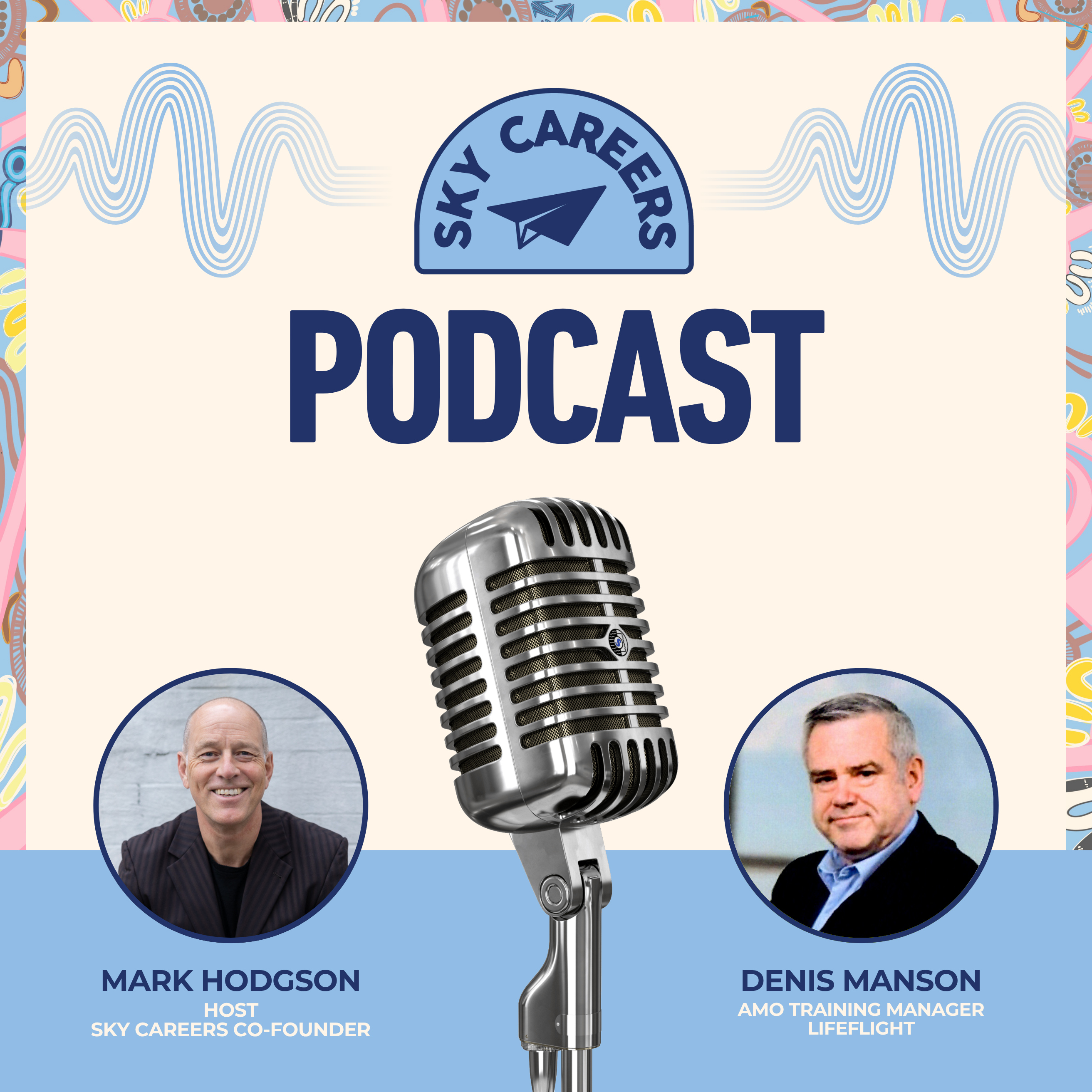
[00:00:07] Speaker A: Hi, my name is Mark Hodgson and I am the host of the Sky Careers podcast. This month it's my pleasure to introduce to you Dennis Manson. Now, Dennis is the AMO training manager at Life Flight. And for those of you who didn't know and I didn't, an AMO is an approved maintenance organization.
Dennis has been in the industry for quite a few years.
Really looking forward to finding out about his aviation story. Dennis, welcome to the podcast.
[00:00:41] Speaker B: Thanks very much, Mark. Happy to be here.
[00:00:43] Speaker A: Fantastic. Really looking forward to our conversation. We always start at the very beginning. Tell us about your early years. Where did you go to school and what were your favorite subjects?
[00:00:54] Speaker B: Oh, well, I went to school in regional New South Wales, so on the mid north coast, just north of Newcastle.
So yeah, it was a very small town, very small school, but nice, nice outlook right on the coast.
So, you know, we were very tempted to sky off and go down the beach.
I was, yeah, I was a bit of a nerdy student. I always liked the sciences. So yeah, I did well in science in high school.
But I also like geography. I really like the, you know, that natural geography and urban geography as well. So that, that sort of was an interest of mine early on. But yeah, mainly a science, science guy and yeah, from a very small town which has sort of informed some of my work later on, you know, talking to young people coming into the industry to say, ye, sometimes when you grow up in a small town, you know, these, these, some of these careers seem a bit daunting. You know, do I have to move away? Do I have to, you know, give up all the friends?
What, what barriers do I have, you know, growing up in a small town? So it's, yeah, it's like, it's interesting to offer my perspective on those things as well.
[00:02:17] Speaker A: Fantastic. So how did aviation come into the early life of a young dentist in a small town in New South Wales?
[00:02:27] Speaker B: Yeah, well, I guess, I guess my first, my first job in aviation was sweeping out the hangar and the, the local aero club.
[00:02:36] Speaker A: You know, that is so funny. We've, we've had that. About four people have told us that in the recent podcast. So there's a, there's a life lesson and a metaphor there, I think.
[00:02:46] Speaker B: Yeah, indeed. Yeah, well, you look for your opportunities when you can get it. But you know, I, I was, I was very interested in, in airline work, you know, big aircraft. That, that was, that always drove me from the, the earliest days when I was interested in aviation.
So, you know, the local aero club didn't have any big aircraft but but I, you know, really learned a lot just hanging out with people at the Aero Club and yeah, trading a, trading an hour of cleaning up for know, a bit of a fly in, in a Cessna over the, over the coast. Yeah, it was a nice little, nice little trade off. And your first baby steps into the industry, I guess.
[00:03:28] Speaker A: At about how old were you then?
[00:03:30] Speaker B: Oh, 16 or so. Yeah.
And you know, a few of my friends from year 10, year 11 started to go into the military. You know, some of them went into the air force. There was a big air force base down, down in Newcastle, you know, not far from where I gre.
So you know, that was interesting also to see, see the opportunities that, that those people followed. Yeah.
[00:03:57] Speaker A: And you went a different route. So what, what was your actual first job in aviation?
[00:04:03] Speaker B: Well, apart from sweeping the hangar at the Costa Tuncurry Aero Club.
Yeah, I went into an engineering apprenticeship with, with the old Ansett airline. So you know, those of you old enough to remember Ansett was a, was a major airline until about the, till the early 2000s. So yeah, I went into an engineering apprenticeship from. Yeah age 18. So yeah, I went to, finished year 12 and I actually did a year of university but then went into Anset and had to move to Melbourne, which was a bit of a shock, but all the horror.
Yeah, but you know, very, I was very happy to get that first job in, in aviation. It was just, just what I wanted.
[00:04:55] Speaker C: Fantastic. And and how was the part? I mean, did you find that whole sort of apprenticeship and, and traineeship was that challenging?
[00:05:05] Speaker B: Very much so. You know, it's, there's so much to learn, you know, working with large aircraft.
Yeah, the, so the apprenticeship went for four years and it was a traditional apprenticeship. Shapes a little bit different these days for some people, but the traditional apprenticeship was basically working four days a week and going off to technical training school for one day a week and so much to learn. So much.
Lots of exams. But in a big workplace like that, having all that experience around you, the older people that you can, that you can draw on their experience and was a really good, really good mentoring experience for me.
You know, working in that large heavy maintenance hangar, getting familiar with the work, familiar with the technology and learning more about this whole industry, you know, which is so much like a system, you know, everybody relies on everybody else to finally get to the end product. You know, an on time departure or, you know, a successful mission.
So many, so many cogs in the, in the network that have to have to all work together.
[00:06:31] Speaker A: Yeah, one of the things that shines through. I mean, I love having these conversations, and I'm not an aviation expert, so I'm kind of. I guess I come at it with fresh eyes. But one of the things that absolutely shines through to me all the time about aviation, it's almost the ultimate teamwork.
You know, as you say, the guy who pulls the chocks out from the.
To push back the aircraft or fuels it or cleans it or does the ticketing or the marketing. Everyone's as important as everyone else, aren't they, in making sure, as you say, an aircraft takes off, safety, whether that's a big airliner or it's a smaller, smaller aircraft doing survey work or FIFO work or whatever. Teamwork is absolutely essential.
[00:07:13] Speaker B: Yeah, absolutely. I always liked that story of President Kennedy back in the 1960s, you know, visiting the NASA base and going up and introducing himself to the.
To a guy who was sweeping the floor or, you know, emptying the trash bins. And, you know, he said, and what do you do? What do you do here at NASA? And the guy looked at him and said, haven't you heard?
We're sending a man to the moon.
He was a guy doing a lowly job, but he saw himself as a necessary cog in the whole system of aviation as well.
[00:07:55] Speaker A: That's a fantastic story. So you were at Anset Heavy maintenance base.
How long were you with Anset and
[00:08:02] Speaker C: how did your career develop from that?
[00:08:05] Speaker B: Oh, well, I was at Ansett until they went out of business so early 2000s, so just just short of 20 years with ANSET.
So the heavy maintenance facility in Melbourne was a. Was a really good place, a really good foundational place to work for young apprentices, as I said, to get your head around the industry and the technology, the type of machinery that you're working with.
Then I moved to Sydney and I was working in a line maintenance capacity. So it's, you know, not overhauling aircraft, but seeing them in, seeing them out every day, rectifying. Rectifying defects, you know, doing. Doing some inspections and regular maintenance checks, but not. Not as deep a maintenance as. As what happens in the. In the heavy maintenance facility.
And that was. Yeah, that was really where I learned more about the industry as a whole. You know, engineers can get very focused on their.
Their own little world and their. Their work because it's pretty important but
[00:09:14] Speaker C: critical, isn't it? If you guys don't do what you
[00:09:17] Speaker A: do and pieces of paper aren't signed, machinery doesn't move.
[00:09:21] Speaker B: Yeah, that's right. Yep, yep.
But yeah, working, working at a, at an airport, you know, at the operational sharp end, you know, you get to see the whole network and you know that, that almost 12 months of planning to, to actually get an aircraft to fly successfully on its, on its sector.
So yeah, I had some exposure to airport management and, and some of the other job roles.
But when Anset finished, well, I'd done a little bit of workplace training with Anset, you know, workplace health and safety training and a few other things.
But when Anset finished and all of a sudden I was out of a job, most of my colleagues were going off to Cornice and Virgin.
I was sort of drawn in a, in a bit of a different direction and I, you. I followed a path into technical training so that's, that's sort of guided my career since then.
I worked at a, at an aviation college here in Brisbane Aviation Australia when it was first established in the early 2000s.
Went off and worked for CASA for a couple of years in Canberra. To actually see how the regulator works is really, really interesting perspective there.
And a few other training management jobs, you know, within, within the airline industry and until until recently with. My career path has brought me to life Flight, the helicopter operator.
[00:10:59] Speaker C: Wow.
[00:10:59] Speaker A: So just. I'm gonna, I've got a couple of questions around that because I know you've compressed probably, probably the best part of 20 years into, into about 15 seconds, going from obviously a qualified engineer to then becoming an expert in, in training and training others. Did you do additional training in how to be a trainer and how to teach?
[00:11:27] Speaker B: Yeah, well, in vocational training there's a, there's a benchmark qualification, a certificate level qualification. So certificate four in training and assessment.
So that was a great stepping stone for me.
I knew that I was interested in training. I didn't really know if I was going to be good at it or not.
The certificate four, there are different styles of delivery of that certificate level. Some are done intensively and you can get the certificate within a couple of weeks.
The way I did it was, yeah, I studied in the evenings and took the best part of six to eight months, I think, to get my qualification. But it's a really good foundational qualification for people to have if they're interested in going into training or training impacts on their job role because it teaches you about people, about, about different learning styles, you know, how to, how to relate to different people, how to, how to develop training materials, you know, which is a skill in itself.
So yeah, it's, it's a, it's a qualification that I would really recommend. And it has taken me from, yeah, from having a, having a fairly niche career path, if you like, as a, as a maintenance engineer. Yeah, it's sort of expanded my horizons a lot and, and given me opportunity to go, go to places that, that, that maybe I wouldn't have chosen.
[00:13:12] Speaker C: Cool. So, so, and this was, which is my second question, that redundancy and the closure of Anset and I, I, I just arrived in Australia when all that was happening. I remember how that was a big deal nationally. It was big, big, so big, big national news. There was a lot of understandable people very, very upset and the market was disrupted and there was a lot of recrimination and obviously forced change on you and your career.
In hindsight, do you see that as a positive thing that happened for you on the other side of that?
[00:13:46] Speaker B: Absolutely, Mark. You know, it was such an upheaval because, you know, I've heard people talking since those days saying, oh, Ansett was like a family and it was, you
[00:14:01] Speaker C: know,
[00:14:04] Speaker B: it was a company where the, everybody tended to know each other and everybody had the desire to stay on long term with the organization.
But, and you know, in hindsight, if Anset was still going, then quite likely I would still be working there.
[00:14:25] Speaker A: I think so, yeah.
[00:14:27] Speaker B: But I've been really grateful for, for the opportunities that I've had and then the experiences that I've had since, since Anset finished and because it's taken me in directions that, that I probably would not have gone in and, and given me a perspective of the industry that, that, that is very broad now and, and, and given me more knowledge than, than I would have had staying, staying in my original job role.
[00:14:56] Speaker A: Unfair question.
Without notice. What would you say, your notwithstanding, obviously your current role at Life Flight? What, what, what are some memorable moments? Memorable, I guess, experiences and places you've worked that come to mind?
[00:15:12] Speaker B: Well, I mentioned so briefly that I worked for CASA for a couple of years and that was very interesting experience because working in the industry, it's very easy to criticize the regulator and say, oh, they should be doing this, they should be doing that.
We should get our license application back quicker than always happens.
But actually working in the regulator, you see the constraints that they're under. They have manpower issues and they have budget constraints just like any other business. So it was quite interesting to get that perspective.
I'm not a natural public servant, so I didn't stay there for very long, only a couple of years. But I'm really grateful for that experience.
But some of my Other jobs have taken me to places. I've worked in Hong Kong for a couple of months training some young engineers in Hong Kong.
I've gone to Saudi Arabia again to, to train young engineers in the, in the Royal Saudi Air Force.
And some of the, some of the interests that I have have taken me to conferences all over the world. So South Korea and the United States and, and Singapore, you know, so this, the industry, you know, you know, you don't know, you don't know what's around the corner in, in the industry and, and you know, developing, developing a broad interest and, and, and having those networking opportunities with lots of people.
You know, it's, it's really confirmed to me that, you know, the interest that I had in the industry as a young kid has, you know, it's still there for me
[00:17:04] Speaker A: and I can see that it shines through. I can see it in your face. You're still enthusiastic and you know, you're probably a similar age to myself and you know, you get a lot of people, you know, middle aged older women and men and they can get a bit jaded and a bit worn down and a bit like meh. About what they do, whether it's aviation or something else. I can see that's clearly not your case.
So bring us up to date with your current role.
What's the, what does a day in your current role look like?
[00:17:34] Speaker B: Yeah, well, as you mentioned, I'm the training manager for the amo, so basically the engineering training manager for Life Flight. So Life Flight is a very interesting organization. You know, they're mainly a rotary wing operator, so the emergency medical helicopter and search and rescue helicopter organization. But they do have a fixed wing fleet as well. Challenger 604s which are based at some cities in Australia and also one aircraft based in Singapore.
So just that breadth of engineering machinery that you got to play with is really interesting.
But a job as a training manager for an engineering department in a big aviation organization.
We're talking about looking after apprentices.
So lifelight have a number of engineering apprentices both in Brisbane and in Melbourne and soon a couple in Hobart.
So it's a mentoring role for the apprentices but also arranging their release to do their training and to do exams and things like that. So I really empathize with young people coming in into the industry. So I spend a lot of time with our apprentices at LifeFlight.
But also other things, you know, people, people require training in their day to day work.
New piece of equipment comes into the organization. The engineers have to learn how to use it properly.
They have to have recurrency training for their engineering qualifications.
And sometimes people request training, you know, they say, well, I want to, I want, I've been working at this level, I want to upskill. So that might be technical training or maybe non technical skills, you know, leadership and management and those human factors type courses. You know, these are the things that I have to be involved in day to day and you know, provide a conduit from, for the people that are working on the shop floor through to the, the engineering management of the organization. To say these are, these are our training needs now and into the future
[00:20:03] Speaker A: sounds like a lot of, lot of variety. What's the part of your job you enjoy the most?
[00:20:09] Speaker B: I love dealing with the apprentices.
That's, that's my, that's my bread and butter and that's, that's why I love the job that I have because these are, you know, I see myself in some of these, some of these young people coming in, male and female, you know, how do they fit into this, this new job that they have? What's their pathway going to be over the next next few years until they become qualified?
And then also, you know, what's our commitment as an organization to, to employ these, these trainees, you know, when they, when they do become qualified.
And that's the advantage of a smaller organization is that, you know, we don't take on apprentices just to see them wave goodbye at the end of their apprenticeship. We, we take on apprentices with the view that they will become qualified engineers for us after their training.
So we take a lot of, a lot of care with our apprentices through, through their training. And yeah, I'm really happy to do that, you know, to be a, well, I've done classroom work and, and you know, training, training the subjects that these people are learning. So you know, I've got a, I've got a library of resources and I've got time to spend with them to, you know, to study for exams and to give them an extra overview of some of the, some of the technical subjects that they're studying.
But yeah, I'm just really pleased to be able to contribute to this, to this learning and, and yeah, be a mentor for, for seeing young people coming through the industry.
[00:21:51] Speaker A: Yeah, I love that.
[00:21:52] Speaker C: Dennis, I think you, I think I'm sure you're very good and I can imagine young, nervous, you know, young, young, young people with what, what they, what they do. And, and as you say, as you said for yourself, I mean, the the learning's pretty intense, isn't it? I mean these are very complicated machines and all the, the technology and the software and the electronics and the avionics. I mean there's a lot to it, isn't there? So having someone with a wise elder, if you will, who can keep things in context for them and help them to work through the elephant one chunk at a time must be incredibly valuable.
What do you do when you're not at work?
[00:22:33] Speaker B: Well, when I'm not at work, I'm a bit of a boring guy.
I'm reading about aviation or following stories online about, about aviation. You know, I love, love keeping that network, network up.
But I, I also have my own business on the side and, and you know, do some work for that outside of aviation and, and in my own business, you know, I do things that, that aren't particularly, you know, you don't find in, in, in the airlines or, or in life flight. You know, they, they're things that interest me.
Some of them. Training, training things, you know, developing 3D models and interactive training opportunities and, and yeah, you, you might have heard of my little project, the Spanner Squad.
[00:23:23] Speaker A: I was going to say, let's talk about Spanner Squad. I want to talk about Spanner Squad. Give me. Because, because you're, you're clearly an av. You're an aviation tragic, which I love.
Go on, you've got, you've got your pitcher. Spanner Squad.
[00:23:36] Speaker B: Yeah. So the, yeah, the Spanner Squad is just my little pitch for encouraging more young people to the industry.
We're hearing lots of statistics about how the old guys like me, we're retiring over the next 10 years.
The industry's growing, especially in India and China and Eastern Europe.
How are we going to attract more people to the industry?
We need more technicians, more cabin crew, more pilots to sustain the growth of the industry over the next next few decades. So the Spanner Squad, it's been through a few iterations, but we're basically developing an animation, an animated series if you like, of a maintenance hangar where there's equal gender representation, there's just as many women as men who work in the hangar. The women are respected for their leadership and their, their decision making and their creative troubleshooting and mentoring.
And it, it also highlights, you know, other areas of diversity. You know, what other people do we want to attract to the industry, want to attract indigenous kids and people from non English speaking backgrounds. So you know, the Spanish squad, you know, it's not, not trying to tickle those diversity boxes but, but we, we just want to mirror society and to say, well, this is what aviation is going to be like in the, in the near future. There's, there's going to be, you know, it's not going to be so, so white man centric if you like. You know, in the next couple of decades we're going to have to attract more, more diversity to the industry because there's just not enough geeky white boys to go around like there was in the 70s. And ladies like me.
[00:25:32] Speaker A: I love the way you put that.
[00:25:33] Speaker C: And of course that is, as I'm sure you, you know, that's, that's very, very much where the sky is. What, it's what brought sky careers into existence. So we are, yeah, we're in violent agreement with each other about the importance and the opportunity to, to attract more young people, more girls and specifically. And it's such a cool industry. You know, in Australia there are 600 plus airports. So it's great for regional and remote, it's great for first nations and indigenous, indigenous employment and it, you know, in a way that very few other industries can be because they're, they're not obviously they're much more centralized and you, and by its nature aviation spans the whole of Australia. And you mentioned, you know, Europe and Central Europe and other places and you know, I'm just, I'm thinking actually I'm going up to Europe in, in about 10 days time and you think all that, all those flights now that didn't used to happen, those low cost carriers and there's I think Ryanair for example, that big Irish carrier, I think it's got something like 1200 aircraft or so. It's, the fleet's massive, it's, it's mind blowing and everyone's got to be operated and crude and you know, and everything around that. So it's such a growth, growth industry. Plus when you add in UAVs and drones and everything on the other side of drones, in terms of what that enables, it's just an extraordinary industry.
[00:26:54] Speaker B: Absolutely, absolutely. And yeah, the growth in, in, yeah, like I said, countries like India and China where lots of people moving from relative poverty into the middle class, they demand better education, better, better roads, hospitals and travel.
So the, the growth of aviation in, in some of those countries is, is going to be astounding in the next 20 or so years.
So for young people considering aviation as a career, what a time to get into the industry.
You know, the world's your oyster.
There are shortages of staff being recognized now.
So you know, It's a great time if you're considering a career where you'll be. You'll be wanted in Australia, but you'll also have the opportunity to travel the world if you want to.
It's a great time to get into the industry.
[00:27:55] Speaker A: Yeah, I love that. And I think the emerging aspect as well is it's AI proof.
There's a lot of traditional roles that are going to be made obsolescent or massively reduced through to use of technologies such as AI, and a lot of what we're talking about, that they're burgeoning, they're not going to disappear as AI continues to grow and its impact.
[00:28:20] Speaker B: Absolutely, yeah, yeah.
[00:28:21] Speaker A: So very exciting. So I'm going to ask you a final question, because we could talk for hours.
[00:28:26] Speaker C: But
[00:28:29] Speaker A: so, just in a nutshell, what advice would you give to other young
[00:28:35] Speaker C: women and men who are thinking about an aviation career?
[00:28:41] Speaker B: Well, like I said, you know, consider that aviation is a booming industry.
It's a little bit paradoxical, you know, because I. I have talked to some young people and they said, well, their mums and dads remember what it was like during COVID Right. You know, and there's lots. There were lots of aircraft parked on the, on airport fences and.
[00:29:03] Speaker C: Yeah, and Qantas pilots stocking shelves at Woolworths. There were.
[00:29:06] Speaker B: Yeah, absolutely. So, you know, there's a lot of par. Who say, oh, aviation, are you sure? You know, it's. It could be. Could be subject to another shutdown.
And I guess that's true, you know, but we can't, we can't predict when the next pandemic's going to be. But all, All I can say to you is all the industry press says that, you know, the big manufacturers, Boeing and Airbus and Bombardier, they're all predicting this.
Well, they all have evidence of this growth in the industry over the next few decades. So they're all gearing up for increased manufacture of airframes, which means that there's a demand out there, there's new airlines starting, and like you say, existing airlines like Ryanair, they've got big fleets now and planning even larger fleets into the future.
So for people who are considering aviation as a career, I would say now is a perfect time to follow your dream and make some serious investigation into careers within the industry.
And there's different pathways you can take.
You can study at university for three or four years and then going to the industry, or, you know, like some of my colleagues do out at Life Flight, you know, they come straight from high school into into an engineering apprenticeship with, you know, with, with a reputable organization and operator. So there's, there's different pathways.
You know, my, my job immediately before coming to life flight was with Alliance Airlines here in Brisbane.
They had had big recruitment drive for cabin crew, which was, which was so successful, but it brought people into the industry who normally wouldn't have considered it as a career.
Lots of people from customer service background and even nurses who said, I want a career change. I'm thinking about aviation.
And just so happened that alliance was, was expanding and they, they had a big recruitment drive. So it was so good to see these new people coming into the industry, this new cohort that, that is learning to love aviation just as, as much as us old guys.
[00:31:41] Speaker C: That's brilliant.
[00:31:42] Speaker A: Thank you.
[00:31:42] Speaker C: So, thank you so much for your time. Dennis. You've got a lovely story. And, and you, you are, you, you are your own case study in, in the diversity and opportunities. Yeah. You started as an engineer, you've grown into a training experts taking you all over the country, all over the world. You're getting more and more interested in helping that next generation.
And with Spanner squad and other things.
And as I said, as a guy of some vintage, around my kind of age, around 60, give or take, you're full of life and full of enthusiasm that shines through and that's a rare gift. So thanks so much for your time and joining us today on the Sky Careers Podcast.
[00:32:22] Speaker B: It's been a pleasure, Mark, and you know, one last message for young people out there. Just keep your horizons open. You know, dream big.
[00:32:32] Speaker A: Love it.
Thanks for listening to the Sky Careers Podcast.
If today's conversation has sparked your interest in aviation, then head over to our
[email protected] au whether you dream of flying aircraft or you're curious about the hundreds of other exciting roles that keep the aviation industry moving, Sky Careers is your gateway to discovering these opportunities.
And if you are already in the industry, check out skycareers Connect and and Sky Careers Leadership and consider joining our online learning community.
Until next time, keep reaching for the skies.