[00:00:07] Speaker A: Hi, everybody, and welcome to this edition of Sky Careers Podcast.
I'm your host, Mark Hodgson, co founder of Sky Careers.
Really looking forward to today's conversation. A little bit of a twist.
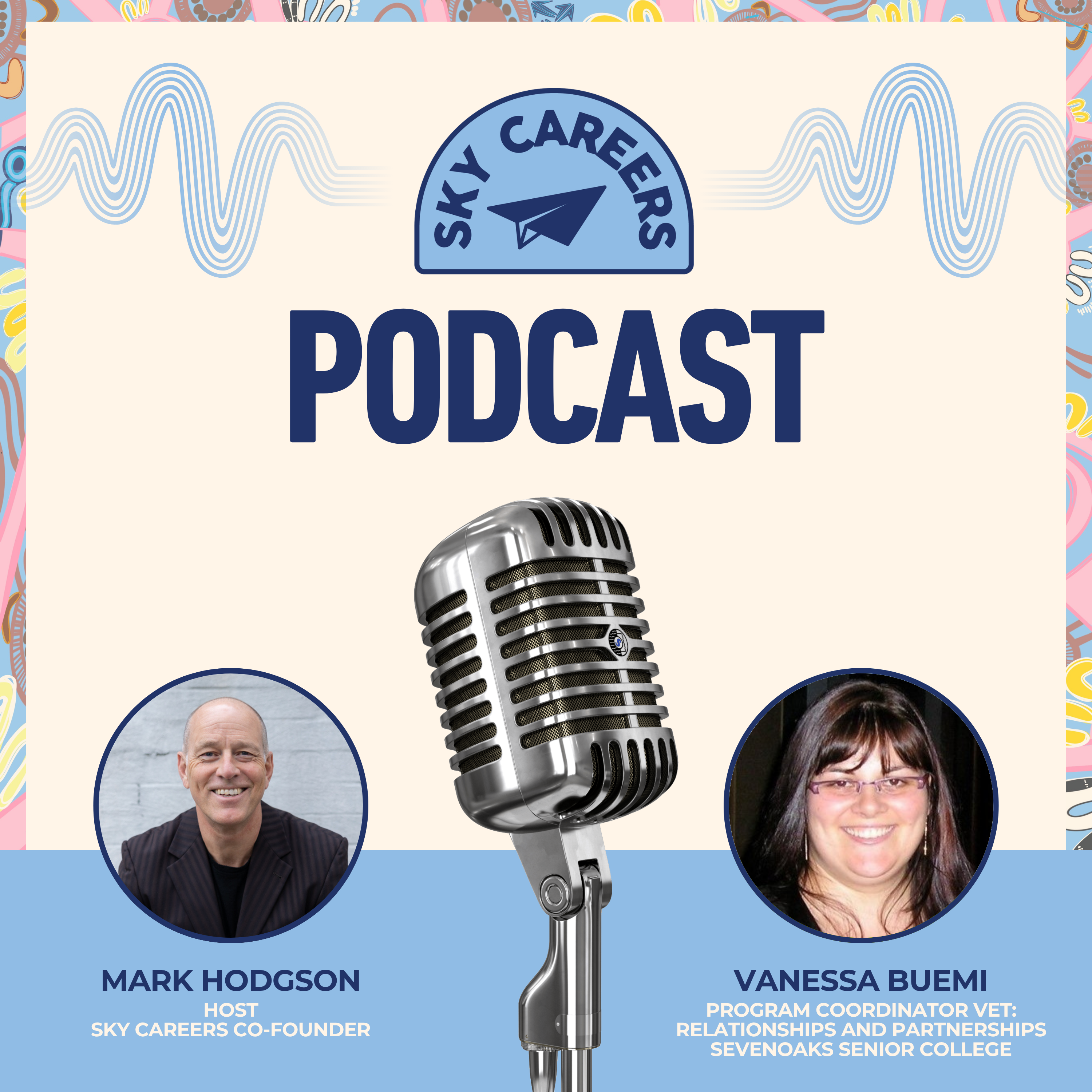
So our guest today is called Vanessa Buemi and she's joining us from wa and she's not actually in the aviation world herself, but Vanessa is the program coordinator for Vet Relationships and Partnerships from Seven Oaks Senior College in wa. So Vanessa's joining us from Perth and we're going to today talk about all the pathways, mindsets, attitudes, opportunities, challenges, problems, everything that we can about that crucial path, pathway piece to go from kind of school or college through to employment. So, Vanessa, welcome to Sky Careers Podcast.
[00:01:06] Speaker B: Thank you. Thanks, Mark. Thanks for having me.
[00:01:08] Speaker A: All right, even though you're not in aviation, I'm going to start with our favorite question. So tell us a little about where did you go to school and what were your favorite subjects?
[00:01:18] Speaker B: Oh, okay. So I went to school in a country town called Narragan.
My father came over on the ship from Sicily and that's where they ended up in 1951.
My favourite subjects, art was my most favourite subject.
But I did really enjoy school and being in a small country town where everyone knew everyone. So going to school was just part of your day. It was great. I really liked it.
But it was also, you know, I sort of viewed it as my way out of that town as well. As you get older, you're like, I'm leaving here and I'm moving on.
But it was good. It was good to grow up there.
[00:01:57] Speaker A: And what was your pathway from there into, I guess a career, a career in education.
[00:02:04] Speaker B: My pathway was definitely not a straight line.
I did what a lot of the students there did. We. You were either going to go down an ATAR pathway, which I think was TEE at the time, or you were going to go and get an apprenticeship or get a job.
So I went down the ATAR pathway. I ended up doing primary teaching, which I did for one semester and I had one prac and it wasn't awful, but it definitely wasn't for me.
But my pathway to becoming a teacher is sort of long and convoluted.
I had myself a really amazing art teacher who has been my friend and my mentor all the way through my education.
And when uni didn't work out initially, I went on to do floristry for a little while, anything that was sort of artistic.
But I got really bored quite quickly in anything that was sort of retail based. So I ended up going to TAFE rather than going to Curtin University. I wasn't quite ready for uni and I did a diploma of fine arts and my wife Tracy, she was with me the whole way and she is the art teacher I'm talking about, just really supported me all the way through.
And at that time in the 90s, doing a diploma in fine art was not going to get you a job.
So I had to push through all of those boundaries and say, yeah, well, we'll just see how we go.
So I ended up with that diploma and then I went into retail again and then I went back to university and then I found my pathway through textiles. I was doing textiles at Curtin University, but as is my way, not the traditional form of textiles, I was doing it in metal and making metal lace.
Yeah. So then I went on to do my master's and did a whole thesis that went with that.
It took forever but it was, it was worth it. So in. I ended up doing about 10 years of art study and working at the same time in retail.
[00:04:24] Speaker A: So you've been in round and through the training system, the work system, the finding jobs, the not finding jobs and everything around that. And so that's. So tell us, just give us a one minute. Tell us about your role today at Seven Oaks Senior College in Perth.
[00:04:41] Speaker B: About my role at Seven Oaks.
[00:04:42] Speaker A: Yes. Yeah, yeah.
[00:04:44] Speaker B: I'm actually the second vet coordinator. So our program has grown so much that we need two full time program coordinators and between us we manage training that happens in the school and well, that's my partner Gary, he does that and I do any training that happens outside of the school. So any of the work placements and building up relationships with industry, which is something that I was doing prior to coming to Seven Oaks. I was a regional vet coordinator and that's how I met Sue Ann and I was just gathering everything, I was trying to get everything I could to get. To help the schools get new pathways for students and to be more aware of industry.
[00:05:26] Speaker A: Great. So there's that big chasm, isn't there, between education and both schools and colleges and also universities.
[00:05:35] Speaker B: Yes.
[00:05:35] Speaker A: Having this conversation the weekend. There's all these people do degrees and then. But there's no, there's no alignment or very little alignment with jobs.
And there is no, there's also no sort of. There's no confines put on universities to not offer degrees or to limit the number of students they've got for degrees. There actually aren't jobs. So I think there's a. It's a complicated conversation. So what Are you seeing from students today when it comes to thinking about their future?
[00:06:05] Speaker B: Some students, they absolutely know what they want to do from the get go, and they're very motivated. And a lot of those students know that they want to go to university, so they know what subjects to choose and to follow that pathway. There's other students that clearly know that they don't want to go to university and they want to work. So a lot of students are quite aware of the trades and the different sorts of vocational training they can do.
And then, you know, a lot of students as well, they don't know what. What they want to do. And it can become a bit overwhelming because there is so much choice now.
So for some it works and for some not so much. And I think the students that are not sure, a lot of that is tied up in their own sense of self and their level of confidence and things like that. So quite often you get that sort of shuttered approach, like, I don't know what I want to do. And you have to work really hard to try and help them out of that.
Right down to, you know, what do you like to do? How do you spend your time? They don't. There's a disconnect there.
So you sort of have to teach them and drag them along with you.
[00:07:14] Speaker A: Yeah, I mean, it's interesting with the aviation. So obviously, through this podcast, I'm having heaps of fantastic conversations. And I would say one of the common threads, and I love this about aviation, is when I ask the question, you know, how did you get into aviation?
Probably, I would probably say only maybe, maybe 15, 20% of people or young women and men say, oh, I knew. When I was 8 or 9 or 10 or 12, I first saw my airplane. I knew. I knew right then. I wanted to be a pilot or I wanted to be cabin crew. I wanted to get. I wanted to fix aircraft or be an engineer, or I wanted to be an air traffic controller or whatever it is, but it is only something like 20%. And a lot, the significant majority, they said, I didn't know. I just drifted into it and someone told me about something and I got my first job here. And then that led to another job. And then I realized I really loved it. And I. And I liked the teamwork. And then there was an opportunity.
And I think, especially with aviation, what's so fascinating about it to me is, firstly, it's a growth industry. There's lots of aviation roles. Secondly, it's almost like best kept secret because airports by definition tend to be on the edge of a town or a city.
And unless you know someone, unless your family's involved or, you know, people are involved in aviation, chances are you don't know what the roles are. And outside of the big, the big employers like Qantas and Virgin, for example, you know, almost all the other hundreds and hundreds of general aviation business are probably complete. Most people would not know who they are, so they see jobs they don't know exist for companies they've never heard of. So you can imagine that there's a big disconnect and that ties back with your thing, you know, where there's so many of these students where actually they have got, they have. There are lots of opportunities and, and we can align their interests with the, with, with the opportunity in whether it's a training role or a more advanced role. And it's about, it's about joy, it's about crossing that chasm. Isn't.
[00:09:09] Speaker B: Is. And, and it's, it's also about building trust with them that, that they trust, you know, what you're talking about and that you, you know, also that they can do it. I think they need a lot of encouragement as well. And I'm talking now more about going out on a work placement and experiencing the industry that they say they want to get into.
And that seems to just induce such high anxiety for students. But others who know that that's what they want to do, they just go for it and they love it.
But you do also get the other side of the coin too, where students go off to do something that they think they wanted to do and they find out that they don't like it.
[00:09:53] Speaker A: Yeah.
[00:09:54] Speaker B: And when they come back and say, oh, Miss, I. It's not for me. I don't like it, they sort of. I say to them, that's fantastic. And they look at me like I'm crazy, but I'm. But in my mind, they've experienced something sooner. Rather than going through year 11 and year 12 exams, everything they have to do and then still finding out that they don't like it.
So that's why that connection to industry and the work placements is so important.
[00:10:20] Speaker A: Yeah. I always say it's the maybes that kill you. You know, you want a yes or you want a strong yes or a strong no, you know, and finding out that something's not for you is actually a real blessing, isn't it?
[00:10:29] Speaker B: It is, because it allows you to pivot and then, you know, reassess. And I think that's also teaching students how to Cope with life as well and being an adult. This is what we have to do all the time.
[00:10:39] Speaker A: Yeah, but just bring that to life a bit for me because I don't know if this is a generational thing, but quite a few of your comments are around. I guess maybe the maturity or the attitude or the job readiness of students as they move into employment. Do you think that's a gap that's always been there, or is it getting better or bigger? Bigger or smaller?
Because I think a lot of students, maybe they're a bit bigger, bit disconnected from some of the roles that might be relevant.
[00:11:15] Speaker B: I think there's a lot for students to consider and they are highly influenced by what their parents want them to do.
So you've got to navigate that. Then you've got students that know that the way that they learn is different to just sitting in a classroom and what you'd call chalk and talk. They don't learn best that way.
So trying to make them have the confidence to go out and just try something, even if it's not exactly what they want to do, but it's related.
If you can get them to go with you with the trust there, then they can start to recognize and fill those gaps themselves, and then they start seeking them themselves.
It's.
You do get a lot of students now that, you know, it's very much like they're in. We're walking around with the phone and they don't even lift their heads up. And everyone talks about students on phones all the time and that they don't have much awareness, but I think they have. But they. They don't necessarily know how to direct it.
And I think a lot of it's confidence as well, a lack of confidence in themselves. They don't know themselves enough to trust something.
[00:12:29] Speaker A: How do you work to maybe I guess metaphorically get their heads out of their phones and into the world and also give them the confidence to actually start to take those first steps of maybe attending either a presentation or sending even a few hours of work experience or a tour of an employer.
How do you make that? How do you start that process?
[00:12:55] Speaker B: Well, every student at our school does a work placement. Even if they are an ATAR student, they still have to go out and experience something in the industry that they say they want to go into.
There's a lot of people involved in preparing students to go out onto a work into a work placement. A lot of training in the classroom for work readiness, a lot of coaching, having mock interviews with people from industry and the kids get quite nervous and they don't want to do it. But once they try, they realise that the people are trying to help them. So it's not just, you know, the vet coordinator doing the work. I've got four or five workplace learning coordinators that are working constantly to find these kids their placements and in the area that they want to do it. But also at our school, we also link their certificate training. So if they're doing a certificate three in aviation remote pilot, we start looking for partners for them in industry to work with them.
We have a program at school that's called Passport to Success that teaches a lot of soft skills that is quite difficult to have. The kids sort of travel with you while you're teaching it. They're like, oh, miss, this is boring. I know how to write an email and I know how to do this or that. But when you're trying to get them to do that for an employer, they just don't know how to do it and they want you to do it for them.
[00:14:30] Speaker A: Yeah, I mean, that's why, it's why we, one of the things we, when we, when we designed and resourced Sky Careers Connect, which is an online program which is, has a, has an industry specific soft skill focus. Those exactly where you're talking about aviation specific, you know, teaching them what's aviation about, what's the language, what's the expectation, what are the kind of things you're going to experience?
And as you say, how do you get out there? And it's interesting and again from lots of my conversations with people who, you know, in aviation careers, it doesn't matter. Whatever they do, they stress the importance of teamwork, of being proactive, of being a good communicator, of being self starting, of, you know, of kind of putting yourself out there a little bit. And I just, you know, a lot of those are, are not. Yeah, that is, you talked about confidence and trust me, those, those things are not necessarily natural to a lot of kids. And you know, and I guess the other, the other, the flip part of that is, and the kids probably aren't aware of it, just how important those soft skills are because they're the things that can get you in the door and someone will give you a chance.
[00:15:38] Speaker B: That's right.
[00:15:39] Speaker A: As opposed to having a whole load of maybe qualifications, inverted commas and then you can't look up, don't want to speak to anyone and people go like, you know, you might be capable of doing the job, but we'll never know because you never show up as in terms of presence. So it's a real challenge.
[00:15:55] Speaker B: Isn't really is. And one of the things that teachers do say is that until the student experiences themselves, they are not necessarily going to know and understand exactly why we're doing this and how important it is.
So, for example, if there are any year 11 students that didn't manage to get a work placement for the end of the term, they come to us in the following year as a year 12 and they're like, oh, Miss, I didn't go, I didn't want to go, or I didn't take it seriously. And now I'm starting to realise the importance of that in my whole pathway and also in terms of transferable skills.
I guess when I think about my own pathway, you know, which was primary teaching, then floristry and then I think I did insurance for a while and retail. I did all sorts of things.
But what I learned along the way was lots of skills and lots of abilities and I was able to make links or use my skills in a different situation and environment.
And that's what I'm trying to get them to understand, that no experience, even if they didn't like it, no experience is wasted because you learn something and you move to the next stage from that.
[00:17:16] Speaker A: Yeah.
I think it's probably more important it's ever been that versatility, the resilience, to take a few knockbacks as well. And also to do, also to do jobs that perhaps aren't your first love. You know, actually to go through stuff and stick, stick at something that you don't necessarily, you know, I don't want to do this forever, but if you do, you do something. Well, yes, you know, you, you get something out of that. You get a satisfaction learning do the satisfaction doing something's difficult and.
[00:17:41] Speaker B: Yeah.
[00:17:41] Speaker A: And then almost always it will lead to something else, but it's, it's, it's, it's trying to get that, that, that, that, that across isn't.
[00:17:52] Speaker B: Is. Yeah. Actually, I was just going to tell you about one student who.
[00:17:55] Speaker A: Yeah, please, please. Yeah.
[00:17:57] Speaker B: Recent.
Recently he had this really amazing work placement that was with a really good employer and he was also wanting to make money. So if he got a McDonald's shift, he would leave his work placement to go to this, to McDonald's. And he just didn't understand that legally he's not allowed to work somewhere else while he's supposed to be at school. So that was the first hurdle and then the second one was, well, I didn't like it, so I Just left. And it's like, well, there's all these people relying on you.
And so I had to talk to him and he was quite defensive about, you know, I don't. There's nothing you can tell me kind of that I don't already know. And I was trying to ask him, what's he want to do and blah. And he said, look, Miss, I don't have to do any of this because I'm going to join the army, it's a sure thing. I'm a cadet. And I thought, I just don't know how you're going to get there with that attitude. You know, he was very closed.
That is something that's really difficult to push through.
[00:19:01] Speaker A: Yeah, yeah. And, and, and, and the sir and the services they look for, you know, those things would, you know, integrity, character, you know, doing what you say you're going to do, turn and for sure turning up on time.
I was in the Royal Navy for two years. They're very good. Yeah.
You spend your whole life. You spend your whole life, when you're in military training, being late and the expression, if you're not five minutes, if you're not five minutes early, you're late. And of course they set it up so you can't be. You can't be five minutes early. So you're always late. So you're always been in trouble for being late.
[00:19:34] Speaker B: Yeah. And they just don't get it. They're sort of like, I don't have to do anything. You say, you know, I'm not interested, you can't teach me anything. And I'm like, I really don't think that pathway is a sure thing for you. You've got a lot of hurdles to jump through.
[00:19:47] Speaker A: First of all, what do you wish the industry understood about working with school? So coming at it from the other, from the up, from the other direction, how can. Because there's two, there's two sides to the challenge here.
Through Sky Careers, we work with a lot of great employers, but I'm sure there's also a lot of employers who. They'll say, we can't get people and we struggle to recruit and we've got all these shortages, which is a common refrain. But what, you know, what, what can. What can industry better understand about how to get the best from. From schools and from. From liaison roles like yourself.
[00:20:25] Speaker B: The first thing that comes to mind is actually understanding that schools are planning for next year. They start. We start planning that in term two, usually. So we're starting to gear up with the Course counseling and everything sort of works through.
And what happens is industry quite often will send you opportunities or say, we've got this event, would you like to come? But they tell you maybe two weeks beforehand.
And what industry don't really understand is that we have to submit things like an excursion request six weeks prior to the event.
And so being on the other side of that, you know, I was listening to industry saying, we keep putting all this out there and we're just not getting anyone. And I said, it's because you're not, you're not realising how schools work. We can't just drop something and go, there's a lot of policies, there's a lot of duty of care, all of that. And then, of course, if you've got to send those forms back and forward between parents and kids, forget. It takes longer and longer.
That is the biggest hurdle.
But I was fortunate in my regional role that I was able to then go into industry and say, this is how schools work and this is what we need from you, and this is when we need it from you. And the flip side as well, working with industry, they told me what they needed and what their parameters were. So I was able to bring the two together and create more opportunities for all of the students in the south metropolitan regional area, because that's where I was working.
And things started to gel a bit. The relationships and the partnerships became a bit smaller because we each understood what the other people have to do. You know, the business rule and insurance. There's so much.
And everyone is trying to do the right thing. And yes, industry need more people and they need them now.
Which is why I've said, well, could we start training them sooner? Could you be looking at the school, the students in school now, instead of waiting until they finish school and they've graduated and they pop out as, you know, a boilermaker or something. Start them sooner.
[00:22:38] Speaker A: Yeah.
[00:22:40] Speaker B: And that's hard as well because you've got a timetable that. And there's. There's a lot of cogs in a school. There's so much happening.
[00:22:47] Speaker A: That's. That's. I think that's such an important point, Vanessa. It's great because. Because you've got. You've got a lot of left hand and right and they're missing.
And as you say, the. So. So the advice to employers is think longer term, be strategic and have a.
[00:23:01] Speaker B: Yes.
[00:23:02] Speaker A: And liaise with people. Yeah. And then create maybe even an annual program that you guys can locate into. And so we can bring people here, we can do Some work experience there. And I think also crucially that point about going earlier. I know one of our big.
And one of the things we concentrate a lot on at Sky Careers is trying to impact kids at an early age. Because we know they're often ruling, they're not necessarily ruling stuff in, but they rule a lot out at an early age, very early, much earlier. And you say, yeah, so we need, we need to, for example, talk about the, the broad range of general aviation careers to kids in maybe who are 11 or 12 or 13, not wait till they're 15 or 16 because in their head they say, no, that's not for me or I can't do that. You know, we've got, we've got some amazing stories. I mean we, in one of our podcasts we've got Amber, 27 now. Two and a half years ago, she was working in a caravan park in Victoria where she stuck after Covid. Then she, then she almost by complete random luck went to Western Australia, ended up in a local town. So what can I do? Ended up working in an aerodrome, got a job with a helicopter company, you know, doing some ramp work. I think it was then, oh, I like this, this kind of suits my, this fits, fits my style, what I'm interested in. I like, I like doing stuff I like. Then she went to, with that, with that company, went to Perth doing another, another role. Then was looking around her, you know, I can be, I can become a rescue airc crew member.
She completed the training about three or four months ago. And so three years from having nothing to do with aviation, Amber is now, Amber's now, now jumping out of helicopters on what. And how many kids? I mean how many kids you think? Who, who would.
And there's, and that's all on the job training. She had some surf life stuff which was useful but not compulsory. You know, there's such a good example of roles that kids can do. They just don't know about those roles. They're interesting and there's, there's so many roles for so many of so many different interests and so many career pathways involved and it's just getting that first bit. So we need to speak, get in front of kids early, which is what we try and do with Sky Careers.
A follow up question. So we're going to run out of time here, but yeah, sorry, are you seeing a shift away from traditional, from the traditional university pathway?
[00:25:27] Speaker B: That's a bit of a political question, but yet yes and no. So before when I was talking about students who are absolutely sure of what they want to do and their abilities.
Often those students are ATAR students and they just, they're on a path and away they go and they manage and they achieve things and they're fine and it works out for them. But then for some students who do go down an ATAR pathway, they might sit their first lot of exams and not pass or fail a few and then they get very disheartened and then they think about, well, maybe I need to do something else. And then they realize that by going to the something else they can then tap into these, you know, work placements during school and training during school and going out to industry and experiencing that. And that's one of the reasons why everyone in our school does it. Whether they're ATAR students or a foundation student, everyone goes out and experiences industry so that they can start to put those two experiences together.
And if they do want to still go on to university, they can. And I think once you show them that there's other ways to get to university, then they relax into it a little bit and they trust it and then that's where they start to link up the transferable skills and move through.
So, you know, we've had quite a lot of students that their parents want them to go directly to university and it's not necessarily their style of learning. They need to learn in a different way.
So they end up usually going a different way.
It works out. It's hard to say. It depends on the school as well and how much support you have for students to experience vocational training.
[00:27:17] Speaker A: Yeah, there's a much bigger conversation going on now, isn't there, about whether there are a lot more jobs that don't require a degree or trade massive opportunities.
Yeah, you know, my, my, I got two kids. One, one. My, my daughter's a, My, my daughter is, is a primary school teacher. So she went through the university degree. Just did, yeah, did a four degree, four degree teaching degree. My son is a carpenter, went through tafe.
Guess who's got the most money.
[00:27:50] Speaker B: Yes, exactly.
[00:27:52] Speaker A: And has had for, for quite a long time and, and, and, and security and, and employment and they're actually, yeah, they could, they can earn very similar money, so, and much more important than that, have very rewarding but different careers. So I think the whole university thing is interesting. And again, coming back to aviation, there are a lot of roles that do not require a degree, including pilot. By the way, most people think you've got to have a degree to be a pilot. You don't. My brother's A pilot. He's a captain of a, you know, a big, A big Airbus flying out of the uk.
And he doesn't have, he doesn't have a degree, so you don't need a degree to be a pilot. And there's lots of other roles. You don't need a degree either. There's plenty of roles you do, but there's plenty you don't. So I think there's a very broad range and it's, it's, it, it's, I think it's, it's really important to get, to get people to find out what, what do they want to do, what's going to really marry with their skills, isn't it? And then, then, as you said, what's the pathway? The pathway might be, oh, you need to go and do an engineering, engineering degree, for example. But the pathway might. No, no, you need to go and you need to go and start working somewhere as an apprentice and work your way up, for example.
[00:29:00] Speaker B: Yeah. And some people will have a linear pathway, you know, not quite a straight line, but as straight as possible. And others will possibly be like me and do a bit of this, a bit of that, a bit of this and that. And then I start to bring it all together. And then everything that I've experienced, you know, academically and through education and through experience has brought me to where I am now.
And it really helped me to teach industry and schools how to work together and to bridge the gap and then work out what else do we need to do together. And one of the things, one of the examples within aviation that is one of the best examples, is that a student will come and say, I want to be a pilot or I want to be cabin crew. And that's it, that's all they see, that's all they know.
And the beauty of working with Suanne and looking at your website and going on the teacher tours and PDs, is that you see so much more and you learn so much more. And so I felt like a small kid excited when I went to the PD that Suanne ran because there was just so many people there who had come from so many different walks of life. Some had degrees, some didn't, some had changed completely what they were doing.
And it was just fascinating to see how much you don't see, you know, so, and, you know, I'm still getting kids. Yeah, they'll still say, I want to be a pilot or cabin crew. And so the work placements we start looking for are ones like, you know, baggage handlers or Something else, or just going and experiencing the industry.
And the certificate. Three in aviation, remote pilot is a. Is a perfect example. You know, no one's going to let you fly a plane, but you can learn how to fly a drone.
And then that opens up so many other avenues for you as well, which makes.
[00:30:56] Speaker A: Yeah, it shows interest, isn't it? It shows. It shows interest and it's. I think one of the. Maybe one of the challenging things for kids to understand is whilst it's true in aviation, there are lots of aviation roles that are open and there are lots of employers looking for people, but just getting a little bit of paper and say, I've got my piece of paper, and you think you're going to get the job.
That gap which we spoke about at the top, people are looking for reliability, they're looking for integrity, they're looking for resilience, they're looking for someone who can work in a team, someone who can handle setback, somebody who's not afraid of hard work and maybe, probably. And shift work and early mornings and late nights and all those things. Those things are probably more important. That character piece.
Yes. And. And you, you. It's not, you know, and even we speak to speak to people, if they completed their. Their pilot's license, they've got their commercial pilot's license. They got me, they've got. They spent $150,000, get the commercial pilot, they waive their piece of paper and. But the next bit is how. How do you actually get a job, people paying you to be a pilot? And again, we've had the conversation with lots of people. You've got a. You know, they're not just going to give a job to somebody who shows up having done the training they're going to give because they want to know that you've got some skin in the game. So they're looking for people who've worked hard, who may be volunteered, who aren't afraid to, if you literally, metaphorically sweep the hanger or some version of that, to show they've got some commitment.
[00:32:20] Speaker B: Yeah.
[00:32:20] Speaker A: I'm going to ask you one last question.
Two quick questions.
We could talk for ages.
[00:32:29] Speaker B: I think we could, we could.
[00:32:31] Speaker A: So I'm going to ask you two more questions, Vanessa, and thank you so much again for giving us your time. This is. This is fascinating.
Question one is this. If you could change one thing about how we prepare young people for careers, what would it be?
Oh,
[00:32:47] Speaker B: I think if we weren't as confined by some of the rules of education and institutions, then we may be able to help students sooner to find out who they are and what they want to do.
Being locked into, well, you're year 10 and you're 14 and a half, you're not old enough yet to do an apprenticeship or some of these things just hold the kids back and they destroy the spirit a bit.
I would like to see more flexibility.
That would be great.
But that's a whole nother conversation. Many.
[00:33:30] Speaker A: Yeah.
Education is both wonderful and you need structure, but you also need flexibility. And it's building that agility within structure is very, very difficult, isn't it?
[00:33:40] Speaker B: Yeah, it really is.
[00:33:41] Speaker A: We, we mustn't try, we mustn't give up trying. Here's my last question. Here's my last question and it's a loaded question.
[00:33:48] Speaker B: Is it another one?
[00:33:49] Speaker A: Yeah, yeah, yeah. It's what gives you confidence about the next generation?
[00:33:58] Speaker B: When you see students sort of so forlorn and downhearted and thinking, I just, I can't do anything, I'm not going to get there.
When you see that little spark, you persist and persist and you suddenly see they get it or they experience or they come back and say, miss, that was the best thing ever.
That's what you've got to hold on to.
Everyone's capable of having that experience and that spark. It's just helping them find it.
And that is really, really hard work. Really hard work, but it's worth it.
[00:34:36] Speaker A: Love it. That's the magic. I know, I know exactly what you're talking about.
I'm not a teacher, but I've coached a lot of people. I've employed quite a lot of people and led a lot of people. And when you just see that little spark and they get both an idea and some self belief and just something to move towards and then they start moving and then things, you get that sense of, you get that sense of actual momentum, something to move towards. Once you start moving, then stuff becomes clearer. You rule stuff in, you rule stuff out. And they're off, aren't they? Just that little spark and it's such a reward, rare but so fantastic when you get it.
[00:35:16] Speaker B: But also tapping into what the student, who they are and what they like. And that's always okay, you know, I know we're running out of time, but I had one student when I first started teaching who absolutely loves Star Trek and I was teaching graphic design and he was like, miss, I don't really know how to do this assignment but because I love Star Trek and I said, well, use it, use Star Trek. And then, and Then let's see. And he just did amazing work. He's in his 30s now and we're still friends, you know, because I didn't go, oh, you're a nerd or no, just do the assignment. I was like, well, how can you bring that into what I've asked you to do?
[00:35:53] Speaker A: I love that, Vanessa.
You tapped it, you made a part. Well, we talked about pathways. I mean, you just made a pathway from what something they're passionate about to something you ask, need them to do. And then you threw that filter and off you go. Bingo. Love it. Yeah, love it.
[00:36:07] Speaker B: Yeah. It might have been because I was an art teacher, I could, you know, let them express themselves. So I had a bit of freedom there in that.
[00:36:13] Speaker A: Yeah. But you, but I think you, I think yes, but you also create. You can be creative in non creative areas as well as you said exactly what you're saying about the school structure. If we can be more creative about, you know, if a 13 year old expresses you. Well, let's get there. Just because they're 13 and we don't do this till they're 15 and then I get them, you know, get, get them involved, you know, get, get, get. Because fundamentally, if we can, if we can, between us, get, find that spark, find out what's the thing that you love or you're super, what you're really good at or what you're passionate about or your superpower is if we can find that for every kid, then we'd solve a lot of, a lot of a lot of the world's challenges, wouldn't we?
[00:36:46] Speaker B: Yes, we would. It's, it's a good first step.
[00:36:50] Speaker A: It is. All right. Hey, Vanessa, thank you so, thank you so much. I said we'd speak for 20 minutes. We spoke, we've spoken for 38 minutes. And, and I'm so glad, I'm so glad we've, we've spent some time together because it, yeah, the area you talk about, it's that, that, that, that, that transition from education to employment. You know, there, it's so, it's, there are so many aspects to it. I think it's rarely done as it's definitely not done as well as it could be.
There's often some really good intent on both sides of the, the equation. And you've, you've, but some. And, and, and as we said, a lot of time. It misses though. And I think the role you're doing at Seven Oaks Senior College is really helping to obviously connect, make those connections specifically for your students. But I think. Yeah. Thank you for sharing some of those that thinking with us today because we can, we can in turn, you know, hopefully. And who knows, out of the back of this conversation, maybe someone somewhere, whether it's an employer or a student, might think, well, maybe I will have another conversation. Maybe I will ask my careers advisor about maybe if there's some things I could be interested in. And maybe, maybe this conversation will just light that little spark which would be. Maybe it will for both of us.
[00:38:03] Speaker B: Yeah, I'm sure once students realize that they can talk to anyone and learn something from anyone, I think, and your mind's open for it, be a sponge, go out there and learn.
You know, there's so much you can do.
[00:38:18] Speaker A: All right, Vanessa, thank you much. Thanks so much for your time. It's been fascinating.
[00:38:24] Speaker B: Good to meet you as well. Thank you.
[00:38:26] Speaker A: See you soon. See you next time. Cheers. Bye.
[00:38:28] Speaker B: All right, bye.
[00:38:38] Speaker A: Thanks for listening to the Sky Careers Podcast. If today's conversation has sparked your interest in aviation, then head over to our
[email protected] whether you dream of flying aircraft or you're curious about the hundreds of other exciting roles that keep the aviation industry moving, Sky Careers is your gateway to discovering these opportunities.
And if you are already in the industry, check out Sky Careers Connect and Sky Careers Leadership and consider joining our online learning community.
Until next time, keep reaching for the skies.