[00:00:00] Speaker A: Foreign.
[00:00:08] Speaker B: Welcome to the latest edition of the Sky Careers podcast.
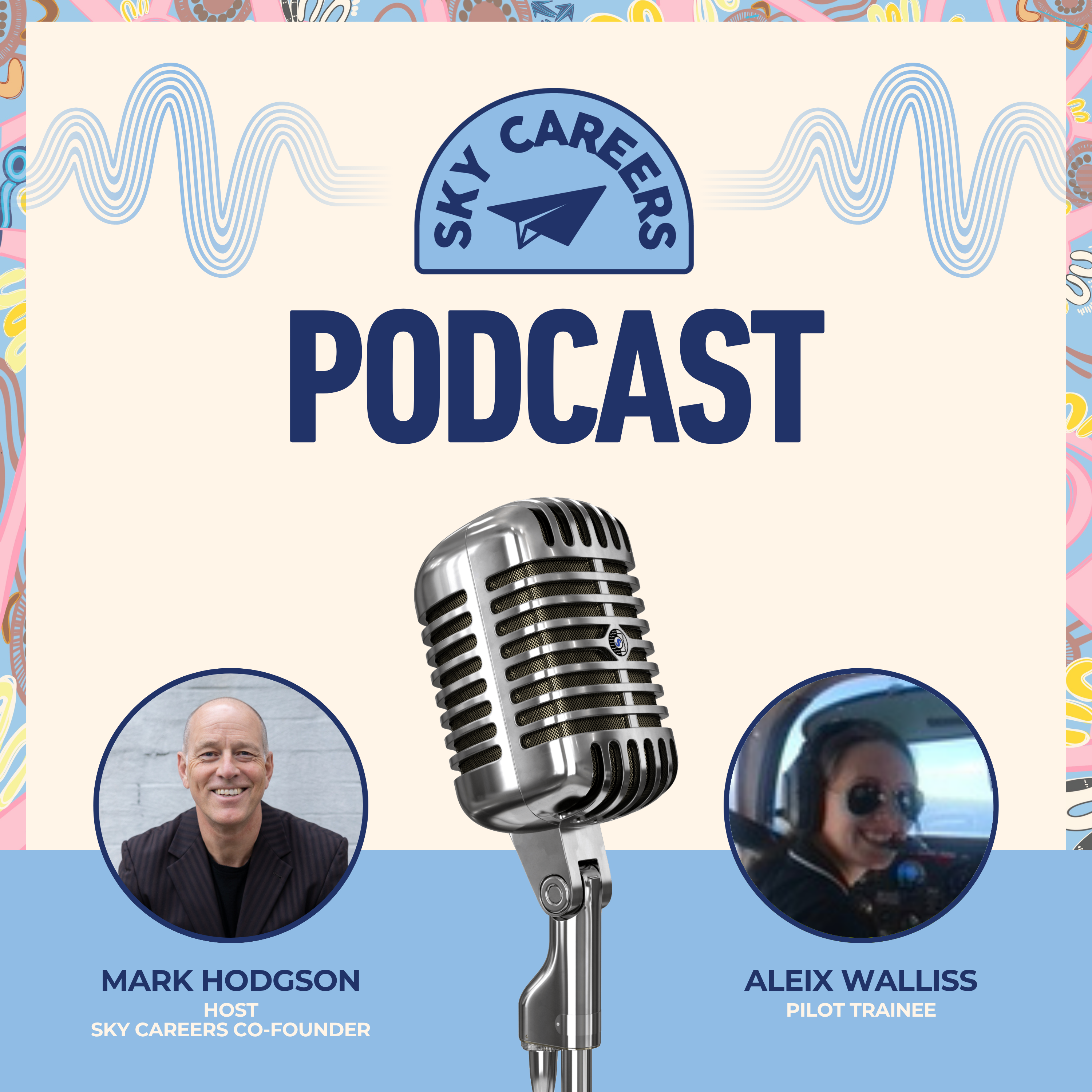
It's my privilege to host this. My name is Mark Hodgson. I'm also the co founder of Sky Careers and today we've got a special edition. We've had a few people recently, have been in aviation for a very long time, but, but today we're going to meet Lex Wallace and Lex is really just starting out on her aviation career.
She's a trainee pilot speaking to me from Perth in Western Australia. And I'm looking forward to finding out more about your young aviation career. Lex. Welcome to the Sky Careers podcast.
[00:00:45] Speaker A: Thank you. I'm very happy to be here and to share my very short story and hopefully inspire some young aviators.
[00:00:53] Speaker B: Sounds perfect. So tell us, so tell us about where you are at the moment and also a bit of your background, where you went to school and also what were your favourite subjects. We love to start there.
[00:01:04] Speaker A: Well, at the moment where I am in my career is I've got a recreational pilot's license and I am studying for my private pilot's license and my commercial pilot's license and my goal is to be a commercial pilot and to fly in fire suppression. We go way back since about year three, my mum has homeschooled me up until I finished year 12. I gotta say maths wasn't my strongest subject but I did enjoy learning all about it, so I guess you could say that was one of my favourites.
When I was 15 I started learning to fly and I went from there on and at 16 I did my first solo and then When I was 17 I got my private pilots license, my recreational. Sorry.
[00:01:51] Speaker B: Fantastic. I'm going to ask you a question I wasn't expecting. Tell me about homeschooling. How did you find that? I think you're our first homeschooler on the podcast.
[00:02:01] Speaker A: Well, I found it really good because I wasn't the most academic person at school and I didn't think that being a pilot was something that myself would be able to achieve. But I've been proven wrong and yeah, it was very, it was very good. And for the way I learned it was the right way for me.
Brilliant.
[00:02:26] Speaker B: And so what was the, what was, what was your first, I guess exposure to aviation. That planted the seed and you said, yeah, I fancy, I fancy, I fancy finding out more about that. How did you, how did you get into, into flight?
[00:02:40] Speaker A: That's a good question. There's no one defying moment. But I had been on a holiday with my parents and we'd been to Singapore and I kind of thought, this is cool. There's some people up there that know how to keep this ginormous thing in the air.
And a couple of months later, I was eight and I said to my mum, I think I might want to be a pilot. And she's like, where did that come from?
She'd never heard that before.
And so I think she kind of just waited for it to get out of my head, but it didn't.
And eventually my parents started letting me learn to fly.
[00:03:26] Speaker B: Fantastic. And how did you go about learning to fly?
[00:03:30] Speaker A: I actually started with a school holiday program that the Aero Club here in WA Run, which is called the Young Eagles.
And so I started in that group and they just took us around and showed us a whole pile of things in aviation.
And, yeah, after that I was like, this is what I want to do, this is what we're doing. And so I think maybe two months later I started learning to fly.
[00:03:59] Speaker B: Wow, so you caught the bug. Sounds like you caught it quite early. You caught it quite bad, and that's probably a good thing. So one of the things that we talk about, we've often spoken to pilots and as we know, flying is an amazing thing, but learning to fly is relatively expensive. So how did you go about funding your flying training?
[00:04:21] Speaker A: Well, I'm very, very lucky that my parents worked very hard and that they could allow me to do this.
So, yeah, I'm very, very lucky for them.
I also got a scholarship through the Australian Women's Pilots association when I was 16 and that pretty much finished off my recreational pilot's license.
[00:04:45] Speaker B: Fantastic. And how did you go about getting the scholarship? Because a lot of people will be interested in that, I'm sure.
[00:04:53] Speaker A: So I just was a part of the association. I joined the association and when scholarship applications opened, I applied to the scholarships that I was allocated eligible for, and I was very lucky that I got one.
[00:05:08] Speaker B: Fantastic. So, so, so, so talk us through. So from there. So once you actually started to fly, learning to fly. So what, what's, what's the, what's your process been so far?
[00:05:17] Speaker A: Eat, sleep, study, fly?
Yeah, I was flying about once a week, sometimes twice a week. And alongside that, studying for the theory exams, for my recreational.
For my private.
I've been doing the theory beforehand and then I will do the flying once I've got the theory exam out of my way.
[00:05:42] Speaker B: And how have you found the ground school or the study?
[00:05:47] Speaker A: It's definitely nowhere near as fun as flying.
I wouldn't say it's impossible, I wouldn't say it's easy either. There are struggles and I'm definitely not the only person that has failed any exams and I'm definitely not the only person that has found it difficult, but definitely is possible.
[00:06:06] Speaker B: Right, Fantastic. So, and so you, you, you, you've now, you've got your private pilot's license, is that right?
[00:06:12] Speaker A: You've now my recreational.
[00:06:14] Speaker B: You've got your recreation and now you're. You're starting out on your commercial pilot's license, is that, is that right?
[00:06:19] Speaker A: Yes. So my private pilot's license and my commercial pilot's license kind of at the same time. So once while I'm doing that flying, I'll be doing the theory exams for the cpl.
[00:06:29] Speaker B: Fantastic. And how, how long's that going to take, Lexi?
[00:06:33] Speaker A: Hopefully not too long. Hopefully I'll be at least done with all of my theory exams by June, July, hopefully. That's the, that's the goal is to have all them out of my way and then just have the flying which is not that, not that long.
[00:06:50] Speaker B: How long, how many, how many hours do you have to do for your CPL? How many flying hours?
[00:06:55] Speaker A: I'll have to have about 200 hours, so I'm already pretty much halfway there. I've got 100.
[00:07:00] Speaker B: Okay, you got 100.
And with what the flying you've done so far, what's been your most memorable flight?
[00:07:10] Speaker A: Actually when I decided that I wanted to fly for fire suppression was probably one of my most memorable and also the first time my mum came flying with me, which I think will be the only time she will come flying.
[00:07:24] Speaker B: So was this just you and your mum or was there an instructor as well?
[00:07:29] Speaker A: Well, she insisted that my instructor came with me. I was completely licensed so I didn't need her. But my mum requested that my instructor came to keep her calm while I focused on the flight, which did happen.
My instructor basically got paid to be flown up the coast and back again.
So nice coastal view. And she got paid for that, so I don't think she was complaining at all.
[00:07:57] Speaker B: So your flying instructor, do you have one instructor or do have a several instructors?
[00:08:03] Speaker A: I have one main instructor and I have another instructor that'll do all my flight test. So yeah, brilliant.
[00:08:10] Speaker B: And let's, let's. What's her name? Let's give her a wrap.
[00:08:13] Speaker A: Her name's Jenny Smith. She's a lovely, lovely lady and she's the best instructor I've ever flown with.
[00:08:20] Speaker B: Jenny, best instructor, we love that. So just, just connect the dots for us. So you, you. So you've said your ambition is, is to, is to be in the, the, the sort of the fire suppression aspect of flying. And as you know there's quite a lot of that in different parts of Australia, including wa. And we've spoken to a few people on the podcast. What, what, what what did you see or what did you experience to sort of set your. Set your sights on that?
[00:08:47] Speaker A: I remember everything. I was doing my stalling consolidation flight so I was probably five flights in and I had to hold for them and they were coming in to land and they were taking off at the same time. They were very quick and I asked my inst. What they did and because I had only ever seen the air tractors I didn't know what they did. And he explained to me that there's a fire and they're taking off and they're going out to fight that and they're coming back and how fast their turnaround time is and stuff. And I sat there for a good 10 minutes just watching them. I was like, wow, they are so cool. And I was like, yeah, that's where I want to go. And so every time an air tractor takes off at Jandicott, I'll be watching, watching.
[00:09:37] Speaker B: And so I should. I'm kind of assuming. So are you your, your sight set on fixed wing or would you consider rotary wing as well?
[00:09:48] Speaker A: Definitely fixed wing.
That's. Yeah, fixed wing is my way to go.
[00:09:55] Speaker B: It's the way to go now in all the, in all. So in all, in all the, in all the training, what was the.
What was what. What was the hardest thing? And then the follow up question, what's the thing you've enjoyed most?
[00:10:06] Speaker A: Probably the hardest thing for myself that I've had to accomplish is the theory.
And that's something that I find quite hard. But I actually do also really enjoy it and especially for ppl. I love doing all the maths calculations. Not that I'm great at it but I do really enjoy working that stuff out. But definitely the flying is the best.
[00:10:29] Speaker B: Fantastic. And when you're so and so this is going to take you. So you've got another 100 hours to do and what other.
What, what are your. What's your plan to translate? Obviously you haven't got yet but once you, once you've got your cpl, what's your plan to actually start to seek to find your first flying job? Have you thought that far ahead?
[00:10:50] Speaker A: I have. I've got kind of two ways that I am probably going to go. One is fire spotting and the other is where my Airplane is parked. My friend's plane is parked in a hangar and next door to that hangar is a charter company, which I have gotten to know the owner quite well. And so he's also one of my options to have a chat with him and see if there'll be anything that he and I can work out.
[00:11:23] Speaker B: Brilliant. And what's the what, how does the fire spotting thing work? I'm not sure. I've not heard of that before.
[00:11:29] Speaker A: That's through parks and wildlife and they basically just go out and fly for a few hours and they're just spotting any smoke and then if there is a fire, they'll go out to that and they'll be helping out with the ground crews and the helicopters and the air tractors and helping coordinate all that. So they're kind of the control tower.
[00:11:53] Speaker B: Yeah, it sounds good because one of the key things we come repeatedly. So I've interviewed a lot of people on the Sky Quiz podcast, had a lot of conversations and one of the biggest challenges is how do you transition from having obviously the qualifications to actually getting a real world job? And one of the things that a lot of people tell us is that it's really important to do exactly what you're advocating. Go and meet people, say hello, put your hand out, you know, volunteer to do some jobs and tasks around, around the place. Because that's, that's the. Yeah.
Who you know and kind of. And your work ethic and your ability to get on the front foot and say hello to people and introduce yourselves is a big part of that, of getting that, getting of that crossing the gap from having the qualifications and certifications to actually getting your first paid flying job. And it sounds like, it sounds like you're, you, you're, you've already worked that out. And you're, you're, you're, you're, you're see ground quite well.
[00:12:56] Speaker A: Yes. And that's definitely true. Do you have to get to know people? And I'm very lucky that I have a wonderful pilot mentor and his aircraft is the one that I hire as well. And through him I've met a lot of people and yeah, I'm very lucky.
[00:13:14] Speaker B: That's cool. And what, so what aircraft are you flying? What are you learning?
[00:13:19] Speaker A: So I got my recreational license in assessment 152 and I'm currently flying a Piper Cherokee 140 and I'll be using that aircraft for my ppl and then hopefully a single engine Comanche for my cpl.
[00:13:37] Speaker B: Sounds amazing. And then just what do you do? So you're obviously very dedicated and focused on achieving your dream of becoming a commercial pilot. What do you do when you're not doing flying stuff? What other interests do you have?
[00:13:55] Speaker A: I am mostly somewhere out on my property with a horse or some other animal, a chicken probably.
And then. Yeah. But pretty much most of my time is taken up by something to do with flying.
[00:14:10] Speaker B: Love it, love it. And then my last question.
Now obviously you're relatively young, you're early in your aviation career, but I think the listeners will see as I do, that you've got a real passion and you've applied yourself to achieve the qualifications and then the next stage to becoming a commercial pilot. So what advice would you give to other young women and also men who are looking for an aviation career or looking to get into flying? What advice would you give them?
[00:14:47] Speaker A: For anybody, I would say you can do it, it's completely possible, but you do have to sacrifice some things and even if you get pushed back exams, whatever, it's still completely possible.
And if I was to say something just for the ladies is that you will still fight men and people that don't think women should be violent, which I've experienced myself on a few occasions.
But yeah, you just gotta ignore them.
[00:15:22] Speaker B: Good. Yeah, great, great, great. Well, firstly, Lex, I'm sorry, I'm sorry, that's still the case and we know it is still the case in certain instances. It's.
[00:15:32] Speaker A: Yeah.
[00:15:33] Speaker B: Why that would be the case is a strange one to answer talking to a lot of people and we obviously have that conversation at Skycares quite a lot.
A lot of it is generational. We think it's some of the older cohort of men in the industry really just not that experienced and comfortable of working with women, which is both completely, completely crazy. But also their loss. I think it's also their loss.
We've also interviewed many female aviation workers who've experienced better experiences. But it's a very real thing and I think it's great advice.
Yeah, don't put up with it. But also I think it's important not to create a completely rose tinted view of it. But also it also happens in other, in other, and I'm sorry, I don't say this to minimize it at all, I don't. But it's also something you'll find in other industries, for example construction and other industries which are, which are seen as inverted commas, male orientated. So yeah, guy careers. We are very proud flag wavers for advocating increasing the participation of women in all aspects of aviation. And none less than, obviously, the pilot. So, Lex, thank you so much for sharing your story. We'd love to have you back in due course when you've ticked off a few of the things on your shopping list. I've got nothing but confidence you'll be successful.
[00:17:04] Speaker A: Thank you.
[00:17:05] Speaker B: And we look forward to hearing from you more and just wishing you the best of luck in continuing to achieve your flying dreams. So thanks so much for sharing your story on the Sky Careers podcast. It's been great, great.
[00:17:18] Speaker A: Thank you. Thank you for having me. And yeah, I really appreciate it.
[00:17:30] Speaker B: Thanks for listening to the Sky Careers Podcast.
If today's conversation has sparked your interest in aviation, then head over to our
[email protected] au whether you dream of flying aircraft or you're curious about the hundreds of other exciting roles that keep the aviation industry moving, Sky Careers is your gateway to discovering these opportunities.
And if you are already in the industry, check out Sky Careers Connect and Sky Careers Leadership and consider joining our online learning community.
Until next time, keep reaching for the skies.