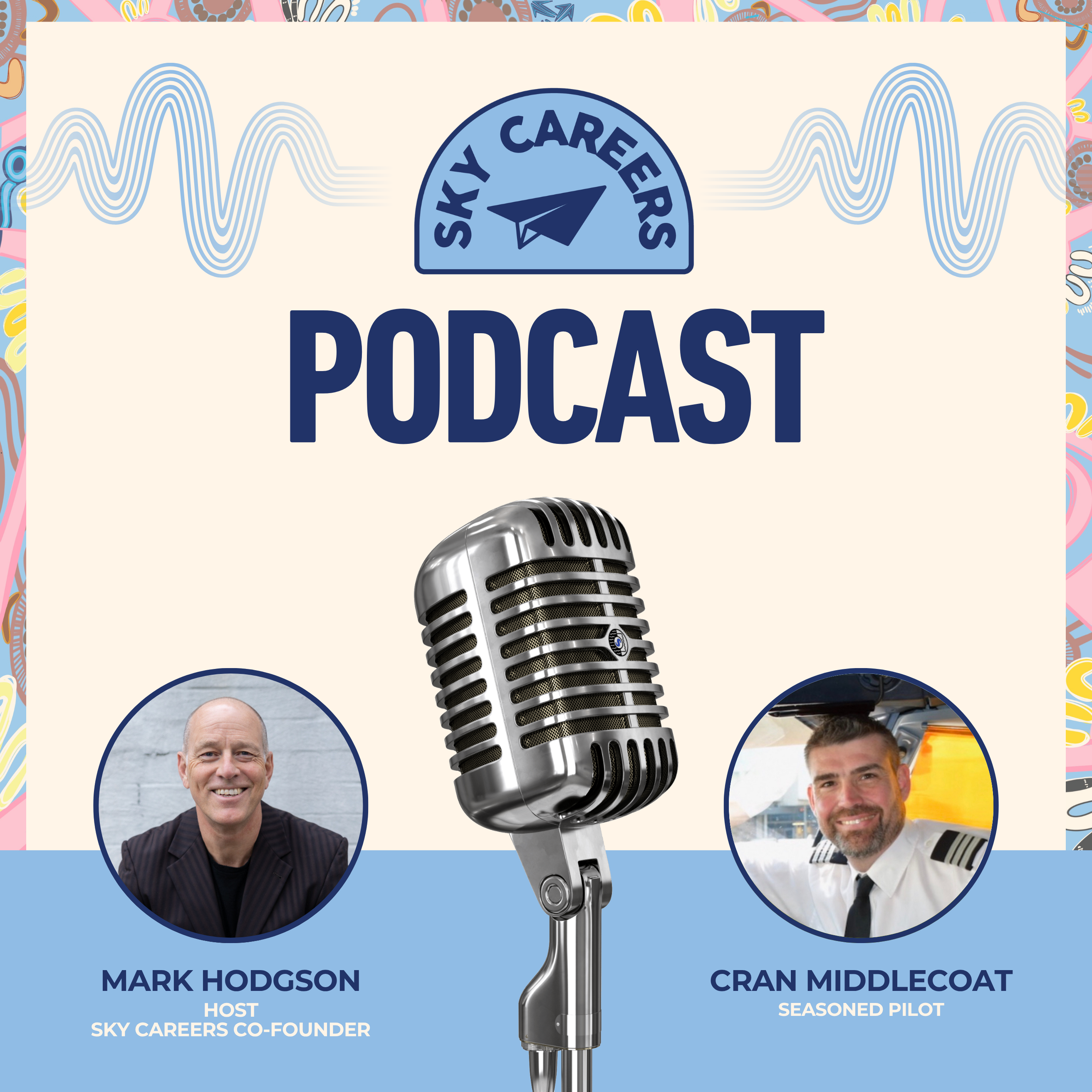
[00:00:07] Speaker A: Hi and welcome to this edition of the Sky Careers podcast. I'm your host, Mark Hodgson, and it's my pleasure this month to welcome you to our special guest, Cran Middlecoat. Now, Cran's description, I'm going to read it out as per his bio and it might not make a lot of sense other than to be interesting to you. And in the next 20 to 30 minutes we'll unpack it all and make sense of it. So let me read it. Crown Middlecoat Airline pilot, inspirational motivational speaker flying STEM University academic Guinness world record holder, survived brain disease sparking passion, courage and perseverance in reminding us all that failure breeds success. Crown Middlecoat, welcome to the podcast Podcast.
[00:00:59] Speaker B: Thank you very much, Mark. Great to be here.
[00:01:00] Speaker A: Right, mate. As I said, there's a lot. There's a lot in there to unpack. So let's get cracking. We always start at the beginning.
Tell us what's your so tell us about where you went to school and what were your favorite subjects.
[00:01:14] Speaker B: My favorite subject wasn't really a subject. I always had my eyes peeled towards the sky looking at airplanes. But what I knew were the important subjects is I wanted to be a pilot. Never wanted to do anything else. For as long as I can remember, I was going to fly. And so I knew I had to have a solid grounding in my math methods, which was maths. B when you and I went to school, English and physics. And so they were really my focal point. I enjoyed geography because there was a lot of maps and that sort of geographic type tone was also fun as well. But mainly the focus was I really had to work hard to make sure I passed those English maths basics, which I knew the airlines would want those down the track.
[00:01:54] Speaker A: Great. And what was you say you're always looking up the sky.
What was a young cran looking at? What captured your imagination in the for the first time started your love in love with flying and aviation.
[00:02:07] Speaker B: Well, I had a little bit of a kick along. I'm a third generation pilot. My grandfather flew the B24 Liberator and the C47 Skytrain during World War II.
Dad learned to fly and ended up having a career as an avionics lamy.
And everyone knows what a lamey is, right?
Yeah.
[00:02:29] Speaker A: No, do tell us though, because we do, we do, we do try and demystify acronyms on the podcast.
[00:02:34] Speaker B: Yes. And that's the worst thing about aviation. There's so many acronyms. So the licensed aircraft maintenance engineer. So that my father was one of those specializing in Aviation electronics, which we all knowingly call avionics.
And I first went flying, I was four years old. It was at an air show at Redcliffe and my father was on the committee for the Aero Club and was running the air show and one of the aircraft he maintained was going doing joy flights. And actually, to be honest, I'm not sure that was the case. I went for a flight in this airplane and I felt completely at ease.
I have very small snippets of memory. I mean, it was 42 years ago and I remember being too short to see out the window, so dad turned round and undid my seatbelt so I could stand on the seat and see the earth beneath me.
And I. I just felt completely at home in that environment. And I think at that moment I knew I was going to be in the cockpit, that's where I was going to be.
And from from then on, I never wanted to do anything else. I. One of the biggest challenges, I had to find a job to pay for flying. And that was harder because I just needed something to pay for it. But no, I was always going to fly. And that was a foregone conclusion.
[00:03:47] Speaker A: Oh, well. Well, that's interesting. A lot of our guests don't know exactly what they want to do and they don't know how to get.
They don't really see aviation as a thing and they don't know they want to be a pilot. But you're one of those who absolutely knew. So from there, what was your path to your first job in aviation and presumably pilot training? How did you track that? And as you say, the second golden question, how did you pay for it?
[00:04:14] Speaker B: Well, I started flying when I was 14 for afternoon school sport. One of the other fathers who incidentally knew my father, organized an introductory program for flight training in high school. And so I started that in year nine and continued it on through and recommenced it and had a bit of a break because there was not much point in doing something. When I was only 14, I couldn't solo till I was 16, so I could go and spend all this money and getting ready to solo, then couldn't then have to go and spend more money revising.
So that was good advice of my father. I didn't particularly like the idea at the time because I wanted to go flying, but it was his wisdom I listened to and got my student license when I was 16, started taking my teachers from school flying for one reason. I needed someone with a car and a driver's license to get me to the Airport and I was allowed to fly but I was not allowed to drive.
And it just went from there. And that was in high school. I was taking my mates flying.
It boggles my mind. I took my friends from school flying what their parents were thinking.
This other 17 year old taking his mates from school in an airplane. It's not like I was. Had my peas and I was picking them up. We're going out for a pizza or something like that and it's just. Yeah, they're pretty cool parents. A 17 year old take them take their sons and daughters flying.
[00:05:30] Speaker A: I love it. And I've just realized I forgot. Whereabouts is all this happening?
[00:05:34] Speaker B: Northern suburbs of Brisbane and Queensland.
[00:05:36] Speaker A: Yeah. So you. So you were flying. So, so then you, you what you, you worked through and you got a ppl I assume. And then. And then what was, what was the pathway from there?
[00:05:45] Speaker B: So I had the old restricted PPL is what we used to call it when I was still on my side.
[00:05:50] Speaker A: Private pilot's license. Having said I'm going to demystify crimes.
[00:05:53] Speaker B: Oh yeah, yeah, that's another.
[00:05:54] Speaker A: Started using them. Apologies. Private pilot's license.
[00:05:57] Speaker B: Yes. But I was restricted. I had to stay within the training area. I hadn't done navigation training and following finishing high school I went pretty much straight into full time work. I was actually working in a real estate office in administration and. And they. And that was what paid for my flying.
Basically every spare cent went to that. I was living at home for a very reasonable board and so that's how I funded things. I paid for it as I went as I could afford it and so I did that for a few years purely just to get the money together. In my early 20s I got that cash together and got my commercial pilot's license and then followed that on with my instrument rating. And I'd already started canvassing for work. And that's one thing for future pilots is to be very proactive. I knew I was going to get my commercial or actually I already had the commercial but I was still working on my instrument rating and already started canvassing the job. And literally the day I got my instrument rating I was offered a job mustering cattle in northwestern Queensland.
[00:07:02] Speaker A: All right, and we'll come into that and that's great advice.
We. I've interviewed quite a few pilots and there's a big gap between waving around with your shiny new CPL and instrument rating, essentially the piece of paper that qualifies you to be a pilot and then getting employed as a pilot. Isn't that a big Gap. And you've got to give that a lot of thought if you're actually going to turn a passion into a career as you've done now, mustering cattle, that sounds A exciting and B, probably a little bit dangerous.
[00:07:38] Speaker B: Yes and yes, yes and yes.
[00:07:41] Speaker A: Paint a picture for it. Cran.
[00:07:43] Speaker B: Well, I was flying a Cessna 182 which you normally picture Mum, dad and the kids flying to, I don't know, Coffs Harbour for the weekend or something like that. It's a nice touring aeroplane, but when it's light with only one person on board and 200 odd horsepower up the front is actually quite a good, effective mustering aircraft.
It wasn't just mustering cattle. I was flying into town to pick up the mail, going and picking up the electrician, flying the manager around.
And during the wet season I'd fly into town and just to get some supplies too. So I remember one, one job. I flew from Mount Isa up to Gregory Downs and every spare spot on the airplane was chock a block full of kfc.
And there's an acronym we don't need to explain.
[00:08:28] Speaker A: No, we don't.
I'm assuming mustering and an outback. You're in the. You're a long way from what one would normally call civilization. Where were you working as a muster?
[00:08:40] Speaker B: Absolutely. And that was a real shock to the system. I'm the city boy, I grew up in the suburbs. I had a very comfortable family and friendship network and that was gone. So it was a shock to the system. It was very character building. But this was happening in the Gulf country, so right up near Burketown, just so about 40 miles south of the Gulf of Carpentaria.
[00:09:00] Speaker A: Wow. Wow, that's. How long did you do that for, Craig?
[00:09:04] Speaker B: 12 months and two days.
Senior pilot said, if you want me to be a referee for your next job, you got to do 12 months for me. So I gave him 12 months and two days.
[00:09:16] Speaker A: Was it, was it one of those that. It sounds like you loved it, but it one of those but hard work and you kind of been there, done that.
[00:09:24] Speaker B: But look, it was hard work, no doubt about it. But the fact of the matter was there was one twin in the air, like one twin engine aircraft, but there was very little opportunity to fly it. And I had a thousand hours total time. I had to get into a twin. So I was at a point where there's just. There was no real point in staying because I was just getting more of the same hours. I had to find a job, maybe still flying a Single, which is exactly what happened. But had the opportunity to move into twin engine aircraft to get that multi engine experience which was a requirement for the airlines.
[00:09:53] Speaker A: Yeah, gotcha. And so I guess was your dream always on getting to airlines at that point.
[00:10:01] Speaker B: For a long time I was flying doctors. I really liked the idea of working for the RFDS and I sort of went off that a little bit because again, there's very little opportunity for living in the city and that's where I wanted to get back to. And also I liked having a roster. I like to know that I was going to go to work, I was going to do a double bundabur and then I'll be coming home and working with the, the flying doctors. You've got to be ultra, ultra flexible and not such a bad thing. But also I did want to be back in, in the cities and yeah, trying to get work with the RFDS and the cities at that point was, is very, very challenging.
[00:10:42] Speaker A: Yeah. Okay. So yeah, so take us through, take us through the, the next few years of your, of your multi getting to where you needed to get to.
[00:10:52] Speaker B: So I finished up with Stambro Pastoral Company, that was the mustering company left on good terms there. I'm actually still friends with the senior pilot. I speak to him occasionally. And then I started canvassing for work and I did a little bit of freelance photography with a friend of mine, owned an aerial photography company so I did a little bit of flying there that kept me current on singles at least.
And I think I renewed my instrument writing as well because that was up for renewal.
And then just every month sending out resumes every single month and firing every following, every resume sent, following up with a phone call every single month. And it was hundreds and hundreds of resumes and phone calls I did over that period. And you just had to do it. And it's like marketing anything you're not gonna, it's very unlikely you'll get it on the first go. And so I had to keep constantly doing. And it was just that persistence eventually paid off.
A company in Western Australia got a small contract to fly an exploration drill team between two islands in the Kimberley called Cockatoo island and Kulin Island.
Very small islands, but there was no accommodation on Kulin Island. It used to be an iron ore mine, but when the price of iron ore crashed, they shut the mine down. In the early 2000s, the demand for iron ore went through the roof. So they decided to reopen the mine. But in the interim, before they had accommodation, I had to fly Three drillers and two geologists. Every morning there's two flights from Cockatoo eight miles over to Kulin and come back and do the same in the afternoon. And throughout the day we sometimes did some transfers from Cockatoo island mine down to Broome and then over to Derby for fuel as well.
Did that. I was on the Cockatoo island gig for about a month or two, probably two months and then got back to Derby where it was one of the main bases for the airline.
Airline, they called themselves an airline, was a general aviation operator and still flying singles. But then the opportunity came up to fly the Britain Norman Islander Multi, my first twin and started flying it and that worked out well. I did 150 hours flying the Islander. A word of advice for our future pilots. If you find yourself flying a Britain Norman Islander, please spend the money and get a good noise cancelling headset. They are so noisy inside those things.
That was the best 600 I ever spent was buying a good headset to fly the Islander.
[00:13:11] Speaker A: Wow.
[00:13:12] Speaker B: And then the opportunity came to Port Hedland. I went down from Derby down to Port Hedland and started flying the, the Navajos and Chieftains down there. So 10 seat twin but constantly, you know, retractable faster than the Islander. Doing clinics for the Royal Flying Doctor service and mail runs and a little bit of charter down there as well. Also some regular public transport flying out of there. That was great fun and that got me up to my 2000 hours total time, 500 multi engine command which was the golden numbers for the airlines. And then it was next step into qantaslink flying the dash 8s.
[00:13:47] Speaker A: Fantastic. And you're painting a lovely picture here Cran of I guess whilst in a sense you had the advantage of knowing where you wanted to get to, the picture you paint is of the determination and the hard work.
It's almost like the flying's, the ease of it, it's the building your career, doing the work, paying your dues, the persistence of sending out resumes and CVs and following up with a phone call and being told no, nine times out of 10 it's testing, isn't it through how important that is to build to crafting a career. And yeah, as I often say on the, on the podcast, even if you don't want to be a pilot, even if you don't want to be in aviation, even if you just locked on the Sky Careers podcast. Yeah, there's great life advice in here and career building advice and it's, it's so. It's I'm so, I'm so glad you share it because, yeah, people just, just, oh, I did this and I lucked into that and then I joined. Then I joined an airline and I, you know, if it's easy, it sounds like it's easy for everyone, but it's not easy for everyone, is it?
It's very much the exception rather than
[00:14:56] Speaker B: the persistence part is. Yeah, very much so.
[00:15:02] Speaker A: I want to keep us moving because, as I say, you've done so many things from the intro. So you got a job with Qantaslink and just fast forward through that piece for us and then tell me what happened. What happened next.
[00:15:16] Speaker B: First of an airline flying the Dash 8s doing regional flying to the regional centres around Queensland, mainly Queensland, a little bit down to New South Wales.
Really fun job. Just myself, the captain and sometimes even just one flight attendant. And I really enjoyed that job. It was very personal. We need to refuel us by name. Knew the obstacle guys by name. You weren't just a number, so that was really good.
But then the temptation for the big shiny jets got too much and decided to apply to Jetstar and was successful getting a position as a first officer on the Airbus A320.
[00:15:51] Speaker A: Wow.
How was the transition from to jet aircraft?
[00:15:57] Speaker B: Well, you see these grey hair up here?
No, no, not so much going to a jet, going to an Airbus, it was a different beast.
Every airplane I'd flown up until that point had been conventional, where you pulled back on the yoke and it was moving a physical cable that was going to the control surface on the outside of the airplane. The Airbus was completely electronic, computerized airplane. And there is just so much to learn.
And I have a infographic I share when I was speaking at schools about the comfort zone. So you got. People think you've got to get outside your comfort zone, which is absolutely true, but we never talk about what's outside it. The first zone you go into is the fear zone, where you really lack that self confidence, subject to the.
The opinions of others. And we just want to go back. We want to go back into that comfort zone. From the fear, we go into learning and then into growth zone. And I hovered between that fear and learning zone for what felt like an eternity. There was just so many procedures to learn and they were pushing us through quickly because the company was expanding, they needed pilots and you had the added pressure that you'd already agreed to a salary sacrifice for the endorsement.
Back then they still had a supply of pilots, so if you wanted the job, you had to pay for the type rating different now because there's a considerable shortage of pilots.
And so you had this added pressure. If I don't get through this, I'm just going to get a $34,000 bill.
[00:17:26] Speaker A: Ouch.
[00:17:27] Speaker B: And so there was a lot of pressure on me there to get through it, and that was a real challenge.
[00:17:31] Speaker A: And sorry, Crane, just give me a rough. Locate me in time here. So $34,000. How long ago?
[00:17:38] Speaker B: Oh, this would have been in the. About 2008.
[00:17:42] Speaker A: Yeah.
[00:17:43] Speaker B: Now it's 20. Yeah, about 28. And I got on about 20. Yeah. 2007. 2008. Yeah.
[00:17:48] Speaker A: Don't get me wrong, $34,000 is a lot now, but it was, it was, it was a lot, lot more in 2008. Very much so take on.
[00:17:56] Speaker B: Yeah, it was. And then, of course, I mean, we'll, we'll still. It was just a.
A more polite way of attending to the debt, having its salary sacrificed, but it was still no, no less amount of money I was responsible for and.
[00:18:10] Speaker A: Yeah, yeah, yeah. So you were challenged. Did you get. Did you get through?
[00:18:16] Speaker B: I got through. I did get through with a lot of hard work and like, a lot of. And because we were the new guys, we're getting all the simulator slots, like the 3:00am Till 7:00am SIM slots, you know, the 11, 11, 11:00pm Till 3:00am oh, and then you're trying to learn so much. I remember going into a sim and doing a dual radar altimeter failure, practicing that procedure. I walked out of that symbol. I said, well, that's just an absolute dog of a procedure, isn't it? That's about the only thing I can remember from it because I was just so tired.
But that's just the reality of it. You had to pull it together. You had to go through. And I got through and then got through line training. And that was, again, that was quite stressful because you had to get through it because you needed this income you were earning to service that debt. I got through it. A lot of hard work, a lot of study and really focusing on it. And so we got through that, and then along came the A330.
So I was flying the A320 where the A330 opportunity came along. And I thought, okay, all right, I don't have to do this. I'm quite content on the 320. But then the opportunity to fly an airplane that weighs hundreds of tons rather than tens of tons, and I thought, right, I'm going to give this a go. And got through my training. On the Airbus A330.
I love my favorite jet, love the 330. My three jets offline. I. The 330 was my favorite. Just a 240 ton, puppy dog, beautiful airplane to fly.
I can only imagine what the A350 would be like. That's just a really refined.
[00:19:43] Speaker A: Yeah, my brother flies that. The A350.
[00:19:47] Speaker B: Yeah. Oh, beautiful airplane, I'd imagine.
[00:19:50] Speaker A: Yeah.
[00:19:51] Speaker B: Then Jetstar decided to retire the 330s and I got the opportunity to fly the latest and greatest at the time out of the Boeing factory, flying the 787 Dreamliner.
[00:20:01] Speaker A: Okay.
Without getting too nerdy about the, the aircraft type stuff, how difficult was it to transfer from, from Airbus to Boeing? Because they're, they're quite different.
They're quite different systems, aren't they?
[00:20:20] Speaker B: Philosophically, they are very, very different.
I had the benefit, I'd already flown a jet, so. And I could then apply those principles to a different type.
I described the Boeing 787 as a brand new. At the time it was a brand new, very old airplane.
You just look at the overhead panel and there's just switches and knobs in semi logical positions, whereas you look at the overhead panel on an Airbus and it's really clearly logically laid out. You hit a fire push button, you'll know at a glance you can see what systems you're affecting. They future proofed that airplane as at the design stage. Whereas Boeing started off on the 707 and it would have been a beautiful machine back then. But then there's sort of been Band Aid on Band Aid on Band Aid and you still saw that in the 787. I found it a little bit frustrating because I knew how clean it was to operate in an Airbus. And then there's just little things which you had to constantly be thinking of with, with a Boeing. Doesn't necessarily make it a bad airplane, but it could be a much better airplane. And I always said if Boeing, they took the best of a Boeing and the best of an Airbus and put it together, it'd be the most magnificent airplane to take to the skies. It really would be.
[00:21:34] Speaker A: So you, you I assume, well, I'm guessing you were successful in your conversion to the Boeing.
[00:21:40] Speaker B: Yes, I was, yeah.
[00:21:41] Speaker A: And then what happened? Where, where, where, where you, what routes, what kind of routes were you flying then?
[00:21:45] Speaker B: Cranberry, mainly Western Pacific and Southeast Asia. So I actually went to Central Asia too. We used to go up to Central China on a, on a charter to a place we all know now. For the wrong reasons, called Wuhan.
We used to go do a charter up there where we'd take a, a plane load of Chinese people who are on their two weeks communist holiday back to China and then the airplane had come back again with another plane load and it was marketed as a lung cleansing tour for the Chinese people.
And I can absolutely attest to that. We would fly out over the northern Australia, across the Philippines, we'd go up to Hong Kong, turn right at Hong Kong, go up to mainland China and you wouldn't see the ground because of smog. You might just see a little peak of a mountain poking through the smog. But it was really annoying and like you wouldn't. You'll be within, you know, 12, 10 models on final approach where you'd actually then before you'd see the Runway because it was just the smog was that thick and that bad. You're doing an instrument approach because of the smog.
And that was, yeah, that was an interesting thing. But a lot of flying up to China, Japan as well and east as far as Hawaii.
[00:23:00] Speaker A: So at this point, life's good. You're flying along well. You've got, you getting your career to. Well, you've, you've achieved your career dream. You're flight, you're flying passenger airliners and working your way up through the, the various scales and sizes and sizes of, of those commercial aircraft.
Then there was, then there was, then there was an unexpected twist, wasn't there?
[00:23:26] Speaker B: I was doing my command upgrade and going through command upgrade selection process that was all progressing well. So I was ready to get that fourth bar on my shoulder and.
[00:23:35] Speaker A: Sorry, Trent, give me. What year are we here?
[00:23:38] Speaker B: We are 2015. 215.
Late 2015 when this happened.
Yeah. So just get. Command upgrade selection process was going well. I was going to get that fourth bar on my shoulder.
And then one day out of the blue, I was walking out of the coffee shop at NARRATOR in Japan and I'm thinking it's like someone threw a switch and I nearly collapsed. I thought if I don't sit down, I'm gonna fall down quite literally.
And I thought, what's going on?
Anyway, I pulled myself together, got back to the hotel and I was okay and I deemed myself fit to fly.
And then in the weeks that followed, I just was so tired all the time. Constantly tired. I'd get back from a trip after flying all night and you're a bit of a zombie that day.
But I just wasn't getting over this fatigue and so went to the Doctor, do a blood test, came back. You got glandular fever. Yes. That explains the fatigue. Take a few weeks off and then you'll be back flying. Nine months later, I was no better.
And so right off to some specialist, oh, no, you're fine. Go see this specialist. Eventually got to see a neuropsychologist and he said, I'm going to do an mri. We just have to tick the box. We don't expect to find anything, but we just have to tick that box.
And they did find something.
It was a lesion, a little. Little sack of fluid about the size of an almond right between the hemispheres of my brain.
And the surgeon looked at it, he said, don't worry, it won't grow. 10% of the population have these. Give it 12 months, we'll do another scan, we'll prove it's stable, we'll send a letter to Casa. You'll be back flying. Okay, no worries. I can tread water for 12 months.
Twelve months later, it had changed shape a little bit, and they said, that's not what we were expecting.
Give it another 12 months. And after 12 months, it had definitely grown about 3 millimetres.
Okay, keep an eye on it. They started doing scans every six months. And from the middle of 2019 to the end of 2019, it doubled in size. It grew 11 millimeters in six months. And it was starting to bruise the brain. You could see on the mri, the brain matter it was pushing against it was starting to change colour. That's when the surgeon said, I'm sorry, we've got to go in. That's going to get nasty.
6th of January, 2020, I woke up in intensive care.
And that was fine, except on the way home from hospital a bit over a week later, I had a seizure and had to be taken back to hospital and ambulance. And that seizure has left me what appears to be permanent brain damage. And I can't hold a flight crew medical at this.
And that was that one job. I'd never wanted to do anything else. All I ever wanted to do was fly. And because of a thing about the size of your pinky finger in the middle of my brain, that was the end of. End of my flying.
So that was. That was a pretty hard pill to swallow, that one.
[00:26:37] Speaker A: Yeah, that's, that's, that's, that's. So that, that, that's, that's so hard to hear. Cranberry and I know. And this starting to make sense of our introduction.
Spiel at the top. How did you. How have you coped with that challenge? Because I think you coped magnificently.
[00:27:00] Speaker B: Look, I'll be honest, Mark, sometimes I didn't.
[00:27:02] Speaker A: Sometimes I'm sure you didn't. But I mean, I mean, you know, I'm interested. How did you manage to, how do you manage to keep moving through such adversity when as you say, your, I guess your childhood dream and something not just, not just out of sight, something you've actually achieved and you've set yourself up and you just want to get captaincy, which I know is really important sort of accolade and recognition of all your skills and all your hard work, I guess. What better question, what have you learned from the last few years?
[00:27:40] Speaker B: Well, I learned that trying to be perfect was the worst thing I could have done.
And we were taught in school that practice makes perfect and we are told that perfection is the standard and we start at an A and go backwards rather than starting at a D or a C and moving upwards. And so that's when I found myself thinking, hang on, why aren't we talking about this at schools?
And then I realized I had this experience. I'm blessed that it wasn't a cancer and I'm in good health now.
However, I got this experience which taught me a lot and so I've decided to reinvent myself to help young people and not so young people too. I speak on the corporate circle as well, to use, share these experiences and these tools that I learned along the way to empower people and to empower young people in particular artists. I like being that person I wish I had when I was young and going into schools, talking about aviation careers, going down the leadership road, resilience and well being and just giving these young people the tools to have ready to go when the tough times hit because they're going to come. You are going, life's going to come, it's going to belt you hard and it's how you respond, which is the important thing.
And these tools that I share help prepare these young people for it and also the teachers and doesn't matter who, what age of audience I have, these same tools are relevant regardless.
[00:29:10] Speaker A: Yeah, I love that. Yeah, I could, I could, I couldn't agree more. It's, you know, you, life, life's easy when everything's going well and the sun's, the sun's out and you know, you're succeeding and being told you're doing a great job and you know you're happy and stuff, you're healthy and all those things are flowing well.
When some or several of those things are no longer true. Maybe you lose a job, maybe you've lost your health, which is really the. What's impacted you or you've had a disappointment or you may be unemployed. And we've obviously with aviation, we had massive turn. You know, we had turmoil through Covid.
You've got stuff going on at the moment with the Iran war and that's causing challenges in different areas yet to be kind of really understood and that you're, you're not just the lessons you're learning, but also I think the lessons you're sharing about building resilience and mental strength and also that mindset of failing. I love the, I love the idea of failing forwards. You know, it's not about failing, it's about keeping going.
[00:30:13] Speaker B: Yeah.
[00:30:14] Speaker A: So you have just crumbling when the, when the first, when you first meet, you know, disappointment or worse than disappointment.
[00:30:25] Speaker B: Well, we talked about the acronyms. Here's one of my favorite acronyms. F A I L, First Attempt in Learning.
Now I've heard a lot of acronyms in aviation in my time, but F A I L means first attempt in learning. That's my favorite one.
[00:30:45] Speaker A: I like that. I like that. So what do you bring us up, bring us up to speed because I know there's a couple of things going on. So what are you, what, what are you currently doing? Are you able to fly at all at the moment?
[00:30:57] Speaker B: Am allowed to fly Recreation Aviation categories. So rals, Recreation Aviation Australia. They're a great team. They're very, very helpful they. In supporting me. They looked into my case. No, you're right to fly, you have to meet the requirements of a commercial driver's license, which I did.
And they said we'd love to have you as a member. And so I do some flying with them, support them in some of their workshops as well. Like they did the Bushcat build, the Ladies Bushcat build in Parks a few weeks ago, which was a really great initiative and helping. Looking at a few projects there. Again, just getting more young people interested in aviation and demystifying a lot of these myths which we have because there is a lot of misinformation about aviation and guidance counsellors, they can't be expected to know it all. So we like to help them. Like a classic one is, oh, I can't be a pilot because I wear glasses.
[00:31:51] Speaker A: That's.
[00:31:51] Speaker B: That's like, no, that's absolutely not the case. An astronaut, maybe even. I've even seen astronauts wear glasses.
That's. They aren't always the case. There's things like that which you want to want to demystify this. No word of a line, Mark. I'm absolute honest truth here. I had a young woman not so long ago saying girls aren't allowed to be pilots.
Where is this information coming? Like, surely that kind of come from a guidance counsellor. I mean, this was. I mean, how archaic are we? Like, this information's still out there. And I do honestly, I find that incredibly frustrating that these young people who have doors closed before they're even opened almost because they have all this misinformation out there. So that's why I really enjoy doing it mainly in high school area. Now, speaking about the aviation careers, I keep along funny stories about the time I had to fly dead bodies in a coffin and they start to burp and fart at you. I mean, teenagers love those stories.
And then I'll work in those funny stories of the careers and talk about the value of your engineers. And when you have an engineer, they're one of your greatest assets, so look after them. So I've got stories about those going into that leadership role and how you have to prioritize in the cockpit and simple things I've heard to help me command a situation which we don't talk about simple things like just breathing properly. We're not giving people these young. I had this breathing technique. I was in the sim. When the check captain's loading you up, you want to control your breathing, otherwise you hyperventilate.
Simple things like that, which I share. And going into that resilience in year 11 and sort of year 12 and that wellbeing approach these tools just to help these young people. Okay, you're at the pointy end of school now. Yes, it's getting hard. Look, you've got six months to go. You've got eight months to go. Look, don't try to be perfect. And that's the worst thing we can. And we're still stigmatizing failure as bad as something to be avoided, whereas it's our greatest teacher.
And that's what I really like, sharing those stories and sharing those tools to help these young people be better prepared.
[00:33:55] Speaker A: Yeah, that's a lovely acronym. And as you say, I mean, as you're aware, I mean, one of the raison d' etre, why we created Sky Careers was to help create a whole load of resources as part of increasing awareness of the broad range of aviation roles. Not just pilot, engineer, air traffic, cabin crew, marketing operations, airfield. Yeah, this there's. I think we've mapped. There's 40 or 50 before you even get. Yeah, very niche.
[00:34:25] Speaker B: Exactly.
[00:34:26] Speaker A: All these careers and the pathways into them are many and varied. They're open to equally to women and men.
And what we found, and one of the reasons we've. We've produced all these resources, is there is a.
There is a massive gap. I mean, you talk about career counsellors at school.
Fun fact. The typical careers counselor at a school, because they're responsible for multiple years, has as many as 600 kids. Young adults they're responsible for. So there's two things there. How can they possibly give bespoke advice? They can't. And the second one, how can they possibly know much or a lot about aviation or pretty much anything? Anything else that isn't fair, isn't fairly obvious or in their experience. And as we know, aviation tends not to be in people's experience unless they happen to be in aviation, because airfields are at the edge of the city or the edge of town. Unless you know one, you know it, or you work there. I know someone who works there. A lot of it will be a mystery, other than maybe if you go flying somewhere in an Airbus or something, which is one aspect of aviation, but it is only one. So that gap is incredible. One of the things we're trying to do with sky careers and, you know, the thing that flies, the thing that shines through from your story cran, and you've told it so well, is the teamwork, the passion, the support you have got. You continue to get your determination to get back into commercial flying as opposed to recreational flying. And just.
I'm going to start to land the plane now. We're at 36 minutes. I knew we'd go long, but it's wonderful.
Yeah. This is just this goal. For anyone who's listening, update us on where you are with your medical journey.
[00:36:15] Speaker B: It's. It's a. It's a long slog. And look, the Casa casa have met. They are very strict and for good reason.
As frustrating as it can be because it takes a lot of time for work. I can't disagree with the process and I'm going through. I've got two A4 pages. I did start the ball rolling with my medical last year and eventually got back to A4 pages of requirements, which I'm slowly chipping away. In fact, this morning I went and saw one of the specialists and we've got another test lined up for, I think, in just under two weeks and we'll see where that one goes and then submit everything. It's going to be a bundle of papers probably an inch thick, figuratively speaking, these days, obviously. And we'll just have to see how it goes.
I want to know. I can.
I really love working with young people. I really enjoy that. I just try to be that person I wish I had when I was young, and I get a tremendous amount of satisfaction out of that. But at the same token, there's just something. I never got that fourth bar on my shoulder and there's that one little niggle that's constantly pecking at me that I really do want. That fourth bar might never happen, but I want to know that I can.
[00:37:29] Speaker A: Yeah, no.
I shared briefly. I remember my brother, who's Carl Hodgson, who's. We guested on the podcast as well.
He was originally a military pilot for 20 years, and he spent the last 20 years flying with Virgin Atlantic Flying.
And he was the first officer quite a long time. And there was. With COVID and stuff and different things. It was a time when there weren't many pilots. I know getting captaincy for him took a couple of goes and it was quite a steep. It was quite a steep learning. And I. He won't mind me sharing. He. He failed. He felt the first time he went for. He failed.
[00:38:07] Speaker B: Yeah.
[00:38:08] Speaker A: I know how important it was to him. And I know also, I can remember to this day where I was when. When he called me and told me he'd got his fourth. His. His. His fourth bar, or ring, as we call him in the Navy. And.
Oh, yeah. And I was so proud of him. And so I. I want that for you as well. And I'm sure. I'm sure, you know, if we can get the medical pieces aligned and, you know, God is good and I think he will be for you, and you've certainly got determination, but there's. There is no. There is. It won't be. It won't be for the lack of trying on your part, will it?
[00:38:39] Speaker B: No, it won't be. And I'll tell you what, there's going to be one heck of a party when I get that medical back, I can assure you.
[00:38:44] Speaker A: Oh, mate. Well, you keep us informed on that. Now, finally, I'd say I do need to bring us to a close. And I should also say that we.
This is our take too, because you were very generous the first time we recorded this podcast. We had technical issues, so you've kindly given us your time.
[00:39:01] Speaker B: It's no problem at all.
We're all on the same team.
[00:39:05] Speaker A: But I think we are. I think we very much agree. My last question, and you've touched on this a little bit, but what advice would you give to other young men and women who are thinking about a career in aviation, whether that's a pilot or something else? What advice would you give them?
[00:39:22] Speaker B: Cranberry don't ever try to be perfect.
Perfection simply does not exist. Even Stephen Hawking said that we're not going to say practice makes perfect anymore. What I'd love everyone to start saying is that practice creates confidence.
Practice creates confidence. That way you can embrace the undesirable outcomes as well and using those as a learning tool.
Practice creates confidence. Don't worry about perfection.
[00:39:52] Speaker A: Awesome. Couldn't agree more. There's your T shirt. Cran, I'm sure we're gonna have you back.
You've been a fantastic guest, really enjoyed speaking with you. We're very much on the same, singing from the same hymn sheet. And all the best with your medical work. And even outside of the medical stuff, all the best with all the great work you're doing, encouraging, leading, engaging kids.
Some of whom, as you say, didn't have that the figure. I mean, you had your granddad and your dad and you know, you had support and you had a clarity of vision that just isn't available to everyone.
Carry on doing the good work and looking forward to having you back another on another time.
[00:40:35] Speaker B: Fantastic. Looking forward to it.
[00:40:37] Speaker A: Thanks, Cran.
Thanks for listening to the Sky Careers Podcast.
If today's conversation has sparked your interest in aviation, then head over to our
[email protected] au whether you dream of flying aircraft or you're curious about the hundreds of other exciting roles that keep the aviation industry moving, Sky Careers is your gateway to discovering these opportunities.
And if you are already in the industry, check out Sky Careers Connect and Sky Careers Leadership and consider joining our online learning community.
Until next time, keep reaching for the skies.