Episode Transcript
[00:00:00] Speaker A: Foreign.
[00:00:08] Speaker B: Welcome to the latest episode of Sky Careers podcast. My name's Mark Hodgson and it's my pleasure to be your host. I'm also the co founder of Sky Careers.
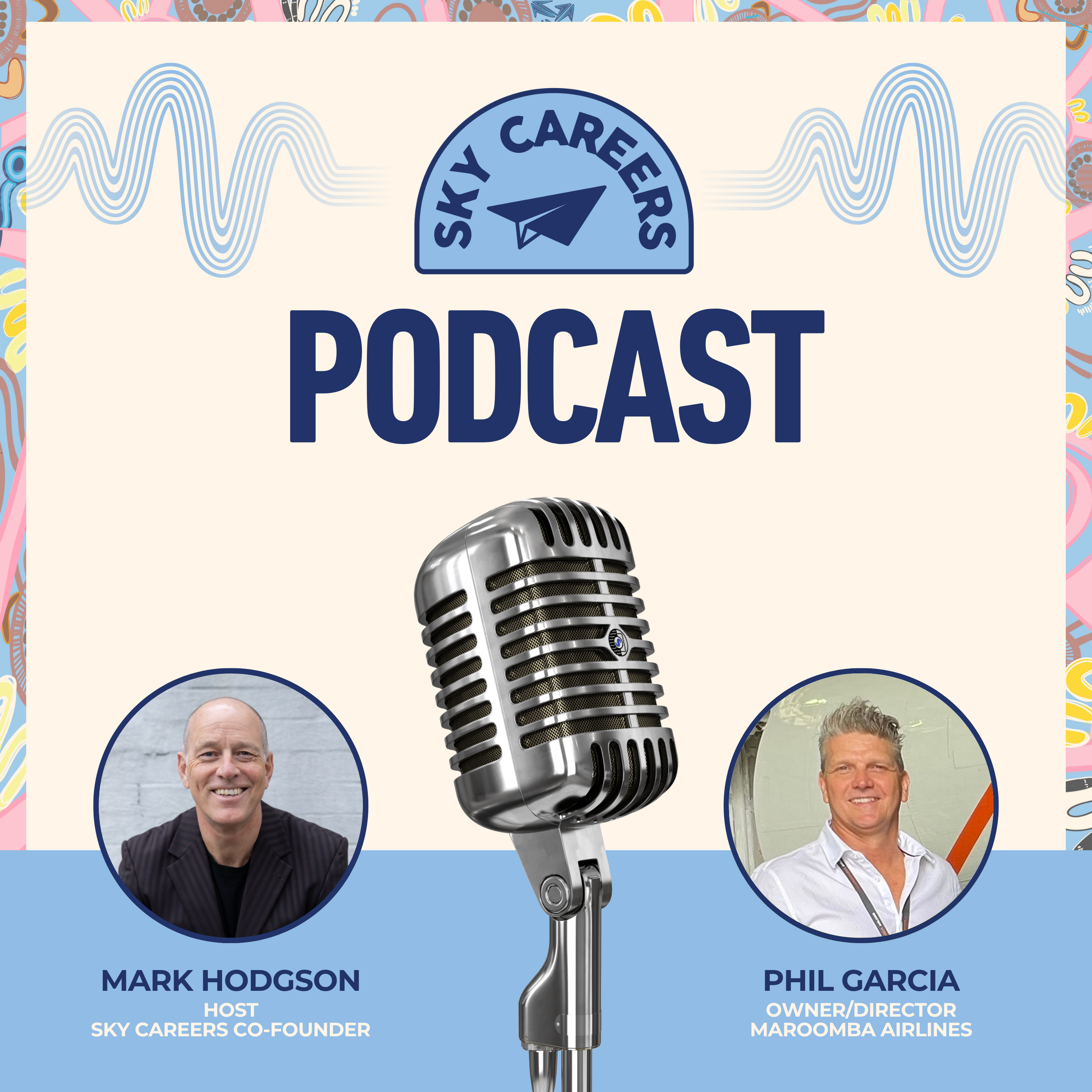
And this month or this episode, it's my pleasure to bring to you, I think, our first owner of an airline. And today we on our as a guest we've got Phil Garcia who's joining us from WA and he is the owner director of Maroomba Airlines. Phil, welcome to the Sky Careers podcast. So I always start in the same place. Take us back to a very young version of Phil Garcia. Where did you go to school? What did you study?
[00:00:48] Speaker A: Yeah, it's, yeah, I was born and bred in Kalgoorlie back in 1971. Lived there for a couple of years and then I spent another 10 years out in Camber Elder in the, in the nickel space there. So my, my father was a electric, genuine. The electrician. Yeah, I think he was the only electrician back in town then. So yeah, school was.
[00:01:09] Speaker B: Phil, sorry, just, just to interject. So can you explain to our, to, to our listeners who aren't sort of cognizant of the geography of Australia, can you tell us a bit about what Kalgoorlie means and where it is?
[00:01:19] Speaker A: Yeah, Kalgoorlie is about 650 km east of Perth. It's in the, the gold fields, the gold region of the gold belt there. Yeah, very big mining town. So, yeah, even back in the 70s it was very, very busy time and it always has been. So, and then Cambelta is just a small town about 50 kilometers away, but yeah, mainly around western mining workers.
So that, that's sort of where it is. But yeah, dad was a General electrician, just doing household and commercial.
Yeah, I sort of grew up in that, which, you know, played a lot into sport, football, cricket. I was big into motocross and still am actually. So that was my passion in my life growing up until I was probably, you know, 1920. I sort of stopped that.
Yeah, school played, you know, that wasn't a high priority back then. You know, if we had a state title on then dad would say, come on, don't go to school for the week, we need to train. So go dad. I'd be like, yep, no worries. So, yeah, so that we were there till about 84 and then a few family setbacks and we ended up moving to Perth and father passed away in about 84. So I was pretty young then and I kept, I kept, you know, racing motocross and as I said, until my, into my late teens there. So that was going to be my job. That's all I wanted to do from a career perspective. But, you know, three knee reconstructions later and broken bones and arms and wrists and you kind of go, yeah, maybe I've run out of talent somewhere along the line.
So, yeah, so it was like, oh, I need to go and find a job. And lucky for me, my brother, he was a pilot with Network Aviation back then with Lindsay Evans. So he said, you know, maybe, maybe come sweep floors. He was getting his aircraft, I think maintained out of Janicot there. So I was always had a mechanical background, love pulling agents apart. So I was always good with my hands. So, yeah, just kind of knocked on the door and got a job, you know, sweeping the hangar floor and making the engineers coffees and getting parts down the road. And then I thought that it's a pretty good industry to be in. Not one I'd ever thought of, be honest.
[00:03:30] Speaker C: And how old, how old are you? How old are you here? Are you here?
[00:03:34] Speaker A: I just finished here. So I was just, just. I was nearly 7 8. Just turned 78 at this stage. So, yeah, and I thought, well, all I can do is ask for an apprenticeship. So I asked a guy called Graham Wilcock, who owned Woolcock Aircraft Company at the time, and, yeah, asked Graham for an apprenticeship and a month later I'd started, so did four, four and a half, five years with Graham.
[00:03:56] Speaker C: So that the apprenticeship was as a.
[00:03:58] Speaker A: It was as an aircraft maintenance engineer. Yeah. So that's. You do. You know, back then we did block tastes, two weeks block, block sections.
But yeah, you'd learn a lot of it on the job. And, you know, doing an engineering apprenticeship in the 80s is probably a little bit different to how it is now. So it was just do the job and don't say too much about it. So fantastic mentors. I think it really did set. When I look back now, it really set me up for where my career is now. There's still guys I speak to now, 30 odd odd years later that still help me out every now and then when I've got a question. But yeah, so finished my apprenticeship and I had to do. And it was. It was a struggle for me to do all my CASA exams. It was. That did not come easy at all. My compreh understanding of what CASA asked for exams and what I thought the answer were very different for a while. So I had to retrain my brain, but learned to bend. Oh, it was. And you know, I could do everything with my Hands, sheet metal wise. We did engine overhauls, landing gear overhauls. Not a problem. So eventually I learned, you know, learned a little bit more about physics and theory of flight, which I find so fascinating now and still love it today. Yeah. So by the time I'd finished my apprenticeship, I'd got my CASA license, so I became a Lamy, which was a pretty big accomplishment for me from where I. What I was previously doing of not having any idea of a career. Yeah.
[00:05:18] Speaker B: So. So. And how old are we now? So you. So you are a license.
[00:05:21] Speaker A: I was probably 21, 22, engineer.
[00:05:24] Speaker B: So at 21, 22.
[00:05:25] Speaker A: Yeah.
[00:05:26] Speaker B: And then you're in Perth, you're at Jandicott.
[00:05:27] Speaker A: In and around. Yeah, out of Janicot there. And then I thought, oh, I'm gonna go and work for myself a little bit. So I started up Garcia Enterprises and I worked for a guy called Rob Pointon, who was rebuilding World War II fighters then at as well.
That was, yeah, great, you know, awesome sheet metal work and just fantastic part. It was a awesome three, four years, what I did with Robbie, working with a lot of great, talented engineers.
[00:05:58] Speaker B: What kind of aircraft were you rebuilding that were the.
[00:06:00] Speaker A: The T6, the Harvard T6s.
[00:06:03] Speaker B: Yeah.
[00:06:04] Speaker A: Rob had his Sea Fury there, which was just a fantastic machine. I think I'd gone just as the Mustang arrived, but it was mainly the T6s.
[00:06:12] Speaker B: Lovely.
[00:06:13] Speaker C: Yeah.
[00:06:13] Speaker B: I was just. Just literally two weeks ago, three weeks ago, I was up at the.
[00:06:18] Speaker C: I was up at Scone just outside of Castle, and they had the.
[00:06:23] Speaker B: The Warbirds over.
[00:06:25] Speaker C: Over Scone sort of show. And I was there on the Friday
[00:06:29] Speaker B: doing a Careers day, and I.
[00:06:30] Speaker C: Unfortunately, I couldn't stay. I had a great time with the kid talking about aviation, but I was
[00:06:35] Speaker B: hanging out, waiting to listen to a Merlin engine because I'm being English and
[00:06:39] Speaker C: Spitfires and all that. And there were no run.
[00:06:42] Speaker B: There were.
[00:06:42] Speaker C: None of them were running on Friday. So I was so disappointed because there's something.
[00:06:45] Speaker B: There's something about those.
That just those aircraft, that generation, that.
[00:06:51] Speaker C: The innovation, the beauty of some of the. I know they're war machines, and they are, but some of the. Some of the engineering and the creativity and the. Just the craftsmanship is stunning, isn't it?
[00:07:02] Speaker A: Yeah, it was good. You know, we were putting new engines in it with the Pratt and Whitney engines, and then it was. It was just a good way to learn all your systems. You know, we're rebuilding whole hydraulics, pipe work and avionics, putting new avionics in it. So as much as taking it back to original, but yeah, just. Just learned. Learned so much. It was fantastic.
[00:07:25] Speaker B: So you're how old? So you're about.
[00:07:27] Speaker C: I'm doing Math. You're about 25 now and you've doing your own business.
[00:07:32] Speaker A: Wow. I was just, just a subcontractor, let's put it as that.
[00:07:35] Speaker C: So hey, let's, let's build. Let's build it up. You're a subcontractor.
[00:07:39] Speaker A: I did have to learn about provisional tax pretty quick, I can tell you
[00:07:43] Speaker C: what you mean you don't keep to keep everything in your bank account?
[00:07:47] Speaker A: Apparently not.
So, yeah, and then, and then we were still doing line maintenance, you know, for, for companies Krath Flying Services. We were looking after their fleet of aircraft they had up there and that was through Graham, my, my boss, I did my apprenticeship with. So and then Graham and I teamed up. He sold his business and then he and I teamed up and we were doing all of Karra Flying Services work. So they had Barons, 172s, Navajos, that sort of thing. We had a hangar at Janicot there. We were just leasing and we were doing like his heavy maintenance as well for him as well as his line maintenance up in Karratha. So we did that for three or four years as well. And then just, yeah, flying all around the state doing all sorts of maintenance wherever we could up in Broome, real rebuilding the.
The aircraft they were operating out of there for the Paspali pearls and all that sort of stuff.
[00:08:38] Speaker B: So we've, we've had the passpaily guys as guests on, on, on the pod. They're beautiful aircraft as well.
[00:08:43] Speaker A: Yeah, it was just, again, it was a lot of sheet metal work and a lot of attention to detail. So it's one thing I did learn during my apprenticeship is that, yeah, the small things, you know, if it, if it looks right and feels right, it generally is.
So, yeah, attention to detail, it's something that still is in my system today. That's probably one of my, my bugs when it doesn't happen. So.
And then eventually I moved up to Karatha. It would have been. Would have been nearly the 29, 30. And I was chief engineer up there for Kratha Fine Services for a little while. Yep, that was. Kratha was another great spot. You know, you're looking after eight or nine aircraft almost by yourself at one stage. And yeah, again, really, really good to get out of the, get out of the city. And you do learn a lot more being away from a main base.
It's fantastic.
[00:09:35] Speaker B: So did you have a team at. Did you have a team at that place? At that point? It was just small team or pretty much.
[00:09:41] Speaker A: It was the original owner, Dick, Pin and myself, and then Graham would come up from time to time and we used to get engineers up when we needed them, but just the day line stuff, it was mainly just Dick and myself. Richard, he was a pilot, but also got his engineering license as well. So.
[00:09:58] Speaker B: Yeah, because one thing that shined out through your story, Phil, is both camaraderie but also teamwork. It seems to be such an important part of aviation because it's a system, isn't it? And ultimately the aircraft doesn't fly unless it's airworthy and signed off and got all the paperwork. And there's so many people in that chain who are necessary. And any, anything in that chain that isn't done right, the thing doesn't take off or it takes off when it shouldn't take off, which, which is another problem. And that teamwork aspect of aviation is. It's just first it shines through to me and all the people I speak to on the Sky Careers podcast. But, but, but also it seems to be such, such a valuable thing. It's. It's such a life skill as well
[00:10:42] Speaker C: and such an important part of why.
[00:10:44] Speaker B: Why I think aviation is such an exciting industry for people to join.
[00:10:48] Speaker A: No, it is, absolutely. And it's teamwork, but it's also jumping in a field that you're not probably comfortable with all the time. And so because it's an engineering defect, it doesn't mean you don't go across and help operations to help resolve the issue with the client. So there's a lot of crossover between different departments as well.
So it does give you that mindset to go, look, I don't have to just worry about me here. I've done my engineering bit. Don't worry about the rest of it. And that's something I've learned probably since, since taken on Maroonba. It's. It's a lot. There's a lot more other departments involved than just engineering.
[00:11:23] Speaker B: So we'll get to that bit. So let's fast forward because. Because before you came on, you told me you told you been. You told me you've been on the, well on the tools, directly and indirectly for, I think over 30 years, you said. So join the dots from where you are up as the, the chief engineer at Karratha Flying Services to, to becoming the director owner director or an owner
[00:11:50] Speaker C: director, I'm not sure yet.
[00:11:51] Speaker B: We'll find out. Of Maroonba Airlines, because that's a.
[00:11:53] Speaker C: That's a big leap.
[00:11:54] Speaker A: It is.
[00:11:55] Speaker B: So Richard Branson.
[00:11:58] Speaker A: Not quite.
Yeah. So left. Left Karatha and moved, came back to Perth and worked down here for a little bit. And then basically I was working just for an Engineering Co. 9 to 5. And it wasn't me, it's not how I can operate. So my mind's going a little bit too quick for just doing that at the moment.
Myself and another engineer started up a company called Premier Aviation out at Janicop and that was basically. It was just a necessity for us to keep motivated, I think.
And that was a fantastic business.
We had Kratha Flying Services work to start with and then eventually we got the Police Air WA South Australia and NT Police Air Wing work became service center for Pilatus Australia.
We were doing work for Maroonba back then, even when Steve Young owned it. And we're doing a bit of stuff for Network. We're helping out the RFTs. So it was just a good size MRO at Janicot.
Again, we got the engineers we wanted. Some of the guys, some of the engineers that came that were my mentors when I was an apprentice. So they came and worked for me, which is just something I never. Oh, how did you go about.
[00:13:14] Speaker B: How did you go about managing people
[00:13:17] Speaker C: who, you know, obviously older than you and who taught you a lot of what you know?
[00:13:21] Speaker B: How did you find that?
[00:13:23] Speaker A: Yeah, it was challenging at some engineers, but most of them, they just wanted to work. They were just. It was such a great environment to work in. We had apprentices, we had guys from 16, 17 through to their late 60s.
[00:13:37] Speaker C: Beautiful.
[00:13:38] Speaker A: And I don't know, it just really gelled. Well, everyone got in and did the work and there was none of this. There was no hierarchy of, you know, I'm a director and this is what I do. Everyone was on the floor working and, you know, it was. It was really good fun. So.
[00:13:51] Speaker C: Yeah, I bet it was. It sounds amazing. And it's funny, isn't it, when you. When you're working, when you're working, you know, and I know you work long hours and you're problem solving, but as you say, literally on one floor, one floor, both, literally and. Or in a hangar, literally, metaphorically. There's lots of life stuff goes on as well, isn't it? I'm sure. I'm sure some of the old hands were able to give some of the young guys a bit of. A bit of life advice.
[00:14:14] Speaker A: No, they're really good. And it was such a pleasant Surprise that they were. They'd come and done that for us as well. You know, they could have stayed where they were, but they. They wanted a bit of a challenge in their life, too. So it just. It. It lined up perfectly.
[00:14:30] Speaker B: Love it.
[00:14:30] Speaker C: Love it.
[00:14:30] Speaker A: Yes. So we had that for 10 years.
So that went from, like, I think it was about 2002 to 2013, I think we sold it. I sold my half to. To Paul Montauban, who was my business partner at this time.
And then, yeah, I came home, and I was probably a bit burnt out then, to be honest.
Life. We had two. Steph, my wife, obviously been married at this stage, and we had two kids going through school, and though I think 10 and eight. And I came home and I said, business is sold. Two weeks. Pack the house up. Let's drive around Australia.
[00:15:02] Speaker B: Oh, amazing.
[00:15:04] Speaker A: So it was a good one for us to get back together as a. As a unit. You know, I just missed too many birthdays and all that sort of thing. So, yeah, I just wanted to live a life in board shorts and surfing and mountain biking, and we did that around Australia for about eight or nine months, looking for a new place to live.
I didn't really care what I went into, whether it was mining.
I. I didn't want to get back into aviation, to be honest. I was just. I had enough.
[00:15:30] Speaker B: I think we all know how this story ends.
[00:15:31] Speaker A: Oh, yeah. So anyway, we ended up driving around Australia, and we. We've always had friends in Dunsborough, and we ended up settler settling, bought a house in Dunsborough, and that's where.
So Dunsborough is down in the southwest area of Margaret River. Around that area. Okay.
[00:15:47] Speaker B: Yeah, yeah, yeah.
[00:15:49] Speaker A: Wa. So beautiful country town and great lifestyle. So Steph, my wife, went to work full time, and I played Mr. Dad for about six, eight months. Took the kids to school, and, you know, don't worry about school. We'll go surfing in the morning. I'll drop you off later.
I've turned into my father, but such a. It was such a fantastic time. And it was, you know, getting that family back together. People talk about it. They don't think it's that, you know, we'll do it, we'll do it. And I guess I was lucky we'd sold a business. You know, we didn't have money issues to worry about, paying bills. Yeah, it does. But that break, even if it's for six weeks, is so good. It was fantastic. So.
[00:16:30] Speaker B: Yes, you're so. You're so right, Phil. It's so easy to you know, I know a lot of our listeners will be probably a bit, bit, bit younger than them, probably for this advice. I'm not, I'm not sure, but it is. So it's so easy to lose sight of.
[00:16:43] Speaker C: That isn't.
[00:16:43] Speaker B: Especially when you get consumed in your career and.
[00:16:47] Speaker A: Oh, absolutely.
[00:16:48] Speaker B: Especially fixing st. Because it, you know, a three hour job turns into a six hour job and it's not done till it's done and you know, you get home late or you're tired or you leave early and it's so easy for that to become a way of being and a habit and suddenly, as you say, oh, what happened to birthdays and anniversaries and holidays? And it's, it's so easily done, so easily done with the best of the best of intentions.
[00:17:10] Speaker A: Oh, well, the funny thing is, even when I, when I first met my wife, which we were 19, I think we got, I met her at 19, we were married at 23. I think I said to her, aviation comes first.
And she was like, what do you mean? I said, if you ring me or contact me and I'm putting a prop on the aircraft, I'm not going to leave enough hanging off with the spanner and going, I've got to go, I've got to finish the job. If that's two hours, it's two hours. I said it. And this was part of the apprenticeship. It's so critical. I just couldn't leave a job half undone as long as I got to the point. It was like, great, sign it off, do it.
[00:17:48] Speaker B: Yeah.
[00:17:49] Speaker A: So, yeah, Steph's always not taken the back seat, but time's always expanded long. If I say it's an hour, it's probably a good two or three hours. So she's, she's come to grips with that over the years and it's done a few things without me along the way, gone on holidays and.
But I've learned I have, you know, reeled it back in somewhat.
[00:18:10] Speaker B: Good for you, good for you.
[00:18:11] Speaker C: So bring us up to that. So how do we become the owner director?
[00:18:18] Speaker A: Yeah, it's probably after about six, eight months, I was starting to go a bit mad. I just thought my brain wasn't used to not being engaged for so long. So I actually did get into an import export business out of China for a little while with another friend who I went to business with for a few years. So that was a bit of fun. Had nothing to do with aviation, it had to do with a bit of pet industry and fitness industry. I went into, but it wasn't my passion and it made me really tick. Like, I miss aviation so much.
Look, at the end of the day, Maroonba Steve Young wanted to sell it and it was an opportunity to get back in it. So, yeah, it was just a pathway to, to jump back in it.
I knew I could do it from an engineering side of things. Steve didn't have his own engineering at that stage. It was outsourced and I knew I could bring that in house and make it very efficient. Done it before a couple of times.
That's sort of where it happened.
[00:19:18] Speaker B: I'm assuming that's a big.
[00:19:19] Speaker C: So I'm sorry to overspeak. I'm assuming the engineering and maintenance and the compliance aspect, that's a big, that's a big cost of an airline. Yeah, massive, massive element cost.
[00:19:29] Speaker A: It is, it really is outsourcing your maintenance.
Sometimes it does work well. But I guess having air cabin toys that we now were buying, Dash 8, the Havilland Dash 8s that we operate and not being able to play with them well, I found very frustrating and I couldn't go and work on them and do line checks and heavy checks on them. So it was more of a good piece of mind for me. But yeah, it's a cost saving for the business. 100%. Yeah.
[00:19:55] Speaker B: And when, when did, when did you, when did you, when did you buy the airline?
[00:19:58] Speaker A: That was 20. Late 2018.
[00:20:01] Speaker B: We bought that 2018.
[00:20:03] Speaker A: Yeah.
[00:20:03] Speaker B: And what, what, and what was. And so I, I should, I should say that we've, we've, we've already done up a Sky Careers podcast with Laura Benger, who's your CEO, and she talked to.
So people can refer to. Find out about the current operations and the current fleet. But for 2018, what was the, what was the fleet then?
[00:20:27] Speaker A: I think we, we had one, we had one dash eight and one that wasn't doing a lot of work.
1900 King Air. We, we looked after the government jets at that stage as well. We did the Flying Forum. Yeah, the Department of Cabinetry there. So we had a couple of Hawker 900s, one with the RFDS as well. But that wasn't what we specialized in. We specialize in mining charter. So. Yeah, and where they wanted to go is not where we wanted to go. You know, they wanted a nice fbo and at the end of the day we just needed a terminal to put our passengers through for our, you know, our clients. So just, it was a good.
Probably not something we wanted to have happen out the way. You know, Covid kind of hit Clients go out the door. But we also picked up a lot of work too. So it was, it was a good transition for the business.
[00:21:15] Speaker B: So you had, you had a good Covid in a sense, did you?
[00:21:19] Speaker A: Yeah, that kind of. It scared us there obviously as it did a lot of companies. But we were very proactive during that stage. You know, we got the tent set up, we had medical staff, we put screens up.
Almost within the first week and a half, two weeks we were good and we just got busier and busier. As you know, the mining scene during that period just, it just grew.
Yeah, it was a, it was a stressful week or two, but it came out really well at the end of it. We learned a lot from it. A lot of all of our policies and driven have been driven out of that as well. Procedures. So it was a good thing. But, but yeah, my roommate now is. I'm, I'm a 50 owner with my director Mike Evans as well. So it's just the two of us in the business.
Mike's a pilot. You might want to do a spam a podcast with him later on down the line.
He's got a fantastic story on his own. So.
Yeah, and we just gel really well together.
So it's sort of developed along that line.
You know, it's like every business, you go through a few CEOs, they all contributed quite a fair bit to the business in their. In their own way.
But the biggest, the biggest change for us was culture in Murumba.
We needed a culture change and that's, that's when Laura jumped on board and we gave the direction of what we wanted and she fits what we need to do or what we want to achieve for the business and we're very much aligned that way. So it's great. And to get where we are now without her would have been a struggle, I reckon.
So we've got enough aviation experts in the business as it is. So bringing somebody else in who's a little bit more on the mining side but definitely culturally understands change. It has been a significant difference in us. Yeah.
[00:23:18] Speaker B: Do you know and I congratulate you there, Phil, because as I said, and I do refer everyone to listen to the pod we've already done with your CEO Laura.
[00:23:29] Speaker C: But wearing my non sky careers hat as I'm an executive mentor, I do a lot of business advisory stuff as well. And the wisdom of your leadership to understand when you need other leaders to lead your business. There's, there's, there's, there's so much wisdom and that's so uncommon. You see a lot of people that are determined to do it themselves or thinking, you know, you know, thinking they've got all the answers and the wisdom. Say, you know what, we know we want to go, but we need new leadership or different leadership or a different voice often or a different perspective. So Laura obviously comes from outside of aviation and she, and she, and we talk about this in the book as well.
[00:24:03] Speaker B: She's.
[00:24:03] Speaker C: She's a woman in a, in a quite male heavy industry and that, that's important as well. But I congratulate her. I think I. That's incredibly wise. And you know, I know you're already seeing the benefits, so well done.
[00:24:15] Speaker A: Yeah, no, and it's, it's taken, you know, a good 18 months to transition through, so.
And you know, I've. I've got a daughter that works in the business. She runs our operations department now, Lauren. So.
And her story is not much different than mine. It's.
She wasn't very academic.
[00:24:34] Speaker C: Well, she had a delinquent dad who kept telling her to go surfing.
[00:24:36] Speaker A: I know. So. And that's, you know, what she wanted to do growing up. So even her story that she's come into this role now, she started on the front desk at Maroonba and where she's transitioned through to operations.
It's all just through hard work, you know, being very resilient.
It's just. Yeah, it's impressive to see. And Laura's helped coaching her now through that process, which is fantastic.
[00:25:01] Speaker C: I can hear a few quiet hands, I'm sure, guiding. I'd love to have a chat with Lauren as well because she's got the blessing and curse of being the boss's daughter.
[00:25:12] Speaker A: Yeah. Well, we're lucky. Mike and I are stepping out of the business quite a bit. So I'm not on the hangar floor that much anymore.
[00:25:17] Speaker C: Yeah.
[00:25:17] Speaker A: Or very rarely.
[00:25:18] Speaker C: We've got a couple of people for that.
[00:25:20] Speaker B: Yeah.
[00:25:20] Speaker C: But it's still not a mystery.
Father is. And I say lots of businesses. I mean, you. And I know, I know you're not a family business. I'm not trying to make that parallel. But you do see some really weird and wonderful things in some businesses where you go, oh, my Lord, that's not good.
And I'm sure not that going on, which is great.
[00:25:37] Speaker A: No. Well, you know, we want our staff to be accountable for their roles and, and you know, my wife's a flight attendant and check and trainer as a cabin crew.
So, you know, she's got to be accountable for her role and her People as much as everyone else is. So no one gets a free pass, I can tell you. So I love it.
[00:25:57] Speaker B: So I'm conscious of time we could.
[00:25:59] Speaker A: That's okay.
[00:25:59] Speaker B: For hours. What. So in a till talker shows a what?
As an owner director today, I know you say you've got line, responsible stepping.
What's a typical day in your world look like right now?
[00:26:13] Speaker A: I guess waking up in the morning making sure the aircraft status is all up to date and the aircraft are flying is probably.
Yep, that's all good.
Yeah. Look, I'm comfortable where the business is with the leadership group we got in there. Now I've got full faith in, in that they see our vision and want to run that out. So I don't, I don't ever think that. Are the engineers doing their job? Where we at with cabin crew? What are the pilots doing? What's, what's our operational staff doing? We've got the right people there. So that, that takes a big, a lot of weight off my plate. So you know, at the moment the big one is acquiring new aircraft. So you know, we're getting into the Q400 market.
So if it's a Q300 the client wants, I'll go and source the world for the aircraft they need and I'll go and do pre purchase inspections on them, organize all the sea checks, the heavy checks that have got to get done.
[00:27:10] Speaker B: So I've got to ask my non aviation expert question, would these be new aircraft or these are used aircraft?
[00:27:18] Speaker A: Yeah, used, yeah. Secondhand pre loved and we get them all up to spec and recertified again, up to our standards and, and into our livery as much as possible and then. Yeah, so that, that's what I'm focusing on a lot at the moment because that it's, it's a special project and you can't, you can't expect to drag people out of the business to run that. Yeah, yeah. And I've got contacts now all around the world in our, in our field of. There's not many people Dash eight, I don't know that aren't for sale or going for sale at the moment. So yeah, we got some fantastic support with, with other companies around the world with, with De Havilland, they're great.
And other companies through Canada that are able to steer us in the right direction when we've got no questions.
So that's it. And obviously Mike and I speak a fair bit and he runs another part of the project team that he does. So yeah, we work well together, work separately but Together as a whole.
For the whole business, really.
[00:28:18] Speaker C: What's the peace party job you least like?
[00:28:21] Speaker A: Sorry, what was that?
[00:28:22] Speaker C: What's the part of the job you least like?
[00:28:24] Speaker A: Probably having aircraft here that aren't flying.
[00:28:27] Speaker C: What's that doing on the ground?
[00:28:29] Speaker A: Yeah, there's, there's. There's not much that keeps me awake at night. Like, I'm, I'm. I, you know, I, I deal with my stress, I think, a lot through the fitness side of things. I'm very active on, you know, whether I'm cycling or going to the gym. It's a good way to release it, you know, my emotions out through that way. Yeah.
Yep.
You know, we talk a fair bit about business at home and try to keep that pretty civil at times, but, yeah, I don't know. It's.
I think I love it all too much. It's just something that I do. And probably one thing we really want to do, we're starting up a maintenance repair organization as part of Maroonba as well. So we're going to start doing heavy checks on the. On the Dash 8 aircraft, which is. It's probably a good 12 weeks worth of maintenance we do. So we formed a really good alliance with Qantas with. For their apprentice program.
[00:29:20] Speaker C: Okay, nice.
[00:29:21] Speaker A: Yep. So we're helping them do their apprenticeships. Just, just getting a bit more experience and a little bit of mentoring ship with them, which is. They helped us out last year. It was such a fantastic way to reconnect back with the younger guys and, and I don't know, we've got to get more people back into aviation. At the end of the day, you know, we're all getting older, we're all going to retire. And it's been a common thing since I've been in aging engineers for the last 38 years, so I've been able to get apprentices in, but also that getting people in aviation, you know, you don't have to be a pilot, you know, from day one going, I want to be a pilot. You know, we've got people that have come through that have been ground staff that have now transitioned to be a first officer on the Dash eight. So they've come in, seen how it works and go, yep, I want to train and go and be a pilot. Well, they'll go and be a cabin crew, so you don't have to come in with the expectation that you've got to be a maths genius or a physics expert. You can actually learn it along the way. So those introductory steps is something we're really trying to promote in the industry. That's a little bit of a passion at the moment.
[00:30:28] Speaker B: I love that.
And again, it's a big part of what we do at Sky Careers. And I think one of the things that strikes me as I say I'm not deep in the industry, I have an understanding of it, but I don't work in it day in, day out, unlike my business partner Suanne. You know, it's, I just, I just think it's such an exciting industry.
It's so broad. You can come into it, as you said, you can come in, you can come into it through many doors. And even if you don't really know what you, what you want to do, I mean it's a sexy industry. It's interesting. It's interesting.
Even today if a helicopter lands in a playing field, I mean we all look at it, don't we, we don't have helicopters or you know, aircraft taking off. There's some, there's some magic around the, around the industry. And I think the other aspect that is something we're talking about more now, I mean we're hearing about AI, artificial intelligence, how that's disrupting a lot of roles in other industries like technology, which I'm seeing in some of the other work I do. And it just strikes me that so many of the roles in aviation that they're kind of AI proof because aviation having gone through, we mentioned it here, having gone through Covid where essentially a whole industry was shut down for what, 18 months. So the businesses that now exist, they've done all the cost cutting and the shedding staff and automating and system as pretty, as much, as much as they can. So the jobs you're talking about, they're long term jobs.
They're not going to be rendered obsolete by AI. And I think that's across the board. There's so many aviation roles which provide great opportunity. They're good fun, they are people working together, which I think is so important in a world where too many people spend most of their life looking at a phone or a device.
It's such a good industry.
And you're the, was the poster child of a guy, you know, misspent youth, you know, going surfing or whatever when you should be at school. Didn't, didn't fly through school, didn't do a STEM degree, didn't do any of that. But kind of, you know, fumbled, stumbled, you know, just kept moving, ended up starting and found yourself on a hangar floor, said oh, that looks kind of interesting.
[00:32:36] Speaker C: I quite like engineering, I can't get,
[00:32:37] Speaker B: get my hands covered in oil or whatever. And you took the first step and now here you are 30 something years later, you're an owner, director of an airline and everything around that. You've learned leadership skills, you learn entrepreneurial skills, you've obviously got your technical skills and you built stuff that didn't exist. I mean, I think, I think that, I think it's as I'm making a general point about aviation, but you are a really good example of where you can go just by putting your hand up and, and having a crack.
[00:33:06] Speaker A: Yeah, I'll look at. It's, you know, surrounding yourself with really good people, intelligent people too. Right. You've, you know, I'm not an accountant, you know, but you've got to, you've got to have faith and have a basic understanding of accounting, I guess. But you know, you do rely on other people to help you get through the navigate it. What our vision is, is, yeah, is definitely got to have the key people there to see where we want to go and, and it's how we treat people too, you know. You know, back in the day, I guess when I was doing my apprenticeship, you were, you know, told how to do something and you know, it may not have been politically correct back at the time, but you know, I'm very aware you just can't do that anymore. So there's other ways to do it, there's other incentive programs. There's. So, yeah, learning that, that's been a massive learning curve through my career. Right. I've had to transition through that. You know, even when I look at, when I'm premiere to what I do now, I'm probably a very different person and engineer to what that is. So yeah, I'm always big. If I can wake up every day and learn something from somebody, then I'm the better for it.
Some days it doesn't happen. But no, here we go.
[00:34:11] Speaker B: I hear, well, hey, listen, I'm gonna, I'm gonna land the plane there because I say we've, we've gone for 35 minutes.
[00:34:18] Speaker C: I told you it'd be a 20 minute conversation. Yeah, there you go. That's us. We said we're 20 minutes and here we are knocking on for twice as long and we haven't got home yet. But, but I'll finish with this last question.
What advice would you give to other young men and young women who are considering a career in aviation?
[00:34:35] Speaker A: Yep. I guess it's that everything's really possible. You've just got to Ask the question, you know, you've got to say, just come in. If you want to be an engineer, what options are there? Or you want to be a pilot or whatever. That way it's about just taking that step of, you know, self confidence in what you want to do and an idea that what you want to do in your life, I guess, will happen as it goes along. But just, yeah, you just gotta knock on doors and get out there and speak to people and present yourself. And communication is such a big thing, you know?
[00:35:07] Speaker C: Love it. Love it. All right, Phil.
[00:35:10] Speaker B: Hey.
[00:35:11] Speaker C: All the best for the future of Maroonba. I have little doubt that you're going to continue to prosper.
Having met you, having met your CEO and just hearing some of the principles, the leadership principles, everything you're espousing, I think, is you're absolutely on point, and I have no doubt you're going to absolutely continue to build great things, enjoy success, but most importantly, I think enjoy the process of success because it's money is one thing, but I say building a team and building an airline and creating something that people want to be part of, I think it's a real gift.
[00:35:46] Speaker A: No, absolutely no. Thanks very much. And it's a pleasure that I could share my experiences and hope it motivates other people more than anything. So thank you.
[00:35:54] Speaker B: Awesome.
[00:35:55] Speaker C: Thanks, Phil. Thanks so much.
[00:35:57] Speaker A: All right, see you. Bye.
[00:36:06] Speaker B: Thanks for listening to the Sky Careers podcast. If today's conversation has sparked your interest in aviation, then head over to our website at skycareers.
Whether you dream of flying aircraft or you're curious about the hundreds of other exciting roles that keep the aviation industry moving, Sky Careers is your gateway to discovering these opportunities.
And if you are already in the industry, check out Sky Careers Connect and Sky Careers Leadership and consider joining our online learning community.
Until next time, keep reaching for the skies.