[00:00:00] Speaker A: Foreign.
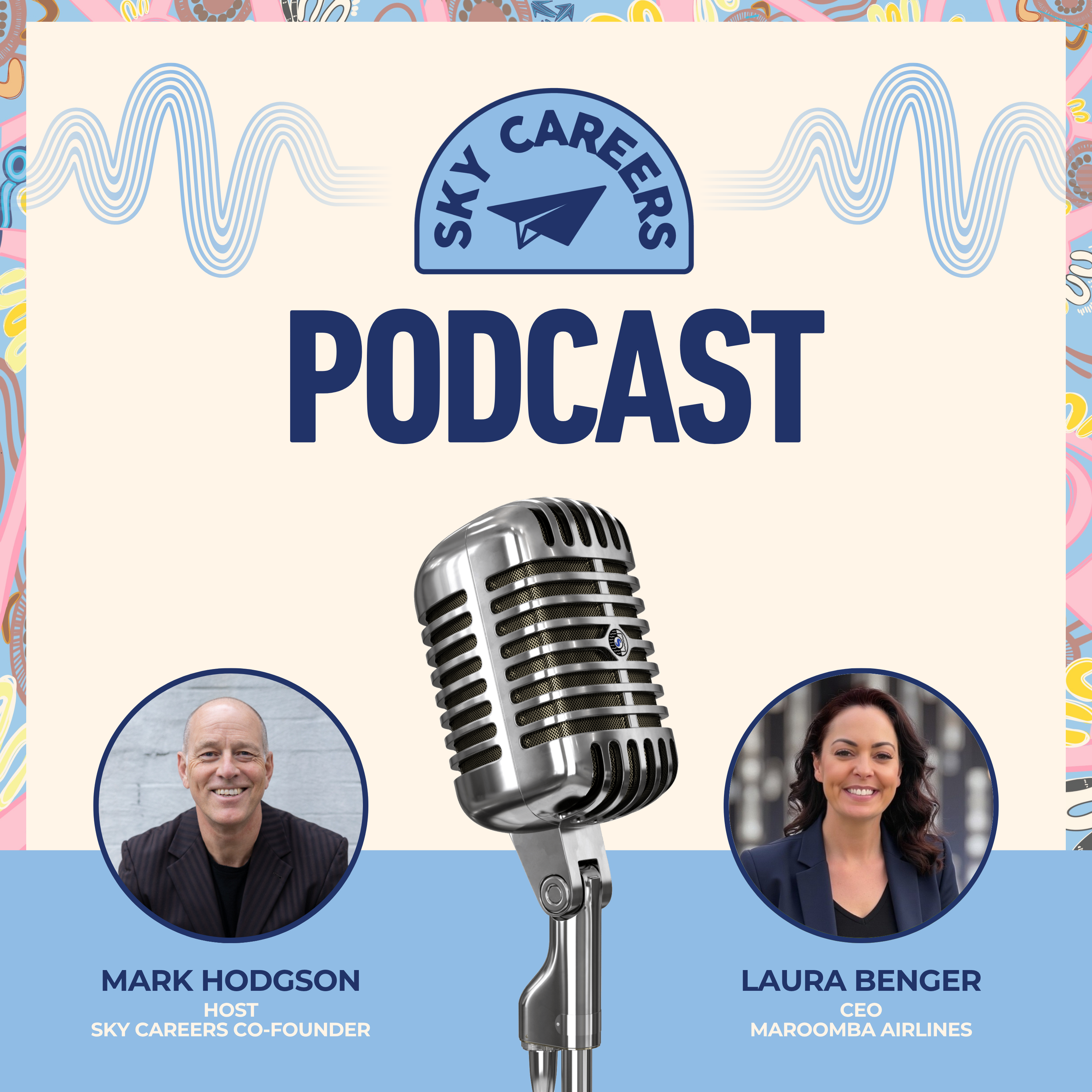
[00:00:08] Speaker B: Welcome to this edition of the Sky Careers podcast. My name's Mark Hodgson, I'm a co founder of Sky Careers and it's my pleasure to be your host. Today we've got a very interesting guest. Laura Benger is the CEO of Maroomba Airlines in wa.
She's relatively new to aviation. We're going to explore that in our conversation. But for now, welcome Laura. Welcome to the Sky Careers podcast.
[00:00:36] Speaker A: Mark. Thank you for having me. Pleasure to be here.
[00:00:38] Speaker B: Right, so tell me, because a lot of people probably won't know about Maroomba Airways, so tell me a little bit about a snapshot of your role as the CEO.
[00:00:48] Speaker A: Yeah, so Maroonba Airlines has been around for 41 years. This year we operate based in Perth predominantly, but we've flown interstate as well.
We have been working predominantly in the charter airline space where we do mostly mining customers, but we work with government customers, sporting organisations, community based organisations and anybody really that wants a high quality charter flight.
[00:01:15] Speaker B: Sounds good. And give us a flavour of some of the kind of airports you would fly from and to.
[00:01:22] Speaker A: Yes, so we're flying to a lot of mine sites, so direct into mine sites, which is really fantastic for those customers. We're flying regionally all over the place, you know, from the Southwest in Albany over to Kalgoorlie up to north into the Pilbara regions, Onslow, Karratha. Yeah. So anywhere really our customers want to go. As long as we can get an aircraft on that strip, we'll be going there.
[00:01:46] Speaker B: Sounds fantastic. And just tell us a little bit about your fleet. What's your fleet, how many and what type?
[00:01:51] Speaker A: Yeah, so growing fleet, we are big fans of the Dash 8, so we've 5, 3 hundreds, we've got 1100 and we're bringing in some Dash 84 hundreds into the fleet and potentially looking at larger aircraft.
[00:02:05] Speaker B: Fantast.
What I hear with my leadership ear attuned, Laura, is I hear a CEO growing a business, am I right?
[00:02:14] Speaker A: We are growing a business, yes. It's a very exciting time for the business and look, we're here to tailor our business to our customers. Our customers are telling us what they need to run their operations and we're aligning to meet that need. We operate with amazing partner airlines as well, which gives us fleet flexibility from nine seaters all the way through to 180 plus seat aircraft. So you've asked me what our fleet is, but we've got that full flexibility and we manage all of that in house through our amazing, amazing operations team.
[00:02:44] Speaker B: Well, sounds like the kind of thing that just does itself. Or am I a little bit wrong?
[00:02:48] Speaker A: It doesn't just happen on its own. There's a lot of amazing people working behind the scenes to keep this running. Look, one of the other fantastic things we do as well is we run our own in house maintenance team, which actually we support other customers as well externally. So we have amazing reliability because we've got those engineers on hand who are dedicated to delivering, delivering for our fleet, which is so fantastic.
[00:03:11] Speaker B: We might talk about that because I know one of the things we've spoken about regularly on the Sky Careers podcast is the demand for aircraft maintenance engineers and licensed aircraft maintenance engineers to keep aviation moving.
So you're obviously covering a lot of things. How big's your team in total? How many staff?
[00:03:29] Speaker A: We're just sub 100 at the moment and rapidly growing.
[00:03:33] Speaker B: Wow, that's a lot of moving parts. So tell me, Laura, what does a typical day in the life of Laura
[00:03:41] Speaker A: Benger look like day for me? Well, I never know, that's the thing. So I do have a calendar that's set up with all the things I'm supposed to be doing and then obviously we have to do those. But look, I like to come into work, check what is on the agenda for the day. For me it's people. And customers always come first. So any routines that I've got in place with my customers are going to be top priority. Phone calls from my customers are going to be top priority. But the rest of the customers are the people that I work.
You know, I'm the CEO. So if we look at the servant leadership model, everyone's my customer. So I'll try to walk the floor as much as I can, get out in the hangar, walk around the facility, check the vibe, see how everyone's doing.
And that's a really important part of my role. And then it's trying to get through the emails, obviously customer emails, working through contract negotiations. We are working with all our external stakeholders, dealing with other airports.
Yeah. Maintenance breakdowns, all of those things. And trying to help out other operators when they've got breakdowns. And yeah, try to help the aviation community where we can.
[00:04:48] Speaker B: Because what goes around comes around, right?
[00:04:50] Speaker A: 100% it does, yeah.
[00:04:53] Speaker B: And with your.
I've asked you how many customers? So how many customers you have, roughly?
[00:05:02] Speaker A: Customers. At the moment we've got nine big major customers that we work with, but we have a lot of regular customers that work with us. We call it on an ad hoc basis, but you know, we build relationships. So our Business model is based on a partnership model. We really, really value our customers. They're long term relationships for us. So we're here for them when they need us and we're here to expand and contract with their operations as needed as well. And that's how we get such a long standing customer loyalty.
[00:05:31] Speaker B: Because that's, that's a very different model, isn't it? To probably most, to, to the, I guess the airlines that most people, listeners would think of. Obviously people fly from A to B or B to C. And whilst if tourism to a certain area increases, more services will be put on and vice versa, you're much more attuned to the specific needs of a specific business, aren't you? In specific operations and specific sites.
[00:05:56] Speaker A: Absolutely. We are an extension of the mining supply chain, predominantly in our work.
So we are flying these people who are going to work every week. We get to know them.
We're building a relationship not only with the companies but with the passengers that we're flying.
So it's quite a unique undertaking and it's not that transactional interaction that you may see in other airlines or other operators. So that's something we really pride ourselves on. And yeah, we want to be a part of their business. And we do have some, I won't name customer names but we do have some that have given us combined names, you know, Marumba X and you know, they see us as part of their team as well. Our operations teams are embedded with our operations team. So it's quite special.
[00:06:43] Speaker B: I love it and I love, I love that mining supply chain.
It makes, it makes a lot of, a lot of sense. And one of the things I, because like you, I'm not, I'm not an expert in aviation, I'm familiar with it, but I don't have a deep. I worked in it for 30, 40 years and I always say it's, it's sort of logistics with wings.
[00:07:04] Speaker A: Yes.
[00:07:04] Speaker B: And you know, when you think of it that way, there are just, I think when we, especially when we talk about the vast array of roles that exist in aviation which is really the focus for sky careers, that's when people say, oh, okay, so it's just more. There's more than a pilot and a cabin crew. Yeah, there's tens of different jobs.
[00:07:24] Speaker A: Yeah, it's a whole ecosystem.
[00:07:26] Speaker B: A whole ecosystem. Yeah, it's cool. So tell me in that very busy day of yours, what's the bit you most enjoy about your role?
[00:07:34] Speaker A: The bit I most enjoy. I do love the variability of the role.
Like I Said, no day is the same.
Sometimes that can have its challenges as well. But look, I just want people to come to work and love what they do, which is so easy to see in aviation because everyone is so passionate about what they do.
I want people to be themselves at work, have a laugh, enjoy themselves. And I get a lot of joy from walking around and seeing people doing their very best with pride, delivering for our customers and feel like they're part of something bigger. You know, we're building something bigger here. It's a purpose driven business and that's what gives me the satisfaction.
[00:08:12] Speaker B: I love that, I love that. And you know the next question, what's the toughest bit?
[00:08:17] Speaker A: Toughest bit. I would say also the people side as well, because when you're running a business, you've got to hold the business standards that are required. You know, we're a high performing business. We have high safety, we have high, high on time performance, high reliability.
And that's not for everyone.
We need people who are willing to stretch themselves, grow, think differently, challenge themselves.
And there's amazing, amazing people that are drawn to that and we want their ideas, we want to know how we can solve problems and do things differently. The challenge is getting everyone there as well, taking them on the journey.
And people are human, you can't control that. And it's working with people, people to coach them and support them and provide them with the training and that's so, so rewarding. But it comes with its challenges as well. So I think that's probably. Yeah, the light and the dark, I guess of the same.
Yeah, the same thing, yeah.
[00:09:17] Speaker B: No, I get we might have a separate conversation. Go much deeper into that by 100%.
So let's go back in time. Laura, you're clearly a very successful CEO and if people want to look, jump onto your LinkedIn profile, they'll see a track record of you leading and transforming not just several businesses, but businesses in several sectors. So there's clearly something quite a lot to you, but let's go back to it.
Let's go back to a younger version of Laura and what were you like at school and what did you think you'd end up doing? Did you think you were going to be the CEO of an airline?
[00:10:02] Speaker A: Never in my life did I think I'd be the CEO of an airline. And I still can't believe sometimes that I am. So it's quite funny when it comes comes out of my mouth. I still catch myself. Look at school, I was very scholarly. I really, really love school and Always have loved learning. So a little bit nerdy, I would say.
Yep. I was in academic extension programs all the way through school, so I had the fortunate opportunity to do that because I didn't realise it at the time, but you get stretched and pushed in ways that you don't really know. So I had a sort of a special class that I was in. It was 30 of us that went all the way through prim and then I had the privilege of being in that again in a high school space. So I did get challenged and pushed, I guess, which helps drive problem solving and out of the box thinking and.
[00:10:52] Speaker B: Sorry, is this in WA or is this somewhere else?
[00:10:54] Speaker A: This was in WA and in Queensland. So I did move. I went to eight different schools, so I did move around quite a lot and I think that's also given me a bit of a worldly experience. I was born in the uk, so that's a whole other thing. Moved here to Australia when I was seven.
[00:11:08] Speaker B: No, no, no. I like you even more. You've got royal blood, like me.
[00:11:12] Speaker A: Oh, I don't know. I'm from the Midlands, so I don't know how royal that is.
[00:11:16] Speaker B: You're a Northerner. No, no, no. You haven't got.
Your royal blood's not as good as my royal blood.
What was your.
So, look, you clearly studied and I assume you went. Well, I'm guessing you went on to do it to university. Would I be right?
[00:11:34] Speaker A: Yes. So I was the first person in my entire family to go to university and that's my extended family as well. So that was a big achievement in itself. So.
And then let alone being the first female, so that was a first female to finish high school as well, which also was pretty, pretty cool.
So I felt like I had sort of big shoulders. I had to carry the weight of a family through that. But, yeah, went to uni, had no idea what I was doing because no one had ever been before. So I had to kind of figure out how all that worked.
And, yeah, I studied a Bachelor of Science in Human Biology. I wanted to be a medical doctor originally, so went on a track to do that.
And partway through that, I fell in love with a discipline called cytogenetics. So that is the Cyto means cell genetics. Genetics. So cell genetics, which is chromosome analysis.
So I did a research project on fragile X syndrome in my final year of uni and spent a lot of time in the lab and was offered a job at the end of my degree. So that was probably one of the greatest days of My life at the time, it felt better than winning the lotto. I think I described it as. Because it was a dream to get my first professional role. And I stayed in that role for about five years, honing my skills as a cytogeneticist.
[00:13:04] Speaker B: What does a.
For the layperson, what is the cyber? So what's the output of a cyber geneticist?
[00:13:14] Speaker A: Yeah, so we're helping lots and lots of people who come through. So when you have a blood test, people going through fertility treatment, we would be testing their chromosomes, we would be helping babies in utero, so amniocentesis, so testing babies to see if they're okay. We did leukaemia. So everyone going through leukaemia treatment, treatment would be testing their bone marrow and a whole host of other tissues, so helping towards a medical diagnosis, which helps provide part of the picture and hopefully their positive prognosis and recovery.
[00:13:49] Speaker B: That is very special work. Now, part of my job as the host of the podcast is to join some dots, and usually that's straightforward. Now, for you, you've got to take Laura, you've got to take us from what you just talked about, cyber genetics to aviation. How did aviation come into your life?
What were the stepping stones? From working in a lab?
[00:14:15] Speaker A: Yeah, exactly. Yeah.
[00:14:16] Speaker B: How do you go from a lab to then starting to get into business?
Business leadership and ship and business transformation and ultimately to. To. To grow it. To growing an airline. That's. There's. There's a few. There's a few leaps. I'm fascinated.
[00:14:30] Speaker A: There are a few. And I sometimes have to look back and reverse engineer my career so I can see how I got.
But look, it makes sense when you walk through it. So I went from on the bench in the lab into a quality management role. So I spent a lot of time in the quality management space. And from going into a lab, into quality management, I was able to then go into manufacturing quality management.
So I did cell therapy. So that was cartilage autologous chondrocytes. So cartilage cells in knee replacement therapies. So live cells growing those and then moved into medical device manufacturing. So contact lenses and things like that. So the quality management system isn't a huge leap from the lab. And then what I started to learn is that every quality management system in any industry is basically the same thing. So when I got to aviation, I was like, I know this. This is exactly the same as every other industry. We just call it something special. In every industry, everywhere you go, everyone thinks it's special and unique, but it's actually the same thing. It's all built on an ISO 9001 QMS, which aviation appears to be very similar. It's got its nuances, of course, which I must learn with every industry, but I'd say it's about 70% the same. So the quality management side has allowed me to sort of travel between industries and then I did a Master of Business and I did a degree in psychology as well. So on top of my original degree. So that's then driven me more into the leadership space. So I really, I rose through the ranks into a leadership role and understood to get the best performance out of organisations was to work with the people and drive the best performance in those individuals. So I've done a lot of leadership coaching as the coach and mentoring and then I started getting drawn into transformation projects and was the person that they would put forward. We need to change this. We need to go from here to here. Let's put Laura into that. And I knew how to take people on a journey. I learned how to take people on a journey and get them to be part of something. So when you've got amazing people working together on one purpose, you can do anything. And that kind of became my niche and that's how I ended up in aviation, is because it was just another place where the directors of the board of Murumbrila Airlines had that vision and I'm trying to execute their vision.
[00:17:06] Speaker B: All right, I'm going to try and put there. There's a few more than a few strands to pull on there, Laura, so let me, let me have it, let me have a go. So, one.
So for anyone listening to this, we obviously typically talk to people already in aviation and how they got into aviation, but I think the thing that I'd like to emphasize from, from, from what you're saying, Laura, is two things. The.
The first thing is a mindset and an attitude to work hard and to be curious about what's possible. So you could have stayed in one lanes in genetics, for example, but you grew and were curious and kept looking around, you kept working, kept getting qualified.
So I think that's important.
The second thing, which was a thing we talk about a lot in aviation, is the fact you have been able to move and jump into multiple different roles.
In your, in your case, it's, it's, it's moving from industry, from across multiple industries. But in aviation careers, there's lots of opportunities within the broader aviation sort of, sort of industry to do lots of different jobs. And we hear about that a lot. So I'm trying to pull that together for listeners though. So whilst Laura, whilst you're not a, you know, a 30 year aviation sort of old timer as it were, your journey to where you are today and talking to us specifically about aviation actually has a lot of parallels with a lot of the other people we have on the Sky Careers podcast. So I think that if people can take something, the relatability out of that, I think it's important.
That's a statement, not a question.
I guess the question is now you've come into aviation or what do you think the skills or experience you've had from before that are, that are best equipping you to, to tackle and. Yeah, but to tackle the role of Marumba. And also I think it's an interesting and probably a, I'm guessing here, I could be wrong.
Quite a, quite, quite a left field hire for the owners of Maroonba to bring in.
[00:19:18] Speaker A: Absolutely.
[00:19:18] Speaker B: Who isn't a 30 year, you know, aviation career expert. So I think, I think that both those things are really interesting.
[00:19:25] Speaker A: Yeah, look, I think some of the skills that I bought in to try and change the way we look at things is I understand the mining space. Having grown up in mining towns all over the country, I was working at a large mining organization, Tier 1, prior to joining Maroomba. So I think understanding our customers and in any industry it's understanding people who are our customers, what do they need from us as a business and what are those key things that are most important to them? Those are transferable skills across any business. So stakeholder engagement and understanding who your stakeholders are. And you know, in aviation, that's our customers, that's our regulators, that's our people that work in our teams.
There's so many people in that ecosystem. So understanding who they are and what they need from you, I think as well, project management is a really transferable skill across all industries. Across all industries. You know, we've brought two aircraft into service since I've been here and we've got another couple at least on the way in the next six months.
So using those transferable skills. No, I've never bought an aircraft into service in my life, but 70% of that again, I know that stuff. It's project management, it's stakeholder engagement, it's people management.
What do we need? When do we need it? Where do we need it? Have we done it? What's the next thing? Moving through those project execution milestones and leadership is transferable because at the end of the day, people are people.
Every industry has nuances, but I've worked in hospital environment. I can say aviation reminds me of that. It's very similar in a lot of ways, in the way the relationships between pilots and cabin crew reminds me of doctors and nurses.
Yeah. And the hospital's a big ecosystem with all the moving parts that work together. So is an airport.
Yeah, it's very similar parallels. So, yeah, for me, it all centers around people skills, understanding people and helping drive the best outcomes out of your people.
[00:21:30] Speaker B: So it makes perfect sense to you, Laura?
[00:21:33] Speaker A: Yeah, it does to me.
I don't know which industry I'll be in in the future.
And I just think, yeah, it's all the same, really. People are people.
[00:21:44] Speaker B: What's the vision for Maroomba? What's the ambition?
[00:21:46] Speaker A: The ambition for Maroomba is to be the number one charter airline in the country. Simple.
For us, that's defined by the viewpoint of our customers and the viewpoint of our people. Again, it comes to customers and people.
So, look, I'm not going to give away all of our commercial secrets. We've got some very exciting things on the horizon. But at the end of the day, we want our customers, customers to be proud that they're flying with us, and we want our people to be proud that they're working for us.
[00:22:15] Speaker B: Love that.
As we've touched on, Maroonba would not be familiar for many listeners to the podcast, but many of you would be familiar with Qantas, for example.
[00:22:27] Speaker A: Yes.
[00:22:27] Speaker B: And Qantas started out as a small regional airline out of Queensland, I believe.
[00:22:31] Speaker A: Well, there you go. I don't know if we've got the same ambitions as Qantas, but I'll give
[00:22:36] Speaker B: that one to the board. I'm not saying that, but it's always interesting when people. People forget that even. Even large national and international business, they all started somewhere.
They all started somewhere. So I love that ambition.
What advice, Laura, would you give to someone who's interested in aviation but doesn't see a clear pathway? Because you are the poster child of someone who's ended up in aviation. And you've explained all the transferable skills and you've explained both the technical skills like project management and quality control and logistics and similarity and the fact that mining is a parallel and another part, the same conversation, as it were. But mostly you talked about people, which I think is really important.
So what advice would you give to other people about, I guess, why should they consider a career in aviation?
[00:23:43] Speaker A: I think a career in aviation provides unique environment where no two days are the same and I hear a lot of people say that, but it's really true.
It allows you to problem solve constantly. So I think if people are interested in a steady state role, then perhaps not aviation. Look, there's elements of routine, like with any role, but aviation is a dynamic industry, it's an exciting industry. There's something, there's a challenge in the way every minute of every day. And that is very exciting because when you start to see the teams pull together and work through challenges and be successful, it's just so powerful and it's just really exciting to be part of.
There's people in this industry that are extremely passionate.
They were born for this industry and it's so that's one of the really cool and unique things is working with people that since they were three years old, they wanted to work in aviation and they knew that. Dead set. You know, you don't see that in many industries and I think that's very, very special. And to be around that passion is a privilege.
Absolutely.
[00:24:56] Speaker B: Yeah. I love that there is. Yeah. An aviation. You know, we talk about this like Scott, it's sexy, right? It's an interesting, you know, people.
[00:25:04] Speaker A: It's cool. Yeah.
[00:25:06] Speaker B: However, however many aircraft you've seen and you run it. Yeah. Around an airfield, you see a helicopter land or an aircraft, everyone stops and has a look, even if you've seen it a thousand times, that it's super cool.
[00:25:16] Speaker A: Yeah, it's.
[00:25:17] Speaker B: It's super cool. I mean, people don't do. In the same way. They don't look at a big truck going past in the same way, do they?
[00:25:22] Speaker A: No, I don't think most people do. But planes that, you know, it inspires or people flying, it still inspires awe. I still can't figure out how it works, you know, and I've studied physics and I've studied maths and I asked the pilots and I still don't get it.
It's magic to me. I think it's magic.
[00:25:39] Speaker B: Oh, there's your code of war. It's magic to me.
What do you do when you're not.
When you're not about the three hours a day that you're not wasting sleeping. What do you do when you're not working?
[00:25:49] Speaker A: All right, my personal life. Well, married, so husband, Jo and Lily, my daughter. Hello.
So he runs his own business, so he's busy doing his thing. I'm busy running this one.
And my daughter's hit her 20s now, so she's living her life. So on a good day we get to have dinner together and Watch an episode of whatever we're watching and around that. I like to surf, I like to hike, like to holiday and hang out with my little dog.
[00:26:19] Speaker B: What's your dog called? Come on.
[00:26:21] Speaker A: Harry.
[00:26:22] Speaker B: Harry.
[00:26:22] Speaker A: Yeah, Harry. Yep. He's just turned 16, going on 17. There's a song about that.
And he's still chugging along.
Yep, he's our little mate.
[00:26:34] Speaker B: Long may he continue to continue to do so.
Just one last question.
No, it's a penultimate question.
The genesis of Sky Careers is about specifically increasing the participation of women in the aviation industry.
You know, you're in the aviation industry and you're a woman. What's been your experience of that?
[00:26:57] Speaker A: Well, I'll give you the PC version. There's been a challenge I've had at times and look, this is in any industry and I don't like to split out men and women, you know, because at the end of the day, I'm a big believer in best person for the job. And I've built my career on being the best I can be. And if I need to do better, I will learn more, I will work harder. So I think I've been lucky in my career, career in general, that I've earned the jobs that I've got and no one's given me a free ride, so. And that has been the same coming into aviation. I've earned my position here and no one's given me a free ride and I need to continue to earn my position here. I think what has been challenging in coming in is I've felt and experienced some very, I would call, strange behaviours and almost visceral responses at times when with people almost saying, you know, or not almost saying, actually saying, you know, you don't deserve to be here, or you're quote, unquote, not from aviation, so I don't get to have a say or what would I know? And these are all true things that have been said to me.
So it's interesting. If people are saying that to people in my position, particularly when I'm, you know, leading, what are they saying to people in all the levels of the business?
And I don't mean Maroonba, I mean the industry.
So I feel then I've got a responsibility as a leader in the privileged position that I'm in, to try and do something about that? Because if people are going to say that to my face, then I'm going to try and stop that being done to other people. I can take it, I don't care. I've got my background, I know who I am, I know my credentials, I know what I can do. But I'm certainly not going to allow and stand by and let someone else be spoken to like that. So I'm trying to find my place in the industry where I can make that change and have the courage to stand up and try to leave it a little bit better than I found it.
[00:28:55] Speaker B: That's great.
And then the follow up question, what advice would you give to other women in the industry?
Sorry, Just because we've had a lot of them, we've had a lot of conversation with people on the Sky Careers podcast and I just get such great advice.
And we interview a lot of women who. Helicopter pilots or their air traffic controllers or their licensed aircraft maintenance engine licensed aircraft maintenance engineers or they're. Yeah, they're running the marketing department or they're doing operations in. I mean, there's so many cool roles. And one thing I love, one things I love about aviation is I can't. Almost without exception, there are, there are almost no jobs that can't physically because most of the jobs are not, not massively physically, if you know what I mean. They don't require sort of a, you know, you better deadlift 150kg. So almost all of the, all the, all the jobs can be done equally well by men and women. So it's, it's, it's very, it's very egalitarian in that sense.
[00:29:58] Speaker A: Look, I think it was a challenge anyway in getting women into a lot of technical roles. And, you know, whether that's a lack of interest, I think that's kind of been the dogma. I actually don't think there is a lack of interest. I think sometimes it's just not on people's radars. From a society in which the way we operate, you know, there's gender roles and if we put those in from thinking in young people, then they grow up thinking, maybe that's not for me. And I think that's what Sky Careers is doing really well is saying, well, this is for everyone. You can choose from this huge range of roles that you just didn't know existed and you're raising awareness of that.
So my advice for women coming into aviation is just go for it first of all, have the courage, try something new.
Because, you know, if you've got the courage to do that, then you're miles ahead of a lot of other people in the world that you know are too frightened.
Mentorship and sponsorship are crucial. I do a lot of time behind the scenes, which you don't get to see. In my day to day, I mentor a lot of people in aviation and outside of aviation. I volunteer my time to sponsor people, help them rise through the ranks when I see top talent emerging. And I will help them navigate their career and fast track them through the challenges so that they're best equipped to be successful.
Something I think is very, very important.
And we've always got to do that. And yeah, I've also started the Women in Aviation Western Australia Network, which started off as me, my EA and the HR manager going to the pub and thinking we might order a pizza and a bottle of wine and no one will come. But I think there was 28 people that actually came to that event in 2024 and it was just me trying to meet people in aviation because I'm going, hey, I'm new here. Is there anyone around? There's lots of people around. You've just got to reach out.
Yeah. If you're in a position where you can see someone that needs help or encouragement, just give it.
[00:32:09] Speaker B: Love it. Laura, that's, that's such a complete answer and it also echoes a lot of, a lot of the other answers we had from the, from, from a lot of women and also men. Because I think the, the vast majority of men, I do think a lot of the, the attitudes are age based, if I'm honest.
And I think, yeah, I think I
[00:32:30] Speaker A: couldn't comment on that, but there are some fantastic people. So I'm certainly not anti anybody. I really, really appreciate. I've been hired by a group of thought leadership males who are on the board as a 50, 50 board, males and females. But they're the thought leaders, they're the advocates for women in aviation. They're the ones actually coming to the Women in Aviation Network and a lot of the leaders across Maroomba. So, so it's about advocacy as well, you know, and that's the men in the industry who love the industry. We want this to survive. There are, we are competing against every other industry to keep people.
How do we let people in? And that's through support, advocacy, mentoring. And that's the men doing that too.
[00:33:20] Speaker B: Yeah. Love it, love it. We're in violent agreement. Hey Laura, thank you so much. You're a busy CEO, so we really appreciate your time on the Sky Cruise podcast. It's been so inspiring listening to your story and whilst you're not a long term aviation sort of long term as it were, you know this. I think you've done such a great, you've told us such a great story and I think inspired and informed a lot of listeners. So thank you so much for your time.
[00:33:49] Speaker A: You're very welcome and great questions. Thank you. Mark thanks Laura.
[00:34:00] Speaker B: Thanks for listening to the Sky Careers Podcast. If today's conversation has sparked your interest in aviation, then head over to our
[email protected] au whether you dream of flying aircraft or you're curious about the hundreds of other exciting roles that keep the aviation industry moving, Sky Careers is your gateway to discovering these opportunities.
And if you are already in the industry, check out Sky Careers Connect and Sky Careers Leadership and consider joining our online learning community.
Until next time, keep reaching for the skies.