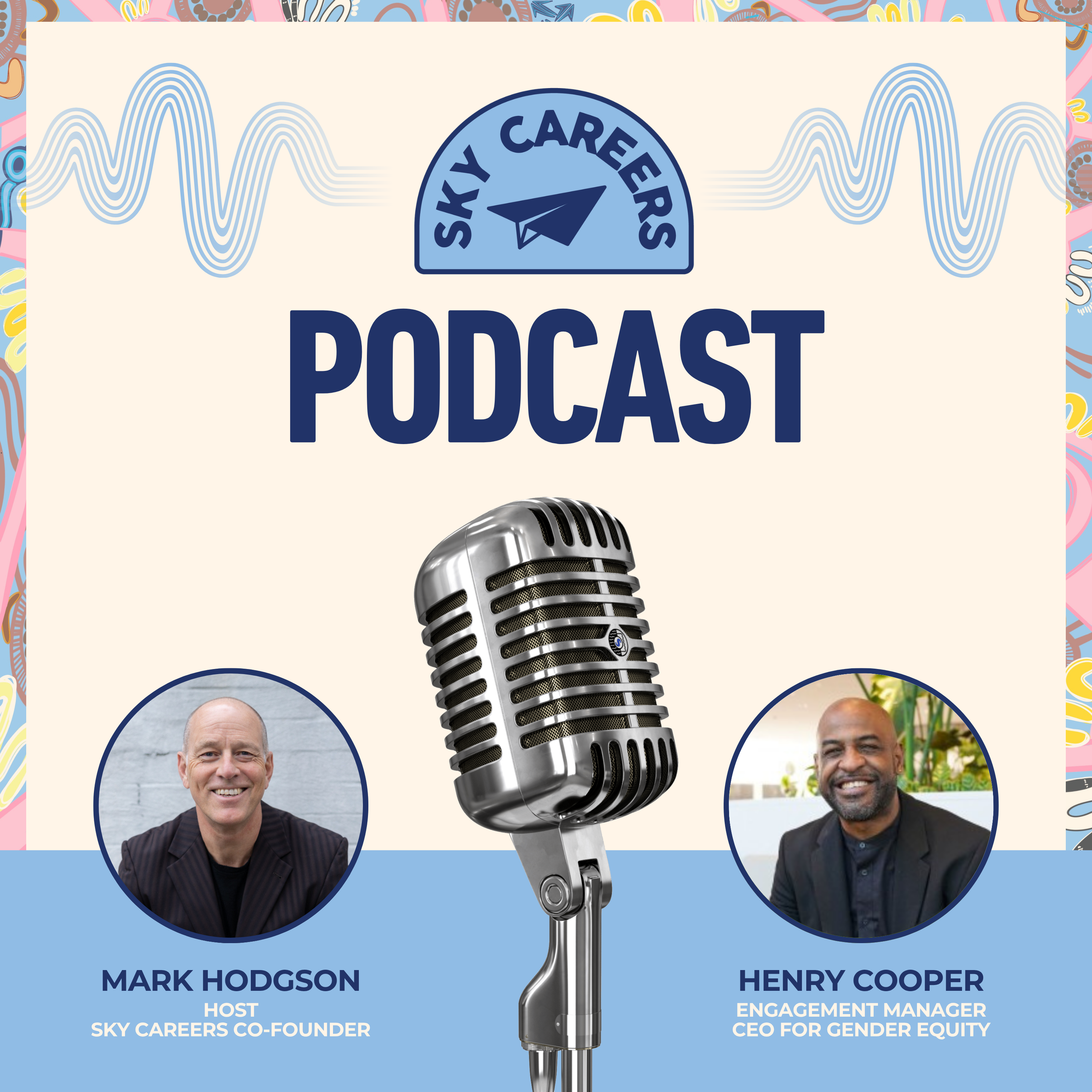
[00:00:07] Speaker A: Hi and welcome to this edition of the Sky Careers Podcast. I'm your host, Sky Careers co founder Mark Hodgson. And today we've got a slightly different episode. We have a non aviation expert, but our guest, Henry Cooper is an expert in accelerating gender equity or in our context, getting more women into aviation.
He's a friend of Sky Careers.
He is coming to us from Western Australia. He's the strategic partnerships and engagement manager at an organization called CEOs for Gender Equity. Henry, welcome to Sky Careers Podcast.
[00:00:50] Speaker B: Thank you so much, Mark, for inviting me. This is great.
[00:00:53] Speaker A: Yeah. Looking forward to our chat. Now, we always start at the beginning before we get into gender equity and getting more women and girls into the industry. Tell us about your backstory. Where did you, where did you go, where did you go to school and what were your favorite subjects?
[00:01:07] Speaker B: Yeah, where I went to school, I was in boarding school in Connecticut, an all boys school.
And I think my favorite subject was probably English, to be honest with you.
I loved poetry at that time. So we were doing a lot of Shakespeare and you know, and Chaucer and it just piqued my interest. I was really, really fascinated with words and putting words together and metaphors and similes and, and it kind of brought me into my career in music. Right after that I was working as a sound engineer and a songwriter for about nine, ten years back in New York. So yeah, that was my favorite subject.
[00:01:55] Speaker A: That's good. Well, we've got a bit of an affinity. I've got an English degree so.
[00:02:00] Speaker B: Nice.
[00:02:01] Speaker A: Neither of us are working in that area, so it just shows you degrees.
[00:02:07] Speaker B: Absolutely.
[00:02:07] Speaker A: Any interesting areas. So tell us, so tell us about. Well, you've mentioned you spent 10 years in New York in that career. How did you transition from there to life in Western Australia?
[00:02:20] Speaker B: Yeah, so at the time I met my ex wife in New York and moved here. She was a Perth girl and moved here. Migrated here about, I would say 13 years ago and I have a 11 year old daughter.
And as soon as I migrated over here, I went right into education because all of my family are educators. I worked for the city. So when I was growing up I was always saying I don't want to go into the family business. So that's why I went right into music.
But I was always gravitating to education. I was always mentoring, I was always creating after school programs for the schools that I had a good relationship with.
Summer camps, I was creating scholarships and opportunities for kids that were in my neighborhood to go to the schools that I had a really good relationship with. So it was always a part of who I was and it was kind of like fighting who I was at that point, but migrated over here and went right into education and became a EA special needs and then went into youth work for high school.
[00:03:30] Speaker A: I love that. Henry, it sounds like you spent 10 years defying gravity before it pulled you back to where you were always going.
[00:03:40] Speaker B: It's like, just look at the dedication of that.
[00:03:46] Speaker A: It's not the right forum, but I'm sure, I'm sure, I'm sure 10 years in New York has got its own.
[00:03:52] Speaker B: Some good few stories with a lifetime.
[00:03:54] Speaker A: Yeah.
Which I'd love to explore at another time. But bring us to your. Bring us, I guess, bring us to your job today. Tell us about your role today at CEOs for gender equity. Maybe, maybe the job that got you into that. And then tell us a bit about the role as you experience it today.
[00:04:13] Speaker B: Okay.
Well, the role, how I got into the role that I'm in today.
When I was in education, there were a lot of things that I really wanted to do for the students as far as social, emotional learning for all of the students.
And it was really about life skills and how to navigate life and conversations. And you know, it was when I was in that role as a youth worker, there were a lot of barriers for me to create those kinds of programs and initiatives for the students. So I was thinking, you know what, I really want to help on a larger scale. I really want to do more. So, you know, I left education and my students were, you know, they were a little upset at first because they told me, they said, well, you, you said you weren't going to leave until we were, you know, graduating. And I said, well, you know, I've always told you about progression and I've always told you about elevating and being more. And I said I would be a hypocrite if I did not do that myself, you know. So I went into an indigenous organization right after that that supported indigenous students in university and we created paid multi year internships in large corporations around Australia. So I had a little bit of knowledge around, you know, corporate and then knowledge around the university space and knowledge around the education space. And I was able to see the challenges and I was able to see the gaps that were present. And there were a lot of asks that was that I was asking for the students to have allowances. And I was just telling, talking to myself, hey, this should already be a part of business with these organizations. Why isn't this a part of business. And then the people that I had to ask, they had to ask three and four other people in order to get things across the line. So again, I was trying to progress and I wanted to help more. So I said, you know what, I got to find something that was, you know, that gets me the opportunity to influence the people that are at the top. And, you know, my CEO saw me and we had a conversation and the rest is history.
[00:06:24] Speaker A: I love it. So tell us, what does your, what is your day job do? Day to day job? So.
[00:06:29] Speaker B: So yeah,
[00:06:32] Speaker A: on a day to day basis. So it's been a long day, Henry. Mike. I don't know. I've got it, but they're not mine. No, it's.
[00:06:38] Speaker B: I'm in the exact same way. It's been a long day, I would say in my role as a strategic partnerships and engagement manager for CEOs for gender equity, my role is to speak with organizations around joining our organization and really tapping into supplying them with practical solutions to accelerating gender equity within their organization. So we said it's for men, women, and everybody in between.
It's a system that is fractured and it's broken and we need to collectively come together in order to create something that is for the people and not against the people.
So what my role is, every day is something different, but it's always engagement with our members. It is always, whether it's speaking engagements or podcasts or just spreading the message of how important accelerating gender equity is for our country, but also for society.
[00:07:33] Speaker A: Yeah, lovely. That's all.
[00:07:38] Speaker B: Just, just a little short, you know, you know, little, little summary. A short summary.
[00:07:45] Speaker A: So talk to us.
What are some of the broad, I guess, barriers or restrictions to getting us to where we need to get to at a general level? I'll get into aviation later on. But what are, what are some of the broad barriers that I guess you see from industry to industry to industry?
[00:08:05] Speaker B: I was actually thinking about this the other day because I've, over the past, probably around two months, I've been collecting a significant amount of data from senior leaders and I've spoken to probably 100 plus senior leaders over the last couple of months. And I would say there's a lot of similarities. I think organizations.
The barrier is the education side of things.
It's conflating the two terms of equality and equity and using it synonymously. It's really educating these senior leaders around what equity actually is.
And I always say, if I can get you to understand what equity is from a gender perspective, you know, inclusion and Diversity is just a byproduct of that.
So that is one of the barriers. The other barrier is this.
I think we're living in an age of instant gratification. They want everything now and not really realizing that we actually have to build the infrastructure in order to have the numbers that we're looking for.
So when we're speaking about women rep being women representation in these male dominated industries, we need to stop with the question of how do we fit women into these industries and start really saying how do we create the environments in which women can actually be supported and actually prosper?
[00:09:39] Speaker A: Yeah, that's a great differentiation. And I think it's not exactly the same point, but one of the things we found at Sky Careers, and just to remind people, the genesis of Sky Careers, we've been going a few years now, the genesis was being selected as part of a federal government program specifically designed to increase the participation of women in the aviation industry, but by the same title. So can there be similar initiatives in e.g. construction or maritime or any number of other, any other. Of transport, any number of other industries?
And one of the things we found in our relatively short time in the sector is that the initiatives tend to be too short term. You can't throw a project or a campaign or even a, an investment such as skycareers was fortunate enough to win. In fact, we've been successful in two successive tenders. But even so, even one or two years isn't enough. It needs to be a multiple, a multi consistent message and probably start small and grow gradually but steadily over time. But it is a multi year investment. It can't be done with a campaign or an awareness, this, that or the other thing, or even a couple of great events. It has to be longer term than that. And I think that's one of the things we're trying to reflect back to government in our feedback to them. And just generally these initiatives, they're great initiatives, but they've got to be funded for five years, seven years, 10 years, not one or two years because they come. And just as maybe organizations or employers or young women getting familiar and maybe starting to think about aviation, for example, then we disappear because the fungus appears and suddenly, oh, and then, you know, the inspiration expires and then, you know, it doesn't happen. You don't get the shift that you're trying to engender. So there's lots of similarities.
So Henry, thinking more specifically about aviation now, what would you think are specific barriers but also solutions to barriers that stopping more young women entering the aviation industry.
[00:12:15] Speaker B: I think one barrier is knowledge around the industry.
I think educating the educators who are the first point of contact for the students, letting them know that these areas of industry are available, and also broadening the scope of aviation representation in the schools. When you ask students, what do you think of when you think of aviation, they automatically go to pilot or air hostess. There's no other areas that they really focus on, but knowing that these other areas exist. So I think that's the first barrier that we need to get across is the education space and it's the representation of aviation.
[00:13:00] Speaker A: Yeah, I mean, one of the things we found, I mean, our initial Sky Careers program, we aimed, we sort of, we worked out, we were aiming at sort of girls and young, young women, probably from the age of 13 to 16, sort of as they were moving into that phase of starting to think about careers and actually starting to access pathways, making maybe subject decisions, studied subject decisions, and then potentially whether they go to university or they go to other places. And that's very valid. That's a really important, critical part of the pathway. But we've also realized as well that we also need to be speaking to kids in primary school, probably as young as seven or eight.
And Sue Ann Monks, who, you know, my founder, is passionate about it, she's absolutely right. And we see this again and again. Again we need to be speaking to kids and in this specific girls when they're 7, 8, 9, when they are to start, when they're starting. I guess it's more about when they're starting to imagine what their future could be.
And whilst they're not ruling stuff in probably at that age, they certainly are starting to rule stuff out.
To your point, if they're only ever told they can be carers or, or nurturers or beauticians or teachers or those things, all great things. Of course, we're not denigrating any of those things, but the other things are either actively suppressed or just never mentioned, not put into their palette of possibilities.
Then you can see that there's so much.
We're losing so many people at that early age, aren't we?
[00:14:43] Speaker B: Yeah, 100%. And another area is, you know, mature age, apprentices or trainees. It's. We're losing, we're.
We're not focusing on what we actually have in front of us and looking more towards the future than what is actually presently available right now.
So I think it's really being deliberate and intentional with creating environments, but also targeting women for these positions in these areas.
[00:15:15] Speaker A: Yeah, you Mentioned you involved in a lot of initiatives, events and campaigns to sort of shift awareness or to solve some of these issues. Can you give us some examples of what those look like and maybe how we might be able to adapt some of those specifically for aviation?
[00:15:33] Speaker B: Well, our member, one of our members, Marimba Airlines, they had a great session, a fire fire chat session on the industry and representation and equity within the industry. I think more conversations like that need to be happening and we need more young people a part of those conversations as well.
I think when we start looking at what we are building for the future, I think it would be in our best interest to actually have the younger generation at the table in that building.
But also areas like having conferences around this, speaking at conferences about this being a lot more visible in areas we all know of the problem.
But no one's really bringing the problem to the forefront. Loudly.
[00:16:32] Speaker A: Yeah, that's that. Well that's a great way. I love that term. And it's one of the things we're trying to been trying to do and I think we have done with some success at Skycriers. But it's difficult and it's expensive and getting in front of people, traveling, setting stuff up, booking exhibition space, it costs a lot of money and it is not of itself commercially viable. It does need funding, it needs sustained funding.
And you know, we seem to have a lot of, a lot of industries like aviation who bemoan the, bemoan the problem.
And I think we do know the answer to the problem. But it takes to your, to your point. It takes long term investment and patience.
It's not something you can solve quickly say with an awareness campaign or even throwing a lot of money at it for a short period of time.
An industry has to invest probably many millions of dollars year after year after year after year after year to get a presence, for example in primary schools for aviation in our instance or whatever the thing is, and you can see how that done consist over time could move the needle. So instead of having, I think we've got something like, I mean I know for pilots we've got about 5 or 6% of women in Australia. So 5, 6% of pilots in Australia are women. I'm not sure about the overall percentage in the, in the broader industry but it's, it's low but there's no reason at all that couldn't be significantly higher with, with some of the initiatives where we're talking about.
[00:18:04] Speaker B: It's, it's looking at what's been done in the male dominated industries really you see how mentorship works, you see how that works. So it's adapting those kinds of ideas and those kinds of structures into representation for women in these areas.
It's the companies that are doing it. Well, I know right off the top of my head, Electrical training group here in wa, they have a big sister program and it's really about representation of women electricians and apprentices, and they're going into mature age apprentices.
But this is what I mean by when I say creating the infrastructure and creating the foundation to actually hold the numbers that you're looking for.
They understand that they're going to need about 10, 20,000 electricians over the next 10, 15 years.
And it's. Where is that coming from? You have to invest in the pipeline and if you're not, you're not going to get the numbers that you want and it's going to be a lot more expensive later.
[00:19:20] Speaker A: Yeah. And also you can't, you can't discount over half the population from your potential recruitment.
[00:19:29] Speaker B: That's $60 billion in GDP that you're forfeiting by excluding the other half of the population. That's insane.
[00:19:39] Speaker A: And I know we're in violent agreement here, Henry.
There are so many of the rules. I mean, like electricity, almost every aviation role. I can't. There may be a couple of exceptions. Almost every aviation role is equally, you know, can be performed equally, you know, perfectly well by a female. I don't. There are hardly any restrictions, if any.
And I know electrical as well. It's, you know, it's, it's. They're, you know, it's a, it's a field where anyone, anyone can enter, but they, people are just. People either discount themselves or feel discounted at such an earlier, at such an early age. And I think the other thing which we love to talk about here is, you know, with, with. So there's so much buzz around the moment. Sorry, at the moment. Is there around AI and AI jobs being lost to AI. But I know the jobs you're talking about in electrical and certainly I know the jobs we're talking about in aviation. You know, they're, they're kind of AI, certainly largely AI proof. A lot of them, they're not going to be automated or systematized or AI'd away, if that's a word.
And they need doing and we need these young women to, to, to want to be there. And it's a great, it's a great industry, aviation. Such a, such a, such a cool industry.
Now, Henry, you've been. We've been, we violently agree with each other. We've both got English degrees, so we're like, you know, brothers from another mother kind of thing.
And you've been very generous with your time.
What would you, what advice would you give to young women and maybe even not just about young women, but also employers who are interested in encouraging more women to enter, not just aviation, but those sort of, those sort of broad, those sort of broader male dominated industries. What advice would you give to those people?
[00:21:37] Speaker B: I'd start with industry first.
I would say invest in your pipeline. And if you're worried about money, I would be more worried about talent leaving the building and not being able to retain or attract talent to the student.
A young woman that is looking at careers, I would say you are able and more than capable of being anything and everything.
See what kind of figure out what your skill set is and reach out.
LinkedIn is a very, very useful tool.
Talk to your educators around, pressing them what careers are actually out there and if you don't get the answers that you like, go search for it. Look for people in these industries. Connect with people in these industries. Female Future Female Leaders is a great, great program that links students with kind of mentors and through in industry.
[00:22:59] Speaker A: Thanks for listening to the Sky Careers Podcast.
If today's conversation has sparked your interest in aviation, then head over to our
[email protected] au.
Whether you dream of flying aircraft or you're curious about the hundreds of other exciting roles that keep the aviation industry moving, skycareers is your gateway to discovering these opportunities.
And if you are already in the industry, check out Sky Careers Connect and Sky Careers Leadership and consider joining our online learning community.
Until next time, keep reaching for the skies.