[00:00:00] Speaker A: Foreign.
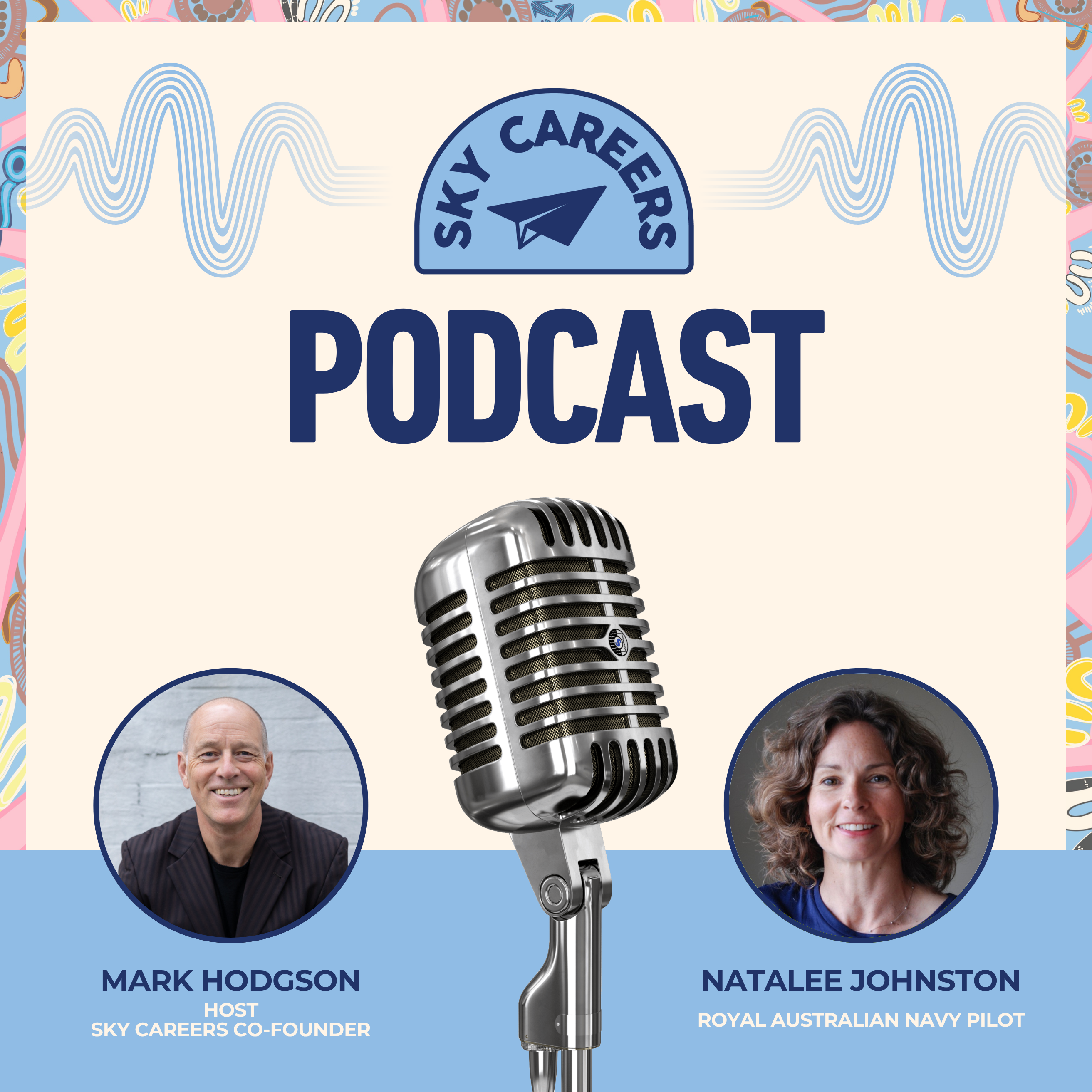
[00:00:08] Speaker B: Welcome to this edition of the Sky Careers Podcast. I'm your host, Mark Hodgson, and today it's my pleasure and privilege to introduce a very special guest, Natalie Johnston. And Natalie was the Royal Australian Navy's first female pilot. As you know, at Sky Careers, we're big advocates of increasing the participation of women in aviation. So, first female pilot in the Royal Australian Navy. That's pretty cool. Natalie is also a keynote speaker and she specializes now in reimagining, organizational culture, safety and the impact of human factors. Natalie, welcome to the Sky Careers Podcast.
[00:00:50] Speaker A: Thanks so much, Mark, for having me.
[00:00:54] Speaker B: Super looking forward to this because as we touched on just before we came on air, I'm a failed Royal Navy pilot. So, Natalie, you got a little bit further than I did. So we always like to start at the very beginning, as they say in the song.
So where did you go to school and what were your favourite subjects back in the day?
[00:01:14] Speaker A: Well, I went to school in a small country town in Western Australia called Narragan. So I used to say it's in the West Australian wheat belt until someone in South Australia pointed out that the West Australian wheat belt is the size of South Australia. So I try and narrow it down.
Now it's about 200k southeast of Perth farming community.
And everything that supports that is pretty much where I grew up. And that's where I went to high school. Naradan East Narragan Prime Narrator Primary and Naradan Senior High.
I was like, I've listened to a few of your podcasts, like many of the people that come on your podcast. A bit of a nerd.
Like I go through.
I really enjoyed maths and sciences particularly.
Loved all the things we used to be able to do, blowing things up in chemistry and understanding things about physics and electrons. And I had a very fantastic maths teacher who just made me love it. And I think he was part of what made me enjoy that part of it so much. I.
I didn't like English and I still don't. I'm still a terrible speller, but that's okay. I can get around it with good numbers.
And then I was very fortunate that there was a metalwork teacher, like a sort of the hardware teacher at school who did metal work and woodwork, who was also a very avid GA pilot, general aviation pilot. And he stole. There's a school in WA called Kent street which is renowned to be an aviation high school.
And it even was back then, back in the day when I was at school and he asked and brought in their aeronautics program. So I was fortunate enough to be one of the first couple of students to do that in my year 11 and 12. And I just found it fascinating because I found that even the theory of aeronautics and aerodynamics and aviation in general, but all those things that I love about physics and maths and all the engineering part of it all together in a nice neat bundle.
And then I was very lucky enough to get a scholarship through a long forgotten airline called Anset and the Ministry of education in WA. And I got a scholarship of $1000 to do some flying. So I was.
We got the Kent street plane down over my year 11 scholarship school holidays and I got to fly at our little Narragan field and kind of. That was the start of everything.
[00:03:51] Speaker B: Sweet. So give us a time. Just. I should have located us in time.
What kind of year is a young Natalie sort of nerding out and getting excited about aviation?
[00:04:06] Speaker A: 93. So the early 90s. So this was back when I suppose things were still very stereotypical, particularly in farming. And I thought I was. When I was little, I wanted to be a truck driver and a farmer. That was my dream.
And I was kind of contemplating eyeing off a very wealthy farmer to give myself a nice bit of land as a farmer's wife.
[00:04:31] Speaker B: That is old school, quite Victorian, in fact.
[00:04:36] Speaker A: And that was kind of where we sat, because that was kind of what everybody did around me.
And having a world open up into aviation kind of gave me new options. So my plan, I think, at the end of my year 11, was to maybe look at doing geology at uni, because I really enjoyed that part of science as well, and the natural part of the environment and how it was formed and all the intricacies and the chemistry and physics that goes into all of that.
And I was going to do that and become a flying geologist. So I figured I'd get my pilot's license, I'd fly and sell myself to the mines. That was.
[00:05:14] Speaker B: That was my flying geologist. I love that. But we did put a bit of a bit of a plot spoiler at the intro. And you, you, you found your way into the Royal Australian Navy. How did that happen?
[00:05:30] Speaker A: I think your terminology of found my way is probably fair, fairly accurate because I got that thousand dollars and my parents were very much kind of struggling farmers. We had a small farm, so it was hard to, you know, make ends meet. We didn't have many sort of, I suppose, frills and fancy things.
So my mum actually saw an ad in late January of my year 12. So just before starting year 12 for an advert to.
I didn't read the small print. It was basically, I saw the winner thousand dollars scholarship.
I'm in.
So the next minute I'm applying to the Australian Defence Horse Academy as an engineer and I just happened to be applying through navy because the navy person in defence recruiting in Perth at the time was really lovely. She was really nice, very welcoming, was very open to my parents. My mum really liked her. So I applied to that for a scholarship as an engineer to the Royal Australian Navy in beginning of my year 12.
I got through the interview stage but I didn't get the scholarship. So I was devastated.
I saw that thousand dollars slip through my hands.
But then Navy actually rang back and said, would you consider reapplying, actually applying for Defence Academy as a pilot?
And
[00:07:02] Speaker B: Sorry, just, just, just, sorry, just, just, just to interrupt you, but this is you, you're the first female pilot. So this is, this is navy. Presumably in the very first throes of saying, hey, we, we need, we need female pilots in the Royal Australian Navy.
[00:07:19] Speaker A: Yeah. So that the Air Force had only just graduated their first two very recently. So it wasn't long before that. And this was a. There was a couple first that year. It was the first year they were opening up for students to join the Defence Academy as a pilot. Prior to that year, if you wanted to be a pilot, you had to join whichever way, whether it was direct entry or Defence Academy and then go off and do your bridge watch keeping certificate, become a ship driver and then transfer to be a pilot.
Our year was the first year they actually recruited us as pilots so we knew from first day that we would go on pilots course. Yeah, yeah. And that year was the first year they had what they called open positions. So they had six positions available and two of them were open, which meant two were available from any gender.
So yeah, so I do giggle a little bit at quotas these days. And go, yeah, it's used to be the opposite way.
[00:08:24] Speaker B: We won't pick the top of that particular.
[00:08:27] Speaker A: So fortunate to get it. Sorry, go.
[00:08:31] Speaker B: No, you go. Sorry, no.
[00:08:32] Speaker A: So I was fortunate to get. So I went through the process. It was a pretty tough process to go through while I was doing my year 12 and exams and all the stuff, driving, you know, we're two and a half hours away from Perth, doing the treks up to Perth to do all the medicals and all the psych testing and all the bits and pieces that it takes to get in.
And then I finished my year 12 exams and they, I got to go to flight screening. So they flew me to Tamworth
[00:08:58] Speaker B: at
[00:08:59] Speaker A: age of just 17 and I'd never been in a big plane before, I'd never left the state before.
So it was a bit of a. And I went on my own. It was a bit. There was definitely dinner plates, eyes going on, I think, at that point.
[00:09:13] Speaker B: Wow.
Off to see the world. And then you did some kind of sort of elementary flying training or some kind of test piece, did you?
[00:09:21] Speaker A: Yeah, they did. They do it all online and electronically now. So they've obviously improved that process to be able to do the assessment beforehand. But what they did is because they weren't sending us through bridge watchkeeping certificate and stuff, first they went, you have to do flight screening. So it was two weeks where they put you through a series of flying sequences and lessons, basic flying for those two weeks. And it was a real assessment on making sure you could learn at the right rate.
Because, you know, as, you know, you could. Anyone can be a pilot, it just changes how long it might take to get there.
But within the military, obviously the time frame is very strict, so they want to make sure you can learn at the right rate. So all the Navy students went through flight screening and. Yeah, so then I got a phone call at the end of the year and got offered a position based on my uni entrance exams. If I got enough points to get in, I was in.
[00:10:25] Speaker B: Fantastic. And then did you then go, did you have to do sort of officer training in the Navy first?
[00:10:31] Speaker A: Yeah, yeah, So I did. I went through the Australian Defence Force Academy in Canberra. So I did my uni degree and did my single service training with all the other navy cadets that were there. There were six of U.S. navy pilots in our year that went through. So, yeah, it was good.
I did like adfa.
It was a great university in the fact that they ran classes with only like four of us in it, which most universities would never do, but if we wanted to do a particular subject and they offered it, they would run it for us. So. So. And we had great facilities and the friends I made on that, I'm still very good friends with a lot of them now. Still.
[00:11:12] Speaker B: That's a pretty. That's a pretty tight community. And I've talked about this a couple of times on the pod before. We've had a couple of military pilots and there's a different emphasis, isn't there? Because first and foremost, you're in the Defense Force and the aircraft helicopter or whatever is a platform for.
You have sensors or weapons or something. So you've got a. It's a different mindset, isn't it?
[00:11:41] Speaker A: Yeah. And I think. And that's it. I think they start you from day one trying to push you to be good under pressure and to have a high level of resilience and also to be able to cope with or be able to make fast decisions and good decisions and all of those sorts of things. So. And that is reiterated from day one and which is why I think there is the pressure of the timeline. They only give you a short timeline to achieve the standard that's required.
They're much better at that these days. Is it Very. Was very much. If the student couldn't get it, the student's fault. Whereas now they actually recognize the fact that a student can't get it. Potentially an instructor is actually the wrong person.
[00:12:23] Speaker B: We'll have a sidebar conversation at the same point.
I'm convinced the reason I got chopped is I had a really bad instructor at the wrong time. I genuinely am. I think a better instructor would have got me through the glitch I was stuck on and I spiraled and I really shouldn't have done. It's interesting looking it back now. Anyway, let's not go there.
It's still quite a point of frustration for Mark.
So let's fast forward. You went through. So you passed out as a Royal Australian Navy officer and you went through the training and then. And you got your wings and then you were deployed, I assume.
[00:13:02] Speaker A: Yeah, so I got my wings. It was back then we were still ADF Helicopter school, so army and Navy joint school out of Canberra.
It was a bit weird because then that dispersed and now it's back again but just in a different location as, you know, defense usually do come around in circles and so yeah, so I got my wings out of there and then ended up. And then went back to Navy just to learn how to be a navy pilot and operate with crews and all those sorts of things. And then. Yeah, my first operational flying type was the Sea King.
My first real tasking was the Sydney Olympics. We did security for Sydney Olympics. So that was quite fun being able to fly over places in Sydney we're not normally allowed to fly over.
[00:13:45] Speaker B: Very cool.
[00:13:46] Speaker A: Yeah. So it was pretty amazing. We got to do that and then. Yeah. And then just randomly did different trips to sea and stuff as a junior pilot, mostly as a co pilot initially. And then I push pretty hard to get my captaincy and move up on that point. And then.
Yeah. And then fast forward a few years. I had some really good. I think One of my favorite trips as a aircraft captain and first pilot and then I was the operations officer. So I wasn't the commander of the flight, but I was as kind of second person down and basically the aircraft captain. So the aircraft was mine.
I was probably only, I think, must have been about 26, 25, 26. So. Which is quite fun to be able to sign for and have an aircraft to do what you want with. We got deployed to Christmas island for three months. So the ships that were up there on station were too small to house our aircraft. So we lived on the island. So that was fun.
[00:14:48] Speaker B: The horror, the horror of not being on a ship.
[00:14:52] Speaker A: We were watching. We'd sit and have dinner at the restaurant or at the bar, at the local bar, pub and watch the ship we should be on sail past and just wait.
So that was great. It was amazing experience. I learned so much.
I got to kind of develop and find, I suppose, leadership in that space to support the black commander. And also because when you're airborne, the flight commander was no longer. Although he directed and controlled the mission and dictated kind of where that the aircraft and the safety of that and how it operated and how it functioned was my responsibility.
So to have that kind of responsibility at such a young age was pretty amazing.
[00:15:36] Speaker B: Yeah, it's that idea of captaincy. Yes.
[00:15:39] Speaker A: Yeah, exactly.
[00:15:41] Speaker B: Yeah.
[00:15:42] Speaker A: And then when I got back from that, I just constantly. I. I found I wanted to do the next thing, which was be a flight commander myself. So I was still quite junior in ranks. I was still. I was a lieutenant and not in the zone for promotion. So you had to do. I think it was five or six years as a lieutenant before you're allowed to be promoted to a lieutenant commander. And I wasn't even close to that yet.
But I wanted to be a flight commander. So I just every day went into my boss's office at least once or twice a day and asked if I could be a flight commander.
He gave in eventually.
[00:16:16] Speaker B: Well, I love. It's. It's interesting. We picked up on this quite a. Quite often. Yeah, the, the. I mean, not, not just the squeaky wheel, but, but I, I think the. Be. Be proactive in seeking, whether it's in military flying or any other flying or even in any other aviation career. It just get on the front foot and show up and be keen or, or be persistent and, and resilient. When they keep saying, no, don' and just keep trying. That's. But that's been such a recurring theme of all the various people we've spoken to on the Sky Careers podcast.
[00:16:50] Speaker A: Yeah, I think it's that thing that when, you know, and I jokingly say it like that, but you know, and I went in and he'd say, no, you can't. I go, well, what do you want me to do? What do I have to do to make it possible?
And so I, you know, I'd put my hand up for every Friday afternoon test flight. I'd put my hand up for any operation. If there was something short notice happening, I'd put my hand up. I'd, you know, I diligently work to try and prove that I could do it. And every day I'd go in and say, what do you need me to do? What can I do?
And yeah, and he did, he did say, okay, yes, you can be a flight commander. But because I was quite junior and they hadn't had it, they were looking at potentially developing a flight commander's course to enable people to be, I suppose, better prepared for that role as the demographic of the Air Fleet Air arm was changing. So, yes, I was one of the first flight commanders courses because they went, oh God, we better do something.
And so I got authorized as that. And then off I went to sea as a flight commander. So I had an aircraft people maintenance team that was mine.
[00:17:53] Speaker B: That sounds fantastic. How long were you in the navy for?
[00:17:57] Speaker A: I did 24 years in the full time Navy and I've done a few years reserve post that just kind of doing odd jobs here and there.
[00:18:06] Speaker B: Wow, that's amazing. Have you obviously went on to do lots of different things. What was your, what was your, what was your, what was your favorite sort of period?
[00:18:16] Speaker A: I think my favorite period was, I'd probably say those two was my doing instructors course. I got to actually come over to the UK and do it at Shawbury or went to Shawbury in Shrewsbury. So I went to do that with the Royal Navy, which is where I met my now husband.
So it was, it was a great course. They were exceptional in how they taught it and what we got to do was really good and, and then probably my favorite time was coming back to 723 Squadron and training my first students.
You know, it's funny that people say like, oh, shouldn't it be some amazing, you know, overseas trip or something like that? I said, well, no, but just taking a student from.
Yes, they knew how to fly a plane but not being able to hover, not understanding anything about helicopters. And it is a different skill set and changing that and then turning them out and putting Them out at the end as competent aircraft captains in a crewed environment, in a helicopter, in dynamic. To make those decisions is pretty amazing to see that transition of the students over a short period of time.
So yeah, I probably enjoyed that. And then going on from that was when I went back then to Sea Kings and become the training officer.
I was there flying that. I did get to do my.
My last big operational trip away to Indonesia. I was flight commander for two aircraft. I had to train the pilots along the way. So we hadn't. They hadn't finished their training. So we did that on the way to a short notice trip post earthquake in Indonesia and went over.
So that was pretty really fulfilling.
[00:19:54] Speaker B: Sounds amazing. And of course tracking through all of that.
Natalie was the first female or one of the first females tracking through all that.
How did. What was your experience of that? Because as you would know and we talk about it reasonably often here. There's the.
It was and still to an extent is very much a male dominated industry. What was your experience of that?
[00:20:21] Speaker A: I think at the time I actually was of the opinion and I think potentially it might have come from. Because I grew up in the country and I always was competing against the boys for anything for all this stuff. My dad just had two daughters so we did everything. So there was no, there was no thought in our family that gender had a role in what you could or could not do. So I think because I came with that attitude initially, when I initially started I was very much like, I don't understand what the big deal is. I just go to a different bathroom and I think that.
[00:20:57] Speaker B: I love that. I just go to a different bath. That's very.
[00:21:00] Speaker A: Yeah, so. And I didn't, you know, and it was the first time, you know, when you're in the military and there's not many women around, you don't have to queue for the ladies. There's a massive queue out the gents because there's a hundred of them and there's only 10 of you. So it's nice.
But.
But I look at that and then I do. There were instances that I got shocked out of that when people were like, I don't want you on my pilot's course because girls are bad luck and you guys are terrible and you shouldn't even be there like.
[00:21:28] Speaker B: And I.
[00:21:29] Speaker A: And I get comments like that and I got comments like that from some of the older senior sailors as well. That and it was along the lines of rans. So the old Women's Royal Australian Navy shouldn't be Allowed in the permanent force and you should not be allowed near an aircraft.
So. And it wasn't just me, there were maintenance women in the maintenance world facing that as well, so.
But I think as I went because.
Because of my background and because my mum and dad taught me to, I suppose a combination of give as good as I could get and don't put up with it, they were a great support when things didn't go well and I was finding it tough, even though I don't think they fully understood what was going on.
And I think there was a level of. I mean, now they call it perseverance. Back then I was just probably stubborn, very stubborn, and I would not give in.
And I look back at it and think, actually there was a lot in the early years that was a level of survival.
So I just kept my head down.
I just tried to blend in as much as possible.
I didn't try and rock the boat.
I always tried to keep my hair up or I had it short or whatever, just to not stand out, to try and just be one of the boys to survive.
Because if I could blend in, then I wasn't different and I couldn't be picked on. Just the standard. The standard one. When you're in the minority, I think in any minority, that whether you think differently, look differently at a different gender, different religion or whatever, sometimes you just.
And I know. And these days it's different. I think the benefit a lot of the women have got these days is they.
Some things may not have changed, but the big difference is, is now they have a voice.
[00:23:16] Speaker B: Yes.
[00:23:16] Speaker A: And people do often listen. I don't say not always, but they do often listen and they're allowed to have a voice. Whereas back in our. I think in that time is. I never wanted to shout anything out because of the potential repercussions of doing that would have on me, and then how much harder it might make it for me over the next X number of years or whatever.
Yeah, so, yeah, so it was interesting. There was. There were good bits and bad bits, as you know. And I think with hindsight, I look back and go, some of that was really not good, particularly by today's standards.
But I do look at it, you know, it was.
And it's not an excuse, but society was different in the late 90s, early 2000s, and it was.
[00:23:58] Speaker B: It was.
[00:23:58] Speaker A: And so, yeah, so a lot of the guys around were products of the society we were in.
[00:24:04] Speaker B: Yeah, yeah.
So you got to your end of your Navy career. What locate us in time. When was that.
[00:24:12] Speaker A: So that was in 2018.
I'd actually kind of made the decision actually way back in 2010, 2011, when I was pregnant with my. Yeah, I know.
So when I was pregnant with my daughter. So that was a navy had a shock and didn't know what to do with all that. And unfortunately, defence aviation is very, I'm going to use the word antiquated when it comes to women flying when pregnant. Basically the moment you found you were pregnant, you're not allowed to fly, you're out.
Which is different across civil aviation.
[00:24:49] Speaker B: It's easier to do that than actually put some signs behind it and work out what protocol would be right.
[00:24:54] Speaker A: Exactly.
And yeah, so they take your choice away, which is the hard bit. I think it's that removal of choice and that decision making.
So, yeah, so when I was pregnant with my daughter, I got. I really wanted to, after my training officer job because the squadron was shutting down, I wanted to, after that job, go and do staff course and then go and do an executive officer gig and then be a co. That was my plan.
Nady went, no, you can't do staff course because you haven't done that position.
So would you be interested in the safety officer job, the Fleet Air Arm safety officer job?
And I looked at that and actually I made the decision and said to my hubby, this is my exit plan.
Because at the time there wasn't a lot of helicopter jobs out there because things like Toll and CHC and Life Flight weren't as big as they are now. They were a lot smaller. There wasn't a lot of opportunities out there for helicopters in other routes, except smaller jobs. So I thought, I need something else. And so, yes, I took the safety job. I got to go to Cranfield and do my accident investigations course. And I actually did a bunch of stuff for the. In the. Did the ATSB human factors course and spent two and a half, nearly three years doing that job. And I found I loved it. I really enjoyed the safety space.
I really enjoyed actually looking at the reasons behind people make decisions about how with better training and better understanding, we could actually reduce a significant number of incidents and accidents.
And it was also driven a bit because I was. I'd just left the Squadron before Chatroom 2 crashed in Indonesia in 2005. And obviously I lost friends in that and that was really hard to deal with.
And because it was a cultural accident and because our maintenance team, that were the, you know, the key point that failed in that because, you know, they didn't have any human Factors training, they didn't understand any of that stuff so they couldn't ever put their hand up and say stop.
So it really drove my passion for that and I found I really enjoyed it.
So then I decided my last job was going to be I wanted to still do xo, so which is executive officer, so second in command of the squadron and I got that position. So I had my second child at the end of my fleet aviation safety officer job and then went off to do my MRH90 training and became executive officer at 808 Squadron and flew the MRH and then left after that. And a lot of people in the navy were going, what do you mean you're leaving?
[00:27:35] Speaker B: What do you mean?
[00:27:36] Speaker A: What do you mean you're leaving?
[00:27:37] Speaker B: We just trained you to do all this stuff and now you're leaving.
[00:27:41] Speaker A: And I said yeah, because. And you know, because the next job after that they'd move the hoops again. I couldn't be CEO straight after that. I had to go and do another couple of jobs in Canberra or something. And I just went, I'm. I'm not waiting anymore. Yeah, exactly. I'm not waiting anymore. I don't want to be a.
[00:27:57] Speaker B: We don't love it that much, do we?
[00:27:58] Speaker A: No.
And you know, the job, none of them excited me so I just went, it's time for me to step out and see what else is out there.
[00:28:06] Speaker B: Okay, bring us up to date. We've got to keep moving because you've got so much.
[00:28:12] Speaker A: Yes, I know, sorry.
[00:28:14] Speaker B: So bring us up to date. What are you, what are you, what do you do right now?
[00:28:20] Speaker A: I actually do lots of things. My husband can't keep up. We have a shared calendar just so he can understand what I'm doing every day.
I do a little bit of subcontract work through to Boeing Defence Australia. Back in the helicopter training school. So back at the joint helicopter school at Naura in their safety space in safety investigations, I help them with their safety management system in risk management and assisting the squadron in their safety system as well because they have a lot of churner people and to have a contractor in there as stabilized with the background knowledge. So I do that a couple of days a week.
I've also just in January, which I'm super excited about, landed a flying job again. So I'm a casual pilot for Westpac Lifesaver mostly down at Maruya.
So it's nice. I'm learning how to fly the BK. I say learning because I've only got 20 hours, but they let Me have it on my own, which is great.
[00:29:17] Speaker B: How long, how big a gap was it between you stop flying and then you started. That's good. It's. Yeah, yeah.
[00:29:25] Speaker A: I, I finished full time flying with the Navy in March 2018. I did a little bit. I went and got my grade 2 civil instructors license through the great Pete Holstein. He's awesome. So he did my ticket for that and then did a little bit on and off and a little bit of fixed wing just to keep my hand in, but nothing significant until this year. So it was about eight years.
[00:29:51] Speaker B: But how did that feel? Because they're, you know, I think people don't really realize till you actually walk up.
They're quite big beasts. And they're, they've, they're. And also, I guess from, from, I don't know, certainly your early flying, I mean, they're massively complex, aren't they, in terms of the systems?
[00:30:08] Speaker A: Yeah, there's some, there's some in. And like the BK is fairly old school, fairly analog and stuff. So.
[00:30:15] Speaker B: Okay, all right.
[00:30:16] Speaker A: But I went from, and I went from the MRH anyway, which is very computerized, obviously. It's fly by wire and all those sorts of things. So it was, it was an interesting.
The biggest difference is probably the nav system and the radios and stuff like that, but it's, it was interesting. I was a little bit worried to see how I'd go jumping back in, but I just felt like yesterday just
[00:30:40] Speaker B: felt like muscle memory.
A lot of hours doing repetitive drills and emergency drills. And it's funny, I know it's not quite the same, but even today, and I say I failed my flying. Oh God, 40 years ago, I can still remember the damn wing checks on a ball, which is ridiculous, but there you go. They're so drilled into your head, aren't they?
[00:31:06] Speaker A: Yeah, yeah. So, and so that's today. So I'll do that and also do obviously a bit of keynote speaking, which I found a lot of the things we do in aviation are actually in the forefront of thinking with respect to safety in the work health and safety space. So a lot of the stuff that I've found that actually I do a bit of keynote speaking just introduced by a friend of mine who said there's not many women who speak on safety would you be interested in.
And so I take what we do as a matter of course and that understanding of human factors and crew resource management and decision making in the aviation space, and I take a lot of that to other industries because the way we do it in Aviation is different, and the way we share our lessons is also different because obviously in the other industries, it's still very much held tight because of a commercial space and also because the regulator treats it differently.
You know, work health and safety regulators are very much about finding a person to fine or still finding a person to claim.
And so it's very difficult then for organizations to look beyond finding that person, but looking actually to understand the key whys behind it, to actually make preventative actions for future.
[00:32:24] Speaker B: Yeah, that's fascinating. I do work with several construction businesses, and it's a. It very much is a compliance risk. And that kind of mindset. I'm not saying that's right and wrong, but that's very much.
It's a risk mitigation thing as much as it is anything else. So it'd be interesting to see.
And there's only so many times you can be told, do this and don't do that with the best one in the world. And we all know that the approach is right, but I think as human beings, that quite quickly fails to connect with us and we kind of forget about it.
[00:33:03] Speaker A: Yeah, and it does. I think people.
It really. Sometimes people really need to see the cause and effect. And I think that's why I find the maintenance world as well, very, very applicable to the work, health and safety world, because, you know, for aviators and pilots who are sitting in the aircraft, you make a mistake, the outcome of that mistake is usually instantaneous and you can correct it straight away. If a maintenance team or someone in construction or something makes a mistake, it could be days, months, years down the track before that mistake actually gets realised and something happens. So it's about being very conscious about understanding the cause and effect of your actions.
[00:33:44] Speaker B: Wow.
You've done. And you continue to do a lot, Natalie.
I knew we'd go long, so we might have to have you back to go deeper into some of the. Into some of this. Some of this, some of this stuff.
What was the. Of all the things you've done, what was your least favorite part of your aviation career?
[00:34:04] Speaker A: My.
I think being.
It sounds very personal, but I think actually trying to be someone I'm not.
So having that always being happy and having that smiley face and being that strong person all the time, and it's quite exhausting. And I think that's probably the worst part of it.
[00:34:28] Speaker B: Okay. And the best. But you've given us. You've given us a few things. What, what's. What's. What, what's. What's the best Bit.
They're looking at the whole thing holistically.
[00:34:36] Speaker A: Whole thing, yeah. The best bit so far.
The best bit so far is actually, I think, without realizing it, the positive impact I've had on others. So Navy is, I'm excited to say, or sad to say. I'm not sure which way it should be. We've just graduated our 14th, 15th Navy female pilot.
It's taken a while.
[00:35:02] Speaker B: Wow.
I was down at.
I was down at a New South Wales air show recently and there were.
There were two or three training trainee pilots and I didn't realize they were.
I thought there'd be hundreds of them, but they're.
[00:35:20] Speaker A: They're still.
[00:35:21] Speaker B: They're still in the under 20s, right?
[00:35:23] Speaker A: Yeah, we haven't made it to 20 yet. So I think positive. And also doing things like, you know, I got to the lot. One of the last flights I did was land the MRH at my daughter's school.
[00:35:35] Speaker B: Oh, that's a shame.
[00:35:36] Speaker A: I know. It's just like.
[00:35:42] Speaker B: That's the only one up machine. What is your mum doing? She built some cakes and she did this and did. That was your armor. She's bringing her helicopter.
[00:35:48] Speaker A: Oh, boom. Win.
Yeah, so. So that was pretty good. And. And just the impact it has, I think, on other kids from regional areas, from other. Whether, you know, regardless of gender. But background and stuff is understanding that you don't have to come from an expensive school and all that sort of stuff to be able to do something different to, you know, you just gotta find something that works for you and if you have a passion for it, then you really need to kind of.
You'll put up with. Unfortunately, you'll put up with stuff, but, you know, you'll push for it and you'll. You'll be able to have a motivation and drive to get there. And I just think there's a bunch of young kids that have driven. I was really happy. You know, there's a couple of people I've run into, they said, oh, I applied for this scholarship and wanted to do this because they listened to podcast I was on and I thought, well, that's so nice.
[00:36:41] Speaker B: Well, you've landed the helicopter for me in this instance, so that's lovely. Hopefully we can do the same with this because you've got. It's interesting because I was in the Royal Navy for a few years and I don't think people would pick you as being a naval aviator. And I think I say that as a compliment.
Naval aviation. Aviations are great. And it's, you know, the navy's great. Awesome. And, you know, but it's, I think you're very, you're very human if that makes, if that, if that lands in the way it's meant to land. And I can see, you know, and so much of this isn't it, it's, it's just helping people. And aviation is such an amazing array of, of of roles, whether it's military or, or civilian flying. I mean, it's, it's such a. And it's, I think it's, it's such a beautiful teamwork environment. You can't, you literally can't do it without teamwork, can you? And good teamwork.
[00:37:36] Speaker A: Not kind of, not kind of the dictatorish teamwork.
[00:37:41] Speaker B: Yeah, yeah. Real, real, real teamwork.
[00:37:45] Speaker A: I think, I think in my career, that's one thing I'm really grateful that I learned what works for me as a leader and at work, learnt that, how good it is to have people come up to you and just say that they respect you because, you know, that's. As a leader, that's all you really want, isn't it? Is that part of it? So I'm really grateful the opportunities that I got to develop that and grow that in my space.
[00:38:11] Speaker B: Yeah. My favorite quote about leadership is that, and I don't know who said this, is that the role of a leader is to bring out the greatness in others. And I reckon, Natalie, you've done a bit of that. So thank you so much for being on the Sky Careers podcast. I think we're going to have you back because I need to pick your brains on quite a lot of other.
It's been a pleasure to host you, absolute pleasure.
[00:38:31] Speaker A: Thanks so much, Mark.
[00:38:33] Speaker B: Thanks, Natalie.
Thanks for listening to the Sky Careers podcast. If today's conversation has sparked your interest in aviation, then head over to our
[email protected] au whether you dream of flying aircraft or you're curious about the hundreds of other exciting roles that keep the aviation industry moving, Sky Careers is your gateway to discovering these opportunities.
And if you are already in the industry, check out Sky Careers Connect and Sky Careers Leadership and consider joining our online learning community.
Until next time, keep reaching for the skies.