[00:00:00] Speaker A: Foreign.
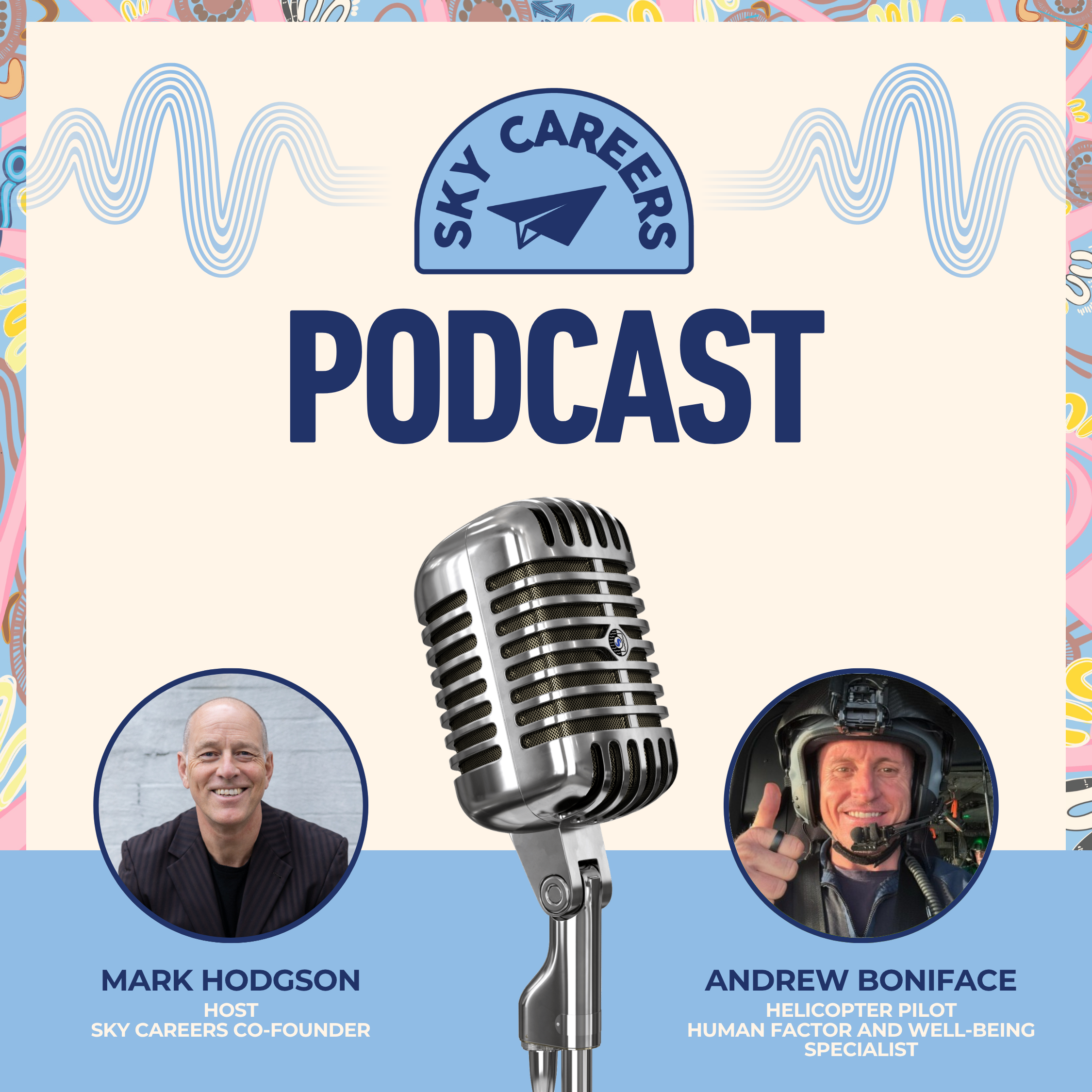
[00:00:08] Speaker B: Welcome to this edition of the Sky Careers podcast. I'm your host, Mark Hodgson. And this edition we've got a very interesting guest. A guest, Andrew Boniface. And Andrew helps teams in the workforce to build the skills to lead themselves, their colleagues, and increasingly importantly, their families with confidence, steadiness and care. Andrew spent years working in human performance through both aviation, as a very experienced helicopter pilot and also corporate health. Andrew understands how the body and mind work together and his focus now is increasingly on practical tools to help build emotional regulation, presence and intentional communication so we can show up at our best with strength and connection in the matters, in the moments that matter most most, both in work and in life. Andrew, welcome to the Sky Careers podcast.
[00:01:07] Speaker A: Thanks very much for having me, Mark. Great to be here with you.
[00:01:10] Speaker B: Super. So let's start at the beginning. Tell us a little bit about where you grew up, what school was like, and when aviation first captured your imagination.
[00:01:20] Speaker A: Yeah, well, I hail from North Queensland. I grew up in Cairns and prior to that had been born in Zimbabwe. We actually came over to Australia when I was about three.
And the earliest memories I have of helicopters is watching Airwolf back in the day and running around the backyard in Brisbane with a Airwolf helicopter figurine. I believe it was a shiny black bell triple two.
And that was what really started to light me up around flying helicopters in particular. When I was about 6, moved up to Cairns and went through my school life in Cairns.
I'd say I really, really loved everything to do with health, sport, science.
So it was really interesting that I then sort of later went into different areas which I guess we'll touch on, which kind of had the foundation built in those early years. So health and phys ed was my favorite subject in high school, along with technology studies, along with things like biology and chemistry were pretty cool. So, yeah, that was what really lit me up and enjoyed them. Did pretty well at those subjects as well. Sort of applied myself while probably still having a bit of fun through school as well. So, yeah, that was the beginning point.
[00:02:40] Speaker B: Well, for that. For our listeners who don't know, Cairns is also the gateway to Far North Queensland and the spectacular Barrier reef. So it's a pretty good backyard to do exciting things, right?
[00:02:55] Speaker A: Very much so, yeah. I was really blessed to grow up there. And I'd say that, you know, it took many years later till I started flying in there in a, in a cornice or a Jetstar jet and looking out over the reef on one side, the rainforest on the other, and I just realized I'D taken it for granted for a little bit as an adult and as a kid in my later teenage and early 20 something years. And it's just a stunning part of the world. And I was blessed to get to do a lot of my early flying in helicopters around there as well.
[00:03:25] Speaker B: Yeah. How did you go from school to aviation, Andrew?
[00:03:30] Speaker A: Yeah, well, it was a goal of mine to start flying helicopters or aircraft of any kind. Probably from the time I left school I investigated defense, you know, going down to adfa, have asthma or had asthma then, which was going to be a little bit counterproductive to making that work.
And the other option was to, you know, try and get a pilot's license to. At that time there wasn't any vet fee help, so my parents worked really hard, but we weren't flush with cash. And so really there wasn't an immediate option for me to go and fly aircraft. So I went and applied myself at uni.
I started doing a biomedical science degree that changed to a sport and exercise science degree. And I sort of had grand plans to go and work at the Australian Institute of Sport with a lot of really cool athletes, you know, the most elite athletes there. Got to do a bit of PRAC there towards the end of uni and really that just led into working in corporate health and mindsights as a health and lifestyle coordinator out there and just trying to bring a bit more joy, a bit more fitness to the culture of the mindsight world. And continued to work in various jobs relating to health and fitness through my twenties. Until I was 28, I worked in the NHS over in the UK as a cardiac tech as well. So got to do that and locum around lots of different hospitals around the uk, which is a really cool way to see that country.
And at that time I'd always been dwelling on getting into flying helicopters and just hadn't really created the path forwards through which I would do that. And I remember I was on a trip with two of my very best friends cruising through South Africa and we actually stayed with a couple of old family friends who were living in Durban at the time. And they said, oh, what do you want to do in the future? And I said, I'm thinking about this helicopter thing, you know, I've got this career that I've started in health and well being and clinical stuff. Now I don't know what I'm going to do, if I'm going to go to helicopters or not. And they really planted a solid seed when they said, well, we've got a Training airport about a kilometre down the hill from where we live, which was in a place called Umhlunga in Durban.
If you wanted to come back after you saved your money, you could stay with us for free here in Durban. You can borrow our son's mountain bike, ride down the hill in about two minutes to the airport and about half an hour up the hill on the way home in the afternoon and you'd be more than welcome to come back. So that just. That lit me up and I've sort of. I've always tried my best to follow the path of excitement and joy if it, if it was, you know, slightly sensible at the same time and yeah, yeah. So I went back to the UK, worked for another 18 months in, in hospitals and in events on weekends, saved my pounds, transferred them to some rand and some dollars in Australia and I went back to Durban and did my first 60 hours in Robbie 22s in
[00:06:28] Speaker B: Durban, was it, I assume it was still expensive, I'm sure, but still a little bit less expensive in, in South Africa than Dublin than most places anyway.
[00:06:39] Speaker A: It was, it was probably equivalent of about $100, $150 an hour cheaper at that point in time. And I thought I'd be saving myself a good whack of money as it turned out. I ended up needing to do a slightly longer course when I got back because I didn't satisfy the prereqs to have done all the hours at one flight school, so didn't really end up saving any money. But to answer the question, it was a bit cheaper and I got to see, you know, a foreign country which was really stunning as well from the
[00:07:07] Speaker B: air sounds now you went on, I'm going to keep moving because you've got so many, so many things we want to, I want to touch on today. And you, you went on to spend or continue to spend more than 15 years flying helicopters across aeromedical offshore media, power line and instructional roles.
What it sounds like you as a late starter in all of that, was it everything you hoped it was going to be?
[00:07:34] Speaker A: It really was, yeah, yeah. I mean, like anything, it came with its challenges. I'm not going to sit here and say it was all bliss because I don't think anything is right, but I would say that, you know, a good friend of mine said once when I was looking at taking a role flying helicopters up in the Torres Strait Islands, he said, mate, you'll never regret it. It'll be an amazing chapter in your autobiography. And I always remember him saying that and I kind of look at aviation in the early days where you need to kind of move around to where the jobs are quite remote, possibly as being just these really cool times that you look back on which are breaking the mold of probably, you know, the standard path that some people take. So yeah, really enjoyed it. There was a solid progression throughout the time as you'd expect if you spend 15 years doing anything, you know, so, you know, got to, got to fly some much bigger aircraft towards the end and yeah, just, just really enjoyed the personal growth, the challenge and also learned a lot through aviation around what not to do in terms of how I combined it with other areas of my life.
[00:08:44] Speaker B: So Eddie said you're a very interesting, there's a kind of sandwich conversation around. You got 10 years doing something that was not aviation and building up a whole lot of expertise and interest and I guess perspective as well before you went into aviation. Then at some point you realized or maybe you re realised that your real passion wasn't just flying helicopters, it was helping people to perform at their best and in your self to perform at your best.
What prompted that shift, Andrew?
[00:09:17] Speaker A: Mark, I'd say that I just got given a few opportunities probably towards the second half of my career. You know, most companies you work for will offer different air crew ancillary roles around the place, whether it's, you know, human performance or a safety officer or EFB administrator, all those sorts of things as you, as you would know.
And yeah, just when I got to a few of the companies there was human factor sort of roles that were available just to jump in and provide the occasional, I guess, presentation to some of the other air crew and pilots working there.
And that just really lit me up because I saw that it was the perfect combination of what I'd done in health and wellbeing in terms of how the mind and the body work mix with I guess the high risk, high reliability side of something like aviation. So it was that, that meeting point which ironically as well was kind of like the, the technology studies and health and phys ed thing back at school.
So yeah, I just decided I really enjoyed it. And it was probably at Life Flight that Babcock initially and then Life Flight I got to do quite a lot more in the human performance world with learning from people like Adrian park and Taryn over there as well.
[00:10:34] Speaker B: Sweet. Just tell us for the uninitiated, tell us a little bit more about what are human factors as pertain to aviation.
[00:10:43] Speaker A: Yeah, so I guess we want to look at human factors as probably very similar to crew resource management came about after a huge crash in Tenerife back in I believe, the 1970s, when 400 people died when two aircraft collided on a Runway. And it was determined at that time that pretty obviously, but not prior to that, that we needed to investigate what was going on in the human more that was contributing more to any errors that we're making and how we as humans can excel in preventing mishaps and also handling emergencies really well. Part of that is how the crew meshes together.
One of the sort of original models of it is the shell model. So the L of shell is the liveware. If you think of it, at the center of a clock and outside the perimeter of the clock are the other elements that me as the liveware, as the human interact with. So the human factor is really adjusting the quality through which I can interact with those other elements of the shell model. So we've got other liveware, other people, we've got, we've got the environment, how I interact with the environment, heat, cold, you know, not being able to see very well, et cetera, et cetera.
We've got the hardware, so the actual helicopter itself and my helmet, any other equipment. And then there's the software which is the SOPs, the, the OPS manual, you know, the way that GPS is programmed, etc. Etc. So the human factors will be anything from, you know, anything in the I'm safe checklist, for example. So if I've, if I'm fatigued, if I've got any sort of, anything going on at home, which is causing me to not really be present, if I've, if I'm not eating well, if I'm not hydrated, if I have a cooked nervous system because I've got newborn bubs and I'm just, I don't have much to give. My source bin of capacity is pretty full. So if a stressor happens, there's not much left to handle that stressor. So all of these things are the human factors and they really inform how well we can manage a crew and the resources of the crew.
[00:13:02] Speaker B: That's a beautiful explanation.
Thank you for that, Andrew. That made a ton of sense today. You spend your time helping people to lead themselves before they lead others.
What does self leadership actually mean? And why do you think so many people struggle with it?
[00:13:23] Speaker A: Well, I'm glad you asked because I've certainly been one of the guys that did struggle with it. And I think that, you know, these sorts of opportunities that you've gifted me here today are really good opportunities to Be really honest, open and vulnerable around what hasn't worked. Because I think we're all human. And what I've really found in aviation, very much starting with myself, is that there's this pursuit of perfection. And I think that aviation certainly attracts that type of person, maybe a type A personality, for example, plus many other people. But there seems to be this reluctance to want to make any mistakes. And of course if we make a big mistake, it can mean damage or someone's life. Right. So I do understand it. What I probably found with myself is that, you know, it was probably so committed to this perfection mentality, not realizing that it was actually detrimental to the way I was doing things. I was hyper vigilant to an extent that that was not just in the cockpit. I was taking that home with me. After, you know, obviously flying helicopters at crazy hours of the day and night, you know, with NVGs and all sorts of things which can, can impact your fatigue and your nervous system a little.
I was taking some of the extra stress and hyper vigilance home with me. So back to your question around quality leadership. I would say that, that it has to start with self care and it has to start with looking after ourselves so that we're able to perform at the very highest of.
Like I've, I've worked with guys that have been renovating their own house through the day and then they come on shift for a night shift, you know, and no surprise when there's been a health outcome or something that needed to an intervention in those sorts of situations.
So yeah, putting our own oxygen mask on first is really cliche, but it's so true. And I think that, you know, when we can.
Excuse me, excuse me. When we can take opportunities when we're not at work to make sure we're well rested, we're eating really well, we're exercising and we're really optimizing our nervous system capacity to come to work. That's when we'll find that as a leader we're able to provide much better leadership at work because we've got the capacity to do so. And that's when we'll find that we can set a solid example for other members of a crew and an organization.
[00:16:04] Speaker B: Yeah, I couldn't agree more.
As someone does a lot of work in sort of leadership coaching, I think that self led, self leadership and I mean we talk about high performance teams and I always say high performance, high performance teams start with self leadership. You lead yourself first, then you lead the teams. And when you've got well led teams, you ultimately achieve high performance. But it starts with self leadership. And there's lots of factors to that that you describe. Some of them that apply to any workplace. I think that so many people, they expect to stay up the night before doom scrolling, maybe drinking too much or other stuff or just not getting enough sleep or not doing any exercise or eating poorly and then to do all that and then expect to roll into work in a place and a state, state of mind to actually be centered and calm and executive and make good decisions and lead others is amazement. Even as I just described that shopping list. It's crazy, right? That can't possibly work. And it doesn't.
[00:17:09] Speaker A: Yeah. And I'm completely on board with that. You know, I've worked for leaders underneath leaders who are incredible people. And at the same time, probably the leadership wasn't where it because they might have had something going on at home. They weren't sleeping well, they were drinking 10 to 12 shots of coffee a day just to function.
And all of that's gonna mean that when they get to work, they're just not able to provide the example, the guidance or the presence or the awareness that people need. I really think that the four things that followers or employees look for is stability, empathy, hope and trust. And I think if a leader can provide those, it doesn't matter what the industry is. I got those from Gallup from a study they did. Then people are really going to be a lot more engaged and they're going to apply themselves with a lot more resourcefulness and initiative, particularly in a high risk industry, that's going to have a huge impact on safety. And that's a big point I wanted to get across too is that, you know, we've got these safety management systems which are incredible, very necessary help us towards a just culture.
However, you know, if we're deeply afraid of mistakes and possibly even punitive of people making mistakes, or we don't have leaders who do empower employees to trust them or to have hope in the organization and share the mission. Much as I'm sure you teach a lot of this in the leadership space. Marc, I really think that the safety takes a big hit and this isn't discussed in aviation very often around how leadership can be very detrimental to safety in an invisible way that isn't really picked up.
[00:18:58] Speaker B: Yeah, that's fascinating.
You've experienced, excuse me, you've experienced a lot of change in both your professional and personal life. You spoke about how have those experiences shaped the way you now lead yourself, but also how you support other people because I know you're doing a lot of work in that space.
[00:19:22] Speaker A: Yeah, well, my, my marriage ended about five years ago. And I would say, as I mentioned before, aviation contributed to that. I mean, I was the biggest contributor to that as we all take responsibility where we can, right. But my decisions around aviation and prioritising getting to the next goal or achievement or type, rating or whatever it might have been, really contributed to that. And particularly when you got young kids, you know, we had beautiful twin girls about nine years ago, and all of that kind of combined to have me feeling really, really cooked.
I would say that, yeah, it's interesting at those times, right. As someone that I, that I follow and really admire suggests that, you know, when you squeeze a lemon, the lemon juice is what was really deep down inside. And when we're stressed in life, I think some of those older patterns of former caregivers and whatnot, AKA one's father, et cetera, might come out and you think to yourself, wow, I never thought that would ever be part of my psyche, you know, or my way of being. So I would suggest that, yeah, through that I dove into a whole heap of men's work. It was really beneficial for me as well as, you know, seeing standard modality professionals like a psychologist, et cetera, just to help me through some of the tougher times.
Men's work was really huge because to me what it does is empower really healthy, positive masculinity and men who really want to lead with their heart.
And you know, to some of my colleagues in aviation, that might sound a bit wishy washy, but when I say lead with you. Yeah, a bit woo woo, yeah. And that's okay too. Right. But what it actually there's a lot of neuroscience to suggest that, you know, the more that us as men venture out of our left brain and go into use our right brain that little bit more, the more we're able to be aware of what's going on in our body.
The right brain is much more responsible for global concepts, connection, empathy, you know, very much involved with how we interact with other people in a much more loving way, whether it's a colleague, a friend or your family. So, yeah, I would say that all of these learnings, the menswork especially, really helped me out. I dove into a lot of courses, menswear facilitator, excuse me, facilitator training course, a whole bunch of other different mini trainings. I became a mindfulness meditation teacher and all of these things really helped me re regulate My nervous system from what was proved by, you know, blood and saliva tests to have extremely high cortisol levels and be super cooked at times that I didn't even realize it was. So yeah, being able to give back now in areas that I received a lot of from different people, different coaches and professionals over the years is really important to me. And doing it by meeting people in, you know, in a guidance context as well as through organizations is where I see that it can really help to tweak culture for the better a little bit as well with some of the concepts that I teach.
[00:22:44] Speaker B: Sweet. And how do you, what does a typical week in your life look like now in terms of I guess what you do, but also connection with aviation or no connection with aviation. Where, where, where, where, where has your journey and it's very much a, it sounds like simplifying it like a three part journey. There was a, there was a can. There, there was a, there was a young can. Can. A young. Andrew grew out of Cairns and traveled the world and did a whole lot of stuff and very interested in physiology and mind and, and, and, and, and healthcare and sort of mind, body and spirit. Always with an interest in aviation that you picked up and actually really ran with, based in Durban and then spent 15 years, I guess actively really driving. It sounded like you really did drive an aviation and helicopter career. And then on the other side of that, in relatively recent, you've come out of that into your sort of current work.
What does a week in your life look like today?
[00:23:48] Speaker A: Yeah, well, creating strategic partnerships is a big part of what I'm doing. You know, I've realized from burning out in the past that the best thing that I can do right now is to, you know, reach out to organizations that have leadership that really put the human at the center and people first within their organization. And you know, probably most organizations would say that they do that on paper and it's certainly not.
[00:24:13] Speaker B: They all say they do it on paper in my experience.
[00:24:16] Speaker A: There you go. So look, it's not a criticism, but it is definitely an observation I've had that I'm going to pluck a figure and say about 20% of organizations probably actually do put the human first. So for me, yeah, yeah, I've been having quite a few meetings lately with organizations that I'm either looking to work with or working with, you know, larger corporate health organizations that serve lots of organizations as well to package up with them.
But as I say, usually it needs to align with a C suite or a leadership group that trust that if you put the people first, the people will get you every metric involving growth, money and material that you could ever dream of anyway, particularly safety as well. So with that as well, probably about to run a masterclass series with a colleague of mine, Nathan Wallace, who's a neuroscience educator and former therapist and counsellor.
And we'll be doing that and running a group container off the back of that for people that work in organizations as leaders, emerging leaders and teams to really dive deep into all of these internal victories that we can look to achieve. We'll also then after a period of time dive into all the interpersonal stuff, skill sets. They only come from our perspective after we've had a deep look within. So, you know, all of us might have done a communication or a leadership course over one to two days and no doubt got heaps of value out of it. However, I think, I'm not sure if you agree, Mark, but unless we look at the internal of ourself first and how we can show up the best that we can, there's not a lot of point with learning how to, how to listen to someone properly when we're actually going to be able to authentically listen anyway if we sort ourselves out. So yeah, that's, that's coming up soon and part of the end of that will be culture and how we can influence the culture of our families and our organizations. I'm still involved with men's work and actively involved with running a one day men's retreat which is a hike through the Sunshine coast forest this Sunday, which should be quite amazing. We've got lots of processes around this same sort of thing. So I offer those to organizations as well.
Yeah, so yeah, it's, it's a little, there's a bit of variety there. However, it's, it's also splattered with a bit of aviation. I fly the media helicopter out of Mount Cooter in Brisbane. One shift per month at this stage is to stay current and keep my hand in.
[00:26:44] Speaker B: Wow. It's, it sounds, thank you, Andrew. It very much sounds like a story that is going to go on and on and on and a lot of what you're speaking about I resonate with. And as I said, that whole piece about, you know, people talk about, you know, and I do a lot of work helping organizations to build high performance teams, but it starts with the individual. And if you, you can put all the wrappings and all the, you know, the, the corporate spin and diagrams and values and mission statements and all that, all the stuff in the world together.
But if it doesn't start with individual leaders leading or individuals leading themselves and position and doing the work to help them show up at their best consistently, then sooner or later it's going to end badly in some terms of performance and obviously in an aviation context that can ultimately roll out very, very poorly. So I love what you're doing. It sounds like it's very much an interesting continuation of those phases of your life and career.
A couple of, a couple of final questions.
You mentioned your twin girls and spoken openly about balancing work, family and personal growth.
How do you stay grounded when it all gets sort of crazy busy?
[00:28:05] Speaker A: Yeah, once again, I'll be super honest, it's an ongoing, I won't say a challenge, but it's an ongoing intentionality that I need to bring to this because if I'm not intentional and scheduling in self care, be it the gym, going to the beach, having a surf or going and hiking up a mountain one morning before I start work for the day, then it doesn't happen.
So for me, scheduling being really intentional, but also having that little bit of flexibility which I'm fortunate to have right now so that if, if you know, I feel a certain way and I've got the ability to not action other work aspects straight away, I can actually go and top myself up when I need to. So yeah, I would say really great food.
Sleep is still something that I'm getting really back on top of after lots of night shifts and strange sleep patterns over the years. However, it's going pretty well back up to about seven hours of sleep a night, which is brilliant.
And yeah, just, just prioritizing the important things and then having work fit around that as opposed to the other way around.
[00:29:21] Speaker B: Yeah, really important. And my last question, Andrew and I really enjoyed our conversation today. If a young person is considering a career in aviation, being that piloting or anything else or somebody in the industry already in the industry wants to become a better leader, what's the one piece of advice you'd leave them with?
[00:29:41] Speaker A: It's a really good question. I think that it all starts within and in my program, my first bunch of modules are underneath the pillar called strong within. Much as we were talking about before. And I think if we want to lead people, yeah, we've got to be good at the skill set that is represented in that organization, be it flying or in management or whatever we're doing.
However, if we haven't sorted ourselves out and got to the bottom of what makes us tick to the point where we can chuck a lot of self care into ourselves and be able to offer more of ourselves from a connected point of view with the people that work for us.
We're really going to be limited in terms of how successful we can be as a leader.
So I really, you know, invite particularly the younger people out there to, you know, start to dive into some reading that might interest you around this sort of thing.
You know, personal growth aisle at a library or a bookstore or online of course, is really amazing.
And then of course to be a better leader, I think it's mostly about guiding, developing and empowering the people that work underneath us. And for me that's really letting go of my own ego and my own drive to excel because if I can empower everyone that's underneath me in a team, that's going to make me look pretty bloody good as a leader anyway and it's going to have the team excel, feel a lot more engaged. And actually one thing I wanted to throw in was that the false economies in a lot of aviation organisations is the revolving door of staff.
So rather than looking at that as a cost of doing business, why don't we look at the amount of staff that are leaving and new staff being employed, needing new type ratings at the cost of 80 grand plus.
It's not, it's, it's completely avoidable in many cases, not all, but in many cases. And you know, if we can really try and develop that trust with our workforce or small team in any organization, let alone aviation, that's going to, I feel, have us be the very best leader and have that organization increase its safety as well.
[00:31:58] Speaker B: Yeah, that's lovely, Andrew. And it comes back to those qualities you spoke about, hope and trust.
Actually, it's funny, I did another podcast recording recently with Natalie Johnston, who I mentioned before we started talking, who was the first female pilot in the Royal Australian Navy and we were talking about similar things.
I shared with her that my favorite quote about leadership is so relevant to this conversation. And I don't know who said this, but the quote is that the role of leaders is to bring out the greatness in others. And I think that very much captures the essence of what you're saying, Andrew. It's been such an interesting conversation. We've touched on aviation but or and we've touched on so many other things from self leadership to biology. So left brains and right brains. My, my good friend Dr. Mark Williams says there's no such thing. So we wrestle over that very topic and I tell him it might not be true, but it's a very useful idea. So he tells me. It doesn't exist. Well, let the neuroscientists fight about that one. And we took we've covered so many things about, you know, leadership, self leadership, being open and vulnerable.
And you've bared and shared a lot of your world, good and bad. And I applaud you for that because it's so easy, isn't it, just to put a shiny shine on everything.
And vulnerability is the pathway to so many good things. So. And you've been an amazing guest. Thank you so much.
We'll post links to some of the programs you've mentioned in the show notes and we look forward to hearing about what you up to you do next. Thanks. Thanks for appearing. Thanks Andrew.
[00:33:42] Speaker A: Thanks Mark. Really enjoyed it today and look forward to being in touch.
[00:33:54] Speaker B: Thanks for listening to the Sky Careers Podcast.
If today's conversation has sparked your interest in aviation, then head over to our
[email protected] au whether you dream of flying aircraft or you're curious about the hundreds of other exciting roles that keep the aviation industry moving, Sky Careers is your gateway to discovering these opportunities.
And if you are already in the industry, check out Sky Careers Connect and Sky Careers Leadership and consider joining our online learning community.
Until next time, keep reaching for the skies.