[00:00:00] Speaker A: Foreign.
[00:00:08] Speaker B: Welcome to this edition of the Sky Careers Podcast.
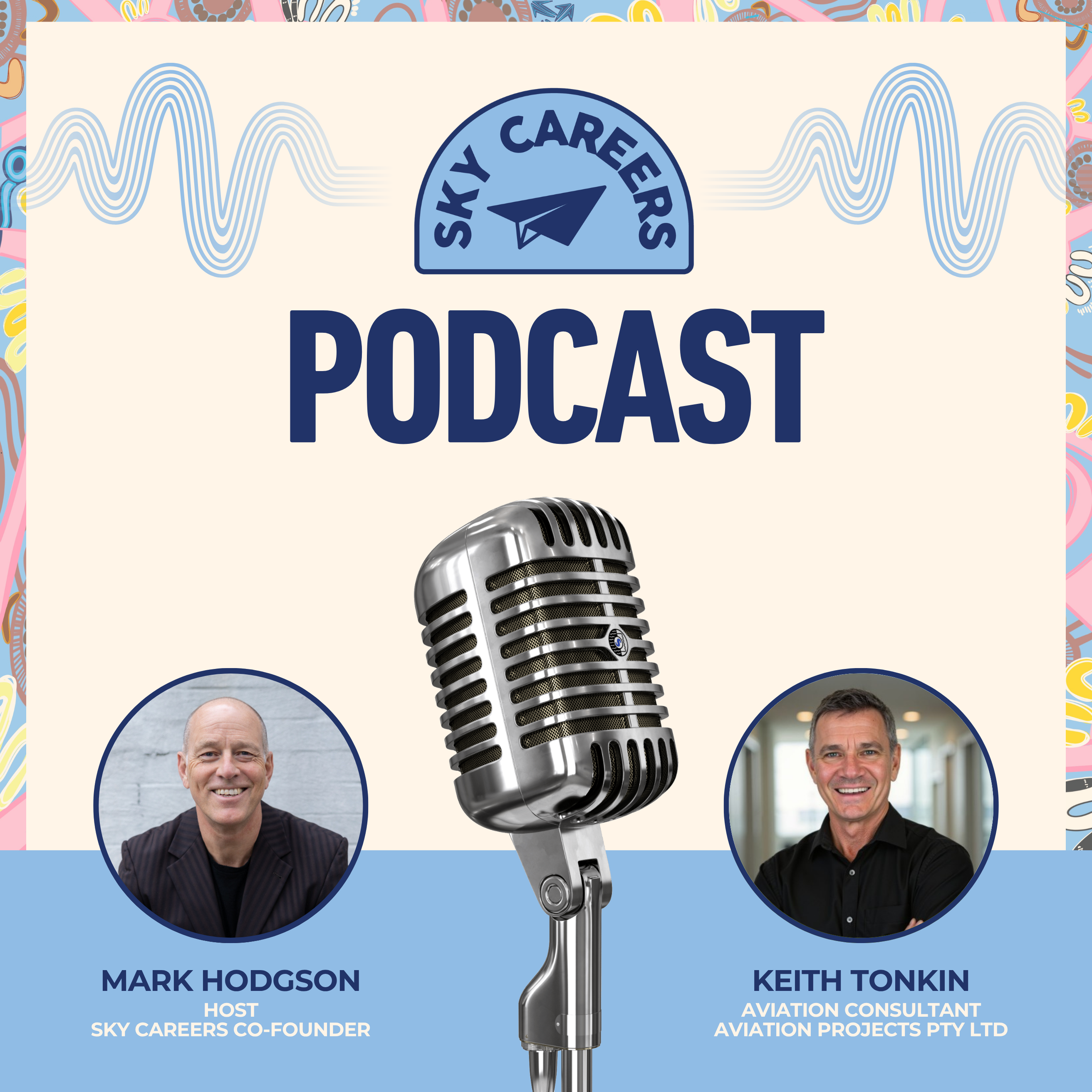
It's my pleasure to be your host. My name is Mark Hodgson and this week our guest is Keith Tonkin. Now, Keith is one of Australia's leading aviation consultants, advising airports, governments and industry on airport planning, aviation safety, operational risk and major infrastructure projects. With decades of experience across the sector, he's also a respected expert witness and trusted media commentator, known for making complex aviation issues easy to understand. Keith, welcome to the Sky Careers Podcast.
[00:00:48] Speaker C: It's great to be with you, Mark.
[00:00:50] Speaker B: Really, really looking forward to our conversation. So, taking us back to the beginning.
So, a young Keith, what first sparked your interest in aviation?
[00:01:02] Speaker C: I grew up on a farm north of Perth in Western Australia and we used to drive past the Rathbase Pierce training Base every time we went there and we'd see the aeroplanes flying around and I dreamed of doing that, literally. And one day I managed to talk my way into the system and ended up there flying those aircraft, the Macchis as they were then, and everything took off from there.
[00:01:24] Speaker B: Sounds fantastic. So what were you studying at school before you did it? Or was it just completely. Just you were transfixed when you saw your first aircraft?
[00:01:38] Speaker C: Yeah, I think from the age of 10, I knew I was going to be a pilot and everything in front of me from then on was directed towards doing that somehow. And my mum was a teacher and she had always told me and my brother and my sister that if we wanted to come back to the farm, that we had to go and do a degree first. And for me, back then, the only way of doing that was to join the Defence Force Academy and do a degree and learn how to fly. And so I did that. And like my brother and my sister didn't go back to the farm.
[00:02:10] Speaker B: That said, that sounds like a great big bit of maternal advice. Go out into the world and then, you know, if you see the world and. And the farm's still the best place for you, come back, but go and check it out first.
[00:02:24] Speaker A: That's great advice.
[00:02:26] Speaker B: Fantastic. So just map us through your early aviation career. Having joined as a pilot in the ADF.
[00:02:32] Speaker C: Yep. Defence Force Academy from 86 to 88 that we were the first, first class into that new institution, which was 40 years ago this year.
And passing my Bachelor of Science, I then went to Rathbase Point Cook to learn how to fly. I did a Junior Air Force officer course first and then number one, flying training school there, went to Rath Base Piers to do number two flying training school and then posting sent me to Caribou's, which are the twin engined radial transport aircraft in Richmond near Sydney. From there the squadron moved to Amberley and I did a little bit of a short nine month posting to recruiting where I went around to schools and told kids all about life in the Air Force. And from Caribou's I got a ground job in the F111 group amending their aircrew manuals. And then while I was there I convinced people in that organization to get me sent to intro fighter course which I managed to pass and then from there posted back to F111s and that saw me out for the rest of my career.
[00:03:42] Speaker B: Right. And how long was your Air Force career, Keith?
[00:03:46] Speaker C: Just on 15 years.
[00:03:48] Speaker B: 15 years.
[00:03:49] Speaker A: Just give us an F111 story.
[00:03:51] Speaker B: Come on.
[00:03:53] Speaker A: What was your best salty in an F111, which is a pretty punchy. I'm going to say it's a fast jet. It's a bomber, isn't it?
[00:03:59] Speaker C: Fast bomber, yeah. I think probably the most exciting thing I did, I didn't earn an active service medal, so I never saw any active service or conflicts. But the most exciting thing I was involved with was an exercise in America based out of Las Vegas at Nellis Air Force Base where we did exercises with a whole bunch of aircraft from around the world and you know, flew past Area 51 and had to avoid ejecting into places where there was nuclear fallout and making sure we didn't look at things that we weren't supposed to look at and drop bombs on the right places. And that was really exciting, a wonderful experience.
[00:04:39] Speaker A: Wow, that sounds very cool.
[00:04:40] Speaker B: But you're only you, well not you
[00:04:42] Speaker A: only you did 15 years in the Air Force and you know, that was really just the very start of your career. So it sounds like you always had a passion and maybe with your degree as well to move on beyond just. Sorry, there's no just about being a pilot, but about moving more into some of the work you're doing now. So map us through that. That path.
[00:05:04] Speaker C: Yeah. My last year or so of the F111 flying, I was a squadron leader posted into the wing in a headquarters role. And I participated as the F111 representative to a project called Aviation Risk Management. And that was as a result of a bunch of flying accidents that had resulted in fatalities across the Air Force and Army.
And I helped to develop the Aviation Risk Management program. And then when I left the Air Force, I went to Qantas and I flew for nine years there as well. And in the Course of the spare time I had, I consulted back to that project and from there developed a real passion for risk management and aviation. And out of that, in my part time work, which became almost full time, I took on little consulting roles with a view to building a business.
And ultimately in 2009, with the global financial crisis with Qantas allowing people to take leave without pay, I did that and did some other things personally. But also took the opportunity to try consulting full time to see if it would work. And that was in 2009 and here we are sometime later and it's still going from strength to strength. So that's how we ended up in a non flying role.
[00:06:17] Speaker B: Sounds very cool. You sound like a chronic underachiever Keith. If I dc so you need to get a bit bus doing some more. It's really interesting, you know, service career and you know, and then obviously Qantas is civil and then you're doing a whole lot of other stuff and risk management and planning and so forth. So you actually looking at what you've been doing, you've worked across many, many parts of the aviation ecosystem.
[00:06:44] Speaker A: So looking back with that I guess
[00:06:46] Speaker B: 40 year perspective, which roles or experience do you think have shaped you the most?
[00:06:51] Speaker C: Oh, definitely the flying.
I was, yeah, I had a really unfortunate experience of some friends when I was flying Caribou's. Two of my friends flew an F111 into the ground at night and that was really quite formative for me.
And yeah, since then it's been really important to be involved in making sure that people think the right way about safety and apply themselves properly to going and doing things that we need to do but still managing risk so that we don't have unfortunate things like that happen.
[00:07:23] Speaker B: Yeah, very sorry to hear that.
That clearly left a big impression on
[00:07:29] Speaker A: you and how you wanted to I guess make an impression on the industry
[00:07:34] Speaker B: and so you would have seen, you've seen aviation evolve over the decades. So when you look at the industry today as a consultant know working on a whole lot of projects including advising at, as an expert with and so forth.
When you look at the industry today, when compared to when you first started, what, what changes you think have had the biggest impact on aviation operations and also specifically on airports.
[00:08:05] Speaker C: Yeah, I think back in, back in the old days, I can still remember flying Caribou's where we took our first handheld GPS with us to use to navigate our way around the place. And just the gps, the system and the avionics and the equipment and the navigation accuracies and tolerances that we have now make things so much better because in the old days, people used to fly airplanes into the ground, trying to maneuver at night visually, and we just don't need to do that. And so something as seemingly as simple as having satellites in the sky and clever electronics to interpret that information and tell you where you are from time to time is amazing.
And with that technology we've got now, you're just able to operate so much more safely, more accurately, and the whole system is much more precise and tolerant of human mistakes. So I think that's probably it. But even just things like safety management systems, which is a way of thinking and operating complex systems, has really helped as well.
[00:09:08] Speaker B: So. And it's interesting you're bringing back memories I think I've shared on the podcast. Before I was a failed Royal Naval pilot, so I did a bit of flying and I remember I was. I was riding along in a seeking helicopter. I wasn't flying it, I was. I was a passenger. And the pilot's navigation system was a map in some kind of box thing, and there were two wires that kind of intersected and moved and they were meant to map where the aircraft was. But there was a. There was a high degree of skepticism about how accurate the thing was. And even things like if you didn't put the map in. Yeah, if you didn't put the map in the correct key, it would just be in the wrong place. So, I mean, when you look at now that you say we just. We just expect things to routinely be absolutely where we need them, it's incredible how that's evolved.
Going more broadly, Keith, I guess for someone listening to this, who's fascinated by aviation but doesn't necessarily want to become a pilot, looking at some of the other areas you're doing in terms of airport planning and aviation consultant, what does that actually entail?
[00:10:18] Speaker C: Yeah, you're right. There are a lot of jobs that make the aviation system work. And we need pilots to fly the airplanes, of course, whether they're inside them or operating them from the ground, if they're non piloted or non crewed aircraft. But there's a whole ecosystem of people and systems to make sure that that can be done. And I mean, we operate a small aerodrome on behalf of an owner here in Brisbane, and we've got a person there, an aerodrome reporting officer, day to day, just making sure everything's being done properly and providing that rigor behind all of the infrastructure and facilities and equipment that pilots rely on. There's a whole scope of operations around airports that make that work, whether it's just day to day operations and infrastructure design and maintenance and construction engineering, there's the commercial people that make all the money move. And in around the consulting world, a lot of airports rely on people with a bit more knowledge and experience to help them make good decisions. So master planning. In Australia, we've just finished the master plan at Armidal Airport, which sets the scene for how to develop that infrastructure over time. And I had a great privilege of helping the Wagners design and develop the Wellcamp Airport out near Toowoomba. And that was a wonderful experience.
And seeing the benefits that flow from that airport to the region is really immeasurable. So there's a lot to contribute even if you're not flying an airplane.
[00:11:45] Speaker B: Yeah, I love that. And in the many conversations I've had with guests on the podcaster, I think the main thing that's become clear to me is that it's wrong to think.
[00:11:55] Speaker A: I think a lot of people tend to think of pilots at the top, the top of the pyramid, and it's not like that at all. Pilots are just part of an ecosystem, aren't they? And you know, they're essential, but so are the people that do the planning, the engineering, the risk management, the catering, the everything. Everything's just as important as everything else.
[00:12:15] Speaker C: Yeah, yeah, that's right.
Air traffic controllers, the people that, that sweep the runways or load the bags, they all make the whole system work.
[00:12:26] Speaker B: One of your strengths is making complex aviation issues understandable.
And what you've just described, for example, the Wagner thing, whether you're talking to councils, developers, communities or the media, what do you think? What's the biggest misconception people have about aviation and airports that you're kind of having to address in terms of operations or getting permissions in the first place?
[00:12:53] Speaker C: I think there's always ways to improve. And there's a pretty high level principle around airports that they have to grow or die. And you'll see that commonly over and over and over, that if an airport doesn't have enough activity and to sustain it, to cover the costs, to increase its utilization and usefulness to the community around it, then it'll just stop being useful. And that's why you'll see very successful airport operators and owners will try and aggregate other uses around them to make them useful. And one thing leads to another.
So there's always that view. And I've been in meetings with councillors at airports and they say, are we thinking big enough?
And usually you have to try and stop them from doing things that are too big and too costly because there's no real benefit for it and the airlines won't pay.
But sometimes it might be that they're not thinking enough about what are the opportunities and they have to be encouraged to come to those conclusions through a bit of a discussion.
[00:13:52] Speaker B: Yeah, I know one of the things we're very intent on at Sky Careers
[00:13:57] Speaker A: is promoting the broad range of
[00:14:01] Speaker B: careers and roles.
And I think, especially when you start to think of the way I think about aviation, I find it the most useful way to think about aviation. It's essentially infrastructure. It's infrastructure.
And so it's a logistics. So it's a logistics system, isn't it, really? And yes, one of the most obvious logistical uses is moving people around. But especially in an Australian context, there are so many goods and operations and other industry and commercial and revenue generating, I guess, activities that airports, just by their very nature, they create or if they disappear, they take away as well. So I think it's a fascinating logistics and often a supply chain compensation, which I think a lot of people don't quite understand if they just think about aviation's getting on an airplane and flying
[00:14:56] Speaker A: to Bali for holidays or whatever.
[00:14:57] Speaker C: Yeah, aviation has a lot of purposes and it's interesting about freight and logistics because Western Sydney Airport just had its first operational flight, if you like, the other day, and it was a freighter, so. So, yeah, freight often comes first. And even talking to the new uses of advanced air mobility, we're seeing freight as the first main commercial use case of those drones and larger unmanned aircraft or uncrewed aircraft is to carry stuff rather than people because you can do that more efficiently over longer ranges without the need to support a human inside it.
[00:15:32] Speaker A: Yeah,
[00:15:34] Speaker B: it's incredible some of the things we're seeing, and I've just seen the socials about the opening of Western Sydney Airport and I think.
[00:15:41] Speaker A: Am I right in saying it's got
[00:15:43] Speaker B: an unmanned control tower?
[00:15:44] Speaker A: Is that right?
[00:15:45] Speaker C: Yeah, that's right.
It's a tower with cameras and people sitting somewhere else providing that service.
[00:15:52] Speaker A: Yeah. Which again is, you know, that's a significant thing. I think that's a really significant piece of technology you've mentioned, Keith, that.
That grow or die, which I think is a really interesting perspective. And I guess in many ways aviation is under pressure. Compliance, cost of fuel, cost of labor. There's a whole load of things. And as you said, you can build the best thing in the world, but if it's not going to make commercial center and airline, they're not going there or they're not staying there.
So if we think about aviation under pressure.
[00:16:28] Speaker B: So if you're sitting around thinking at the ball table of a, of a regional or even a major airport today, what are the things that are keeping you up at night, do you think?
[00:16:39] Speaker C: Well, the cost of fuel because that affects the customers. And airports that make money rely on airplanes taking off and carrying people mostly to and from somewhere to their place or from their place or somewhere. And the cost of fuel and the disruptions that are happening through the Middle east still are really affecting the global networks and they've been under pressure since 2020 and coming back in bits and pieces. And now we've got another really significant disruption. And because the Middle east serves as a main hub for a lot of air aircraft movements from our region to Europe, that's been very disruptive. And so that's definitely in the back of people's minds.
And just the cost base of the airlines trying to make money but still pay the bills at the airport.
And even input costs like pavements, bitumen's made from that same base material. So the input cost to any works, maintenance and those big infrastructure cost items is going up and that'll be weighing on people's minds as well.
[00:17:46] Speaker B: In my day job I also work
[00:17:49] Speaker A: with a large construction business and it's amazing as I sometimes because things like PVC piping which you wouldn't think but that's massively effective because it's made from all and so forth. There's so many things that are rolling out of that are mission critical that you would kind of unremarkable in terms of how everything's connected.
I guess picking on that point.
Where do you see the sustainability conversation in an aviation context? There's an incredibly obviously, I mean Australia's bending whole policies towards sustainability and environmentalism and net zero and so forth and aviation's often cited in that conversation.
But again, as you said, there's cost pressures everywhere. I'm really interested in your view on where you see that aspect of aviation heading.
[00:18:48] Speaker C: Yeah, there's the aviation industry worldwide still got the 2050 net zero aspiration and there's a lot of work going on in all sorts of ways around the world to try and achieve that with a view to we've still got to cost effectively sustain and grow. And I know there are isolated pockets of work happening in all sorts of different ways like sustainable aviation fuel plants and programs. Wellcamp's got one. I was hearing the Lytton refineries has got A plan to try and introduce some sort of sustainable aviation fuel program. It's happening with the airlines and it's happening with governments, Australia and around the world. But the airlines are being a bit more thoughtful about either maintaining their commitments or rolling them back just because they're relatively unachievable at the moment. So work's underway. There's still an aspiration, but it's hard, it's going to be hard to get there.
[00:19:43] Speaker B: Yeah. And I guess as ever, someone's got to pay, right?
[00:19:47] Speaker C: Yeah, that's right.
[00:19:49] Speaker B: Yeah.
It's fascinating.
There's actually a very good short documentary. I watched it last night on the Qantas, the Project Sunrise, the non stop service that's going to begin in 2027 or is slated to begin in 2027 from places like Sydney to London and Sydney to New York. And it was fascinating.
They were talking about the technology.
The technology piece actually wasn't the hardest piece in many ways, that kind of known. But it was making the numbers work. It was interesting how it had to have a much larger percentage of business and premium economy passengers to make the numbers add up. So it's not just a case of getting your typical. It's not just a case of putting bigger fuel tanks in, in a long haul sort of aircraft that we may typically have flown in. And it just made the point again and again and again how they needed to save weight, how they needed to redesign the cabin and so many things just to make that thing work commercially and not just technologically.
[00:20:59] Speaker C: Yeah, there's a lot of work that goes in behind the scenes to having it seat on an airplane, that's for sure.
[00:21:05] Speaker B: Keith, what excites you most about the future of aviation? You've got such a fascinating story and perspective from a military perspective, from a piloting perspective, you're clearly really across a whole lot of planning and infrastructure and commercial aspects.
[00:21:22] Speaker A: So you have a very interesting and broad yet expert view. So what excites you most about the future of aviation in Australia?
[00:21:33] Speaker C: All of the endeavour. There's so much endeavor that you read about and hear about and see and there's ways that you would never have thought of five years ago that aviation has used, whether it's doing spraying crops or surveying things or carrying cargo where you wouldn't have otherwise done it, or electric aviation, which is almost upon us and we've been thinking about that for some time now, and all of those brand new uses that we wouldn't have thought of and will finally be here and the future will become a Reality. So that's just another step in the long journey of aviation and how it develops and grows and provides use for the human capacity.
[00:22:17] Speaker B: Now his name escapes me. So I apologies, but we had a guest on the Sky Cruise podcast who's actually running at a wa. Electric, little electric powered aircraft.
You may want to know the operation. Operation. And yeah, as it was described, it made a load of sense. You know, the, the actual, the, the model and the maintenance model and relatively short flights for now. I think it was about half an hour, but enough it was sustainable, it was safe, you know, and then you, then you landed the plane and it got recharged and it used to think that that's not far off being mainstream commercial, especially when you've got greatly reduced maintenance costs, which, you know, as, you know, a big part of a. Of the aircraft is not just running it, it's all the maintenance and safety and servicing and all those things that we've talked about with lots of different people. So it's not quite here yet. Probably at a larger sort of, I guess, mainstream uptake.
[00:23:10] Speaker A: But certainly in terms of early adoption,
[00:23:13] Speaker C: we're very close, aren't we, in terms of carrying people? Yes. In terms of carrying cargo, the logistics, uses, it's definitely here. Not on a long, long range or a large weight scale, but it's coming and that's just going to be amazing to see as it grows and becomes more and more contemporary rather than futuristic.
[00:23:34] Speaker B: Yeah, just changing gears a little bit now.
[00:23:37] Speaker A: You're clearly immersed in this whole aviation thing.
[00:23:40] Speaker B: You've got the bug badly. I think it's probably lifelong.
[00:23:44] Speaker A: But what do you do when you're not in the world of aviation?
[00:23:50] Speaker C: I'm pretty sad to say. I like traveling, which generally involves an airplane.
I like getting outside.
Just in December last year, my son and I went to Nepal and trekked to Everest base camp. And that was a pretty great experience. So getting out and about and seeing the world.
[00:24:11] Speaker B: Awesome.
Do you still fly?
[00:24:14] Speaker C: Only occasionally. Only occasionally.
I have this thing where I like to be proficient and to do that you've got to spend a lot of time and effort and money as well. And because I can't satisfy my own standards, I don't do it for the moment.
[00:24:28] Speaker B: Yeah, I can understand. Is it something.
Does a post work, Keith, do you think, get back behind a joystick somewhere?
[00:24:39] Speaker C: I think so. Yeah.
[00:24:43] Speaker B: I think so too. Hey, Keith, look, thank you so much for your time. We've covered. I've thrown a whole lot of different sort of curveballs at you and you've answered them all with aplomb and you clearly demonstrated both your passion for but also your deep expertise in a whole lot of different aviation areas. And I guess rounding all this up, I'll ask the question that I often ask, which is if you were giving advice to a young person or even an 18 year old Keith, or someone listening who's thinking about joining the military or thinking about aviation, or maybe isn't even thinking about aviation, just looking for something to do that isn't working on the farm. To use your story, what advice would you give them?
[00:25:31] Speaker C: I'd say that to do some homework. And it's easy to find information now about what opportunities there are available in the aviation industry. Whether it's Sky Careers or some of the other online platforms. Women in aviation have an amazing resource about how to find different types of jobs that aren't just flying airplanes. There's aviation adjacent careers that can find yourself in aviation just because there's something that comes along. So there's lots of opportunities and aviation is increasing its scope and scale of operations across different other industries and there's lots of exciting opportunities.
[00:26:04] Speaker B: Yeah, fantastic. Couldn't agree more. We've got aviation, you've got now a
[00:26:09] Speaker A: whole lot of drone technologies, you've got aerospace and space. I've just finished doing some judging. I judge for both the aviation industry was and also the space industry was. And it's interesting the kind of there's a massive crossover in those industries.
And one of the things I get excited about, as I say, I'm not an aviation expert, don't claim to be, but one of the things that excites
[00:26:32] Speaker B: me is there's so much growth. You talked about industry, you talk about commerciality and even and maybe or because of all the increase in technology like AI, there's so much possibility for aviation and this idea that AI might eat a whole lot of jobs and I think it will in lots of sectors in certain applications. But for aviation, I think so many of the roles we're talking about, in a sense, from a defensive sense, they're AI proof because being a very commercial business, cost is driven out of the aviation business relentlessly at all times. If more costs could be driven out by AI or systems, I mean that probably Covid did most of that, didn't it?
[00:27:16] Speaker C: Well, it definitely drove out the cost, but it drove out a lot of experience too. I think the industry suffered from that.
[00:27:21] Speaker B: Yeah. And we hear that often. And one of the things that we're, that we're doing at Sky Careers is helping not just spread the word, but
[00:27:29] Speaker A: we're actually helping to create better specific awareness around specific roles and actually building an applicant base because there's such a gap of awareness. I mean, you know all about aviation. I have an understanding of it, but
[00:27:44] Speaker B: a lot of people have never been
[00:27:45] Speaker A: apart from going on holidays through an airport or if they don't know anyone in the industry, chances are they don't know much about or if they know anything about it at all. They think about pilots and cabin crew, but they don't think about the other 30, 40, 50, 60 roles that you've alluded to that are so important and really offer exciting career opportunities. So I think it's a fascinating business. Keith, thank you so much for your time.
Really enjoyed speaking with you. I say you cover so many things and you also, as a fellow consultant, you run a consultancy which is, which is its own excitement all in itself. So congratulations on doing all those things and thanks so much for giving us your time to talk on the Sky Careers Podcast.
[00:28:27] Speaker C: Thanks, Mark. It's been a pleasure.
[00:28:37] Speaker D: Thanks for listening to the Sky Careers Podcast. If today's conversation has sparked your interest in aviation, then head over to our
[email protected] au.
Whether you dream of flying aircraft or you're curious about the hundreds of other exciting roles that keep the aviation industry moving, Sky Careers is your gateway to discovering these opportunities.
And if you are already in the industry, check out Sky Careers Connect and Sky Careers Leadership and consider joining our online learning community.
Until next time, keep reaching for the skies.