[00:00:00] Speaker A: Foreign.
[00:00:08] Speaker B: Welcome to this edition of the Sky Careers podcast.
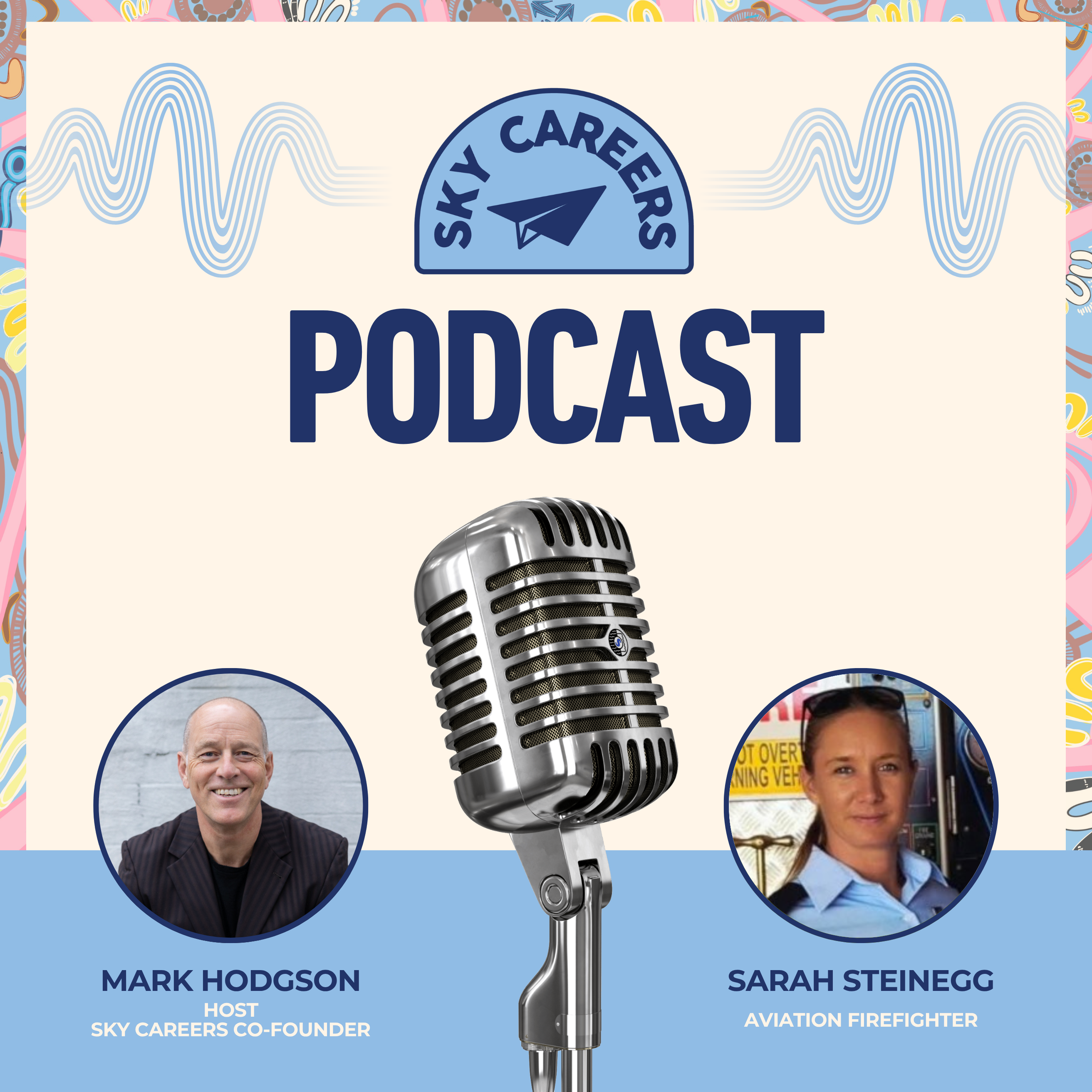
It's my pleasure to be your host. My name is Mark Hodgson, co founder of Sky Careers and this, this episode, we've got a first. We've got our first firefighter. We've been hunting high and low to find a firefighter and we've finally done something. We've done very well. We've got Sarah Steinik. Now Sarah is a talented and highly decorated substation office at the Townsville Aviation Rescue Firefighting Service, which is a mouthful. It's ARFF is the, is the short the abbreviation. So Sarah won the ARFF Firefighter of the Year award in 2026, which is a peer nominated honor in recognition of her outstanding professionalism and commitment to crew.
And she also in 2025 won an awe recognition award which is honored by the Australasian Women in Emergencies Network for her persistence, innovation and connection in building systems for community preparedness and recovery. Wow, Sarah, what a mouthful.
Lovely to welcome to the podcast. How are you?
[00:01:22] Speaker A: Thanks Mark. Thank you very much and thanks for having me. Yeah, I'm doing great. How are you?
[00:01:26] Speaker B: Yeah, really looking forward to this conversation. As I say, we've been trying to get an aviation fire firefighter on the pod for a while and we finally secured you and we've done really well. So I'm really pleased. We always like to start at the beginning. Sarah, tell us a little bit about your young, the young Sarah, where did you go to school and what kind of things did you study?
[00:01:43] Speaker A: Ah, yes, right. Well, we have to travel back to Christchurch in New Zealand.
So my parents immigrated from Germany and they landed in beautiful Christchurch and I went to school. High school was a Ricketon High school.
Many people won't know it. The odd Kiwi out there might know it.
And I must say I did enjoy school to a point.
I was very, I guess, sidetracked and about the world. More interested about the world than learning.
So yeah, to get me set, you know, settled down and paying attention, it had to be, it had to be something interesting and well taught as well for me to know take it on board, which I'd later figure out probably was a, a type of a learning difficulty, but yes.
[00:02:31] Speaker B: And what, what, what kind of, what kind of, what kind of subjects? Just anything that was well taught and, and captured your, captured your attention 100%.
[00:02:39] Speaker A: So I loved everything so long it captured my attention. You know, I, I liked maths to a point.
I liked art. I actually ended up getting into a lot of randomly as well. I played a few instruments along the way. But, yeah, sport, love sport. So, yeah, a little bit of everything, which in the end, now where I sit is quite interesting, where it's. I am, you know, a little bit. No. Little bit of everything, but not a master of anything really cool.
[00:03:05] Speaker B: And so what was. What was. What was the. What was the pathway from. From. From New Zealand? Well, first, I guess into.
Into your. Into. Into. Into employment and then ultimately into aviation, firefighting and Queensland. That sounds like a bit of a journey.
[00:03:22] Speaker A: Yes, huge journey. So the initial leap over was after the Christchurch earthquakes in 2010 and 2011. We lost basically most of our inner city and a lot of suburbs around the area. I always had a eye for emergency services. At that time, I was working actually in retail, hospitality. So, you know, working with people on the front line. Yes, it was retail. But obviously when the earthquakes went down, you saw who went, went which way. So I kind of went to a point of helping people, you know, evacuate, ensuring my family was safe and all that sort of. So that kind of brought that out of me. So we had a few friends actually move over or were already living in Mount Isa, which is as far into the desert as you can for Queensland, and we decided to hop over there and see what opportunities were there for us to, you know, early 20s, you know, you want to start making money, you know, start, you know, putting down some foundations and trying to. Yeah. Get your foot in the door and find out what you really want in life. So going exploring is probably the best way to do that.
[00:04:34] Speaker B: Well, tell me a little bit more about the instinct to walk, to turn towards the danger, rather than. Rather than, I guess, walk or run the other way. That's interesting.
It sounds like it's innate, which is really interesting because most of us, I think, love to think faced with a challenge like that. We do the right thing or the inverted commas, the courageous thing.
But I wonder what most of us do. I'm struck.
There's a podcast I was listening to the other day, and there's a guy written a book, and he talks about this principle of the 2%.
And the 2% is basically. Well, basically 98% of us aren't in the 2%, if that makes sense. And the example he uses that when given the opportunity to either use an elevator or a lift, 98% of people would choose an elevator or a lift. Only 2% will choose to use a. Stairs, which are. Obviously it's slower, but it's physical. It's probably better for us. And there's a whole lot of Mindset things around that. And I wonder if there's some kind of correlation between the 2% who actually say there's danger, I want to go and help people as opposed to whoa, panic, panic or some degree of either panicking as fear or I just want to save myself and run away. So there's a really interesting dynamic.
How did you find that desire or courage or whatever it was to actually move towards the danger and helping people rather than the other way?
[00:06:03] Speaker A: That's a really interesting point. And I think with the elevator and the lift thing, I would rather take the stairs, which is my way of I guess living. I've always, I've always taken the hard route. I don't know what it is. I guess you can. I've learned that you learn a lot more through the hard route and it's hard to live in that uncomfortable area. But that is the best way to learn is the hard way.
So if you choose an easy life and you know, kudos to you and some people need to because they're not in that headspace to be able to take these challenge challenges on, on top of everything else in life.
But yeah, I guess an instinct when something happens, whether you do fight or flight is I guess might be an internal instinctual thing. I've been brought up in a family of self defense so I in myself are quite comfortable. So then I feel like I am prepared to help others.
[00:06:57] Speaker B: Cool. Okay, so Mount Isa, Christchurch cold. Mount Isa warm or hot?
Then what happened? How did you end up in aviation? Or was that, was that, was there another step in between?
[00:07:11] Speaker A: Yeah, there's a few steps in between.
Obviously man eyes are, you know, your day job. But then I found out from a friend that you could actually volunteer as a firefighter. So I, the comment was, oh, you can do this for free. This is fantastic. So that's kind of that one comment, that one suggestion from a friend.
It literally opened up all these doors for myself. And giving your time to a service, even if it's volunteer, you're able to build these skills that then obviously move over into a paid career in that same sort of aspect, which is really amazing.
[00:07:48] Speaker B: Yeah. And what, how so you started as a volunteer firefighter and then when did, when did that. Well, firstly, how was that and what was the, what training was involved?
[00:07:58] Speaker A: So the rural fire service is absolutely amazing for people. You know, a giving back to the community, being there in the community when they need you most.
The training there is you just sign up obviously being at a certain age. So I think 16 year olds can sign up with the permission from their parents, otherwise there's just application form, blue cards, all that just to ensure our community is safe. And then we teach you everything, you know, hose bowling, pump operations, everything that we do now in.
In air service with the aviation job. So yeah, learned a lot of skills there.
Moved into obviously when it wasn't burning in Mount Isa, it actually floods so moved into the SES as well. So brought on some more skills on top of all that.
[00:08:47] Speaker B: And then the ses, Sarah, for those, for those who aren't familiar.
[00:08:51] Speaker A: Yep. Is the state emergency services. They do a lot of floodboat search and rescues. They are now under the banner of Queensland Police Service.
[00:08:59] Speaker B: Okay.
[00:09:01] Speaker A: And yeah. So with that moved on and pushed the boundaries a little bit more and joined the Queensland Fire Department as an auxiliary, which is a casual on call 24 7. We back up the permanent station. If they go to a call, we either join them or we cover on station. So then adding to the skill sets, we're able then to learn about structure fires and car accidents and how to educate patients and furthering developing these skills and first aid and so forth. Which really laid a really good foundation for when I applied for the aviation job. Edworth Air Services Australia.
[00:09:43] Speaker B: Right. So that.
[00:09:44] Speaker A: What.
[00:09:44] Speaker B: What kind of. So you're being trained both as a volunteer and as a semi paid firefighter along how many years are we talking about that sort of that journey for you?
[00:09:57] Speaker A: Yes. So I would say about two years into the rural fire service, I joined up with the auxiliary service and all up from about 20, so I'd say 2011 I was a Mount Isa and I left in 2016.
[00:10:11] Speaker B: So I guess you don't sound like someone who spends a lot of time sat home watching television.
[00:10:15] Speaker A: No, to this day I have not watched a single episode of let's say Game of Thrones. I have no idea what goes on.
[00:10:23] Speaker B: So yeah, that's really interesting picking up on our 2% piece. I wonder if there's something in that about the 2% thing.
I suspect there is. I suspect there is now also it sounds. And I can. For those who are watching this on YouTube, we can see your face, your face lights up. You obviously love the training and the learning aspect of all of that.
[00:10:45] Speaker A: Yes. So obviously I found my niche in learning with hands on understanding the why behind the concept of this learning why we bowl a hose a certain way, why the pump has to, you know, be at a certain level or what happens when something breaks. I absolutely love. And I did, yeah. End up finding what my how my, how I learn is why, why do we do this? You know, keep asking that question and finding that bottom foundation of where this developed from, basically.
[00:11:15] Speaker B: Yeah, I love that idea of multiple intelligences and you know, that the academic idea of, oh, you've got to be this or that or the other thing, but that kinesthetic learning, so many different of learning. And for you it has to make sense. Why. What? Show me a practical why this thing needs to be done this way and then I'm interested in and then maybe the theory or the physics or the whatever that, then that comes behind it. But actually, you know, make it, make it, make it make sense to me, which I, which I love. I think, I think that's so powerful.
[00:11:43] Speaker A: Yes. Yeah. And it took me many, many, many years to, to figure this out, which is fine. Like, you know, it's brought me to where I am today and it's enabled me to go into study as well because I've been learning the whys for, you know, many, many years. So I'm actually able to apply academically
[00:12:02] Speaker B: eventually and picking that apart a little bit more. So how, as you get more, I guess you get involved in more complex as both in terms of scale and complexity, challenges, whether floods or fires or get into aviation, there's a whole lot of other things as well.
Is were you able to, were you able to access that study and enjoy that study? Because I guess it gets more theoretical as well.
[00:12:29] Speaker A: Yes, it does. But that didn't open up until I was actually in the.
Once I made it into Air Services Australia with the aviation rescue firefighting service. A couple years into that I achieved, you know, found myself with again more, you know, great people in my life were had decided to start studying something and I didn't realize as a Kiwi in Australia that I was able to study as a. An Australian. So not international fees. So I actually looked into and just tried one subject, you know, you don't know. Right. And so I tried a subject and we are almost seven to eight years into my bachelor's degree now and you know, try one thing.
[00:13:15] Speaker B: Well, yeah, eat the elephant one bite at a time. Right. I know what's your bachelor's in, Sarah?
[00:13:21] Speaker A: Bachelor's is in emergency management or disaster management.
[00:13:26] Speaker B: I love that. Now get us. How did you get.
What was the final stepping stone into aviation firefighting?
[00:13:35] Speaker A: Right. So this was actually a bit of a fluke, to be honest. So in 2016, after being unsuccessful becoming a permanent firee in the Queensland Fire Department, I made a choice to beeline for the coastline, so that for any sort of unit applications going forward, reapplying any of that sort of desire, I had to be on the coast because it was quite expensive to fly in and out of Mount Isa for any type of testing.
So I beeline for Townsville, straight line out of Mount Isa, kept it nice and simple. I did have a few friends here were able to take me in straight away, which was really good. I made those friends through the hospitality industry that was still working in Round Isa, as well as all that volunteer stuff, too.
So a year into that, I was driving trucks. To be honest, I'd managed to get my HR truck license while I was a Mount Isa and I was driving trucks around the city and I really wanted to get back into it. I'd missed the camaraderie, really. Yeah. I just loved it. It was great.
So I started looking for jobs and I came across the air services, aviation rescue, firefighting service on seek, and I was like, you know what? I've got nothing. Got nothing to lose. Right. I can either drive trucks.
Yeah. I can, you know, drive trucks for the rest of my life, which is fine. But, yeah, yeah, nothing, absolutely nothing wrong with that. That's how the country turns.
So I gave it a shot. Nothing to lose, no anxiety over, if I didn't pass the theoretical, which was always a barrier for me, and decided to do something about it as well. So I got some. Paid for some online, not exactly tutoring, but more like testing for aptitude testing. So just the tests online. So I was like, all right, let's, let's, you know, you got to give a little bit back into it, pay some money, get this underway, start to learn how the aptitude testings are expecting of you. So I did that, applied for it, and that was back in 2017.
I applied for that one and found out I was successful and I was on the recruit course in 2018.
[00:15:59] Speaker B: Wow. Fantastic.
That must have been very exciting for you.
[00:16:04] Speaker A: Oh, it was.
It was a dream. And what was really sweet was the company that I was working for were really excited for me as well.
[00:16:12] Speaker B: That's very cool. That's very cool. So 2018, you started your aviation firefighting training.
How was that? How did you find that training? Because, you know, it's another level, isn't it?
And specialization as well.
[00:16:27] Speaker A: Yes. So the great thing was I obviously had a background in bowling hoses and cutting up cars.
[00:16:33] Speaker B: I got the houses done by that. Yeah.
[00:16:37] Speaker A: So. And look. And it had already been to, you know, car accidents and already had done, you Know the worst case scenario with CPR as well. So I knew what I was like around people who were not quite successful or a house fire, you know, actually being engulfed in flames. So that sort of stuff you don't know until you've actually tried it. So having that already happening and having that foundation was really good. So I was able to really pay attention to the aviation part of this job and which is time critical. Right. So we gotta, we've gotta use our resources really well in a really time critical situation and make the best of the situation that you can.
[00:17:20] Speaker B: Yeah. Talk us through that a little bit more. I think I know what you mean, but what's the big difference between I guess, you know, not just real firefighting but you know, if there's a house fire or a kitchen fire or something. And yeah, we probably, we've either seen or we've seen that on TV or we've seen maybe people have been unfortunate enough to see people around houses burning and so cars crashes and so forth. We're probably fairly familiar with that. What changes when it's around aviation and
[00:17:49] Speaker A: aircraft, a lot changes. Problem with, not really a problem, but the issue with the aviation is that you have a lot more people in a small amount of space.
So like a house fire, you might have a house of maybe two to I don't know, six people, family members in an aircraft. We're ranging from maybe the flight school has the person, the student and the pilot or you can get up to 200 plus people depending on which airport you're at, obviously.
So you have, yeah, like I said, a lot of lives to a confined space and then that confined space. Not to make it sound super scary because obviously aviation flying is the most safest transport.
But you're surrounded by fuel, you're surrounded by luggage, a lot of things that are flammable. So that's, this is why it's so time critical. And it also depends on what's going on as well. You know, it could be as small as hot brakes from a rough landing or you could have a full blown crash where the fuselage is broken. And it is a bit harder because you've got the oxygen's been introduced to the fire. But again, time critical amount of people involved, the amount of fuel that's around as well. Hence why they do try and dump fuel before landing in case they have an issue just to reduce that hazard.
[00:19:09] Speaker B: Yeah. And also I'm just imagining, funny, I'm flying to Perth tomorrow, you know, and going back to our 2% thing, we started the podcast with, I mean, you just know if there was even a minor emergency that you've got 98% of people. So that's probably a bit of a. You have a lot of people flapping and panicking and the cabin crew are obviously trained primarily to control those things as well. But I can imagine the reality would be complete a lot of panic with people, plus obviously all the other things. So I think when were it to happen, it would be a very, very challeng challenging situation. So you guys have got such an important part to play in trying to de risk or create the best possible outcome, haven't you?
[00:19:56] Speaker A: 100%. And that's our job basically.
To the nuts and bolts of it, that's our job. We get there in a timely manner with the amount of trucks that required. So here at Townsville, you'll have two on a Jetstar flight. If something goes wrong, you'll have two of our trucks right there ready to go. And that's our job with the, you know, obviously with the water, the foam or the dcp, whatever is required to deal with whatever material was burning.
[00:20:24] Speaker B: Lovely. Remind me, what color are your trucks?
[00:20:27] Speaker A: Yeah, that's the argument. Is it yellow? Is it lime green?
[00:20:29] Speaker B: Is it now? Now we've, we've got the intro stuff out there. What's the real what's. What's. What's the answer that what color are your are your trucks, Sarah? Starting.
[00:20:38] Speaker A: Ah, I don't know.
It's not yellow. Look, I've driven all three trucks and all three different services. It's not yellow, it's a lime green. It's a green. I don't know, in between.
[00:20:52] Speaker B: Anyway, we're not going to miss you o when you come hurtling out, hurtling out to help us talk us through a typical day in your role.
[00:21:02] Speaker A: Right. So I'm split between two worlds as a substation officer.
I still do the fiery things and I also support the officers in charge. And then I can also step into the role of the station officer, which is one below the fire commander.
A typical day for a Whari or anyone at the moment would walk into work with your coffee in hand or go to the kitchen, make a coffee and funnu me.
You come in, you check your roster because we do certain riding positions and we also have to be in the fire control center that we also manage.
So everyone gets a turn up there.
So. And also the seats rotate so you can either drive or you can operate and that rotates through the day. You rotate trucks as well, depending every station, every Cruise different. Every station is different. But can you come in?
[00:21:58] Speaker B: Just. Just.
Does everyone drive?
[00:22:01] Speaker A: Yes. Yeah, yeah, yes. So as a requirement before your recruit course even starts is you need your HR truck license.
[00:22:10] Speaker B: Okay, cool, cool.
[00:22:11] Speaker A: Yeah, yeah. You. But you don't drive operationally until you have done everything that's required at your local station. So you don't come in straight from your recruit course and jump on a seat.
[00:22:24] Speaker B: Okay, cool, cool. Now, I was just. Because the reason. Sorry. The reason I asked the question. I was surprised that I've got a friend who's in. Who's in the.
[00:22:31] Speaker A: The.
[00:22:31] Speaker B: The. The. The. Not the rfs, but in the fire brigade in. In Sydney. And he was telling me everyone drives. I was assumed. I was assumed they were designated drivers for you, for the. The blue light drivers going in. But apparently, apparently everyone does it. Which. Which did surprise me.
You said it surprises him, some of them.
[00:22:50] Speaker A: Oh, I know. And. And look, look, there are people, you know, who have, you know, never driven a truck before they got into our job. So. And, and look, they. They are very professional and they go away and they get the training they do require. So there's no doubts there. But yet you don't drive on your first day when you first rock up to station. So that's definitely.
Look, you. You may have driven them on the recruit course or not, but they're every. Every airport's different. Right. And you don't know your way around and you still need another license to drive airside and all those.
[00:23:25] Speaker B: Okay, sorry I interrupted you. Sorry. That's fine for your day. No, it's my bad. Sorry.
[00:23:32] Speaker A: So where are we? Right, so you get your riding positions, figure out what you're doing for the day. You make a coffee, we'll go out and switch the crew out and have a good yarn about everything and probably nothing for the first half an hour. It's where the officers, you know, they've finally got all of us together before the day starts and we have a discussion about what's going to happen that day, regards to the training. If there's any visitors coming through, anything, anything.
Have a couple of coffees. And then the daily on the vehicles begin. So we track our trucks, operational readiness every morning.
And that's every bit of equipment and the operation of the pump.
And then from there we will go into what's called. It's called max. It's like a maintenance sheet. So basically every item, depending on what it is, has a monthly. We call it a monthly or a quarterly or an annual maintenance check. And depending on what it is, it either gets checked by us or a specifically trained person on station or it gets sent away back to the manufacturers for that's normally something like annually done.
Once that's all complete, we have a separate sort of station duties which is either sometimes on the weekend can be full kitchen cleanup.
It can range from washing out the engine bays, all sorts of other sort of side maintenance just to keep our, you know, keep our station clean and tidy and operational. It is very important, you know, there's nothing in the way that can stop us from responding. Basically.
[00:25:14] Speaker B: Yeah, yeah. And how long are your shifts, Sarah?
[00:25:19] Speaker A: So this is also very station dependent.
I couldn't tell you which ones are, but we are a 24 hour station.
We work 24 hours on, 24 hours off, 24 hours on and then five days off.
This was, we were, we used to be a 1014 station, which is what a lot of the state fire services do, which is the two days a day off and the two nights and then your four off. But we changed about two years ago.
[00:25:51] Speaker B: So you're, you're basically that you're living there for a day.
Living, training, breathing.
[00:25:57] Speaker A: Yeah, living, training, sleeping.
There is downtime because obviously we are there 24 hours and we do need to be operationally ready.
So there are downtime, there is sleep time. If you're not upstairs in the fcc, like I've said, the fire control center where we dispatch our crews from.
[00:26:18] Speaker B: Fantastic. And I guess it's all about training, isn't it? Because in any, you're obviously doing training, you're doing maintenance stuff, you're doing training stuff during the day and there would be long periods of not much happening and then very short periods where you, you need to, you know, you need to be on your game immediately. So that's. That, that, that strikes me as a, as a, that that must, must be down to an immense amount of muscle memory and just, just training, training, training. So when it, when, when it becomes real, you, you guys are just ready to go because it's just another, it's, it's what you've been doing anyway, but it's just not a drill. Would that be accurate?
[00:26:57] Speaker A: Exactly, exactly. And that's any fire service, you need to be able to do your job basically blindfolded. You just, it should be second nature. And this is, this is why we train. And it is hard sometimes because we're training for something that hopefully never happens, most have never seen before.
So. But it is if you're comfortable with the foundation of your, of your skills and your equipment, then the next thing you have to worry about is the actual situation.
[00:27:26] Speaker B: Yeah, yeah, that's. It's, it's really interesting.
There's a big, there's a massive mental part to that, isn't there? Because, because I. The enemy is boredom or, you know, I guess then you can. Bit of a complacency and you can see how without very rigid systems it would be quite easy. Oh, I don't need to do that. We know that works because someone checked it an hour ago or a day ago and yeah, it's very easy how you can see it could go wrong and how it's so important that you not only have the systems but also the mindset that supports the systems 100%.
[00:27:57] Speaker A: And that's where that discipline comes in because it is very easy just to go, oh, we did this last week. I'm like, yes, you did. And one of the good things is we have a really, really well set up training system. A because obviously we're very heavily regulated by casa. CASA tell us everything that we have to do in whatever amount of time and how it's done and everything like that. Which is, which is great. Look, they tell us how to do it, we implement it, we get it done and that even comes down to training. It ensures that certain things that are good, critical are done every three months at least. At least, if not more. But that's the bare minimum for certain things. Obviously some things can be left because not as critical, but especially something like your ba. So that's the breathing apparatus that we use to wear to internally. So something like that has to be done more frequently due to the safety behind that as well.
[00:28:55] Speaker B: Yeah, cool, cool. Do you enjoy the leadership aspect of it, Sarah?
[00:28:59] Speaker A: I do, I.
It's funny, it's. I was thinking about this. I was like, I think I've been formed by good and bad leaders, if that makes sense.
[00:29:10] Speaker B: Yeah, it does.
[00:29:12] Speaker A: So I've. I've had ones that, you know and though. And this is not talking inside a services, I'm talking broadly people and I've just gone, I don't want to do that. Or I think that's either outdated maybe, or you haven't considered everybody in the room and that. And that was me. I was the, I was the weirdo in the corner who was like, this doesn't make sense to me or I'm not learning this or this. You know, it doesn't. I can't quite capture what they're trying to teach me. And so I have taken that on board and gone. All right. Anyone who's learning from me, I want to ensure that, you know, they are understanding. And if they don't tell me, I'm more than happy to readjust and readjust and learn how I can better serve these people.
[00:30:00] Speaker B: Way to communicate it.
[00:30:02] Speaker A: Yeah, exactly, exactly. Because I've been there. Right. And this is kind of like trying to break this cycle of, all right, I can be better for you. And that's what a leader should do. Right. They shouldn't get stuck going, no, I know this. And this is how it works.
[00:30:17] Speaker B: Yeah. And then they default to tell mode and command and control and, you know, just so finger pointing, as opposed. And I keep coming back to.
I love your earlier, earlier comment about the why I need to understand why.
Help it make sense to me why this is done this way or why it's important or why in that sequence or whatever those things are. So I think that's fascinating. What part of your job do you enjoy the most?
[00:30:44] Speaker A: Like I said, I've been in the fire service, got out, got back in again. It's the people, the camaraderie, the family that's built around it, but it's also the service, you know, serving the community, serving the people, having that skill to help them as well. You know, you're in. You're like the best people for the job, to help because you train and.
Yeah, just. I love it. And of course, the trucks, they're. They're nothing. That's. They're only. In our country, it's only a federal service. No one else has them. It's. They're fantastic.
[00:31:14] Speaker B: I know what color they are, but we love them.
[00:31:16] Speaker A: Yes, exactly.
[00:31:19] Speaker B: What's the least favorite part of your job, Sarah?
[00:31:23] Speaker A: Well, to be funny, like, obviously, I've come from a background of, you know, a busy fire service into a less busy fire service, which is great. Right. So for the fine public, for the community who use the airport, we're not busy, which is great for them.
For us, it's. It's. We love to train, but it's also that feedback on, okay, I've helped someone and what I've been taught actually works.
[00:31:48] Speaker B: Yeah.
[00:31:49] Speaker A: So it's kind of that confirmation bias.
[00:31:50] Speaker B: Yeah.
[00:31:51] Speaker A: So that's a little bit hard to, I guess, train for or even explain to people who have never been to an actual job.
So that'll probably be the least. But it's manageable. Right. So for me, I occupy myself on my days off in, you know, giving back to my community and being part of the Rural fire service as well. So that kind of ticks that box for me. And that's personal, obviously.
[00:32:16] Speaker B: Yeah, it's actually I was going to ask you what, what do you do when you're not, not at work? So I'll ask you a bit about the non volunteer thing. But volunteering seems to be very important to you or contributing and giving back.
[00:32:29] Speaker A: Yeah, it's, it's again, it's a, it's a, it's a, I guess another family again, you know, moving countries and stuff like that. It's where you find people, very like minded people who are willing to give up their own time as well to help the community and learn and yeah. Grow as well as people as well as a group and as well as a community because you're actually in the community that you're serving and it's, they see you, you're driving around their properties or you're filling up the truck at the local fuel station and they, you know, they're grateful that we are there on our days off or have even left work.
Like we don't recommend that to our volunteers but if they're able to take some time off work that hopefully does not affect their personal life.
[00:33:21] Speaker B: And what hobbies do you have that aren't giving back and sort of being ready to save 200 people's lives?
[00:33:33] Speaker A: That's a really good question because currently, you know, my life is filled with preparing for the bushfire season, being ready, you know, obviously going to work.
We, I am at uni, obviously I'm currently on uni breaks so that'll start up again in a week's time or so and then otherwise we're just at the gym. Right. And again that's being prepared for the, for the job and being fit for the service.
So downtime, going to the gym, hanging out with the hubby and the dog, hang out with friends. Obviously it's really, really important. All the training, all the teaching and all the learning that you actually do find some time away from everything just for your brain. You have to, for your mental health, you have to be able to take a day away from everything.
[00:34:20] Speaker B: Yeah, I think that's, I think, I think that's great advice. I think, I think it's funny. There's, I mean there's a big, there's a bigger conversation about how, how technology make isolating us in lots of ways. But yeah, I think what you do in its own way can be quite isolating because there's a lot of hanging around on your own as well as Being part of a team, isn't it? So it's really important to lean into friendships and the team aspect.
[00:34:46] Speaker A: Yes, definitely. And yeah, just to give your brain also a break as well. It's always on what mine is anyways. It's always thinking about something, how can we do better with this and how can we better that? So you do need to have that break. And I've learned that a lot over the recent years, especially with the added, I guess, stresses of uni, promotional courses at work, all that sort of stepping up role. You need to find some time just to walk away.
And you do come back better, right? It's like anything, a rest day from the gym, you need it because you come back better, you come back stronger.
[00:35:22] Speaker B: 100%. Yeah, yeah, yeah.
What advice would you give to other young women and men who are looking for a career not just in firefighting. Aviation. Firefighting. But obviously you're touching, but you're completely integrated with the overall aviation community doing what you do. What advice would you give to other young men and women looking for a career in and around aviation?
[00:35:53] Speaker A: I think in general it's, and it's happened to me multiple times is one conversation can change everything. Talking to this one person or engaging yourself in a certain course or showing up and talking to someone in the sector one. That ripple effect from that situation can open so many doors, especially, I mean, fire service. Obviously you can apply and find out the requirements to get into the fire services. So for Air Services Australia, on our website you can see the requirements to become an aviation firefighter. But in life in general, I think having these conversations with certain people is just so important, you don't know what's going to happen.
[00:36:42] Speaker B: I love that. I think that's even.
I'm thinking I'd love a Sky Careers T shirt that says one conversation can change everything.
I think that's really cool.
[00:36:52] Speaker A: I like it.
[00:36:53] Speaker B: Yeah, I do too. I do too. One conversation can change everything. I think that's very cool and I get it.
I mean, I've got to land the plane, as we say, because I'll take too much of your very generous time. But your story, you've got a lovely style around you. So, Sarah, and an openness. And in this very short period of time, you've told us about how a young girl from Christchurch in New Zealand, you know, got a bit curious and didn't particularly like certain kinds of learning and then thought, that looks interesting. And then I think, really interested about the Christchurch earthquakes and found that there was something in that Horrible, horrible situation. The challenge that brought out something in you that said, I want to help, I need to help. And I, I have the makeup, some trained, some innate into being able to operate. And as you say, it's not for everyone being able to operate in stressful conditions and actually help. And then you've gone from there and you've taken yourself to different places, to warmer climbs in Mount Isa, and then you've sort of carried on that curiosity and not just one path, but use your, to use your language. You've had a few one conversations that have you taken from one place to another place to rural fire, rfs, ses, then into aviation. And now you're obviously doing really well in that and thriving. And also the other thing that shines through is your passion for giving back to those around you, building teams and contributing to the community. So I love that. I've really enjoyed speaking with you. Sarah, thank you so much for being on the on the Sky Careers podcast. You're exactly the kind of conversation we love because I think so many people can pick on different parts of what you're speaking about, whether whether you're a new person, interesting, potentially specifically becoming a firefighter or generally interested in aviation or really maybe there's nothing to do with that at all. They're just in an area where they think, actually, I'd really like I should be volunteering in something or I want to become part of a team, I'm operating outside of teams or I'm not, or the other thing, I'm not really doing what I. Because one thing that shines is you've really got a passion for what you do.
And that goes a long way. And it's a, you know, I would think if you don't love being a firefighter, then spend 24 hours on the side of an airfield will be really boring. So you've obviously, you obviously love that, so that's really cool. So thank you so much, Sarah, and I wish you all the best for wherever your career takes you next, because I'm sure it'll take you somewhere interesting. Thanks so much.
[00:39:29] Speaker A: Thanks, Mark. Thanks so much for having me.
[00:39:39] Speaker B: Thanks for listening to the Sky Careers podcast. If today's conversation has sparked your interest in aviation, then head over to our
[email protected] au whether you dream of flying aircraft or you're curious about the hundreds of other exciting roles that keep the aviation industry moving, Sky Careers is your gateway to discovering these opportunities.
And if you are already in the industry, check out Sky Careers Connect and Sky careers leadership and consider joining our online learning community.
Until next time, keep reaching for the skies.