[00:00:07] Speaker A: Hi, welcome to this edition of the Sky Careers Podcast.
My guest today, I've been hunting him down for a while. He's been a bit.
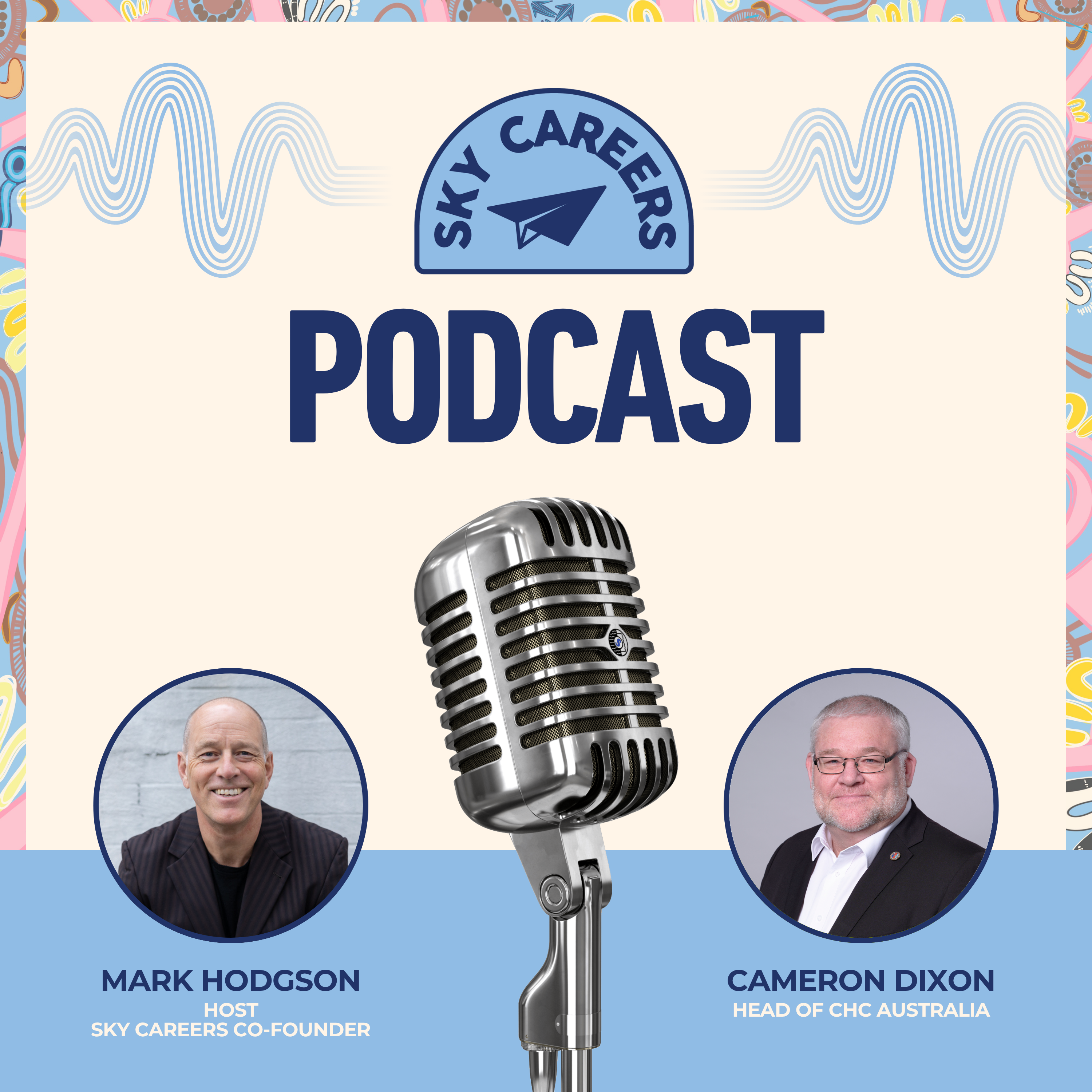
A bit all over the place. He's a busy man, he travels a lot, but we finally got him. Cameron Dixon is the head of CHC Helicopter in Australia. He also has responsibilities across Asia Pacific. He's a. He's a delightful man, a great character. Got lots of experience starting in defense and now in the pointy end of helicopter operations in Australia. It's my absolute pleasure to welcome you, Cameron, to the Sky Cruise podcast.
[00:00:46] Speaker B: Welcome.
[00:00:47] Speaker C: Thanks, Mark. Great to be here and thanks for that introduction.
[00:00:51] Speaker A: Well, let's start with where you are today to give people a bit of an outline of what you do. So tell us a bit. What does CHC Helicopters do in Australia and what's your role?
[00:01:03] Speaker C: Yeah, CHC Helicopters, global company within Australia. We have a range between 20 and 30 aircraft. As a global company, we can move the aircraft around the world to suit operations. We have three divisions here in Australia. The oil and gas division where we provide transport out to the offshore facilities as well as limited search and rescue capability and 24,7 medevac. The other area is search and rescue. We have a defense contract on six military bases where we provide search and rescue helicopters. We've had that contract for almost 40 years now. And we also have the DFUS EMS aircraft, bright yellow RAC rescue aircraft here in Perth where we operate out of two bases, Jandicott and Bunbury. Three aircraft to provide EMS for the Western Australian public.
[00:01:58] Speaker A: Well, there's a lot going on there, but I'm going to go back in time. Let's go right back.
Where did you grow up and what did you think you'd end up doing when you left school as a young Cameron Dixon?
[00:02:11] Speaker C: Yeah. Interesting. I grew up in Raysbud on the Morning Peninsula in Victoria, a beachside town on Port Phillip Bay. A great place to grow up.
Didn't really like school, but at school I did enjoy accounting, economics and languages.
So originally I was going to go into accounting, but that didn't happen.
[00:02:34] Speaker A: Oh, my Lord, we saved you from that. Sorry, accountants listening.
[00:02:37] Speaker D: Yes.
[00:02:40] Speaker C: So, yeah, I did leave school and start working at a bank and that was the initial sort of direction I took for a very short period of time.
[00:02:49] Speaker A: Okay, which leads me to the obvious next question.
As someone who's spent probably most of their adult career in aviation in some way, shape or form, how did aviation first come into the picture for you?
[00:03:02] Speaker C: Yeah, I was in Melbourne for a course working Working with the State bank of Victoria. And I was extremely bored and I wasn't enjoying myself and I just happened to walk past the Defence Force recruiting office.
So I wandered in and sort of said, hey,
[00:03:21] Speaker A: get me out of here.
[00:03:23] Speaker C: And it was interesting. They sort of said, well, what would you like to do?
And as I said, I enjoyed languages at school. So I said, look, I'd like to be a linguist in the military. And they said we're not recruiting. What are you doing at the moment? I said, work in a bank. And they said, well, you can come in as a pay club and then once you come in you can apply to transfer across to be a linguist. But sort of sign here. And went home to my mother. I was only 17 at the time and had to get her to sign a piece of paper to allow me to leave home at 17.
[00:03:54] Speaker A: How did that go?
[00:03:57] Speaker C: Look, from memory, she wasn't that happy, I don't think, at that age. And funnily enough, my youngest son at home here said to me recently, he said, dad, I'm now at the age where you told your mum that you were leaving home. And that sort of struck home and I thought, okay, now I think I understand how she might have felt.
[00:04:14] Speaker A: Wow, that's, that's funny. So, so you, so you, you, you joined which defense, which defense force did you also, which grant branch did you do you join?
[00:04:23] Speaker C: Yeah, Air Force. So joined the Air Force, ended up doing 23 and a half years.
Did, did a few years as a pay clerk until eventually I got accepted to move across to languages. 12 month full time study at the Australian Defence Law School of Languages.
[00:04:42] Speaker A: What, what languages, Ken?
[00:04:44] Speaker C: Indonesian. Say Bahasa was the primary and then you normally do it a second or a third. My second was pidgin. So png, Vanuatu, sort of language.
Yeah. So yeah, from there went to the Defense Signals Director in Melbourne and a few years there, a few years as an instructor up in, in Toowoomba in Kabala on an army base Joint Force training School. And then out of the blue I was asked if I wanted to become air crew on the P3 surveillance aircraft, maritime patrol aircraft. And I thought, yeah, why not? And that's sort of where I went into.
[00:05:21] Speaker A: How, how when are you there in your career?
[00:05:24] Speaker B: When did that happen?
[00:05:26] Speaker C: That was around 95, 96. So about 10 years into my Air Force career, I got asked, you know, am I interested to move into, into actual flight crew?
[00:05:38] Speaker A: Well, and was that, was that to
[00:05:39] Speaker B: do with the language piece or, or, or completely separate?
[00:05:43] Speaker C: No, a little bit, but Completely separate. Was just out of the blue they're looking for people to move into the mustering called aea Airborne Electronics Analyst. And again, why not?
[00:05:54] Speaker A: Yeah, I, I, I love the, I
[00:05:56] Speaker B: love the, I was gonna say this isn't the right word. It's I love. I was, it's not. I was going to say, I was going to say randomness. It's not randomness. I love the fact that you, you opportunities that come to you as they tend to do in aviation generally, obviously defense does that kind of stuff. Some sometimes with great logic, sometimes with no logic at all.
[00:06:13] Speaker C: Yes.
[00:06:15] Speaker A: And you know, you've seized the day so that then led you to do, to stay on the, on the aircrew side of things. Did it?
[00:06:24] Speaker C: Yeah. So 10 plus years on the air crew side of that.
Normally during a air crew career sometimes you get a break posting, we'll call it from, from flying.
So I got one of those and went into operations in wing operations and squadron operations. So that really gave me the boost, you know, the, the knowledge and experience I needed to move into sort of this role. But went into wing operations, a few tours into the, into the Middle east during that time, then back to, back to flying for a very short period of time before I joined chc.
[00:07:00] Speaker A: Right. So, so what, what, how I'm trying to do some, some. So you're in Your what, early 40s when you left left the Air Force, something like that or late.
[00:07:10] Speaker C: Ah, I would have been very early 40s.
[00:07:13] Speaker A: Yeah, early 40s. And was that, was that, was that always always the obvious next thing or was was it you kind of done done defense or was, was it was, I guess. How did you find out about CHC and what.
[00:07:27] Speaker C: Yeah, again, out of, out of the blue. I wasn't looking to leave the Air Force.
Interestingly around that time, you know, the, the 20 and 25 year mark in, in defense, I feel you've got to make that decision. Are you going to stay in for the rest of your life or, or is there something else outside?
As I said, I wasn't looking for a job, but someone I worked with was and he got a ping of a job that was coming up at CHC for, they called it an operations manager.
He sent it to me and said I think this one's for you.
Which I just sort of ignored for a few days and we were heading away on a deployment and the day before I thought, you know what, I'll just put it in and see what happens. And I think I landed in, we were heading to Thailand and landed in Thailand and the phone pinged and it's like, can you come in tomorrow for an interview? Which I had to delay, obviously. So a week or so later I went in the next, the day after getting back to Australia and did an interview.
[00:08:30] Speaker A: Before we move into cac, all that time in the military, what do you think? What are the main things you got out of your time in defence?
[00:08:39] Speaker C: I think the biggest one for defence, and I think a lot of military will say the same is just friendships and teamwork.
The people you meet in defence, the people you work with, defence you become very close with. And even if you don't see them very often while you're in the military, you still connect. And then, you know, when you get out of the military, there's so many people that you connect with that you haven't seen for, for years and years.
[00:09:05] Speaker B: Yeah.
[00:09:06] Speaker C: And it's like you just talked to each other yesterday over a beer or, or a coffee. And it's amazing that that side of the house and I think the other big one is life experience.
You know, defense gives you, we'll say, a lot of life experience. Yeah. Some good, some bad. Yeah. But it teaches you.
It teaches you a lot. And I think, you know, as I've gone out and as gone into to, you know, the civilian side of the house, you can see the difference between military people and civilian people. Military people do bring it a different mindset sometimes to the, to the game.
[00:09:43] Speaker B: Yeah, yeah.
[00:09:43] Speaker A: When it gets serious especially, I would think. Yeah, yeah, that's good. Okay, so chc, you joined there and chc, I mean, operates in some pretty serious environments, as you explained at the top of. The top of our conversation, including search and rescue, emergency response and offshore operations.
What do you enjoy about that world? Sort of leading the teams around that
[00:10:05] Speaker B: and what are some of the challenges?
[00:10:08] Speaker C: Yeah, look, I enjoy the dynamic way that aviation is. We'll say it's always something new.
It's definitely not a 9 to 5 job.
I think I'd be very bored in a 9 to 5 job going to the office, doing the same thing day in, day out.
I've been very lucky in CHC to, to have various different roles before I got to this one. One of those in, in global. I was based in Dallas for six years.
[00:10:38] Speaker B: Looking after Dallas, Texas.
[00:10:40] Speaker C: Yeah, Dallas, Texas.
Yeah. Yeah. So we had an operations center there. And then I was asked again, would I look after our global operations again? Why not?
So, you know the challenge of looking after bases in, in Africa, Southeast Asia, Central Europe, South America, we'll say there's, there's challenges in all those locations.
So when, when I moved back to Australia, end of 2019, into a roll back here, I will say life was a little bit easier than dealing with the challenges of those countries.
Even though it's dynamic, even though day in, day out, it's just so much fun. And I think the team, you have to have the team that wants to work hard and have that fun as well, because everyone needs to do their share. Otherwise in aviation, it just wouldn't happen. So many different people in so many different roles to make it happen.
[00:11:37] Speaker B: Yeah, I mean, I think I've been privileged in this sort of. As the podcast host spoke to some fabulous people, and I think you mentioned it already. One of the key, key themes is teamwork. You know, everyone's as important as everyone else. From the person who put the. Puts the chocks in and checks, checks some engineering last minutes and signs off on the paperwork to the, to the air crew and the pilot, you know, it's. Yes, nothing works for air traffic. Nothing works. If a single point of failure, if one of those people, one of those things doesn't work, that something failure or the mission or the things just don't. Just don't happen. Which is incredible, I think. Test teamwork.
[00:12:17] Speaker C: Yeah, definitely. And I raised that a year or so ago in a. In a meeting we're in with a wider leadership group globally. And I said, people need to understand what they do in the business. And in the business, they help the aircraft fly. And, you know, if you look at our emergency service aircraft on the RXC Rescue, deepest aircraft, you know, it saves lives.
So you might be in procurement, buying birds or paper, or, you know, you might be in hr, managing people and sometimes problems. But all of that leads to that aircraft flying and saving a life.
[00:12:51] Speaker A: Yeah, no, I think that's true. And just going back, you reel off a shopping list of both exotic and interesting locations from Central Europe, South America, Dallas, in the States, which was. Was there a particular favorite or. All of them had their own flavor.
[00:13:10] Speaker C: I think they all had their own flavor.
There were places I went that I never thought I would ever go to.
One of those. Kazakhstan. The first time I sort of said Dasvadanya was like, well, I never thought I would say that, but I think Kazakhstan was probably my favorite.
Going in there and the people.
It's just an amazing place. An amazing place.
[00:13:36] Speaker A: How long were you there for? Okay,
[00:13:39] Speaker C: in Dallas?
[00:13:40] Speaker A: No, no, in Kazakhstan.
[00:13:41] Speaker C: Oh, in Kazakhstan. Look, I was in and out, probably Five or six times a year for a week here or a week there. So not, not there permanently. Just flying in and out looking after the operation. We had a really good team on the base there.
[00:13:55] Speaker B: Right.
[00:13:55] Speaker A: Yeah, I must, it's, it's, it's, it's on my, it's on, it's on my. All, all the, there's lots of the stones. I think it's, it's, it's fascinating part of the world and not, not a place most. Well, you would know more about it than I do, but a lot of people don't know much about it. So it's always, it's always had an appeal.
[00:14:10] Speaker B: But what, but what?
[00:14:11] Speaker A: I'm just, I'm just as we, as we rattle through this. Obviously. Yeah, we're minute 14 and we've rattled through your life from a, from a, from a, from a, from a lost
[00:14:18] Speaker B: bank clerk in 17 year old in
[00:14:21] Speaker A: Victoria suddenly, suddenly seen a recruitment post. That's got to be better than this, you know, to doing all the things you've done. I mean it's, it's an, it's an incredible adventure you've been on.
Talking of which. So you've, in the course of that lucky sort of journey or, you know, you've led people in some very different environments which you've described.
How do you think you've evolved as a leader and what have you learned along the way?
[00:14:48] Speaker C: Yeah, look, I think going through all those locations and the different people that you work with, you learn to, to understand and accept a lot in people you need. You learn to read people and, and find their strengths.
Not everyone is as good as everything at everything. And as I say to people, you know, you've got to find people who are good at the things they do and utilize that to help it operate. So you know, finding, finding that in each person and helping drive that in each person builds that team.
You know, I say different, different people, different minds, different skills. Right. And you need them all, you know, good, bad, strange. You need them all.
[00:15:38] Speaker A: I love it. You've, you've always come. I mean, you know, obviously I met, I met you a few times. You, you seem very much as a collegiate leader who leads, you know, who leads from within.
Not from the top, not sort of some top down. I know everything, I'm the smartest guy in the room. But as, as in, as in essentially fostering and arranging teamwork, that seems to me to be the way you lead.
[00:16:00] Speaker C: I read a Richard Branson book many years ago and he said surround people, surround Yourself with people smarter than you and it makes you look good. And I think that's the way to go. I'm surrounded by a lot of people, a lot of smart people, and I'm not a pilot, I'm not an engineer. So I surround myself with those that are, that help lead. Right, all right.
[00:16:19] Speaker A: Well, you've linked me beautifully. To my next question.
Beyond pilots, which is an obvious career, what are some of the careers and opportunities at CHC that, that people listening to this might not immediately think about?
[00:16:35] Speaker C: Yeah, look, it goes across all areas, right. If you look at our operation here in Australia at the moment, around 28 aircraft, we have about 500 people to support that.
[00:16:48] Speaker B: Wow.
[00:16:49] Speaker C: And they're not all pilots and engineers. You know, if you look at our, our offices in Perth and Adelaide, you know, we've got engineering management, we've got pilot management, but we've got operations people who look after scheduling and travel. We have a large Turing workforce. So that's, that's a lot of work. We have a HR department, we have a finance department, we have technical records, administrators.
Commercial and sales is critical for any business.
Procurement critical, again, trying to not only find aircraft parts, but all the bits and pieces you need need to operate it these days.
It is critical with the systems we have just continually developing. So, so many, so many jobs. And then out on the bases, right, we've got, I want to say about 15 locations at the moment around Australia. And, you know, yeah, there's pilots and engineers there, but, you know, another big one for our aircraft is aircraft officers. So we have the air crew officers and the rescue officers that operate the winch and go up and down the winch to, to rescue people.
You can't have a rescue aircraft or, or search and rescue or medevac without these critical, you know, additions to the aircraft. And then you have operations people on bases, you have, you have ramp staff who load the bags and unload bags, stores people on the basis. So, so many different roles. And when you look at, again, 20, 28 odd aircraft and 500 odd people, it's a lot.
[00:18:21] Speaker A: And do, obviously.
[00:18:22] Speaker B: Yeah, the clues in the title, CHC helicopters.
What are the specific challenges and complexities that helicopters bring over? For example, just, just fixed wing aircraft, do you think?
[00:18:37] Speaker C: Yeah, look, I, I think helicopters, you know, as people, they, they shake themselves apart. You know, helicopters require a lot of maintenance and, and a lot of work continually. So there's that side of the house, you know, the environments we fly. We're not, not just flying from one Runway to Another oil and gas. Yeah, they're going from a Runway, but then they're going out to an offshore facility. Landing on heli decks or a vessel. Yeah, the search and rescue and the EMS aircraft, you know, they take off, they don't know where they're landing.
A lot of times the, the alarm will go off and they're landing on the road, they're landing in a paddock, side of a hill. You know, that's a challenge.
Whole lot different to a fixed wing. Going from an airport to an airport.
[00:19:26] Speaker B: Yeah, yeah, that's good.
[00:19:27] Speaker A: And you know, just, I guess moving our focus now a little bit to workforce. And you and I've had a bit of a chat about this before, but. And you've reeled off, as you say, when you, you paint the picture, you know. Yeah, there's, which is a 23 aircraft, but 500 people. I'm trying to do some maths. Is that 20 people?
Yeah, 20. 20, 25 people on average per aircraft. Yeah. That gives you a sense of one or two pilots maybe, but 25 other people gives you a sense of the complexity and lots of people. And you name some of the roles in terms of workforce, where do you see the biggest gaps both in awareness and recruitment and talent?
Where do you see those emerging in the next next five or so years?
[00:20:12] Speaker C: Yeah, it's, it's interesting. We'll just duck back to the, the crew, the pilot side of the house, you know, and engineers, as I said, at most our workforce are touring in the oil and gas world. So, you know, two pilots up front actually requires, you know, four pilots back to back. And then you've got leave and training to cover. And, and we have 24, seven operations. So there is a larger portion of pilots, engineers and can air crew.
[00:20:34] Speaker A: But yeah, I was trying to, I was trying to dial them down. You've dialing back up. You know what they're like. They've all got egos the side of size of small, small planets.
[00:20:42] Speaker C: Numbers. Numbers.
Yeah, I, I think, look, our, our challenges with the workforce is it is an aging workforce in aviation. I think if you look at the average age of, of our, our pilots now engineers, it's, it's getting up there. You know, we had one base recently where we did an average age of, of around 60.
Yeah. Which is quite severe. You bring one, one, one junior person in and it changes it just a little bit.
But yeah, the challenges we've had previously, if you look at the pilot sort of workforce and even some of the engineering came out of military but there's not, not as many coming out of military anymore. Military are short on people as well, so they're trying to retain people, air crew, side of the house.
It's, it's a lot younger, you know, you, you, we can bring in pretty young, young guys and girls into that, that sort of field.
So I think our biggest challenge in, in recruiting at the moment is probably engineering.
Everyone needs engineers, everyone's sort of short engineers. And that's a global thing. It's not just Australia.
Globally, it seems to be, you know, all our divisions within CHC are always looking for engineers. So that would be our biggest focus. And then if you look in the support functions, especially in the Perth area, it's very hard to recruit into support functions.
Even in today's environment. You know, there's a lot of opportunities out there for people and they don't always look and go, oh, I could go into it. You know, helicopter company is, you know, they, they finish up school or uni and they're focused on something and aviation doesn't. I don't think it comes into people's minds.
[00:22:32] Speaker A: Well, I think we, and we've talked about this a lot with Sky Careers. I mean, by, by, by then, by, by its very nature, aviation is on
[00:22:39] Speaker B: the edge of town, on the edge of the cities. And whilst most, most people's understanding of aviation, if they have any at all,
[00:22:46] Speaker A: would be airline aviation going through a
[00:22:49] Speaker B: major airport, Perth or Sydney or wherever,
[00:22:51] Speaker A: but that's not general aviation.
[00:22:53] Speaker B: It's not the kind of thing you're talking about.
[00:22:55] Speaker A: And one of the reasons I got you to describe what CHC does at the top, I know what CHC does and anyone in aviation knows what CHC does. But I'm sure if I walked down the local shopping center and said, have you heard of CHC helicopters? They wouldn't have done.
And to be fair, probably the only companies they would have done would have been probably Qantas, Jetstar and Virginia. Beyond that, you know, you, very quickly there's just no awarenesses of the industry beyond that, beyond the airline. So I think that's an interesting aspect of it.
But the other thing we've talked on this with a couple of guests on the Sky Careers podcast is the fact that, you know, there are some really good jobs, interesting jobs, sexy jobs, the aviation, it's a sexy industry. It's not boring. I mean, going back to you, 17 year old thinking, I don't want to be a bank teller for the rest of my life. You know, these are exciting jobs. So I think there's a.
There's an opportunity in maybe just raising awareness, isn't there? As much as anything else. I mean, engineering's different. I know engineering's obviously much technical. We've got to have more qualifications, which is probably a STEM conversation.
There's plenty of roles, I think, where the people where. One of the things we're trying to do with sky careers, working with schools and obviously with employers like chc is to connect those two things. I think there's a whole load of people who just don't know the other people exist and go, actually, that would like you did almost accidentally. Yeah, I'd much rather do that than do a job that's. That's boring. And then the last aspect. Aspect of courses, and we've touched on technology a little bit. You know, a lot of these jobs that AI is potentially going to render,
[00:24:27] Speaker B: you know,
[00:24:30] Speaker A: potentially obsolete over time. I mean, I don't think any of the jobs you reeled out there that you're going to say, well, AI can't do ramp, it can't fly, it can't do stores. You know, I'm sure there's applications that can help, but fundamentally, I mean, you don't see your workforce going, oh, in 10 years time, Mark. Yeah, my workforce will be, you know, go from 500 to 200, because AI will do all these jobs. That's just not the case, is it?
[00:24:54] Speaker C: No, no. Look, we, we're delving more and more into AI at the moment and we are utilizing it for, for, you know, analysis. It's, it's excellent for analysis, but it still needs that human, human eye over it because it can still make things up. And it does make things up.
[00:25:14] Speaker A: Yeah.
[00:25:14] Speaker C: So. And in our, in our environment we operate in, we can't have things like that, you know, from a safety point of view. But, you know, back to the people and getting into it again, I don't think it's at the top of people's minds when they leave school or uni and then the different roles, it doesn't, you know, you don't need these qualifications to come into a lot of those roles. Our scheduling team, our operations team, you know, they're problem solvers. They're trying to make the schedules where they're trying to make the shift patterns work.
Yeah, I said, once, stop. Stop sending in the U.S. stop sending me people with degrees.
Start sending me people who can do, you know, a combination crossword puzzle, sudoku, jigsaw, blindfolded with their hands tied behind their back. They're the people we need in operations
[00:26:03] Speaker A: with a lot of common sense because it goes commonly uncommon. Yeah, yeah, it's a great. It's a great.
Actually, I know as, as the head of the organization in Australia, and obviously you've mentioned several times, these are global issues as well. You know, maybe I'm naive. I think there's a lot of opportunity to connect these two things and increase awareness. I think aviation does offer some really, really good jobs across the board. And as I say, and we mustn't lose sight. It is a sexy industry compared to most.
[00:26:39] Speaker B: There's something about it.
[00:26:40] Speaker A: And even I mentioned this to my
[00:26:43] Speaker B: last guest, you know, I remember. Yeah. I'm 61.
[00:26:47] Speaker A: Back in the day, if a helicopter
[00:26:48] Speaker B: landed on a field or, you know, the emergency or something, or a military helicopter, everyone stops. Cars stop, kids stop, everyone looks. That's still true today in 2026, you know.
[00:27:00] Speaker C: Oh, yeah, look, definitely. And I always say when you see our guys, you know, practicing, practicing a winch just off the beach, you know, it's just awesome. And all phones turn towards that aircraft. And even a couple weekends ago, we were asked to say, support the 85th anniversary of the Air Force cadets. So we landed one of our aircraft search and rescue aircraft in Langley park in Perth, which was just awesome. And then, you know, we landed there and we're meant to be there for a few hours for, for the general public and, and for the cadets to look through as part of their career. Career event.
And as soon as the captain opened the door and it was very strange, an orderly line appeared to have a look on that aircraft from, from, you know, little kids and babies, dogs, to, to a couple in wheelchairs. Like, the line formed and the line stayed there for.
I think in the end we were there probably four or five hours.
[00:27:57] Speaker B: Wow.
[00:27:58] Speaker C: And it didn't die down. Everyone wanted to have a look at that aircraft and, and a lot of people were like, well, when does it leave? Because we want to be here when it leaves. Because again, you know, the sight of a helicopter landing or taking off in a park or any location.
Yeah, awesome.
[00:28:13] Speaker B: Yeah. Well, I think there's a, there's a lot in that. If we can harm, if we can harness that in making more awareness of careers, I think we're onto a good thing.
[00:28:23] Speaker A: So look, lastly, Cameron, I love that
[00:28:25] Speaker B: conversation and I've even kept us broadly on time, which I'm quietly impressed with myself. So the last question for you.
What advice would you give someone thinking about a career in aviation today and whether that's you know, aviation's in the broadest sense, whether it's defense, whether it's chc, whether it's whatever.
What advice would you give them?
[00:28:48] Speaker C: Take the opportunities.
Take the opportunities, because you never know if they're going to come again.
You know, if people offer you a chance to do something and you think about it, don't think about it for long because other people will take that opportunity. And if you don't, you might be kicking yourself down the track that you didn't.
[00:29:07] Speaker B: Yeah, love that. That's awesome advice. And I say, and even in our half hour together, as I say, you didn't, you know, some of the guests I work with, you know, they've got aviation in their family or they're a defense family, and you're none of those things. You kind of, you know, I'm not quite sure. Did. Took one turn, saw a recruiting thing, went into the Air Force as a linguist, then got a chance with, to do some air crew stuff, then got the chance to travel around the world, then got a chance to, you know, very randomly. And that's, I mean, that's what comes across in a lovely way, not in an unplanned way. Then you get the CHC thing, which wasn't for you, it was for someone else, but you thought, I might as well do it. Then that takes you around the world and then, and then you've done a beautiful, you've done a great job of talking us through how you've built your career over, what, 40 years?
[00:29:54] Speaker A: And yeah, imagine if you hadn't, if you hadn't seized the opportunity, you could, you could be a bank manager in, in Victoria or something.
[00:30:01] Speaker C: It's scary when you think about it. Yeah. Yeah, so glad I did. And, and I say people, you know, you know, the, the time in, in the military, in the Air Force, and, and, you know, having so many friends across all services, you know, I would say that's one of the best things ever and enjoyed that. And I would never say to anyone, don't do it. The military was a great career and it, it gives you, you know, the qualifications and the experiences that can lead you into a whole different world once you leave.
[00:30:33] Speaker A: Love it. Cam, it's been a pleasure, absolute pleasure talking. I'm glad we, I'm glad we finally, we finally got our diaries coordinated. And thanks so much for being a
[00:30:41] Speaker B: guest on the Sky Careers podcast.
[00:30:43] Speaker C: No worries. Been fantastic. Thank you.
[00:30:45] Speaker A: Cheers.
[00:30:46] Speaker C: Cheers.
[00:30:55] Speaker D: Thanks for listening to the Sky Careers podcast. If today's conversation has sparked your interest in aviation, then head over to our
[email protected] au whether you dream of flying aircraft or you're curious about the hundreds of other exciting roles that keep the aviation industry moving, Sky Careers is your gateway to discovering these opportunities.
And if you are already in the industry, check out Sky Careers Connect and Sky Careers Leadership and consider joining our online learning community.
Until next time, keep reaching for the skies.